




This article breaks down how to spot a fraudulent rate confirmation, how to verify a broker before you roll, and the systems every small fleet needs in place to avoid being scammed. The mentions of Landstar, CH Robinson, and other large brokerages in this article are solely for illustrative purposes. The rate confirmation shown below is an example of an impersonation by a fraudster pretending to be or have a legitimate connection with Landstar, which it does not, and not a claim or implication that Landstar was involved in or responsible for any misconduct.
Scam loads are on the rise. Fraudulent rate confirmations—fake documents posing as real broker contracts—are being used to trick carriers into hauling freight they’ll never get paid for. These scams aren’t just hurting new carriers. They’re costing experienced fleets thousands in fuel, time, and credibility.
Fraudsters are getting better. They mimic real brokers, forge FMCSA credentials, copy MC numbers, and even create fake dispatchers with legitimate-sounding names. In most cases, it all looks real—until it’s not.
This article explains the red flags to watch for so you don’t end up on the hook for a fraudulent load.
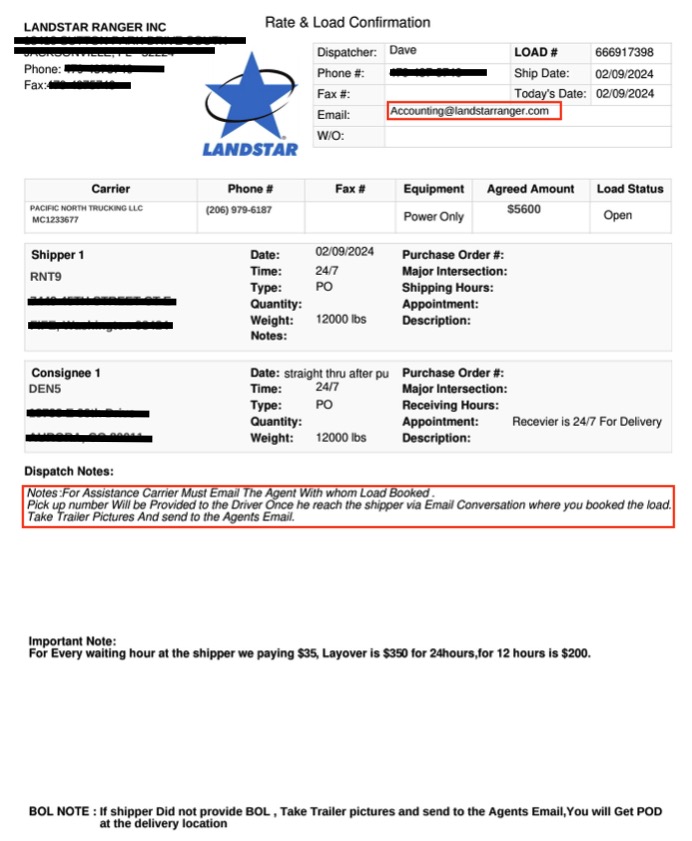
What Is a Fraudulent Rate Con?
A fraudulent rate confirmation is a fake load agreement sent to a carrier, typically by someone posing as a legitimate broker. These rate cons look real—they list the broker’s logo, load details, and even a real MC number—but they often:
- Come from spoofed email addresses
- List non-official phone numbers
- Contain payment instructions not tied to the broker’s real systems
- Are tied to fake dispatchers using stolen broker identities
Once the carrier books the load and hauls the freight, the scammer disappears—and the real broker has no record of the agreement. The carrier gets stiffed, and there’s no bond to file on because no valid contract exists.
Why Small Carriers Are Targeted
- Newer MC numbers often don’t have set verification processes
- Many carriers run spot freight and book fast under pressure
- Fraudsters know owner-ops may not have a back office to catch red flags
This is why small carriers must run tighter systems than ever before. Verification isn’t optional. It’s essential.
Red Flags on a Fraudulent Rate Con
1. Unfamiliar or Misspelled Email Domains
Legit broker rate cons come from official domains—like @chrobinson.com, @coyote.com, or @landstar.com.
Watch for:
- Gmail or Yahoo addresses (e.g., chrobinson.logistics@gmail.com)
- Subtle misspellings (e.g., @chrobbinson.com, @landstarr.com)
- Free or suspicious-looking domains (e.g., @fastfreightloadbrokers.com)
2. Unverified Phone Numbers
Fraudsters list fake dispatch numbers that won’t connect to the broker’s main line.
Verify by calling the official number listed on the broker’s FMCSA profile or company website.
3. Rush Pressure or “One-Time Use” Language
Scammers will try to speed up the process:
“We need to move this ASAP, don’t worry about the paperwork right now.”
“This load was just added and has to move tonight. Can you confirm?”
Any pressure to skip verification is a sign to stop and double-check.
4. Inconsistent Company Info
Legit rate cons list:
- Correct company name and MC/DOT number
- Physical address
- Broker’s contact info
Red Flag Example:
Rate con lists CH Robinson, but the company name on the FMCSA profile is “Fast Haul Logistics Inc.”
Run the MC number at safer.fmcsa.dot.gov and match it to the name, address, and phone number listed on the rate con.
5. Sketchy Payment Terms
Fraudsters may ask you to send:
- Invoices to an unknown factoring company
- BOLs to a third-party email address not associated with the broker
- Zelle or ACH info to a personal account
Real brokers never ask for payment routing changes outside of their TMS or verified process.
Real-World Example of a Scam Load
An example is, a carrier received a rate con from what looked like C.H. Robinson, offering $2,900 for a load from Georgia to Texas. The email address was @chrobinsongroup.com, and the dispatcher used a real broker rep’s name.
The rate con looked clean. But:
- The phone number wasn’t listed anywhere online
- The MC number matched C.H. Robinson, but the invoice submission email was a Gmail address
- The pickup appointment had already been booked with a different carrier
The scam was caught—but only because the dispatcher Googled the contact and called the real C.H. Robinson main line to verify.
How to Verify a Rate Con Before Booking the Load
1. Look Up the MC Number
Use safer.fmcsa.dot.gov and search by:
- MC number
- Company name
- DOT number
2. Call the Broker’s Official Number
Don’t rely on the number in the rate con. Call the main number listed on the FMCSA site or the broker’s website and ask:
“I received a rate con for load #123456 from [name]. Can you confirm this is valid?”
3. Verify the Email Domain
Check the broker’s website for their real email domain.
If the rate con doesn’t come from that exact domain, it’s a red flag.
4. Review Payment Instructions
Real brokers submit payments:
- Through TMS portals (e.g., TriumphPay, RMIS, MyCarrierPacket)
- To official accounting email addresses
Never send invoices or BOLs to a Gmail or Yahoo address.
What to Do If You Suspect a Fraudulent Rate Con
- Do not haul the load until confirmed
- Call the real broker immediately
- Report the fraud to the FMCSA and Office of The Inspector General
- Keep all communication records—screenshots, emails, voicemails
- Check the Shipper Directly, if you’ve already been given a pickup number—call the shipper and confirm if they expect you
How to Prevent Your Team From Falling for It
- Train your dispatchers to verify every MC, phone number, and domain
- Use a rate con review checklist that includes scam-check questions
- Assign a single person or system to vet all rate cons before the truck is dispatched
- Use digital tools like Highway, MyCarrierPackets, or Carrier Assure to track broker legitimacy
Final Word
In this freight market, no one can afford to haul for free. And no one should be scammed because they didn’t know what to look for. Fraudulent rate cons are slick, and they’re getting better every month. But with a little structure, a little awareness, and a zero-rush policy—you can shut the door on scam loads before they hit your truck.
Brokerage Compliance Symposium
The day before F3. Every compliance issue you face - fraud exposure, carrier liability, FMCSA rules, cargo theft, insurance gaps - navigated by attorneys and operators defining best practices in a changing industry.
F3 Awards Dinner
The night before F3. FreightTech100 companies honored. FreightTech 25 and Shipper of Choice winners revealed live. Cocktail reception into dinner and live music - 300 industry leaders in one purpose-built room.
F3: Future of Freight Festival
Industry-defining keynotes, rapid-fire technology demos, and industry leaders networking in experiences across Chattanooga - plus the inaugural F3 Awards Dinner featuring the FreightTech and Shipper of Choice reveals.
The day before F3. Every compliance issue you face - fraud exposure, carrier liability, FMCSA rules, cargo theft, insurance gaps - navigated by attorneys and operators defining best practices in a changing industry.
The Signal at Chattanooga Choo Choo • Chattanooga, TN Register NowThe night before F3. FreightTech100 companies honored. FreightTech 25 and Shipper of Choice winners revealed live. Cocktail reception into dinner and live music - 300 industry leaders in one purpose-built room.
The Signal at Chattanooga Choo Choo • Chattanooga, TN Register NowIndustry-defining keynotes, rapid-fire technology demos, and industry leaders networking in experiences across Chattanooga - plus the inaugural F3 Awards Dinner featuring the FreightTech and Shipper of Choice reveals.
The Signal at Chattanooga Choo Choo • Chattanooga, TN Register Now