




In addition to the June cyber attack that crippled operations at APMT and resulted in a cascade of issues for the company, a 2.5 percent decrease in volumes and increasing unit cost, as well as a 26 percent higher bunker price for the third quarter, also negatively affected the group results.
A.P. Møller-Maersk during the third quarter officially separated its energy business from its transport and logistics operations, resulting in a loss of $1.4 billion, negatively impacted by an accounting impairment of $1.75 billion in Maersk Drilling, the company said. Maersk Drilling was classified as discontinued and its underlying performance reflected several rigs being idle and low day rates on new contracts.
The company also entered into an agreement for Total S.A. to acquire Maersk Oil for $7.4 billion in a combined share and debt transaction, as well as a deal for A.P. Møller Holding to acquire Maersk Tankers for $1.1 billion in an all-cash transaction. The company said a structural solution for Maersk Drilling is expected within the next 12 months.
The group’s underlying profit was positively impacted by increased freight rates for container carrier Maersk Line compared to the third quarter of 2016. The carrier’s acquisition of north-south specialist Hamburg Süd is progressing as planned with closing expected in fourth quarter 2017, the company said. As such, Maersk Line has a binding offer to divest its Brazilian cabotage subsidiary, Mercosul Line, and has received unrestricted approval from the Brazilian regulators to acquire Hamburg Süd.
A.P. Møller-Maersk now expects a gross capital expenditure for 2017 of around $4.5 billion, adjusted for the discontinued operations of Maersk Oil, Maersk Tankers and Maersk Drilling and excluding the acquisition of Hamburg Süd.
Maersk Line
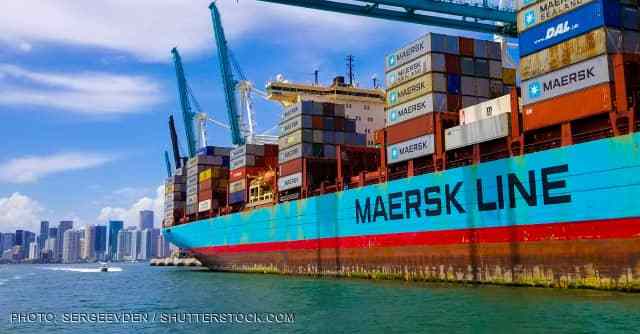
Maersk Line reported a profit of $220 million on revenues of $6.1 billion in the third quarter of 2017. Market demand growth remained solid at 5 percent while freight rates increased 14 percent compared to the third quarter of 2016. However, freight rates decreased by 1.1 percent compared to the second quarter of 2017. The freight rate increase compared to last year was driven by a 20 percent increase on East-West routes; 14 percent growth on North-South routes; and a 7 percent increase on Intra-regional routes.
Transported volumes slipped 2.5 percent due in part to the NotPetya cyber attack. Volumes grew 0.6 percent on headhaul routes, but this growth was more than offset by an 8.8 percent decrease on backhaul routes, the company said.
Maersk Line’s fleet consisted of 285 owned vessels and 383 chartered vessels with a total capacity of 3.5 million TEUs as of the end of the quarter, an increase of 12.6 percent compared to the same period last year. This was due in part to more capacity deployed to accommodate incoming volumes from the slot purchase agreement signed with Hamburg Süd and Hyundai Merchant Marine (HMM) at the beginning of the year, the company said.
Maersk’s idle capacity included four vessels at 13,200 TEUs at the end of the third quarter, compared to one vessel at 10,000 TEUs last year, corresponding to 3.3 percent of total idle capacity in the market.
Maersk Line recycled three vessels during the quarter and took delivery of two of its 11 second generation Triple-E ships and three of the nine 15,200-TEU vessels the company ordered in 2015. By the end of Q3, Maersk Line had 20 vessels with a total of 261,000 TEUs in the order book for delivery by next year with no current plans for new orders.
For the rest of 2017, Maersk Line now expects an improvement around $1 billion in underlying profit, down from the previous estimate of in excess of $1 billion, due to continuing higher cost to recover services and reliability after the cyber-attack combined with increasing bunker cost. However, global demand for seaborne container transportation is expected to increase 4-5 percent, the company said.
APM Terminals
APMT reported an underlying profit of $110 million, which was negatively impacted by overcapacity in the industry leading to pressure on profit and margins, as well as additional costs related to the cyber-attack, said AP Møller-Maersk.
Revenues of $1 billion were negatively impacted by a loss of service in North America, though partially offset by volume increases in other markets. Average terminal utilization was 64 percent when factoring in terminals that started operations this year, including Lázaro Cárdenas, Mexico, Izmir, Turkey and Quetzal, Guatemala, the company said. Excluding those terminals, utilization stood at 68 percent.
Throughput at APMT terminals grew 6.5 percent year-over-year for the quarter to 10.2 million TEUs (weighted by the share of equity in each terminal), mainly due to strong volumes in Rotterdam, the Netherlands, joint venture terminals in China, and terminals that have started operation this year. Volume growth was slightly higher than Drewry’s estimated global port volume growth of 5.7 percent in the third quarter, according to A.P. Møller-Maersk.
APMT has also reached an agreement to divest the majority shareholding in APM Terminals Zeebrugge to COSCO Shipping Ports. The transaction is expected to be finalized in the fourth quarter, subject to customary regulatory approvals and with only a minor financial impact.
The company noted that the customer landscape on east-west trades is showing signs of stability following the revamping of the major carrier alliance networks in April. While APM Terminals lost some services following the changes in alliances, volumes have been positively impacted following the extension of 2M with HMM, and Hamburg Süd participation on some services, the company said.
Drewry’s forecasted growth for global port throughput is 5.7 percent for Q3 2017 and 5.5 percent for full year 2017. However, Drewry’s forecasted global market growth for 2018–2021 is 3.6 percent to 4.2 percent, lower than the growth forecast in 2017.
Brokerage Compliance Symposium
The day before F3. Every compliance issue you face - fraud exposure, carrier liability, FMCSA rules, cargo theft, insurance gaps - navigated by attorneys and operators defining best practices in a changing industry.
F3 Awards Dinner
The night before F3. FreightTech100 companies honored. FreightTech 25 and Shipper of Choice winners revealed live. Cocktail reception into dinner and live music - 300 industry leaders in one purpose-built room.
F3: Future of Freight Festival
Industry-defining keynotes, rapid-fire technology demos, and industry leaders networking in experiences across Chattanooga - plus the inaugural F3 Awards Dinner featuring the FreightTech and Shipper of Choice reveals.
The day before F3. Every compliance issue you face - fraud exposure, carrier liability, FMCSA rules, cargo theft, insurance gaps - navigated by attorneys and operators defining best practices in a changing industry.
The Signal at Chattanooga Choo Choo • Chattanooga, TN Register NowThe night before F3. FreightTech100 companies honored. FreightTech 25 and Shipper of Choice winners revealed live. Cocktail reception into dinner and live music - 300 industry leaders in one purpose-built room.
The Signal at Chattanooga Choo Choo • Chattanooga, TN Register NowIndustry-defining keynotes, rapid-fire technology demos, and industry leaders networking in experiences across Chattanooga - plus the inaugural F3 Awards Dinner featuring the FreightTech and Shipper of Choice reveals.
The Signal at Chattanooga Choo Choo • Chattanooga, TN Register Now