CLEVELAND–The Montgomery decision before the Supreme Court that greatly expands potential broker liability in crashes and other incidents also has put the focus on the Federal Motor Carrier Safety Administration (FMCSA).
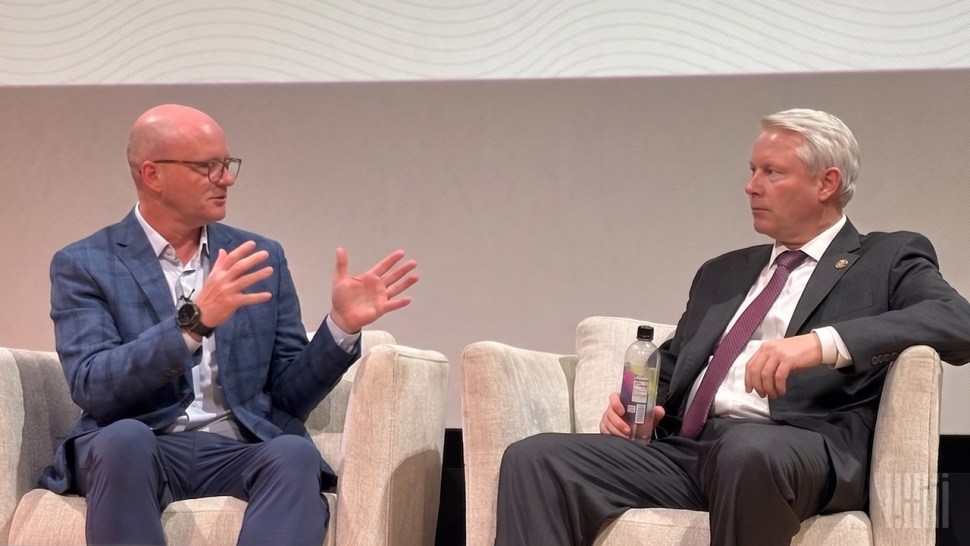
And though the Montgomery case decided last week was not the key area of discussion at the FreightWaves’ Freight Fraud Symposium held at this city’s Rock & Roll Hall of Fame Wednesday, a keynote fireside chat with Jesse Elison, FMCSA deputy administrator, inevitably turned to what changes, if any, the agency will make in the wake of the new reality created by the court.
Elison, interviewed by FreightWaves CEO Craig Fuller, said the outcome of Montgomery “doesn’t change anything for us. We have the same authorities that we had. We don’t have safety authority over brokers.”
But the concern in the brokerage community after Montgomery is that it largely believed 3Ls were protected from liability by two defenses when a carrier it hires is involved in a crash.
One was a body of court rulings that the safety exception in the Federal Aviation Administration Authorization Act (F4A) protected it from liability, and there were court rulings that backed that up. But Montgomery ends that protection.
The other defense had been that if a carrier did not have a red flag in its records at FMCSA, it was acceptable for a broker to book them.
What’s FMCSA’s role?
But right after saying that Montgomery didn’t change anything for FMCSA, Elison seemed to concede that it does. “What’s changed is that clearly the activity of a broker is now considered part of a motor vehicle, and that is within our purview,” Elison said.
The court’s ruling held that the phrase “with respect to motor vehicles” in the F4A safety exception that permits state action against a carrier also includes the broker that booked the truck.
Doug Waggoner, long-time CEO of Echo Global Logistics, asked Elison during a question and answer session about the percentage of fully vetted carriers under FMCSA jurisdiction. Waggoner cited a long-time statistic that only about 92% of carriers have been certified by the agency.
“So that puts the burden on us now that we have the legal liability to vet the carrier when the regulatory agency hasn’t done anything,” Waggoner said.
But Elison pushed back.
How extensive is the coverage?
Elison said the “touches” on the carrier population, which can be defined as simple as an inspection, are between 60% and 70% of the carrier population. “So this idea that we’re not regulating motor carriers, it’s been unfortunate that it was not told better,” he said.
But things have changed, Elison conceded. Earlier standards for a broker might have been as simple as whether a carrier has FMCA authority, whether they are adequately insured and that it doesn’t have an unsatisfactory rating from the agency.
The new question, Elison said, will be “what is the standard?”
Earlier in the week, Chris Burroughs, president of the Transportation Intermediaries Association, said of FMCSA in the wake of Montgomery that the agency “has really got to step up on this, and they have stepped up a lot in terms of safety, going after some of these drivers. But this is , clearly an area where they’re going to have to step up and really provide solutions for the public.”
Something that will not be changing, Elison said, is that “we’re not a certification agency. I know the broker industry has wanted FMCSA to be a certification agency. But the only time we make a determination on the safety fitness of a carrier is when we say a company is unsatisfactory.”
Fuller, pointing to Waggoner as an example of a broker facing the new reality, asked Elison: “So what does a small carrier do? If Doug’s trying to underwrite these small carriers and you’ve got a guy with five trucks who doesn’t have an inspection, who knows that he’s clean? How does he possibly get rated by FMCSA?”
Fuller, only partly joking, wondered whether that carrier shouldn’t just “drive to the weigh station” and seek out an inspection.
Elison said something like that was proposed to him by a carrier recently. And it drove home for him, he said, that “those are the carriers that we need to be proactive for, the smaller carriers and brokers who are absolutely legitimate that are running legitimately great businesses.”
The key to that, he said, will be “clarifying what the standard is” to be considered acceptable even under the more treacherous terrain of the freight world post-Montgomery.
Motus role in fighting freight fraud
Elison’s appearance at the Freight Fraud Symposium came a day after the Department of Transportation formally launched Motus, the agency’s new registration system that has been years in the making.
As Secretary of Transportation Sean Duffy said in announcing Motus’ launch, “the Department will now use biometrics and modern data analytics to verify that those who apply for these numbers are who they say they are (and) the businesses they represent are legitimate, legal entities.”
Elison said the launch of the registration system does not necessitate steps to be taking by all carriers immediately. “If you don’t need to go in, don’t go in right away. Most of our population doesn’t need to.”
Motus, Elison said, is one of FMCSA’s biggest tools to fight freight fraud. “It will do a much better job at confirming an identity and making sure you are who you say you are,” Elison said. “Then there’s going to be additional verifications for the business in place.”
More articles by John Kingston
Labor Dept. jumps in on the push for driver English language proficiency
Crucial changes in latest NJ independent contractor rule impacting truckers
Post-Montgomery, focus grows on fate of 3PL insurance premiums
Brokerage Compliance Symposium
The day before F3. Every compliance issue you face - fraud exposure, carrier liability, FMCSA rules, cargo theft, insurance gaps - navigated by attorneys and operators defining best practices in a changing industry.
F3 Awards Dinner
The night before F3. FreightTech100 companies honored. FreightTech 25 and Shipper of Choice winners revealed live. Cocktail reception into dinner and live music - 300 industry leaders in one purpose-built room.
F3: Future of Freight Festival
Industry-defining keynotes, rapid-fire technology demos, and industry leaders networking in experiences across Chattanooga - plus the inaugural F3 Awards Dinner featuring the FreightTech and Shipper of Choice reveals.
The day before F3. Every compliance issue you face - fraud exposure, carrier liability, FMCSA rules, cargo theft, insurance gaps - navigated by attorneys and operators defining best practices in a changing industry.
The Signal at Chattanooga Choo Choo • Chattanooga, TN Register NowThe night before F3. FreightTech100 companies honored. FreightTech 25 and Shipper of Choice winners revealed live. Cocktail reception into dinner and live music - 300 industry leaders in one purpose-built room.
The Signal at Chattanooga Choo Choo • Chattanooga, TN Register NowIndustry-defining keynotes, rapid-fire technology demos, and industry leaders networking in experiences across Chattanooga - plus the inaugural F3 Awards Dinner featuring the FreightTech and Shipper of Choice reveals.
The Signal at Chattanooga Choo Choo • Chattanooga, TN Register Now