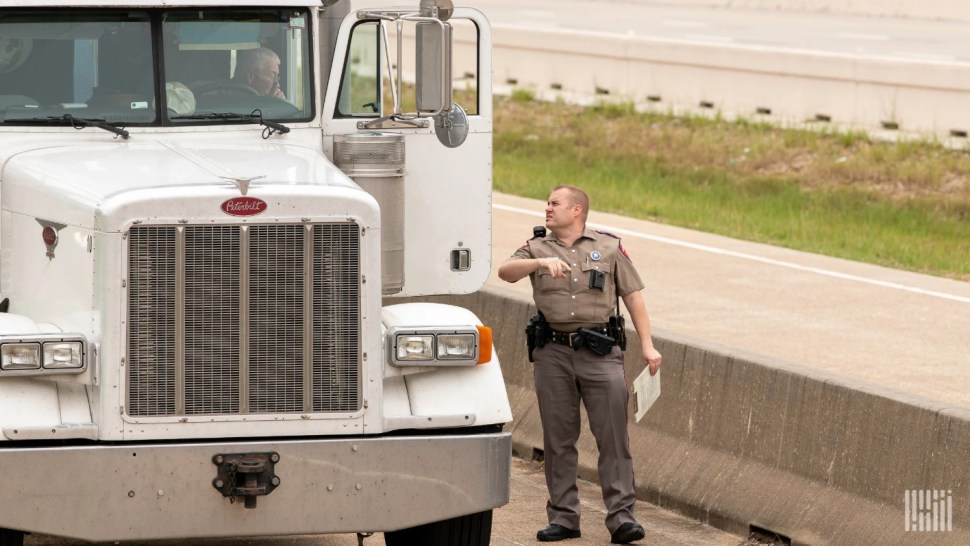
In another step aimed at making the point that the Trump administration is intent on enforcing English language proficiency for truck drivers, his administration’s Department of Labor (DOL) has released what it calls “sub-regulatory guidance” to clarify its own role.
The thrust of the announcement published last week by the DOL is that an employer seeking to fill a role that involves use of a commercial motor vehicle needs to inquire about the English language proficiency (ELP) during the application process. It is “sub-regulatory” because it deals only with the Labor department’s narrow role in the enforcement push.
There are no new regulations attached to the DOL’s declaration. Both the DOL’s prepared statement on the issue as well as accompanying FAQs reiterate historical and recent regulatory steps to enforce the English language requirement, which had been on the books for several years but with spotty enforcement.
According to the DOL, the Federal Motor Carrier Safety Administration (FMCSA) is required to enforce the English language proficiency requirement. But the DOL’s Office of Foreign Labor Certification “also ensures that employers include the required skills, qualifications and certifications for job opportunities involving commercial motor vehicle operations, which includes English language proficiency.”
Ensuring uniformity
The DOL, in its statement, said a “significant portion of the regulated community already complies with this federal requirement.” But it added that it was publishing the FAQs to “ensure uniformity” in the hiring of drivers with English proficiency.
Questions regarding ELP will need to be required on “all job orders and applications for temporary or permanent labor certification for positions which would require foreign workers to operate a commercial motor vehicle.”
Failing to include the standard in the relevant documents will result in the employer being hit with a “Notice of Deficiency.” That notice comes along with the DOL halting the processing of driver applications.
What the law says
The standard in the federal law is that an applicant must be able to “read and speak the English language sufficiently to converse with the general public, to understand highway traffic signs and signals in the English language, to respond to official inquiries, and to make entries on reports and records.”
While the federal law on English language proficiency has been on the books for many years, its enforcement has become a central core of Trump administration highway safety policy through several actions. The biggest was the executive order from April 2025, “Enforcing commonsense rules of the road for America’s truck drivers.”
In the executive order, President Trump said ELP “should be a non-negotiable safety requirement for professional drivers.”
The DOL, in its FAQs, noted a dichotomy in the English Language Proficiency rules. A driver can be operating a commercial motor vehicle in interstate commerce that doesn’t necessarily require a full CDL. But they still need to be able to speak English.
It also added that there are other departments in the federal government with an ELP. But the “sub-regulatory guidance” provided by the DOL only covers that agency. Meeting the standard for DOL doesn’t cover requirements elsewhere through the federal government, the FAQs said.
More articles by John Kingston
What’s next after Montgomery? Likely a boost to the bigger 3PLs
Crucial changes in latest NJ independent contractor rule impacting truckers
Brokerage Compliance Symposium
The day before F3. Every compliance issue you face - fraud exposure, carrier liability, FMCSA rules, cargo theft, insurance gaps - navigated by attorneys and operators defining best practices in a changing industry.
F3 Awards Dinner
The night before F3. FreightTech100 companies honored. FreightTech 25 and Shipper of Choice winners revealed live. Cocktail reception into dinner and live music - 300 industry leaders in one purpose-built room.
F3: Future of Freight Festival
Industry-defining keynotes, rapid-fire technology demos, and industry leaders networking in experiences across Chattanooga - plus the inaugural F3 Awards Dinner featuring the FreightTech and Shipper of Choice reveals.
The day before F3. Every compliance issue you face - fraud exposure, carrier liability, FMCSA rules, cargo theft, insurance gaps - navigated by attorneys and operators defining best practices in a changing industry.
The Signal at Chattanooga Choo Choo • Chattanooga, TN Register NowThe night before F3. FreightTech100 companies honored. FreightTech 25 and Shipper of Choice winners revealed live. Cocktail reception into dinner and live music - 300 industry leaders in one purpose-built room.
The Signal at Chattanooga Choo Choo • Chattanooga, TN Register NowIndustry-defining keynotes, rapid-fire technology demos, and industry leaders networking in experiences across Chattanooga - plus the inaugural F3 Awards Dinner featuring the FreightTech and Shipper of Choice reveals.
The Signal at Chattanooga Choo Choo • Chattanooga, TN Register Now