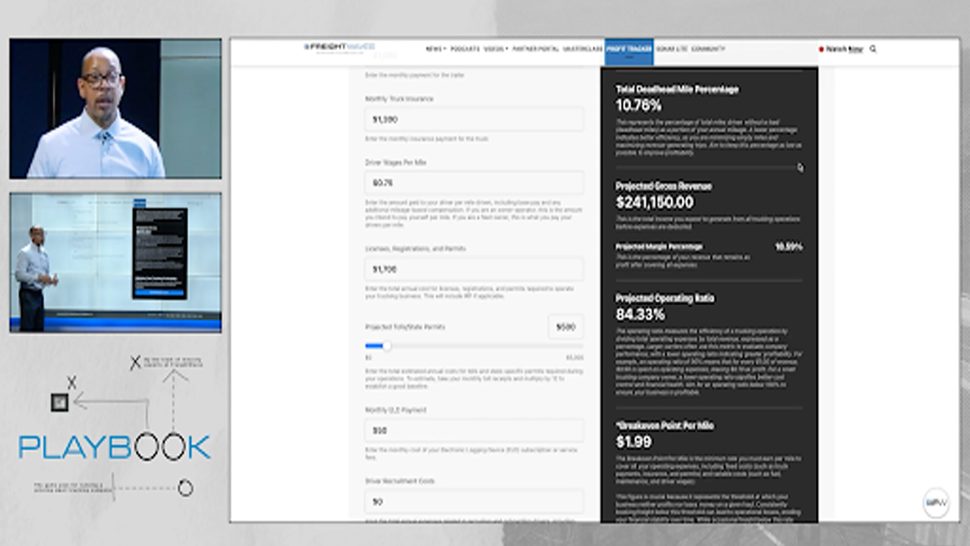
Why This Class Matters in a Down Market
Rates are tight, volumes are shifting, and fuel isn’t doing anyone any favors. A lot of carriers are hanging on by a thread, and in a down market, it’s natural to think adding a second truck might help you grow your way out of it. But here’s the hard truth: growth isn’t a fix.
If your first truck isn’t consistent, if your cost per mile is out of control, or if you’re running load to load in panic mode, a second truck doesn’t free you up — it buries you faster.
That said, downturns also create opportunity. Some carriers are scaling right now, and they’re doing it safely because they built their foundation before the market turned. They know their numbers cold. They can survive low rates because their first truck is dialed in.
The First Question – Why Do You Want to Grow?
In this class, we started with the most overlooked piece of scaling: motivation.
- Are you chasing growth because the market is down and you’re desperate for more revenue?
- Are you trying to get out of the truck before you’ve built a process to replace yourself?
- Or are you scaling because you’ve built predictability and you’re ready to multiply profit?
In a down market, growing for the wrong reason is even more dangerous. Your “why” matters more now than it does when the freight market is hot.
Growth Is Not a Fix
We made it clear: adding trucks won’t solve your problems.
- Poor dispatch habits? They’ll just spread across more trucks.
- Weak cash flow? One truck turns into two fuel cards you can’t keep up with.
- No structure or SOPs? Chaos grows with every driver you bring on.
In fact, downturns magnify weaknesses faster. That’s why only the carriers with tight systems are finding success adding trucks today.
The Truck Audit – Know Your Numbers Before You Scale
Scaling in a tough market requires absolute clarity. That’s why we pushed students to audit their first truck before ever thinking about a second.
- Weekly gross revenue
- Net after fuel, insurance, and debt
- RPM (loaded and empty)
- Deadhead percentage
- Actual revenue days per week
When you break those numbers down, you can see if Truck #1 is strong enough to carry Truck #2 through a weak market. If it’s not, scaling just adds risk.
Break-Even – The Line You Can’t Ignore
In today’s environment, break-even isn’t just a concept — it’s survival math.
When costs add up — truck payment, insurance, fuel, maintenance, ELDs, apps — some carriers land around $5,500–$6,000 per week just to cover the basics.
If your first truck isn’t consistently clearing that, especially with market rates where they are, the second truck isn’t a business move — it’s a gamble.
But if Truck #1 is netting $2,500–$3,500 weekly even in this market, and you’ve proven you can do it week in and week out, you’re in position to grow while everyone else pulls back.
Load Strategy vs. Load Panic
A weak market separates the planners from the gamblers.
- Strategy means stacking loads, locking in freight, and knowing your weekly RPM before you turn the key.
- Panic means refreshing boards every morning, grabbing whatever looks decent, and praying for a reload.
If you’re in panic mode now, scaling doubles the stress. But if you’re already running a strategy and protecting profit, downturns become your chance to secure lanes and position yourself ahead of the rebound.
The Owner-Operator Bottleneck
This was one of the toughest pills to swallow in the class: many carriers are bottlenecked by themselves.
If the money stops when you step away, then you’re not ready for another truck. Period.
Scaling safely requires systems, not just ambition. That means:
- Someone else could dispatch your truck and still hit profit goals.
- You can onboard a driver without walking them through every detail yourself.
- The truck makes money without you being behind the wheel or glued to the load board.
Carriers who have this dialed in are the ones scaling in today’s market — because they’re not just drivers with a truck, they’re business owners with a system.
The Stress Test
We wrapped the class with a simple self-test. Score yourself from 1–5 on:
- Is your truck running five revenue days per week?
- Do you pre-plan loads instead of reacting?
- Are you consistently netting $2,500–$3,500 per week?
- Could someone else dispatch your operation without you?
A score under 16 meant stop. Fix your foundation first. Growth will break you. A score in the 22–25 range? That’s how you know you’re one of the few who can grow in a down market without drowning in debt.
The Final Truth
Markets rise and fall. Rates go up and down. But the carriers who scale smart are the ones who build discipline before they build fleets.
Even in a down market, there are owner-operators turning one truck into two. But they’re not doing it out of desperation — they’re doing it because their first truck is rock solid. Their numbers make sense, their systems are tight, and they’ve proven they can survive lean weeks without panic.
That’s the difference between adding profit and adding problems.
Your Next Step
Want the Templates, Frameworks, and Access to the Next Class?
Join the Playbook Masterclass Series.
We host a brand-new class every two weeks with real tools, real walkthroughs, and real strategies built specifically for small fleet owners.
This is your training ground.
If you missed this session, you can still catch the replay—and we’ll see you in two weeks for the next one.
Brokerage Compliance Symposium
The day before F3. Every compliance issue you face - fraud exposure, carrier liability, FMCSA rules, cargo theft, insurance gaps - navigated by attorneys and operators defining best practices in a changing industry.
F3 Awards Dinner
The night before F3. FreightTech100 companies honored. FreightTech 25 and Shipper of Choice winners revealed live. Cocktail reception into dinner and live music - 300 industry leaders in one purpose-built room.
F3: Future of Freight Festival
Industry-defining keynotes, rapid-fire technology demos, and industry leaders networking in experiences across Chattanooga - plus the inaugural F3 Awards Dinner featuring the FreightTech and Shipper of Choice reveals.
The day before F3. Every compliance issue you face - fraud exposure, carrier liability, FMCSA rules, cargo theft, insurance gaps - navigated by attorneys and operators defining best practices in a changing industry.
The Signal at Chattanooga Choo Choo • Chattanooga, TN Register NowThe night before F3. FreightTech100 companies honored. FreightTech 25 and Shipper of Choice winners revealed live. Cocktail reception into dinner and live music - 300 industry leaders in one purpose-built room.
The Signal at Chattanooga Choo Choo • Chattanooga, TN Register NowIndustry-defining keynotes, rapid-fire technology demos, and industry leaders networking in experiences across Chattanooga - plus the inaugural F3 Awards Dinner featuring the FreightTech and Shipper of Choice reveals.
The Signal at Chattanooga Choo Choo • Chattanooga, TN Register Now