
The Fourth of July is a significant benchmark for the U.S. truckload market, marking a seasonal uptick in demand that challenges transportation providers across the country. Historically, this holiday period is characterized by heightened freight activities driven by an increase in consumer spending and the need for timely distributions of goods as various industries prepare for summer events and promotions. This demand surge, while lucrative for carriers, simultaneously strains the logistics network, as evidenced by recent trends in tender rejection rates and spot rates.
Tender rejection rates, a metric for gauging how often carriers decline contracted loads, have demonstrated significant fluctuations leading up to July 4th. According to SONAR , the national average Outbound Tender Rejection Index (OTRI) climbed above 7.8% at its peak on July 1. This uptick indicates that carriers are benefiting from tighter capacity and strained networks, enabling them to opt for higher-paying spot market opportunities over less profitable contract obligations. These conditions create a freight environment where higher rejection rates are symptomatic of a system near full capacity, affording carriers the leverage to be selective and capitalize on elevated spot rates.
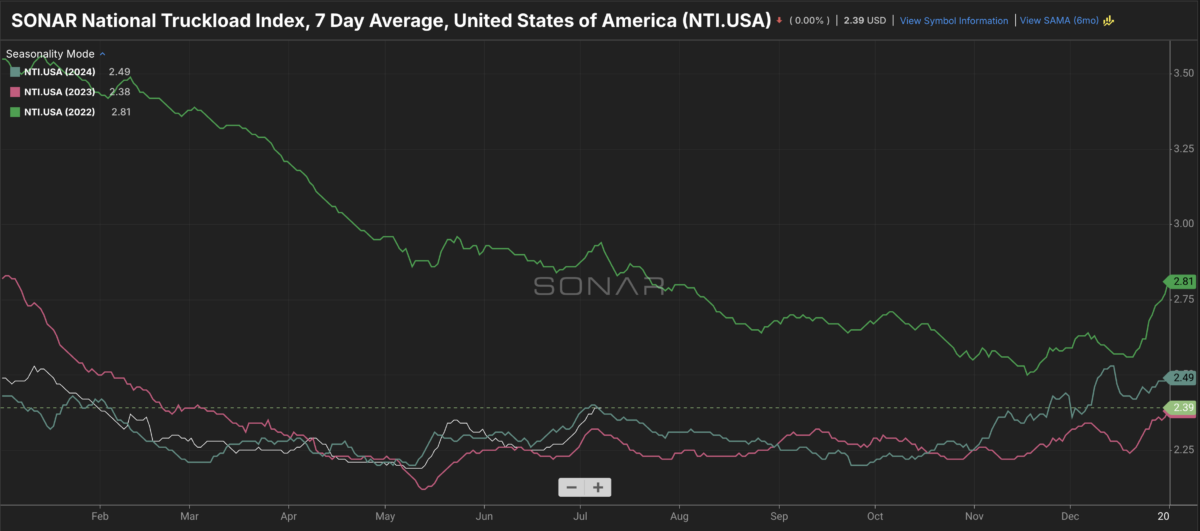
(The National Truckload Index is an average of truckload spot rates inclusive of fuel, expressed in USD/mile. Chart: SONAR. To learn more about SONAR, click here)
The National Truckload Index (NTI), which tracks the average national spot rate, recently saw a surge, climbing to $2.39 per mile. These fluctuations are driven partly by seasonal factors and broader economic conditions such as inflation and rising operational costs. The spot market, unlike contract freight, allows for dynamic pricing based on real-time supply and demand imbalances, which can lead to substantial rate increases during periods of elevated demand.
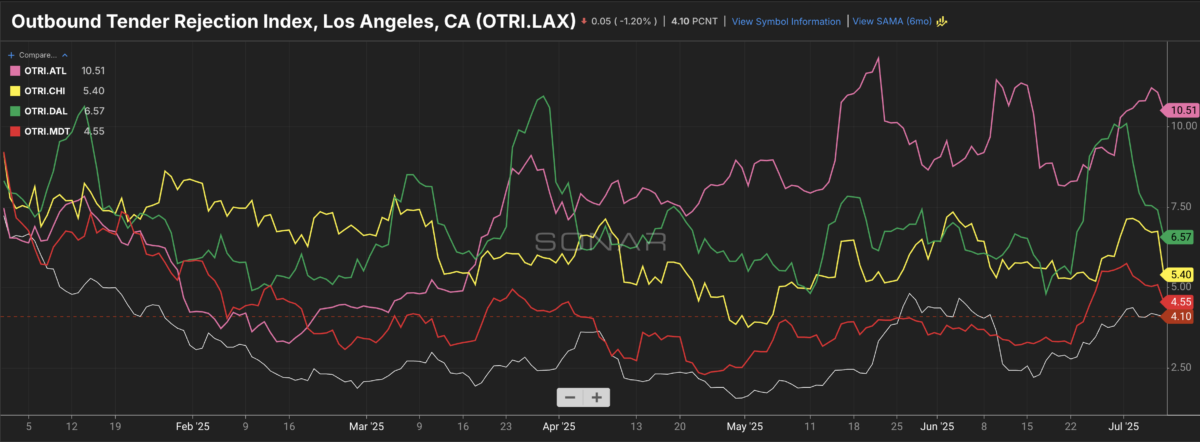
(The Outbound Tender Rejection Index measures the percentage of truckloads tendered by shippers that are rejected by carriers. Chart: SONAR. To learn more about SONAR, click here)
Analyzing the market-level data reveals that Atlanta has recently outperformed other major freight hubs, demonstrating a surge in demand distinct to its region. The Outbound Tender Rejection Index (OTRI) for Atlanta peaked later than the national market, on July 5, at 11.2%, highlighting the localized nature of this demand spike. This pattern of divergence emphasizes the uneven recovery and differing dynamics across the national market. The heightened OTRI levels suggest that carriers in Atlanta are benefiting from a favorable mix of strong demand and constrained capacity, which enables them to refine their pricing and load selection strategies effectively.
In addition to Atlanta, the Dallas market has also experienced significant increases in tender rejections, peaking at 10.2% amid localized pressures tied to specific industry sectors. As regional differences in freight demand become pronounced, transportation providers are likely to find varying conditions challenging, requiring nimble strategies to maintain balance and profitability.
Looking ahead to the rest of the summer, transportation providers should brace for continued volatility in tender rejections and spot rates, as uncertain economic conditions and fluctuating consumer confidence affect freight volumes. The gradual contraction of capacity, a remnant of the post-pandemic market correction, suggests that carriers may continue to wield greater leverage in the freight market. For shippers, this environment necessitates adaptability and proactive engagement with carriers to secure favorable terms.
The driving forces of supply chain interruptions, economic headwinds, and evolving trade policies will likely persist, necessitating a strategic outlook for both carriers and brokers to navigate these complexities effectively. Freight brokers should probably bid conservatively on Q4 projects. Those who can effectively adjust their operations and pricing strategies to accommodate market demands stand to benefit as the transportation sector approaches the latter half of the year.
Brokerage Compliance Symposium
The day before F3. Every compliance issue you face - fraud exposure, carrier liability, FMCSA rules, cargo theft, insurance gaps - navigated by attorneys and operators defining best practices in a changing industry.
F3 Awards Dinner
The night before F3. FreightTech100 companies honored. FreightTech 25 and Shipper of Choice winners revealed live. Cocktail reception into dinner and live music - 300 industry leaders in one purpose-built room.
F3: Future of Freight Festival
Industry-defining keynotes, rapid-fire technology demos, and industry leaders networking in experiences across Chattanooga - plus the inaugural F3 Awards Dinner featuring the FreightTech and Shipper of Choice reveals.
The day before F3. Every compliance issue you face - fraud exposure, carrier liability, FMCSA rules, cargo theft, insurance gaps - navigated by attorneys and operators defining best practices in a changing industry.
The Signal at Chattanooga Choo Choo • Chattanooga, TN Register NowThe night before F3. FreightTech100 companies honored. FreightTech 25 and Shipper of Choice winners revealed live. Cocktail reception into dinner and live music - 300 industry leaders in one purpose-built room.
The Signal at Chattanooga Choo Choo • Chattanooga, TN Register NowIndustry-defining keynotes, rapid-fire technology demos, and industry leaders networking in experiences across Chattanooga - plus the inaugural F3 Awards Dinner featuring the FreightTech and Shipper of Choice reveals.
The Signal at Chattanooga Choo Choo • Chattanooga, TN Register Now