




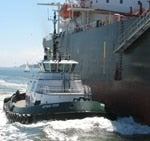
Vessels pump water into ballast tanks to lower their center of gravity and increase stability and maneuverability. They typically discharge the water when carrying a heavy load. The Coast Guard regulations, which require vessel operators to retrofit their fleets with expensive ballast water treatment systems, are designed to stop the spread of invasive organisms that are transported from one region to another by vessels.
The barge and towboat industry says the proposed requirements improperly cover the entire maritime industry with a broad brush and could sink many businesses.
One way to avoid the cost of installing ballast treatment systems is to seal up the tanks.
'Even on the ocean tugs, we're finding that the captains are mostly using fuel to manage stability, so we're thinking with a good majority of our fleet we won't use ballast at all,' Hayman said in a follow-up interview. And harbor service vessels have small ballast tanks and don't need to fill up very often, she added.
On the other end of the spectrum is a specially-designed Foss vessel for carrying NASA rocket components that has about 1 million gallons of ballast capacity.
Foss is in the process of analyzing the ballast requirements of its entire fleet, Hayman said.
The Coast Guard rulemaking was issued in August under the authority of the National Invasive Species Act to comply with International Maritime Organization standards. The Environmental Protection Agency (EPA) for decades exempted vessels from obtaining discharge permits, as is required for landside facilities under the Clean Water Act. In February, the agency initiated a vessel general permit program after a federal appeals court in 2008 agreed with environmental groups that ballast water and other discharges should be covered by the anti-pollution law.
Vessel operators are allowed to have 26 different types of discharges as long as they follow instructions in their permit, such as minimizing gray water production or using phosphate-free soap.
One of the features of the current process is that states can add their own conditions to the EPA permit.
Neither federal effort 'preempts the states from doing their own laws, so there's an infinite number of possible rules,' Jennifer Cox, senior vice president for national advocacy at the American Waterways Operators, said when reached by cell phone.
'There's really a need for one, uniform national approach with one agency that has the clear lead so that the industry has one set of rules to follow,' she said.
Environmental groups argue that the EPA should have sole responsibility for regulating pollution discharges.
Vessels have always required a ballast water management plan, but the Coast Guard proposal would force ship owners to install large ballast water treatment systems that can remove microscopic organisms.
'The proposal was not based on an accurate understanding of the effective vessel population. They assumed that tugs and barges don't carry ballast water,' Cox said.
Industry officials say the large systems, which can cost more than a half million dollars to purchase and install, are designed for large vessels, not tugboats.
'You're talking about potentially taking thousands of barges and towing vessels with small ballast capacity and putting in systems that cost as much as the vessel itself,' she said. Sealing up the tanks or making other vessel modifications would be less expensive than installing the treatment systems.
The Towing Safety Advisory Committee, which consists of industry members that provide feedback to the Coast Guard, last year estimated that 90 percent of barge and towing companies qualified as small businesses. There are about 4,000 towing vessels and 25,000 to 30,000 barges operating in U.S. waters.
'We think there's no justification for including this type of burden on hundreds of small businesses,' Cox argued.
The Coast Guard 'has failed to make the case that applying ballast water treatment requirements to the tugs and barges in the domestic trade is justified,' Cox said. The National Invasive Species Act exempts crude oil tankers in the coastwise trade from ballast water management requirements and the same standard should apply to tugs and barges that have much smaller volumes of ballast water capacity, she said.
'We are not aware of any ballast water treatment systems that have been approved, installed or even tested in our class of vessels,' Cox added. Such vessels include those of limited size, those that operate in freshwater and have low ballast water flow rates. Many tank barges don't have ballast water piping and there may be safety issues with putting electricity on those barges, which often carry flammable materials, Cox said.
The barge and tow industry is recommending as an option that vessels with closed systems which take on municipal water at a dock be granted an exemption from the treatment system rule, she said.
Some of the systems also consume a lot of energy, Mike Gaffney, executive vice president of engineering for Alaris Companies LLC, warned at the Propeller Club meeting.
Alaris is a Petaluma, Calif.-based company that provides ship management services.
Vessel operators will probably employ a wide variety of different control technologies to meet any new requirements, according to Hayman.
Cox said Coast Guard officials have been sympathetic to waterways industry concerns, but noted they are under pressure to address water quality issues.
The deadline for submitting comments to the docket for the Coast Guard's ballast water rule is Dec. 4. ' Eric Kulisch
Brokerage Compliance Symposium
The day before F3. Every compliance issue you face - fraud exposure, carrier liability, FMCSA rules, cargo theft, insurance gaps - navigated by attorneys and operators defining best practices in a changing industry.
F3 Awards Dinner
The night before F3. FreightTech100 companies honored. FreightTech 25 and Shipper of Choice winners revealed live. Cocktail reception into dinner and live music - 300 industry leaders in one purpose-built room.
F3: Future of Freight Festival
Industry-defining keynotes, rapid-fire technology demos, and industry leaders networking in experiences across Chattanooga - plus the inaugural F3 Awards Dinner featuring the FreightTech and Shipper of Choice reveals.
The day before F3. Every compliance issue you face - fraud exposure, carrier liability, FMCSA rules, cargo theft, insurance gaps - navigated by attorneys and operators defining best practices in a changing industry.
The Signal at Chattanooga Choo Choo • Chattanooga, TN Register NowThe night before F3. FreightTech100 companies honored. FreightTech 25 and Shipper of Choice winners revealed live. Cocktail reception into dinner and live music - 300 industry leaders in one purpose-built room.
The Signal at Chattanooga Choo Choo • Chattanooga, TN Register NowIndustry-defining keynotes, rapid-fire technology demos, and industry leaders networking in experiences across Chattanooga - plus the inaugural F3 Awards Dinner featuring the FreightTech and Shipper of Choice reveals.
The Signal at Chattanooga Choo Choo • Chattanooga, TN Register Now