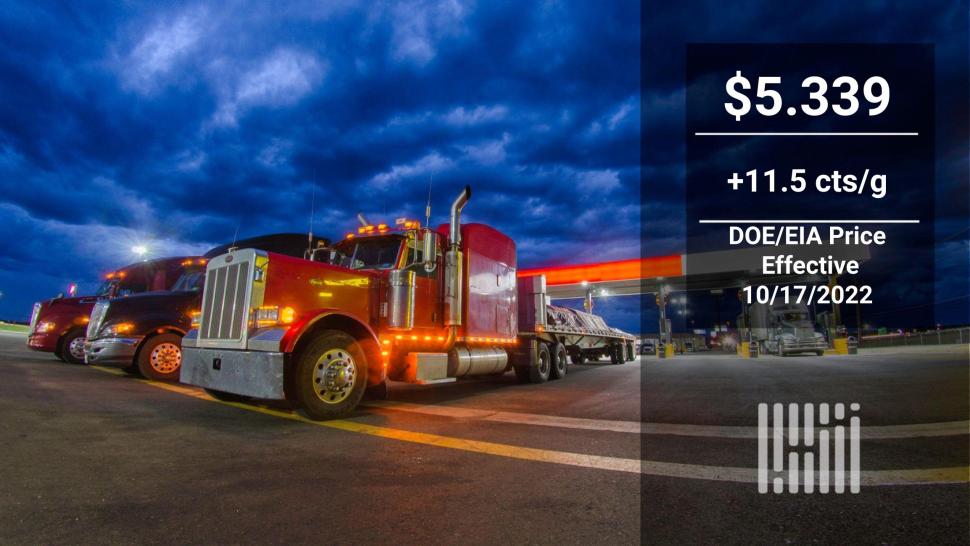
Between the all-time high Department of Energy/Energy Information Administration price of $5.81 a gallon on June 20 and the recent low of $4.836 a gallon two weeks ago, the benchmark price of diesel used for most fuel surcharges fell more than 97 cents a gallon.
It has now clawed back more than half of that.
The latest DOE/EIA price is $5.339 a gallon, effective Monday. That was an increase of 11.5 cents a gallon, which comes on top of last week’s increase of 38.8 cents a gallon. That is a two-week gain of 50.3 cents.
Retail diesel appears to have been reacting primarily to gains on the CME commodity exchange’s ultra low sulfur diesel (ULSD) of 79.71 cents during the week of Oct. 3. Those increases on the CME commodity exchange were followed last week by a relatively volatile week which ultimately saw prices for the week close not far from where they began the week, finishing at $3.9802 per gallon.
But with the normal lags in retail prices, the increases of more than 50 cents over the past two DOE/EIA numbers can be seen as reacting to those earlier gains.
The ULSD on CME added another 10.5 cents in trading Monday. What was more significant was that the 2.64% increase on the day came as global crude benchmark Brent barely moved.
The continued strength of diesel relative to both crude and gasoline is starting to suggest that there has been a possible permanent realignment in what is considered a “normal” spread between crude and diesel.
If the issue were one of just refinery capacity being squeezed, the gap between gasoline and diesel prices would be relatively steady. But as can be seen at the pump, the gap between the two of them has exploded this year.
You can see it also in the futures market. The most indicative numbers from the CME commodity exchange come by comparing two spreads. One is between Brent crude oil — the international benchmark — and RBOB gasoline, the unfinished gasoline product that serves as a proxy for gasoline in commodity trading, and the spread between Brent and ULSD.
In 2019, the average spread between the Brent-gasoline spread and the Brent-ULSD spread was about $9 per gallon, with the ULSD spread that much higher than the gasoline spread. Tossing out 2020 because the pandemic skewed many price relationships, the spread in 2021 was actually negative $1.30, with the Brent-gasoline spread stronger than the Brent-ULSD gap.
But in 2022, the full-year average through last week is $17.14. And since July 1, it’s been about $24.90.
Philip Verleger, a longtime energy economist who produces a widely read weekly report, reiterated in his latest edition that it is IMO 2020 that is blowing out diesel prices relative to the rest of the market.
IMO 2020 is an international rule, years in the making, that requires the fuel oil that powers ships to have a sulfur content of no more than 0.5%. Several steps had been taken to get there incrementally from what had been much higher limits (or no limits at all). But the 0.5% rule, mandated by the International Maritime Organization, took effect at the start of the year for which it is named.
One of the pathways to make the lower sulfur fuel involves a product known as vacuum gasoil (VGO), which is often used to produce finished diesel. But with VGO diverted to make lower sulfur marine fuel, there was concern among many analysts — Verleger included — that diesel prices could spike as a result of IMO 2020.
With the pandemic creating a surplus of all sorts of oil products, that theory never got its test in 2020. But as economic activity has bounced back, it is getting a workout now, and Verleger points to IMO 2020 as a key reason for diesel to be soaring well above gasoline and crude.
“While the IMO rule went into effect in 2020 as planned, thanks to the coronavirus, its impact was delayed until 2022,” Verleger wrote in his latest weekly report. “This November, voters may go to the polls … with diesel selling for $7.”
He noted that California gasoline prices, which were at record highs just a few weeks ago, have come down considerably. One of the reasons, Verleger said, is a relaxing of some environmental rules that impact the quality of California gasoline.
“On several occasions, we suggested that governments could force the IMO to relax its rule and allow more sulfur to be blended into marine fuels,” Verleger said. “Our advice has been ignored even though it reached individuals in the Treasury Department. The inflexibility … contrasts starkly with the flexibility observed in California.”
More articles by John Kingston
DOE methodology for determining diesel prices sees 2 key changes
DOL Independent contractor definition could pose problems for truck fleets
Brokerage solution to California’s AB5 rule gets support from Cowen panel
Brokerage Compliance Symposium
The day before F3. Every compliance issue you face - fraud exposure, carrier liability, FMCSA rules, cargo theft, insurance gaps - navigated by attorneys and operators defining best practices in a changing industry.
F3 Awards Dinner
The night before F3. FreightTech100 companies honored. FreightTech 25 and Shipper of Choice winners revealed live. Cocktail reception into dinner and live music - 300 industry leaders in one purpose-built room.
F3: Future of Freight Festival
Industry-defining keynotes, rapid-fire technology demos, and industry leaders networking in experiences across Chattanooga - plus the inaugural F3 Awards Dinner featuring the FreightTech and Shipper of Choice reveals.
The day before F3. Every compliance issue you face - fraud exposure, carrier liability, FMCSA rules, cargo theft, insurance gaps - navigated by attorneys and operators defining best practices in a changing industry.
The Signal at Chattanooga Choo Choo • Chattanooga, TN Register NowThe night before F3. FreightTech100 companies honored. FreightTech 25 and Shipper of Choice winners revealed live. Cocktail reception into dinner and live music - 300 industry leaders in one purpose-built room.
The Signal at Chattanooga Choo Choo • Chattanooga, TN Register NowIndustry-defining keynotes, rapid-fire technology demos, and industry leaders networking in experiences across Chattanooga - plus the inaugural F3 Awards Dinner featuring the FreightTech and Shipper of Choice reveals.
The Signal at Chattanooga Choo Choo • Chattanooga, TN Register Now