The relatively small decline in the benchmark price of U.S. diesel masked a day in oil markets that was crazy even by recent standards.
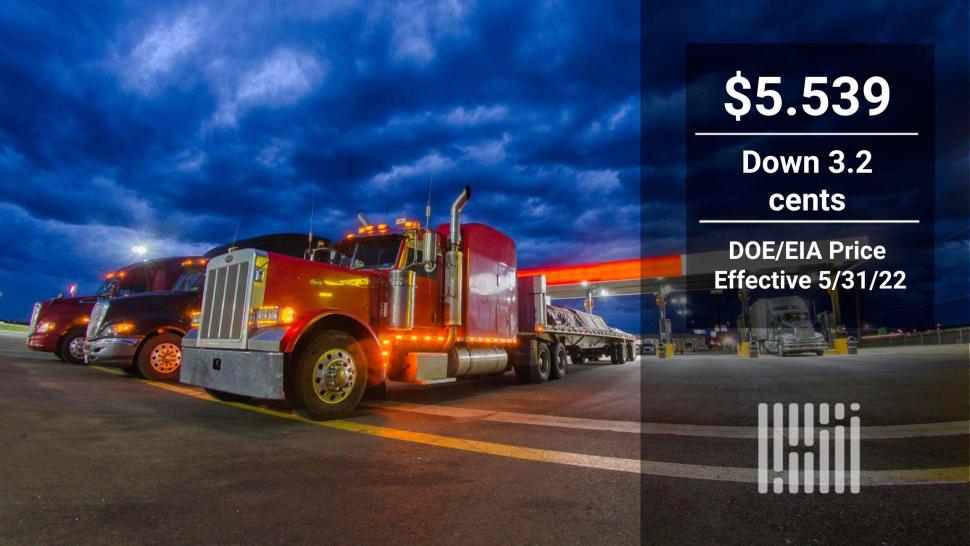
A drop of 3.2 cents was recorded in the weekly national diesel price of the Department of Energy/Energy Information Administration. The latest price for the number used for most fuel surcharges, $5.539/gallon, is down 8.4 cts/g from its record level three weeks ago of $5.623/g. It has declined three consecutive weeks.
The price on the East Coast declined more than the national average. Its level of $5.848/g was down 5.7 cents, putting the spread with the national price at 30.9 cts/g. A week earlier, it was 33.4 cts and was 33.1 cts a week before that. On April 18 it was just five cents.
Another key indicator pointed to the East Coast squeeze easing. Data from benchmark gateway General Index has now recorded a weakening of the East Coast spot market price relative to the Gulf Coast for six consecutive days. Its assessment of the East Coast market Tuesday put it at 10.88 cents more than the Gulf Coast assessment. Its recent high was 76 cents on May 16; a week ago, on May 24, the spread was 21.5 cents. This suggests that a combination of higher refinery runs and lower exports are beginning to bring some normalcy back to the East Coast, though the almost 31-cent spread recorded by the DOE/EIA is still well above the normal range of flat to a few cents negative or positive.
Broader oil markets Monday were crazily volatile, even by the standards of recent weeks. The ultra low sulfur diesel price on the CME commodity exchange got as high on the day as $4.2474/g and as low as $3.9894/g before settling up 8.8 cts/g on the day to $4.0909/g, a jump of 2.2%. However, Tuesday was the expiration of the June contract for ULSD, and the movement in the contract clearly suggested some traders were getting squeezed before the curtain fell on June trade. In the contract for July, a relatively minor increase of 0.7% took ULSD for the second month up 2.97 cts/g to $3.9350.
Volatility was most pronounced in crude. For example, the price of West Texas Intermediate crude swung almost $6, from a high of just under $120/barrel to a low of $114.15/b, settling at $114.67, a drop of 40 cents.
Bullish trade overnight in Europe and Asia was focused on the European Union’s agreement to ban most Russian crude imports, with an exemption for landlocked Hungary.
But later news out of the OPEC+ group, which includes the members of OPEC as well as several non-OPEC nations led by Russia, took the wind out of the sails created by the Russian news. Reports are that OPEC+ largely sees Russia as irrelevant now, since the various national and corporate actions taken against its oil exports and its industry will not allow the country to continue to increase production on a monthly basis, as it has done under the OPEC+ pact since April 2021.
With that decision in hand, countries like Saudi Arabia and the United Arab Emirates are reported to feel free to increase their own production to fill the lost increases that were to come from Russia.
According to the most recent survey by S&P Global Commodities Insights, which includes the legacy Platts business, Russia produced 9.14 million barrels/day in April. That is almost 100,000 b/d less than it produced in March, and well below its full quota of 10.436 million b/d. This is presumably the gap other countries believe can be filled by other production while still keeping the spirit of OPEC+ production guidelines.
More articles by John Kingston
C.R. England customer information may have been compromise in October data breach
Divergence in sentencing grows as 2 more Louisiana accident scammers are sentenced
Solicitor general advises Supreme Court not to review C.H. Robinson case
Brokerage Compliance Symposium
The day before F3. Every compliance issue you face - fraud exposure, carrier liability, FMCSA rules, cargo theft, insurance gaps - navigated by attorneys and operators defining best practices in a changing industry.
F3 Awards Dinner
The night before F3. FreightTech100 companies honored. FreightTech 25 and Shipper of Choice winners revealed live. Cocktail reception into dinner and live music - 300 industry leaders in one purpose-built room.
F3: Future of Freight Festival
Industry-defining keynotes, rapid-fire technology demos, and industry leaders networking in experiences across Chattanooga - plus the inaugural F3 Awards Dinner featuring the FreightTech and Shipper of Choice reveals.
The day before F3. Every compliance issue you face - fraud exposure, carrier liability, FMCSA rules, cargo theft, insurance gaps - navigated by attorneys and operators defining best practices in a changing industry.
The Signal at Chattanooga Choo Choo • Chattanooga, TN Register NowThe night before F3. FreightTech100 companies honored. FreightTech 25 and Shipper of Choice winners revealed live. Cocktail reception into dinner and live music - 300 industry leaders in one purpose-built room.
The Signal at Chattanooga Choo Choo • Chattanooga, TN Register NowIndustry-defining keynotes, rapid-fire technology demos, and industry leaders networking in experiences across Chattanooga - plus the inaugural F3 Awards Dinner featuring the FreightTech and Shipper of Choice reveals.
The Signal at Chattanooga Choo Choo • Chattanooga, TN Register Now