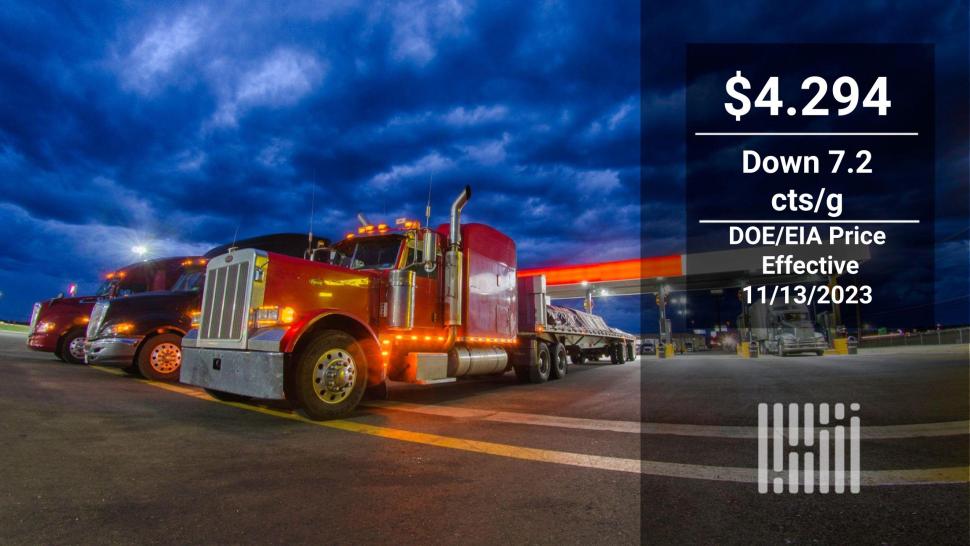
Retail diesel prices as measured by the Department of Energy/Energy Information Administration are now down almost 34 cents a gallon in the past eight weeks.
The DOE/EIA price for Monday came in at $4.294 a gallon, a decline of 7.2 cents. With that drop, the price is at its lowest since it fell to $4.239 a gallon on Aug. 7. The most recent high price was $4.633 on Sept. 18.
The price, used as the basis for most fuel surcharges, has declined in seven of the past eight weeks.
Diesel prices on the CME commodity exchange, as well as crude and gasoline, have been moving sharply lower in recent weeks, though they have turned up the past few days. Ultra low sulfur diesel on CME posted a recent high settlement of $3.2117 a gallon on Oct. 13. By last Thursday, the settlement came in at $2.7191 a gallon, a drop of 49.26 cents.
But on Monday, ULSD on CME settled up 3.51% on the day to $2.8393 a gallon. Combined with an increase on Friday, it brought ULSD futures up just over 12 cents a gallon in two days.
During the decline that for now has stopped the past few days, wholesale prices as measured by the ULSDR.USA data series in SONAR declined roughly 70 cents a gallon, significantly more than the almost 50-cent drop in the price on the CME. Those two prices — wholesale and futures — generally track movements with a relatively high degree of correlation.
Prices at the rack, the industry term for the wholesale distribution point, are affected not only by the movement in the ULSD price on CME but also by shifts in those physical markets.
These markets are traded for physical barrels either on a pipeline or on a barge. Their price is traded as a differential to the CME ULSD price.
As of a week or two ago, the trend in several of those physical market differentials had been weaker. The real-world impact of that can be seen in that steeper decline in wholesale prices compared to futures prices.
But in just the past few days, there has been a decided upward shift. Those increases will be expected to provide another bullish lift to wholesale prices in certain geographic markets on top of the increase in futures prices the past few days, reversing the recent trend.
Barrels traded on the Buckeye Pipeline system that runs from the Midwest to the East Coast were traded Monday at a 17.5-cent differential to CME, according to DTN Energy. As recently as Nov. 2, that spread was negative 19 cents.
A similar shift occurred in Chicago, where a differential Monday of 17.5 cents contrasts also with negative 19 cents a gallon on Nov. 2.
In the heavily traded Gulf Coast market, those signs of tightness have been more limited. The differential Monday was negative 13.5 cents a gallon; it was plus 12.5 cents Oct. 23. But on the West Coast, the differential since last week has been between 23.5 and 30.5 cents a gallon, according to DTN. It closed out October at “flat,” with no differential between the two prices.
At the root of the volatility in the past month has been a sentiment about both supply and demand from market bears.
The trend pointing downward on the supply side sees increasing crude flows out of several countries from the OPEC+ group, a rise in barrels that is not supposed to occur given the group’s agreement from April to limit production. It also is based on more oil from several other non-OPEC nations, such as the U.S. — which is up roughly 1 million barrels a day from the end of July — as well as Guyana and Brazil.
On the other side of that bearish coin have been projections of weakening demand worldwide.
But that assumption took a hit Monday when OPEC came out with its monthly forecast of oil demand and supply.
While OPEC’s estimate of its own supply in October differed little from those of third-party sources such as S&P Global Commodity Insights, it was the demand numbers that caught the attention of the market, propelling crude and diesel prices higher.
The OPEC report that was seen as driving the market Tuesday increased its projected global demand growth for petroleum to come in at 2.46 million barrels a day this year. That was a tiny increase of just 20,000 barrels from a month earlier, but the projected increase came in the middle of a market where slowing demand had been becoming almost a consensus view, magnifying its impact.
OPEC also projected that its forecast growth in 2024 would be unchanged at 2.25 million barrels a day and produced estimates on non-OPEC supply growth that remained tepid, even as the market has been reacting to increasing production out of various countries as 2023 winds down.
In reaction, the price of global crude benchmark Brent settled Monday at $82.52 a barrel. That was up 1.34% on the day, leaving Brent just shy of $3 a barrel more than the settlement of last Wednesday.
More articles by John Kingston
Uber Freight records tiny levels of improvement in Q3
Truck transportation jobs drop again
CRST, back in the acquisition game, buys Larkin’s BCB Transport
Brokerage Compliance Symposium
The day before F3. Every compliance issue you face - fraud exposure, carrier liability, FMCSA rules, cargo theft, insurance gaps - navigated by attorneys and operators defining best practices in a changing industry.
F3 Awards Dinner
The night before F3. FreightTech100 companies honored. FreightTech 25 and Shipper of Choice winners revealed live. Cocktail reception into dinner and live music - 300 industry leaders in one purpose-built room.
F3: Future of Freight Festival
Industry-defining keynotes, rapid-fire technology demos, and industry leaders networking in experiences across Chattanooga - plus the inaugural F3 Awards Dinner featuring the FreightTech and Shipper of Choice reveals.
The day before F3. Every compliance issue you face - fraud exposure, carrier liability, FMCSA rules, cargo theft, insurance gaps - navigated by attorneys and operators defining best practices in a changing industry.
The Signal at Chattanooga Choo Choo • Chattanooga, TN Register NowThe night before F3. FreightTech100 companies honored. FreightTech 25 and Shipper of Choice winners revealed live. Cocktail reception into dinner and live music - 300 industry leaders in one purpose-built room.
The Signal at Chattanooga Choo Choo • Chattanooga, TN Register NowIndustry-defining keynotes, rapid-fire technology demos, and industry leaders networking in experiences across Chattanooga - plus the inaugural F3 Awards Dinner featuring the FreightTech and Shipper of Choice reveals.
The Signal at Chattanooga Choo Choo • Chattanooga, TN Register Now