




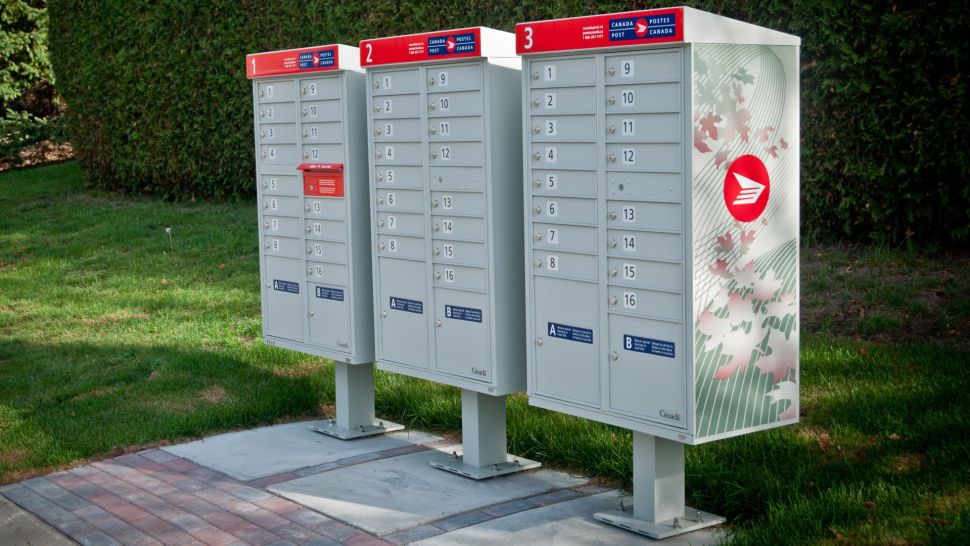
Canada Post on Thursday said it will convert 485,000 additional addresses in 37 communities from door-to-door delivery to community mailboxes in 2027, as part of a recently approved restructuring initiative aimed at modernizing the postal service and restoring its financial health.
The planned change in mail delivery service is on top of the 136,000 addresses Canada Post previously said would be converted to community mailboxes in late 2026 or early 2027.
Parts of Halifax, Ontario and Calgary are among the areas that will lose door-to-door service, according to a news release. Canada Post said it will begin communicating with communities about the change in the next few weeks and months.
Consolidating mail delivery to central neighborhood locations is expected to save considerable sums of money because the cost of delivering to individual homes and businesses is expensive. Officials say the change is needed after Canada Post had a record loss of US$1.15 billion in 2025 and a first- quarter loss of $147.5 million. The national post has lost money for eight consecutive years.
The move to community mailboxes will also increase security by putting nearly all mail and parcels delivered by Canada Post under lock and key.
Earlier this month, more than 50,000 letter carriers represented by the Canadian Union of Postal Workers ratified a new contract after more than two years of labor uncertainty from strikes and other tactics that hurt revenues as businesses shifted mail and parcel volumes to alternative carriers. Contract approval unlocked Canada Post’s ability to move forward with operational and other reforms.
Nearly three quarters of Canadian addresses already receive mail and parcels through some form of secure, centralized delivery such as community mailboxes, apartment lobby boxes and post office boxes.
As part of its transformation plan, Canada Post is converting 4 million addresses that still receive door-to-door delivery to community mailboxes. The national conversion program is expected to take about five years, with different areas transitioning each year.
Canada Post said it is working with local governments in 13 initial communities scheduled for conversion to identify and finalize suitable locations for community mailboxes. As sites are finalized, residents will be notified of the location of their community mailbox and receive keys before any change to their delivery.
More than 80% of parcels delivered by Canada Post fit into a community mailbox’s individual compartment or a dedicated parcel compartment. Parcels that don’t fit or that require a signature are delivered to the door or held for pickup at a nearby post office.
Residential customers who are physically limited from accessing a community mailbox are eligible for accommodations, such as sliding trays, Braille features or a more accessible compartment. In some cases, weekly home delivery may be provided on a seasonal, temporary or permanent basis.
Postal services around the world, confronted by the challenges of declining mail volume in a digital age and competition from more nimble parcel carriers, are similarly reimagining their business models. The U.S. Postal Service has been losing billions of dollars per year and now is seeking regulatory independence to set prices, reduce service levels where delivery is uneconomical, invest workers’ retirement funds, while implementing operational efficiencies.
Click here for more FreightWaves/American Shipper stories by Eric Kulisch.
RECOMMENDED READING:
Brokerage Compliance Symposium
The day before F3. Every compliance issue you face - fraud exposure, carrier liability, FMCSA rules, cargo theft, insurance gaps - navigated by attorneys and operators defining best practices in a changing industry.
F3 Awards Dinner
The night before F3. FreightTech100 companies honored. FreightTech 25 and Shipper of Choice winners revealed live. Cocktail reception into dinner and live music - 300 industry leaders in one purpose-built room.
F3: Future of Freight Festival
Industry-defining keynotes, rapid-fire technology demos, and industry leaders networking in experiences across Chattanooga - plus the inaugural F3 Awards Dinner featuring the FreightTech and Shipper of Choice reveals.
The day before F3. Every compliance issue you face - fraud exposure, carrier liability, FMCSA rules, cargo theft, insurance gaps - navigated by attorneys and operators defining best practices in a changing industry.
The Signal at Chattanooga Choo Choo • Chattanooga, TN Register NowThe night before F3. FreightTech100 companies honored. FreightTech 25 and Shipper of Choice winners revealed live. Cocktail reception into dinner and live music - 300 industry leaders in one purpose-built room.
The Signal at Chattanooga Choo Choo • Chattanooga, TN Register NowIndustry-defining keynotes, rapid-fire technology demos, and industry leaders networking in experiences across Chattanooga - plus the inaugural F3 Awards Dinner featuring the FreightTech and Shipper of Choice reveals.
The Signal at Chattanooga Choo Choo • Chattanooga, TN Register Now