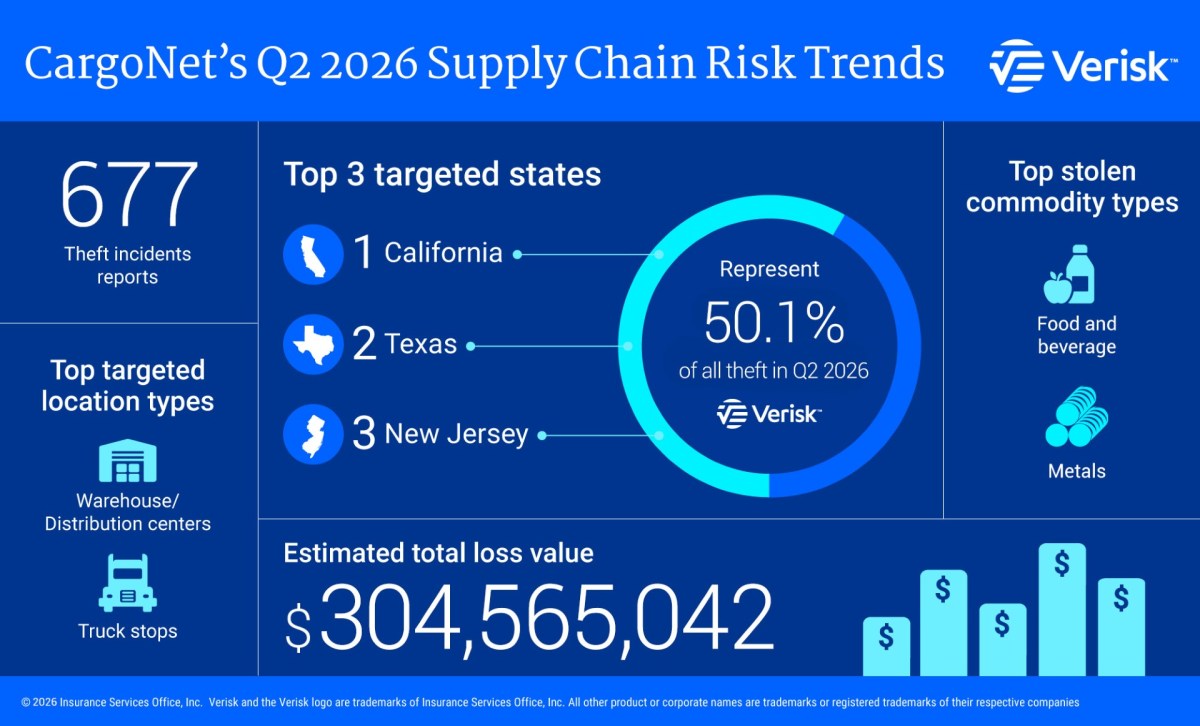
Fewer cargo theft reports did not mean smaller losses during the second quarter, according to Verisk CargoNet’s analysis. The intelligence network documented 677 incidents across the United States and Canada. That total fell 26% from Q2 2025. It also dropped 14% from the previous quarter.
Estimated cargo losses nevertheless climbed to $304.6 million during the three-month period. That figure more than doubled the $135.7 million reported during Q2 2025. The average reported commodity value reached $564,009. Several multimillion-dollar thefts involving metals and enterprise technology heavily influenced that average.
“Lower incident volume should not be mistaken for lower risk,” Keith Lewis, Verisk CargoNet’s vice president of operations, said. “The groups driving the largest losses are not necessarily trying to steal more freight; they are trying to identify the right shipment.” Lewis pointed to metals and enterprise technology as areas attracting organized theft groups. Those shipments can offer major value and established resale opportunities.
One quarter does not establish a trend
Scott Cornell, EVP, Crime and Theft Specialist at SPG Cargo & Logistics and chair of TAPA Americas, discussed the results during a recent FreightWaves interview. He described the decrease as welcome news after years when theft activity stayed elevated. Cornell also urged the industry to avoid treating one quarter as proof of a broader shift. “It’s not going to be a trend until we see it for maybe two or three quarters consecutively,” Cornell said.
Cornell noted that cargo theft numbers have historically moved up and down. He said recent law-enforcement arrests could be contributing to the quarterly decrease. Those efforts included operations in New York, New Jersey, California and Canada, along with FBI and Homeland Security cases. Cornell called the results from law enforcement and private-sector cooperation encouraging.
CargoNet’s data showed declines in physical thefts involving loaded equipment and non-delivery schemes. Those schemes involved bad actors acquiring established motor carriers, booking freight under their operating authority, then failing to deliver it. California and Texas recorded notable reductions in that activity. Theft classifications dropped from 488 events during Q2 2025 to 378 this year.
Fictitious pickup incidents moved far less, falling from 165 reports to 158. CargoNet also found steady activity involving business email compromise and shipment misdirection. Compromised accounts can expose shipment details, contact directories and transportation-management tools. Criminals can then impersonate trusted parties or alter load information.
Metals and technology drove severity
Metal theft increased from 54 incidents during Q2 2025 to 80 this year. Copper remained the most frequently targeted metal. Aluminum, nickel, tungsten and other specialized materials also drew increased attention. Cornell noted that CargoNet’s numbers placed metals second among commodity categories, behind food and beverage.
“Copper has been number one for two years now,” Cornell said. “That’s the longest stretch I’ve ever seen on copper.” He added that companies moving metals need to slow down and place stronger controls around those shipments. He described targeting as a question of when, not whether, for many metal loads.
CargoNet also identified continued targeting of enterprise computer equipment, networking components and cryptocurrency mining hardware. Those loads can carry multimillion-dollar values while moving as conventional dry freight. Food and beverage thefts declined overall, including mixed grocery products and alcoholic beverages. Seafood thefts moved the other direction, increasing by 11 events.
Why It Matters: Lower incident counts offer some positive news, but $304.6 million in reported losses shows the financial exposure remains serious. CargoNet’s findings give brokers, carriers and shippers specific commodities and tactics to watch more closely.
In my opinion, the report shows why fraud prevention cannot sit with one person or department. CFCO training helps teams build consistent verification around carrier identity, email changes and shipment instructions before freight moves. Fraud does not beat smart people. It beats inconsistent processes.
Click here for more articles on cargo theft and freight fraud by Phil Brink.
Truck driver admits $510K fuel card fraud without buying fuel – FreightWaves
392 stolen vehicles worth $28M stopped before overseas export, RCMP says – FreightWaves
Brokerage Compliance Symposium
The day before F3. Every compliance issue you face - fraud exposure, carrier liability, FMCSA rules, cargo theft, insurance gaps - navigated by attorneys and operators defining best practices in a changing industry.
F3 Awards Dinner
The night before F3. FreightTech100 companies honored. FreightTech 25 and Shipper of Choice winners revealed live. Cocktail reception into dinner and live music - 300 industry leaders in one purpose-built room.
F3: Future of Freight Festival
Industry-defining keynotes, rapid-fire technology demos, and industry leaders networking in experiences across Chattanooga - plus the inaugural F3 Awards Dinner featuring the FreightTech and Shipper of Choice reveals.
The day before F3. Every compliance issue you face - fraud exposure, carrier liability, FMCSA rules, cargo theft, insurance gaps - navigated by attorneys and operators defining best practices in a changing industry.
The Signal at Chattanooga Choo Choo • Chattanooga, TN Register NowThe night before F3. FreightTech100 companies honored. FreightTech 25 and Shipper of Choice winners revealed live. Cocktail reception into dinner and live music - 300 industry leaders in one purpose-built room.
The Signal at Chattanooga Choo Choo • Chattanooga, TN Register NowIndustry-defining keynotes, rapid-fire technology demos, and industry leaders networking in experiences across Chattanooga - plus the inaugural F3 Awards Dinner featuring the FreightTech and Shipper of Choice reveals.
The Signal at Chattanooga Choo Choo • Chattanooga, TN Register Now