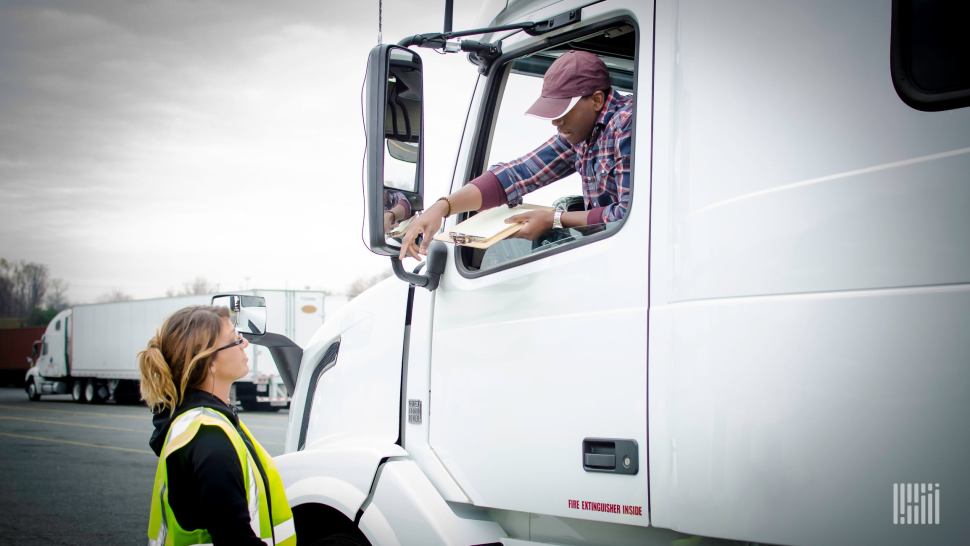
International Roadcheck will be May 13-15 this year.
The Commercial Vehicle Safety Alliance announced the dates Wednesday.
The focus of Roadcheck this year will be both compliance with federal hours-of-service regulations and tire maintenance.
International Roadcheck is important not only because of the inspections in the U.S., Canada and Mexico over the focus areas and other safety regulations, but also because it tends to tighten up truck capacity for a few days as some truck drivers, mostly independent owner-operators, stay home for the duration of the event.

This is what the Outbound Tender Rejection Index did last May when Road Check week began on May 14. A movement higher–presumably because of drivers beginning to stay home–began a few days before the actual inspections began.
In a sheet released by CVSA that accompanied the announcement of the date, the agency said inspectors would be looking for a variety of indicators in the two focus areas.
For tires, CVSA identified, among others: low tread depth, “audible” air leaks, flat tires, exposed treads, tread or sidewall separation, bulges in a sidewall, improper repairs, and items lodged between dual tires.
In the record-of-duty status (RODS) data carried by a truck driver, the potential violations CVSA said its inspectors would be looking at include tampering with ELDs; a “ghost driver,” or as it defined it, “claiming a co-driver when there is no codriver present”; “improper use” of the personal conveyance exemption, always a hot topic with HOS because it allows driving in excess of the rules if the driver is, for example, driving home or somewhere else without any commercial activity as part of the trip; improper use of other exceptions that are built into the HOS rules; and improperly logging off-duty time.
The standard inspection is Level I. It involves a 37-step procedure “that includes an examination of driver operating requirements and vehicle mechanical fitness,” CVSA said.
If a vehicle passes a Level I or Level V inspection, it receives a CVSA decal. That sticker is good for three months of protection against further inspections. A CVSA Level V inspection is like a Level I inspection, but according to the definition of CVSA levels, a driver is not present during the Level V inspection.
An out-of-service violation handed down keeps a truck off the road until all the violations have been “properly addressed,” CVSA said. Last year, according to CVSA, the vehicle out-of-service rate after Roadcheck was 23% and the driver out-of-service rate was 4.8%.
Roadcheck last year was May 14-16.
If for some reason an inspector can only conduct less rigorous Level II or Level III inspections, a truck that passes that inspection does not receive the decal handed out after a Level I or Level V inspection.
More articles by John Kingston
XPO lawsuit against 2 ex-employees gives look into noncompete agreements
Chalk up another nuclear verdict: More than $21M in Los Angeles case
‘What did these men do?’ judge asks in throwing out indictment of NFI’s Brown