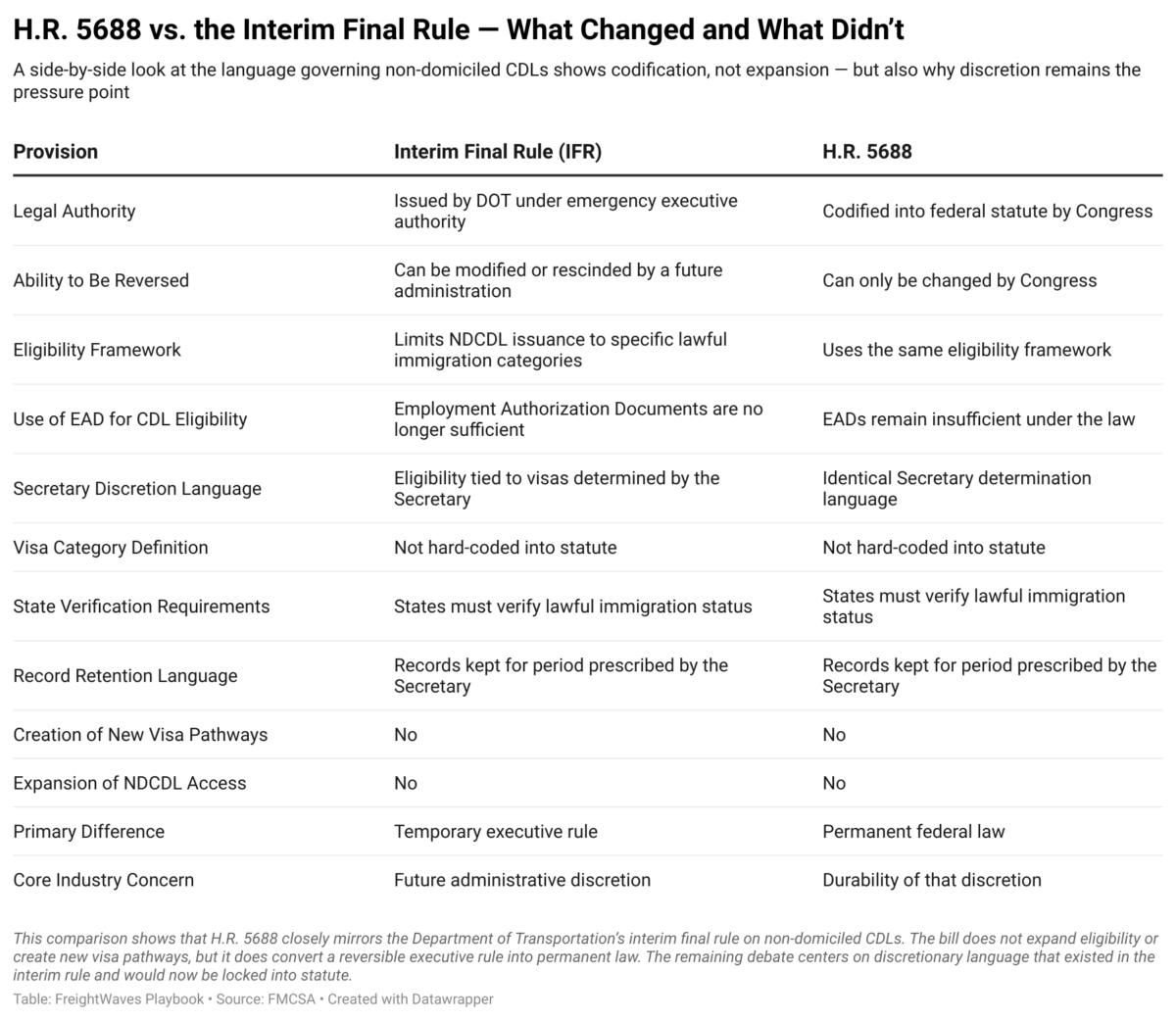
H.R. 5688 does not materially expand the Interim Final Rule (IFR).
It largely codifies it into statute, which means the same rules—but harder to undo.(Photo: John Gallagher/FreightWaves)
The conversation around non-domiciled CDLs has become one of the loudest and most emotionally charged debates trucking has seen in years. Depending on where you get your information, HR 5688 is either a long-overdue fix to a broken system — or a Trojan horse that could reopen the very loopholes drivers believe flooded the industry in the first place.
That tension is exactly why the issue was brought to The Long Haul.
From the opening moments of the episode, host Adam Wingfield set the tone clearly: this was not about picking sides or telling drivers what to think. It was about hearing perspectives directly, in full context, and allowing listeners to decide for themselves.
“My goal… is to take different perspectives and hear different sides of stories, to formulate my own opinion,” Wingfield said. “Because at the end of the day, you can’t hear someone else’s opinion if you’re not listening.”
For this episode, that perspective came from Lewie Pugh, Executive Vice President of OOIDA — a former driver who has spent decades navigating both the cab of a truck and the halls of Washington.
What followed was not a clean endorsement, nor a defensive press tour. It was a candid, sometimes uncomfortable discussion about how HR 5688 came to be, what it actually does, and where its limits — and risks — may lie.
What HR 5688 Was Designed to Fix
At its core, Pugh explained, the original intent behind non-domiciled CDLs was operational, not ideological.
“The problem it was designed to solve was if a person living in Florida went to Utah to work for a motor carrier… they could train there, test there, and get their CDL even though they weren’t a resident,” Pugh said.
That structure allowed large carriers and military programs to train drivers centrally, issue a CDL, and then have the driver transfer it back to their home state later. On paper, it solved a logistical bottleneck.
But as Pugh acknowledged, what lawmakers and regulators failed to anticipate was how broadly the door would open.
“What we didn’t realize… was that we were opening the floodgates to not only allow people from other states, but other countries.”
He was blunt about where responsibility fell.
“There’s a lot of unscrupulous trucking schools out there… and these people should have never gotten behind the wheel in the first place.”
That acknowledgment matters, because it undercuts the narrative that industry groups were blindsided only recently. OOIDA, Pugh said, opposed the expansion early — sending cease-and-desist letters to more than 40 states issuing non-domiciled CDLs.
Key Takeaways
Future risk depends on interpretation, not volume
The eligibility rules are effectively the same
No new access is created by H.R. 5688
The main change is permanence, not policy
Secretary discretion exists in both versions
The “Driver Shortage” Narrative Under the Microscope
As the conversation widened, Pugh returned repeatedly to what he described as the industry’s original sin: legislating around a perpetual driver shortage narrative.
“For the last 40 years, we’ve been regulating and legislating from this whole bull crap driver shortage narrative,” he said. “We don’t have a shortage of drivers. We have a shortage of pay, training, and places to sleep.”
That framing shaped nearly every policy decision that followed — including fast-tracking CDL access, easing training requirements, and tolerating churn.
“We fast-track truck drivers, but we don’t fast-track electricians, doctors, or carpenters,” Pugh said. “Why wouldn’t we want the guy hauling freight to actually know what he’s doing?”
In his telling, non-domiciled CDLs became one more lever to keep seats filled rather than improve job quality — a decision whose downstream effects are now impossible to ignore.
The turning point of the discussion came when Wingfield pressed Pugh on HR 5688’s substance — not its intent.
Pugh’s core argument was straightforward: the bill does not expand access. It codifies existing restrictions already put in place through the Interim Final Rule issued under Secretary Sean Duffy.
“This bill is nothing but codifying the Interim Final Rule,” Pugh said. “It’s mirrored language. It’s the exact same thing.”
And codification, he argued, is critical because agency rules can be undone by the next administration with the stroke of a pen.
“If Congress makes this a law… then it will take Congress to change it.”
That explanation addressed one concern — permanence — but raised another.
The Loophole Question
Wingfield did not let the conversation stop there.
He read directly from the bill’s language, pointing to clauses allowing eligibility based on visas “determined by the Secretary” and record retention periods also “prescribed by the Secretary.”
The concern was clear: discretion today could become vulnerability tomorrow.
“Wouldn’t it be advantageous to amend the bill now,” Wingfield asked, “so we remove the potential for loopholes instead of dealing with this again down the road?”
Pugh did not dismiss the concern.
“I would love to see no non-domiciled CDLs. Period,” he said. “That would be perfect.”
But he framed HR 5688 as a choice between imperfect progress and regulatory whiplash.
“If we don’t get this codified… the next administration can just do away with the rule completely, and it’s back to the Wild West.”
Pressed further on whether discretion itself creates risk, Pugh conceded the uncertainty.
“Anything can happen,” he said. “But there are steps before it ever gets to that level — labor need, visas, funding. It’s still better than what we have now.”
That exchange marked one of the clearest moments where OOIDA’s position showed strain: supporting a bill it does not love, to prevent outcomes it fears more.
Why the Backlash Hit So Hard
Another recurring theme was social media’s role in amplifying distrust.
“Social media has become the new CB radio,” Pugh said. “Everybody has an opinion.”
Wingfield pushed further, noting that advocacy organizations are now judged not just by policy outcomes, but by how fast and clearly they communicate.
Pugh acknowledged OOIDA was slower than ideal to adapt — but emphasized the challenge of representing a diverse membership across generations.
“You’ve got drivers in their 20s and drivers in their 70s. They get information completely differently.”
That gap, he suggested, allows simplified narratives to fill the void — including the belief that OOIDA supports foreign non-domiciled CDLs.
“OOIDA does not support non-domiciled CDLs. Period,” Pugh said. “We were the only ones pushing back in 2019.”
The Core Tradeoff
As the episode closed, the disagreement crystallized into a single question:
Is HR 5688 a flawed safeguard — or a necessary line in the sand?
Pugh’s answer was pragmatic, not triumphant.
“Is it perfect? No. Is it the best chance we have right now? Yes.”
He warned that refusing to engage, or making the bill politically toxic, could leave the industry with nothing at all.
“Something is better than nothing — when nothing means going backward.”
Wingfield did not dispute that reality. But he left listeners with the unresolved tension at the heart of the debate: whether settling now risks reopening the door later.
What neither side disputed was this — the era of quiet policymaking is over. Social media has turned every bill into a public trial, and every advocacy group into a defendant.
In that environment, clarity matters more than alignment.
And for truckers trying to make sense of HR 5688, the takeaway was not who to trust — but what questions still deserve answers.
Upcoming FreightWaves Events
Compliance
Brokerage Compliance Symposium
The day before F3. Every compliance issue you face - fraud exposure, carrier liability, FMCSA rules, cargo theft, insurance gaps - navigated by attorneys and operators defining best practices in a changing industry.
October 26, 2026
The Signal at Chattanooga Choo Choo • Chattanooga, TN
The night before F3. FreightTech100 companies honored. FreightTech 25 and Shipper of Choice winners revealed live. Cocktail reception into dinner and live music - 300 industry leaders in one purpose-built room.
October 26, 2026
The Signal at Chattanooga Choo Choo • Chattanooga, TN
Industry-defining keynotes, rapid-fire technology demos, and industry leaders networking in experiences across Chattanooga - plus the inaugural F3 Awards Dinner featuring the FreightTech and Shipper of Choice reveals.
October 27, 2026 – October 28, 2026
The Signal at Chattanooga Choo Choo • Chattanooga, TN
ComplianceBrokerage Compliance SymposiumOct 26 • The Signal at Chattanooga Choo Choo • Chattanooga, TN
The day before F3. Every compliance issue you face - fraud exposure, carrier liability, FMCSA rules, cargo theft, insurance gaps - navigated by attorneys and operators defining best practices in a changing industry.
The Signal at Chattanooga Choo Choo • Chattanooga, TNRegister Now
AwardsF3 Awards DinnerOct 26 • The Signal at Chattanooga Choo Choo • Chattanooga, TN
The night before F3. FreightTech100 companies honored. FreightTech 25 and Shipper of Choice winners revealed live. Cocktail reception into dinner and live music - 300 industry leaders in one purpose-built room.
The Signal at Chattanooga Choo Choo • Chattanooga, TNRegister Now
FreightTechF3: Future of Freight FestivalOct 27 – Oct 28 • The Signal at Chattanooga Choo Choo • Chattanooga, TN
Industry-defining keynotes, rapid-fire technology demos, and industry leaders networking in experiences across Chattanooga - plus the inaugural F3 Awards Dinner featuring the FreightTech and Shipper of Choice reveals.
The Signal at Chattanooga Choo Choo • Chattanooga, TNRegister Now