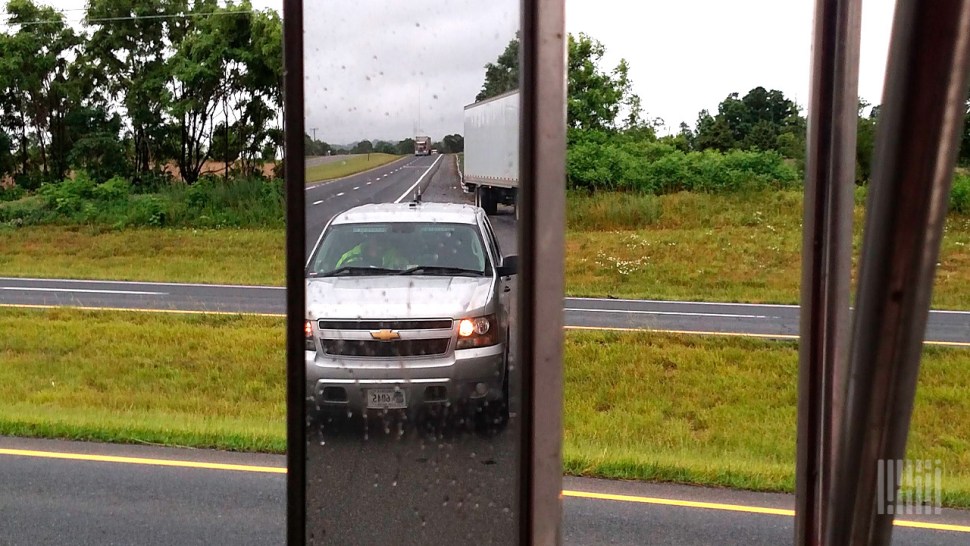
Here’s a question I get asked more than you might think: “Can law enforcement really knock on my sleeper berth door and demand an inspection while I’m on my mandatory 10-hour break?”
The short answer is yes. The longer answer explains why, and it’s a legal reality that’s been settled for decades.
I get it. You’ve been running hard, you finally pull into a rest area to grab some sleep, and suddenly there’s a badge at your window. Your gut reaction is to think this violates your constitutional rights. After all, that sleeper berth is your home while you’re over the road.
You need to realize that when you climbed behind the wheel of a commercial motor vehicle, you entered what the Supreme Court calls a “closely regulated industry.” That designation fundamentally changes how the Fourth Amendment applies to you.
The Burger Decision Changed Everything
Back in 1987, the Supreme Court handed down a ruling in New York v. Burger that still defines inspection rights for anyone operating in heavily regulated industries. The case involved a junkyard owner who objected to warrantless police inspections, but the principle they established reaches far beyond auto salvage.
The court created a three-pronged test that allows warrantless administrative inspections. There must be a substantial government interest, the inspections must be necessary to further the regulatory scheme, and the authorizing statute must provide adequate notice of what’s being regulated and limit inspector discretion.
Commercial trucking checks all three boxes. Highway safety is a matter of overwhelming public interest. Random roadside inspections are essential to making safety regulations actually work. Title 49 of the Code of Federal Regulations clearly defines what can be inspected and who can do it.
The practical effect? You accepted reduced Fourth Amendment protections the moment you got your CDL and started driving commercially on public roadways.
What “In Operation” Actually Means
Here’s where many drivers get tripped up. Under 49 CFR 396.9, authorized personnel can inspect commercial motor vehicles “in operation.” Most drivers read that and assume it means vehicles actively moving down the highway.
Wrong.
“In operation” includes vehicles parked at rest stops, sitting at weigh stations, pulled over on highway shoulders, and stopped at truck stops that are open to public access. If your rig is on public property or publicly accessible property, you’re subject to inspection. Does the state DOT maintain that rest area? That’s public property. The interstate shoulder? Public property. The truck stop that anyone can pull into off the exit ramp? Also fair game unless it’s specifically gated or signed as private. Even then, they could get a warrant.
The key distinction is public accessibility, not whether your wheels are turning.
The CVSA Policy Everyone Cites (But Doesn’t Understand)
Drivers love to point to CVSA Operational Policies 13 and 15 as a shield. “They can’t wake me up during my rest break!” is something I hear constantly.
CVSA guidance states that certified inspectors should not disturb or interrupt a driver who’s in off-duty or sleeper berth status for a random inspection, provided the vehicle is legally parked. Notice the operative word there: should not. That’s guidance to inspectors, not a prohibition. It’s not the law. It’s not a regulation. It’s an operational policy designed to prevent drivers from being forced into HOS violations by requiring them to go on-duty for an inspection during their mandatory rest period.
More importantly, there’s a giant exception: inspectors can absolutely wake you and require compliance if there’s an immediate safety concern. Leaking fuel, a visibly flat tire, and your rig parked in a way that creates a hazard all give an officer legal grounds to interrupt your break.
If you’re parked illegally, on a ramp, in a non-truck parking area, or anywhere that’s not a designated commercial vehicle spot, you’ve surrendered whatever protection that CVSA policy might have provided.
The Reality
What should you do when an officer knocks during your break?
First, comply. Fighting a DOT inspection on constitutional grounds at the roadside isn’t going to work out for you. The case law is settled. The regulatory framework is clear. You’re going to lose that argument, and you’re going to make your life harder in the process.
Second, document everything. The moment an officer requires you to assist with an inspection while you’re on your 10-hour break, you’ve moved to on-duty, non-driving status under 49 CFR 395.2. Log it that way. Note in your ELD remarks that the status change was due to a mandatory DOT inspection. Get a copy of the inspection report. Record the officer’s badge number and agency.
That documentation is your defense if you end up with HOS violations because an inspection interrupted your restart or broke your consecutive rest period. It’s also your carrier’s defense when explaining delays to customers.
Third, know the difference between legal authority and departmental policy. Officers have broad legal authority to conduct inspections. Whether they should interrupt your rest for a random inspection is a different question, and that’s where CVSA policy comes into play. If an officer interrupts your mandated rest without an articulated safety concern, that’s worth documenting. It might not help you at the roadside, but it provides context for any subsequent proceedings.
The Fourth Amendment protects Americans from unreasonable searches and seizures, but “unreasonable” doesn’t mean the same thing for commercial motor vehicle operators that it means for someone driving their personal vehicle to the grocery store.
When the Supreme Court looked at industries with extensive government oversight, it recognized that operators in those industries have a diminished expectation of privacy. Trucking sits squarely in that category. The feds have been regulating commercial vehicle operation since the Motor Carrier Act of 1935. That’s ninety years of continuous government oversight.
You didn’t give up all your rights when you got your CDL. But you did accept that maintaining highway safety for the general public takes precedence over your expectation of being left alone at the rest area.
My advice? Park legally, document interactions, maintain your equipment, and keep your paperwork in order. The inspection you’re worried about becomes a lot less stressful when you’re running compliant. If there was ever a fantastic argument for paid parking, it is the protections that gated, signed private property offers through parking locations provided by vendors like Truck Parking Club.
Brokerage Compliance Symposium
The day before F3. Every compliance issue you face - fraud exposure, carrier liability, FMCSA rules, cargo theft, insurance gaps - navigated by attorneys and operators defining best practices in a changing industry.
F3 Awards Dinner
The night before F3. FreightTech100 companies honored. FreightTech 25 and Shipper of Choice winners revealed live. Cocktail reception into dinner and live music - 300 industry leaders in one purpose-built room.
F3: Future of Freight Festival
Industry-defining keynotes, rapid-fire technology demos, and industry leaders networking in experiences across Chattanooga - plus the inaugural F3 Awards Dinner featuring the FreightTech and Shipper of Choice reveals.
The day before F3. Every compliance issue you face - fraud exposure, carrier liability, FMCSA rules, cargo theft, insurance gaps - navigated by attorneys and operators defining best practices in a changing industry.
The Signal at Chattanooga Choo Choo • Chattanooga, TN Register NowThe night before F3. FreightTech100 companies honored. FreightTech 25 and Shipper of Choice winners revealed live. Cocktail reception into dinner and live music - 300 industry leaders in one purpose-built room.
The Signal at Chattanooga Choo Choo • Chattanooga, TN Register NowIndustry-defining keynotes, rapid-fire technology demos, and industry leaders networking in experiences across Chattanooga - plus the inaugural F3 Awards Dinner featuring the FreightTech and Shipper of Choice reveals.
The Signal at Chattanooga Choo Choo • Chattanooga, TN Register Now