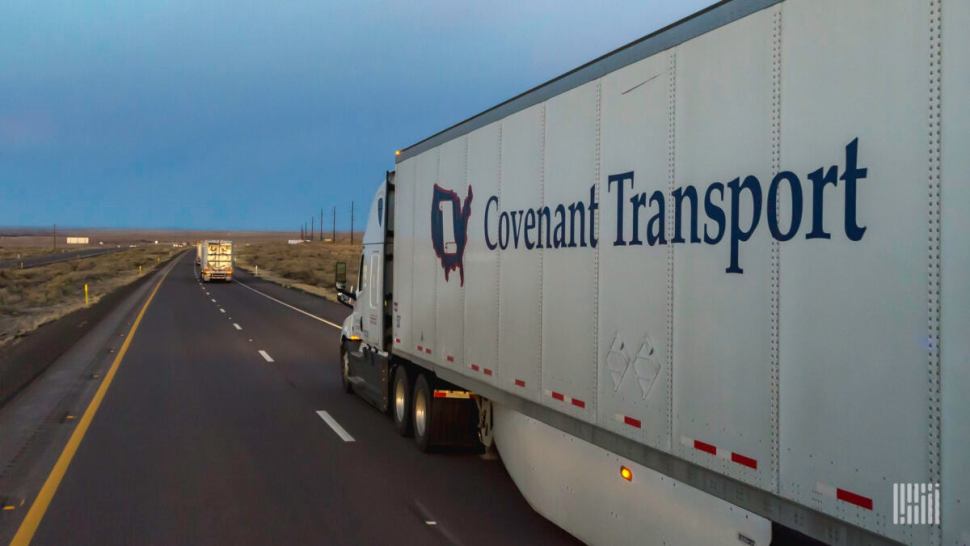
Covenant Logistics Group CEO David Parker told analysts Thursday that the trucking market remains mired in “one of the most interesting times” of his five-decade career — but believes the prolonged downturn is nearing an inflection point as more smaller carriers close under mounting regulatory and insurance pressure.
Chattanooga-based Covenant Logistics Group (NYSE: CVLG) released its third-quarter earnings on Wednesday and held an earnings call on Thursday.
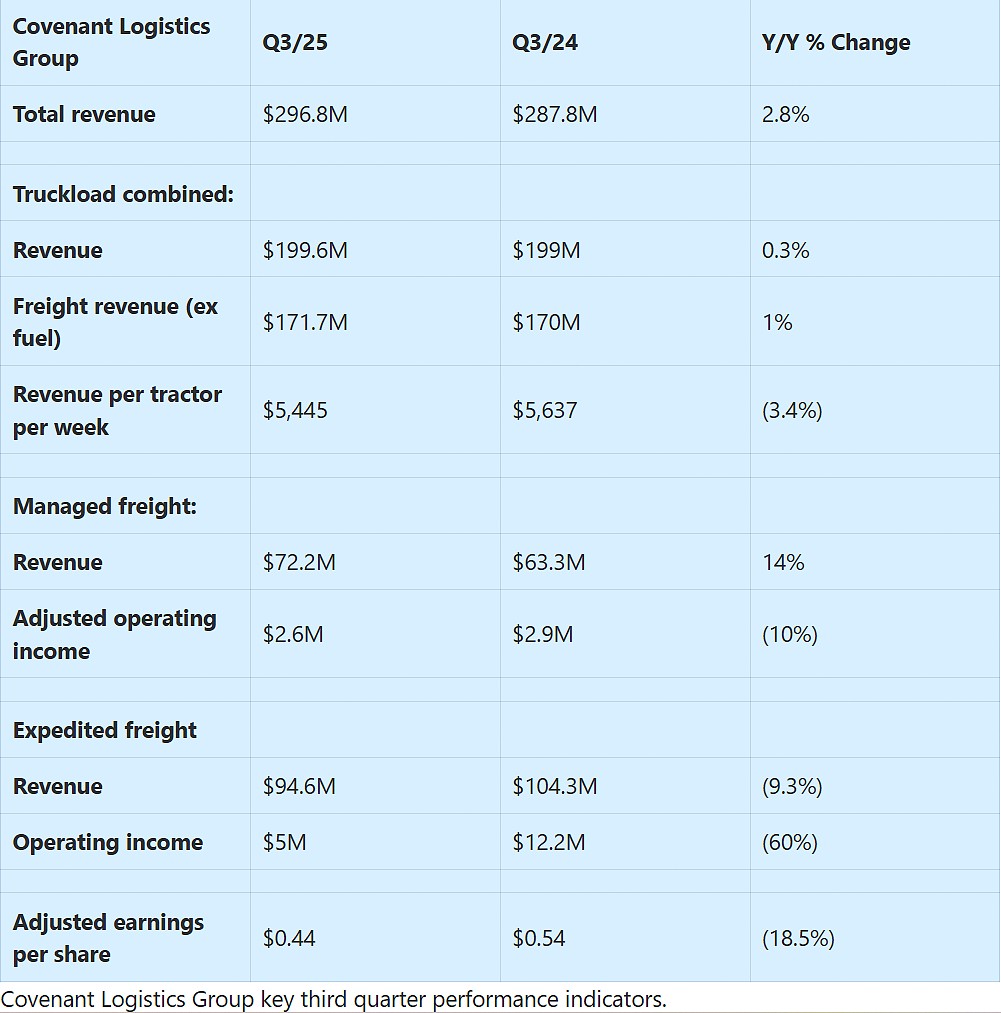
The company posted revenue of $296.9 million during the third-quarter. Adjusted earnings came out to $0.44 per share, compared to $0.54 in Q3 2024.
Parker said that the exit of small carriers — accelerated by higher insurance costs, enforcement of English-language proficiency requirements, and crackdowns on non-domiciled commercial driver’s licenses — is starting to tighten freight capacity in regional markets, even if national spot rates have yet to respond.
“I think you’re going to see insurance companies that are not going to insure non-domiciled CDL license holders,” Parker said. “California is leading it … capacity is leaving the market.”
Related: Covenant Logistics Q3 profit slips on truckload weakness
The company’s truckload segment reported operating income of $9.2 million, down sharply from $23.1 million a year earlier, as rising insurance, wages, and maintenance costs weighed on margins.
Covenant’s freight revenue per total mile in the third quarter increased 5% year-over-year, but lower utilization drove a decline in overall efficiency. The expedited segment saw freight revenue fall 9% year-over-year to $80.2 million, while dedicated operations grew 11% year-over-year to $91.6 million, supported by new contracts in the protein supply chain.
Parker added that Covenant is “seeing compression on margins” in its brokerage division as enforcement actions and equipment under-utilization ripple through the industry, but said those pressures “should help asset carriers more” as rates eventually rise.
Covenant is holding off on new truck purchases amid uncertainty over tariffs on imported heavy-duty trucks and components, calling current OEM order boards “very slack.”
“Our fleet is very, very healthy,” Parker said. “Our balance sheet remains very, very healthy, and we’re going to buy some equipment. It’s hard to commit to a number when you don’t have pricing on it.”
Looking ahead to the American Trucking Associations’ annual conference next week in San Diego, Parker said that carrier sentiment could echo his cautious optimism.
“I think you’ve got motor carriers that are happy with what the government is doing, and I think that that’s going to be the tone at ATA conference,” he said. “Inflation has been bad for 36 to 42 months, and regulation on trucks has been intense — but it’s going to be pain before the gain.”
Brokerage Compliance Symposium
The day before F3. Every compliance issue you face - fraud exposure, carrier liability, FMCSA rules, cargo theft, insurance gaps - navigated by attorneys and operators defining best practices in a changing industry.
F3 Awards Dinner
The night before F3. FreightTech100 companies honored. FreightTech 25 and Shipper of Choice winners revealed live. Cocktail reception into dinner and live music - 300 industry leaders in one purpose-built room.
F3: Future of Freight Festival
Industry-defining keynotes, rapid-fire technology demos, and industry leaders networking in experiences across Chattanooga - plus the inaugural F3 Awards Dinner featuring the FreightTech and Shipper of Choice reveals.
The day before F3. Every compliance issue you face - fraud exposure, carrier liability, FMCSA rules, cargo theft, insurance gaps - navigated by attorneys and operators defining best practices in a changing industry.
The Signal at Chattanooga Choo Choo • Chattanooga, TN Register NowThe night before F3. FreightTech100 companies honored. FreightTech 25 and Shipper of Choice winners revealed live. Cocktail reception into dinner and live music - 300 industry leaders in one purpose-built room.
The Signal at Chattanooga Choo Choo • Chattanooga, TN Register NowIndustry-defining keynotes, rapid-fire technology demos, and industry leaders networking in experiences across Chattanooga - plus the inaugural F3 Awards Dinner featuring the FreightTech and Shipper of Choice reveals.
The Signal at Chattanooga Choo Choo • Chattanooga, TN Register Now