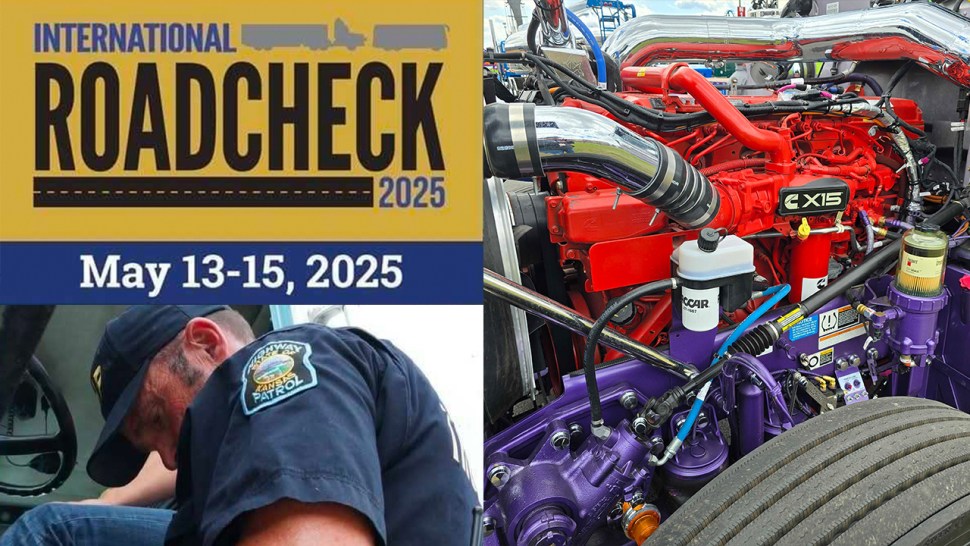
The Commercial Vehicle Safety Alliance (CVSA) has released results from its 2025 International Roadcheck, the annual 72-hour inspection blitz that puts the continent’s trucking industry under a magnifying glass. This year’s event, held May 13–15, saw 56,178 inspections conducted across the U.S., Canada, and Mexico, up from 48,761 in 2024 and slightly below the 59,429 seen in 2023.
Overall, 81.6% of vehicles and 94.1% of drivers passed without any out-of-service violations. Still, inspectors grounded 10,148 trucks and 3,342 drivers, producing a vehicle out-of-service rate of 18.1% and a driver rate of 5.9%. Both figures show mild improvement year over year, though the raw numbers remind carriers that safety and compliance gaps persist.
Each year, CVSA highlights one driver and one vehicle focus area. For 2025, inspectors zeroed in on tires and false records of duty status (RODS), two issues that never seem to go away.
Brake systems once again topped the list, accounting for 24.4% of all out-of-service violations. When combined with the “20% defective brakes” category, brake-related issues made up more than 40% of all vehicle OOS violations. Tires followed at 21.4%, with nearly 2,900 tire-related violations cited.
On the driver side, hours-of-service issues led the way, making up 32.4% of all driver OOS violations, followed by no CDL (24.4%) and no medical card (14.9%). The special focus on falsified logs uncovered 332 out-of-service violations, roughly 10% of the total driver enforcement actions.
Seat belt compliance also continues to lag. Inspectors issued 726 seat belt violations, despite years of awareness campaigns and crash data showing that seat belts remain the simplest life-saving measure in trucking.
By the Numbers: Top Violations 2025 vs. 2024
| Rank | 2025 Violation Category | % of Vehicle OOS Violations (2025) | 2024 Violation Category | % of Vehicle OOS Violations (2024) |
| 1 | Brake Systems | 24.4% | Brake Systems | 25.2% |
| 2 | Tires | 21.4% | Tires | 18.6% |
| 3 | 20% Defective Brakes | 16.7% | 20% Defective Brakes | 15.0% |
| 4 | Lights | 12.8% | Lights | 11.3% |
| 5 | Cargo Securement | 11.4% | Cargo Securement | 10.6% |
| 6 | Steering Mechanism | 4.1% | Steering Mechanism | 4.3% |
| 7 | Suspension | 3.3% | Suspension | 3.1% |
| 8 | Coupling Devices | 2.1% | Coupling Devices | 2.0% |
| 9 | Fuel System | 1.8% | Fuel System | 1.9% |
| 10 | Exhaust / Emissions | 1.5% | Exhaust / Emissions | 1.3% |
Driver Top Violations (2025 vs. 2024):
| Rank | 2025 Driver OOS Violation | % (2025) | 2024 Driver OOS Violation | % (2024) |
| 1 | Hours of Service | 32.4% | Hours of Service | 34.7% |
| 2 | No CDL | 24.4% | No CDL | 22.3% |
| 3 | No Medical Card | 14.9% | No Medical Card | 14.5% |
| 4 | False Logs | 10.0% | False Logs | 8.9% |
| 5 | Suspended CDL | 5.1% | Suspended CDL | 4.8% |
(Source: CVSA, FMCSA Roadside Inspection Data 2024–2025)
Hazmat and Beyond
Hazardous materials and dangerous goods inspections turned up 177 out-of-service violations, with loading (28.8%), shipping papers (20.3%), and placarding (18.1%) topping the list. Improper loading continues to dominate HM enforcement data, reflecting training gaps among carriers moving hazardous cargo.
CVSA’s 2026 Enforcement Calendar
Next year’s 2026 International Roadcheck is scheduled for May 12–14, with focus areas to be announced later this winter.
Additional CVSA safety campaigns are also on deck for 2026:
- Operation Safe Driver Week: Expected July 12–18, 2026 (historically mid-July).
- Brake Safety Week (Operation Airbrake): Aug. 23–29, 2026, emphasizing brake system condition and maintenance documentation.
- Unannounced Brake Safety Day: One-day inspection event to occur without prior notice sometime during 2026.
These programs ensure enforcement pressure remains steady throughout the year, not just during May’s International Roadcheck.
The 2025 International Roadcheck proves once again that the industry’s biggest compliance threats remain essentially unchanged, still including brakes, tires, hours, and honesty.
Despite improved technology and telematics, the fundamentals still rule the day. Fleets that get ahead on maintenance and documentation aren’t just staying compliant, they’re protecting drivers, lowering insurance risk, and proving that safe operations are smart business because when inspectors roll out again in 2026, the numbers will tell the same story: the fleets that check every box before the scale are the ones still rolling after it.
Brokerage Compliance Symposium
The day before F3. Every compliance issue you face - fraud exposure, carrier liability, FMCSA rules, cargo theft, insurance gaps - navigated by attorneys and operators defining best practices in a changing industry.
F3 Awards Dinner
The night before F3. FreightTech100 companies honored. FreightTech 25 and Shipper of Choice winners revealed live. Cocktail reception into dinner and live music - 300 industry leaders in one purpose-built room.
F3: Future of Freight Festival
Industry-defining keynotes, rapid-fire technology demos, and industry leaders networking in experiences across Chattanooga - plus the inaugural F3 Awards Dinner featuring the FreightTech and Shipper of Choice reveals.
The day before F3. Every compliance issue you face - fraud exposure, carrier liability, FMCSA rules, cargo theft, insurance gaps - navigated by attorneys and operators defining best practices in a changing industry.
The Signal at Chattanooga Choo Choo • Chattanooga, TN Register NowThe night before F3. FreightTech100 companies honored. FreightTech 25 and Shipper of Choice winners revealed live. Cocktail reception into dinner and live music - 300 industry leaders in one purpose-built room.
The Signal at Chattanooga Choo Choo • Chattanooga, TN Register NowIndustry-defining keynotes, rapid-fire technology demos, and industry leaders networking in experiences across Chattanooga - plus the inaugural F3 Awards Dinner featuring the FreightTech and Shipper of Choice reveals.
The Signal at Chattanooga Choo Choo • Chattanooga, TN Register Now