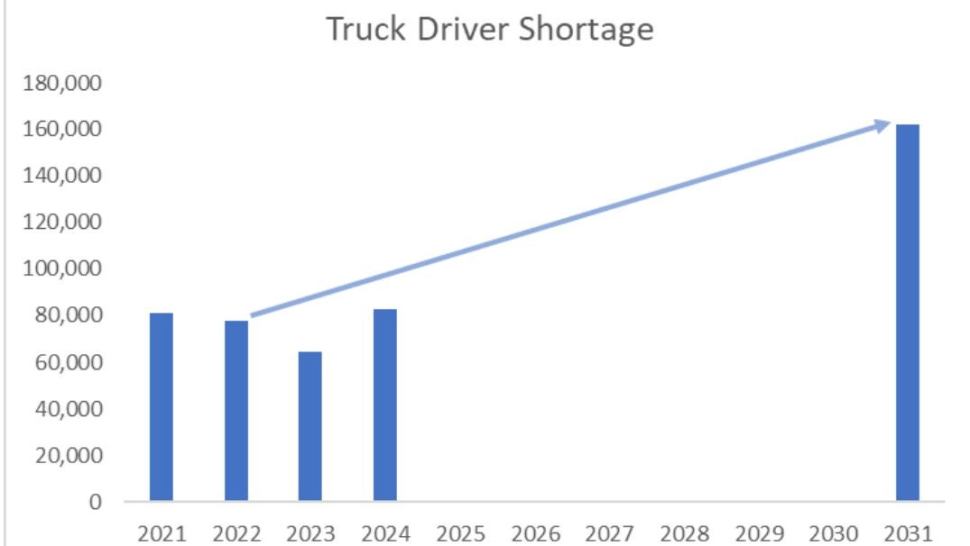
The shortfall of truck drivers should ease slightly this year. But the long-term trajectory still points to an enormous gap between available and needed drivers, according to the American Trucking Associations.
The ATA calculates the shortage estimates by determining the difference between the number of drivers currently in the market and the optimal number of drivers based on freight demand. ATA’s 2022 projection is the second-highest level on record after 81,258 in 2021.
“The good news is rising pay and other factors have helped the industry attract new drivers,” Bob Costello, ATA chief economist, said in a news release. “However, that influx is still not enough to make a substantive difference in the shortage — particularly in the long-haul, for-hire truckload sector, the part of the industry most acutely impacted by the shortage.”
As freight markets soften, significant numbers of independent drivers are surrendering their U.S. Department of Transportation authorities and signing on with large carriers and seeking jobs with local and regional haul carriers. Some seek work outside the trucking industry.
Multiple causes contribute to the driver shortage. The aging of drivers tops the list. Retirement becomes attractive, especially when per-mile rates for spot freight recede as they have been in recent months.
Paucity of women drivers
Being away from home for extended periods is a drawback, especially for older drivers. Finding safe parking is an issue beginning to get attention at the state and federal level. It is one reason why attracting women drivers continues to be a struggle. Women account for just 8% of drivers compared to overall workforce participation of 47%.
The national clearinghouse for drug and alcohol abuse has removed tens of thousands of drivers from the industry. The clearinghouse makes it harder for a driver with a substance abuse record to hire on with another carrier.
Trucking is experimenting with lowering the minimum age for commercial driver’s license eligibility But that is a slow process. Trucking tends to attract second and third career aspirants more than first-time job seekers.
Higher pay not raising miles traveled
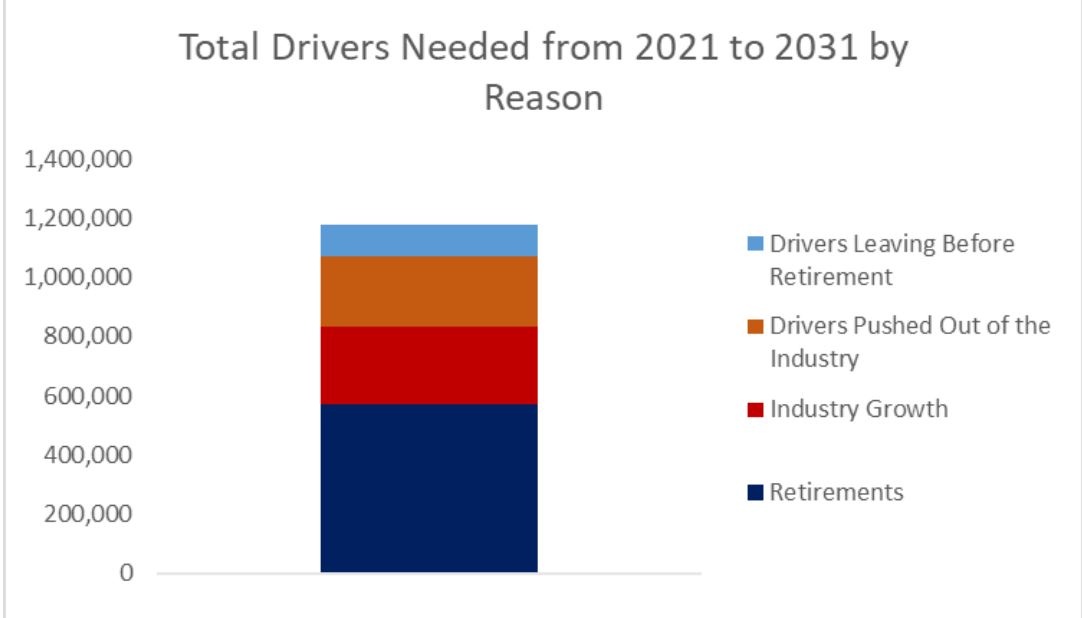
The driver shortage could surpass 160,000 in 2031 based on driver gender and age along with freight growth. Over the next 10 years, the industry needs 1.2 million new drivers to replace those who retire, quit or are forced out.
The driver shortage is increasing pay and compensation for those who remain behind the wheel. ATA data released earlier this year showed the average truckload driver earned more than $69,000 in 2021 in salaries and bonuses, 18% higher than in 2019. The data showed 90% of truckload carriers raised driver pay in 2021.
Higher pay did not always equate to more miles driven. About 40% of truckload drivers chose to work less and spend more time at home while making the same amount of money, truckload carriers told the ATA.
Trucking accounted for $875.5 billion in gross freight revenues from primary shipments, representing 80.8% of the nation’s freight bill in 2021, according to the ATA.
Related articles:
Driver shortage not on FMCSA safety head’s radar
Is the driver shortage fact or fiction? — Loaded and Rolling
Brokerage Compliance Symposium
The day before F3. Every compliance issue you face - fraud exposure, carrier liability, FMCSA rules, cargo theft, insurance gaps - navigated by attorneys and operators defining best practices in a changing industry.
F3 Awards Dinner
The night before F3. FreightTech100 companies honored. FreightTech 25 and Shipper of Choice winners revealed live. Cocktail reception into dinner and live music - 300 industry leaders in one purpose-built room.
F3: Future of Freight Festival
Industry-defining keynotes, rapid-fire technology demos, and industry leaders networking in experiences across Chattanooga - plus the inaugural F3 Awards Dinner featuring the FreightTech and Shipper of Choice reveals.
The day before F3. Every compliance issue you face - fraud exposure, carrier liability, FMCSA rules, cargo theft, insurance gaps - navigated by attorneys and operators defining best practices in a changing industry.
The Signal at Chattanooga Choo Choo • Chattanooga, TN Register NowThe night before F3. FreightTech100 companies honored. FreightTech 25 and Shipper of Choice winners revealed live. Cocktail reception into dinner and live music - 300 industry leaders in one purpose-built room.
The Signal at Chattanooga Choo Choo • Chattanooga, TN Register NowIndustry-defining keynotes, rapid-fire technology demos, and industry leaders networking in experiences across Chattanooga - plus the inaugural F3 Awards Dinner featuring the FreightTech and Shipper of Choice reveals.
The Signal at Chattanooga Choo Choo • Chattanooga, TN Register Now