





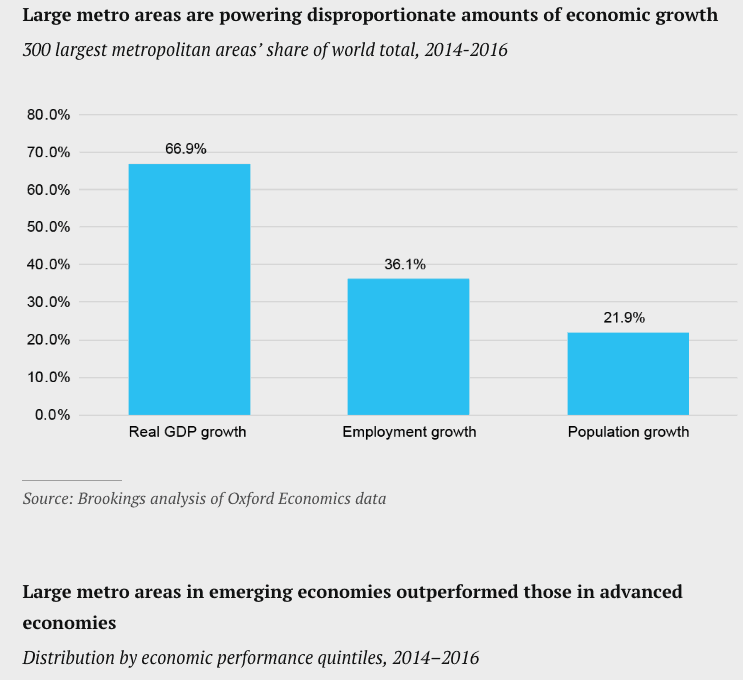
According to the latest Brookings installment, more than half the world’s population now lives in urban areas, and the 300 largest metropolitan economies in the world account for nearly half of all global output. The concentration of economic growth and prosperity in large metro areas defines the modern global economy, creating both opportunities and headwinds in an era in which national political, economic, and societal trends are increasingly influenced by “subnational dynamics.” The report examines economic trajectory through employment and GDP per capita measures of these large metro areas.
Takeaway #1: Large metropolitan economies concentrated and accelerated global economic growth between 2014 and 2016.
The 300 largest metros accounted for 36 percent of global employment growth and 67 percent of global GDP growth. Emerging economy metro areas continued to disproportionately drive growth, accounting for 80 percent of the 60 best-performing metropolitan areas.
While large metro areas expanded at a faster pace than the global economy, there is much regional variation in performance. China and Emerging Asia-Pacific overwhelmingly dominate the upper ranks of performance, whereas those that exhibited slower growth included many Latin American metro areas, especially Brazil’s large cities.
Takeaway #2: Global trends mask notable variation in the performance of large metropolitan economies across world regions between 2014 and 2016.
Metro areas in China and Emerging Asia-Pacific experienced the fastest GDP per capita growth while Middle Eastern and African metro areas exhibited the fastest employment growth. By contrast, Latin American metro areas experienced the slowest GDP per capita and employment growth.
To measure overall economic performance, the report presents an economic performance index based on four economic indicators depicted above: absolute and percent change in jobs and GDP per capita. There is much regional variation in the performance index. China and Emerging Asia-Pacific overwhelmingly dominate the upper ranks of performance, although North American tech hubs such as San Jose and San Francisco also demonstrated significant growth. Meanwhile, those that exhibited slower growth included many Latin American metro areas, especially Brazil’s large cities, and metro areas in Western Europe and the Advanced Asia-Pacific region.
Takeaway #3: Between 2014 and 2016, just over half of the world’s 300 largest metropolitan economies were considered “pockets of growth,” high-performing metro areas disproportionately accountable for employment and GDP per capita growth.
In the short term, between 2014 and 2016, 51 percent of the 300 largest metro areas registered higher growth rates than their region in both employment and GDP per capita. Over the longer term, between 2000 and 2016, slightly more metro areas (53 percent) were pockets of growth, driven by the better long-term performance of metro areas in Advanced Asia-Pacific, Western Europe, and China. Notably, in North America and the Middle East and Africa, large metro areas were much more likely to be pockets of growth in the short term than in the long term, whereas in Advanced Asia-Pacific and Western Europe the reverse pattern holds.

Takeaway #4: Reflecting its historic urban economic growth, China led this “pocket of growth” category between 2014 and 2016 with 75 metro areas, followed by North America (26) and the Middle East and Africa (14).
The report reaffirms the economic power of large cities in the global economy. In 2016, the 300 largest metropolitan economies accounted for under one-quarter of the world’s labor pool but nearly half of global output. These large metro areas continued to be critical sources of economic opportunity between 2014 and 2016, accounting for disproportionate shares of global job and GDP growth.
The statistics partly reflect trends occurring in particular world regions, both emerging and advanced. Most prominently, China’s dramatic urbanization has resulted in more than one-third of the world’s 300 largest metropolitan areas now calling that country home, underscoring that the world’s urban growth story cannot be told without a focus on China.
The report also took a look at large metropolitan economies in the Middle East and North Africa, a region that urgently must address twin challenges related to security and economic opportunity. Currently, large metro areas in the Middle East and North Africa are neither leading on economic growth nor holding the region back. That will need to shift to improve both opportunity and regional security.
In North America and Europe, there is a newfound focus on the disparities between large cities and their surrounding hinterlands. While the report is not definitive on this account, it does reveal mixed evidence that regional inequalities are growing in these advanced economies. Rather, the largest disparities in GDP per capita between cities and their adjacent regions continue to be in emerging markets, largely due to the low living standards offered outside of the biggest cities.
For local leaders, the “place age” demands an understanding of metropolitan economic advantages and weaknesses in a regional and global context, with a clear and consistent focus on policies that will improve wages and incomes. For national leaders, the place age demands a greater focus on sub-national economic trends, as those seem to be increasingly important in shaping national and international policy and politics. The hope is that policymakers listen and form strategic goals to help make a difference with the data.
Stay up-to-date with the latest commentary and insights on FreightTech and the impact to the markets by subscribing.
Brokerage Compliance Symposium
The day before F3. Every compliance issue you face - fraud exposure, carrier liability, FMCSA rules, cargo theft, insurance gaps - navigated by attorneys and operators defining best practices in a changing industry.
F3 Awards Dinner
The night before F3. FreightTech100 companies honored. FreightTech 25 and Shipper of Choice winners revealed live. Cocktail reception into dinner and live music - 300 industry leaders in one purpose-built room.
F3: Future of Freight Festival
Industry-defining keynotes, rapid-fire technology demos, and industry leaders networking in experiences across Chattanooga - plus the inaugural F3 Awards Dinner featuring the FreightTech and Shipper of Choice reveals.
The day before F3. Every compliance issue you face - fraud exposure, carrier liability, FMCSA rules, cargo theft, insurance gaps - navigated by attorneys and operators defining best practices in a changing industry.
The Signal at Chattanooga Choo Choo • Chattanooga, TN Register NowThe night before F3. FreightTech100 companies honored. FreightTech 25 and Shipper of Choice winners revealed live. Cocktail reception into dinner and live music - 300 industry leaders in one purpose-built room.
The Signal at Chattanooga Choo Choo • Chattanooga, TN Register NowIndustry-defining keynotes, rapid-fire technology demos, and industry leaders networking in experiences across Chattanooga - plus the inaugural F3 Awards Dinner featuring the FreightTech and Shipper of Choice reveals.
The Signal at Chattanooga Choo Choo • Chattanooga, TN Register Now