





The Census Bureau reported that the US economy’s trade deficit widened in January to -$56.6 billion dollars from -$53.9 billion in the previous month. This marks the 5th consecutive month of widening deficits in the economy and represents the largest trade deficit for the economy since late-2008.
Broadly speaking, this widening trade deficit is nothing new, as import growth has generally outstripped export growth over the past four years. Towards the end of last year, imports surged with growth reaching double-digits for the first time since late-2011.
What sets apart January’s results is that both imports and exports fell for the economy, resulting in less trade volume overall. The results were particularly pronounced on the goods side of international trade, where merchandise imports fell by $183 million while merchandise exports fell by nearly $3 billion. (Story continued below)
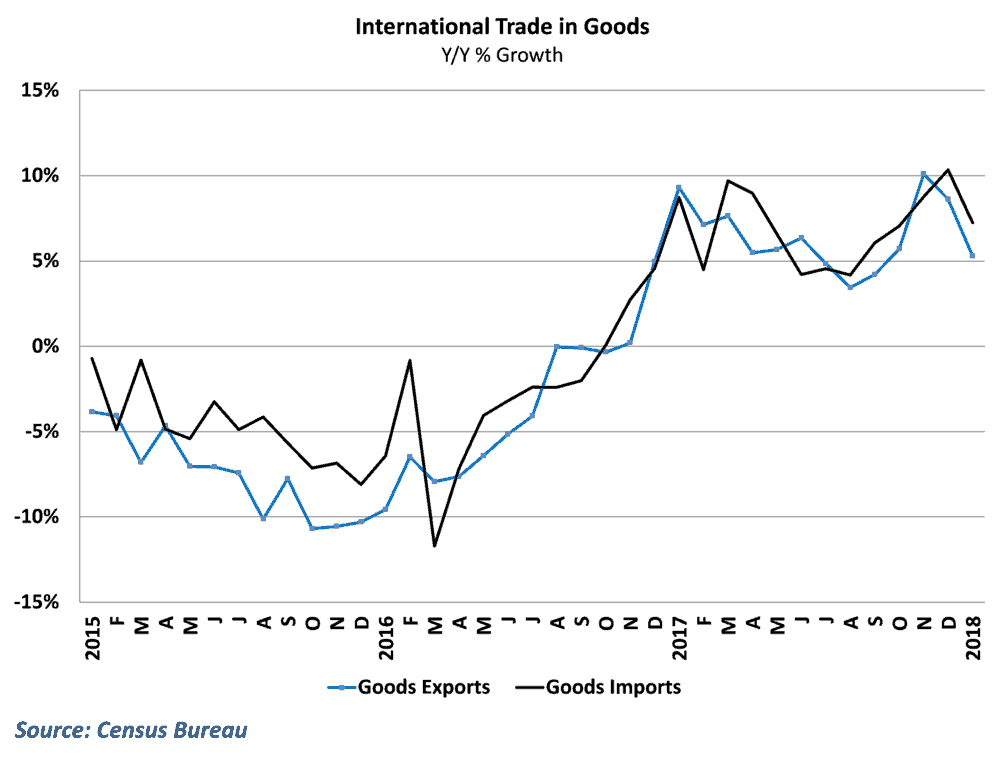
International trade in goods plays an important role in transportation, freight, and logistic markets. The volume sent in and out of the country directly influences ocean freight, air freight, and port activity, and goods imported from other countries are then transported by rail or truck to end customers. The rapid rise in imports at the end of last year was yet another factor keeping trucking capacity tight and putting upward pressure on prices.
Is the import decline the start of a trend?
Looking at some of the fundamentals in the economy, conditions for export growth remain generally positive. Global growth outside of the US improved considerably in 2017 and looks to be set for continued solid growth this year, providing healthy demand for US exports. In addition, the US dollar weakened quite a bit throughout the course of 2017, which makes US goods cheaper for foreign buyers. Exchange rate effects typically take some time to take hold in consumer and business buying patterns, but the weakened dollar should further boost exports going forward.
The import picture is a bit more muddled. On one hand, the fall in the US dollar discourages US consumers and businesses from purchasing imports from foreign countries and favors domestic manufacturing. However, consensus expectations continue to call for stronger growth in both consumer spending and business investment throughout the course of 2018. This typically leads to improved growth in imports.
Trade policy
Of course, the great unknown in the trade outlook has been the recent discussion of tariffs for certain goods imported into the US, and what the global response to those tariffs might be. President Trump is expected to begin enacting tariffs on steel and aluminum at some point this week, and is weighing implementing broader tariffs on Chinese imports.
The global community has come out strongly against such tariffs, with representatives from the European Union threatening retaliatory tariffs, and Mexico, China, and Brazil weighing their own responses. This is a worse-case scenario for both imports and exports in the economy, and carries the potential to outweigh any positive momentum that may exist from the fundamentals of the economy.
Behind the numbers
On its face, the decline in in the trade deficit and the slump in trade volume is not a huge concern. Trade numbers are notoriously volatile from month to month, so any decline seen in January might easily be reversed in next month’s release. In context with a slew of other releases, the trade numbers just look like yet another disappointing January report. The general fundamentals would suggest that the trade deficit should improve some once exchange rate effects take hold.
Of much greater concern are the prospects of escalating trade conflicts with many of the US’ main trading partners. The departure of Gary Cohn from his position as the President’s top economic advisor only worsens the outlook for this sort of thing, as he often championed the virtues of open trade with other economies. As these protectionist measures begin to take shape, they likely will take a significant bite out of overall trade performance, and economic activity overall.
Ibrahiim Bayaan is FreightWaves’ Chief Economist. He writes regularly on all aspects of the economy and provides context with original research and analytics on freight market trends. Never miss his commentary by subscribing.
Brokerage Compliance Symposium
The day before F3. Every compliance issue you face - fraud exposure, carrier liability, FMCSA rules, cargo theft, insurance gaps - navigated by attorneys and operators defining best practices in a changing industry.
F3 Awards Dinner
The night before F3. FreightTech100 companies honored. FreightTech 25 and Shipper of Choice winners revealed live. Cocktail reception into dinner and live music - 300 industry leaders in one purpose-built room.
F3: Future of Freight Festival
Industry-defining keynotes, rapid-fire technology demos, and industry leaders networking in experiences across Chattanooga - plus the inaugural F3 Awards Dinner featuring the FreightTech and Shipper of Choice reveals.
The day before F3. Every compliance issue you face - fraud exposure, carrier liability, FMCSA rules, cargo theft, insurance gaps - navigated by attorneys and operators defining best practices in a changing industry.
The Signal at Chattanooga Choo Choo • Chattanooga, TN Register NowThe night before F3. FreightTech100 companies honored. FreightTech 25 and Shipper of Choice winners revealed live. Cocktail reception into dinner and live music - 300 industry leaders in one purpose-built room.
The Signal at Chattanooga Choo Choo • Chattanooga, TN Register NowIndustry-defining keynotes, rapid-fire technology demos, and industry leaders networking in experiences across Chattanooga - plus the inaugural F3 Awards Dinner featuring the FreightTech and Shipper of Choice reveals.
The Signal at Chattanooga Choo Choo • Chattanooga, TN Register Now