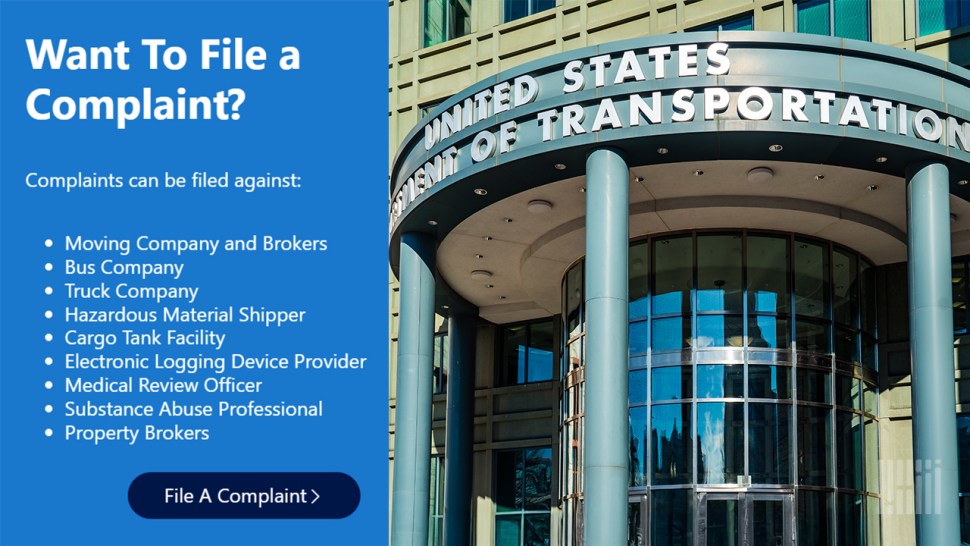
Transportation Secretary Sean P. Duffy announced this week that the first phase of the NCCDB modernization is now live, marking what the agency calls “an overdue tech upgrade” that could fundamentally change how safety violations, fraud, and service issues get reported and addressed in trucking.
The modernized database represents a significant shift in how federal regulators plan to crack down on bad actors across the entire trucking ecosystem, including brokers for the first time.
The updated NCCDB at nccdb.fmcsa.dot.gov includes several significant improvements that drivers and fleets have been requesting for years:
- Enhanced Navigation and Mobile Optimization: The old system was notoriously challenging to navigate, especially on mobile devices. The new platform is designed to work seamlessly across devices, which is crucial when filing a complaint from a truck cab or while dealing with a moving disaster.
- Expanded Reporting Categories: This is significant because complaints against property brokers are now officially part of the system. Given the explosion in broker fraud, double-brokering schemes, and identity theft affecting carriers, this addition could be a game-changer for enforcement.
- Streamlined Agency Response Process: The FMCSA promises faster response times and improved communication about the actions, if any, they’re taking on complaints.
- Better User Experience: The interface has been rebuilt from the ground up to be more intuitive and less frustrating to use.
The addition of broker complaints to the NCCDB is recognition that the freight broker industry has become a significant source of problems for carriers and drivers.
The FMCSA has requested statutory authority from Congress to impose civil penalties for unauthorized freight brokerage violations, citing both double-brokering schemes and outright fraud. In 2023 alone, the agency conducted investigations into household goods brokers in Nevada, New Jersey, New York, and Florida, reviewing a total of 35 brokers and identifying 166 violations.
Until now, there was no official way to file broker complaints through the primary federal complaint system. That’s been a massive gap in enforcement capability, and it’s finally being addressed.
For carriers dealing with broker fraud, whether it involves double-brokering, identity theft, or payment issues, having an official federal complaint mechanism could provide the necessary documentation for more serious enforcement actions.
The NCCDB receives between 25,000 and 30,000 complaints annually, encompassing a wide range of issues, including unsafe driving, moving company fraud, and discrimination; a staggering amount of complaints flowing through what has been, by most accounts, an antiquated system.
These complaints help FMCSA identify problematic motor carriers for enforcement actions, provide data for safety ratings and compliance reviews, and create a paper trail that can be crucial in legal proceedings.
For household goods movers, complaint data is used to alert consumers about companies with poor track records. For freight operations, complaints can trigger safety audits, compliance reviews, or more serious enforcement actions.
The NCCDB modernization is part of Secretary Duffy’s “Pro-Trucker Package” announced in June, which includes more than $275 million for truck parking expansion, elimination of the speed limiter mandate, and various regulatory reforms designed to reduce red tape.
The package represents a significant shift in how DOT approaches trucking policy, focusing on practical improvements for working drivers rather than top-down regulatory initiatives. The complaint database modernization aligns with enhancing government systems to work more effectively for the people who actually use them.
What Does This Mean?
- For Drivers: Filing complaints should be easier and faster, with better feedback on the status of your complaint. The mobile optimization alone is a huge improvement for drivers who need to report safety violations or service issues while on the road.
- For Carriers: Having an official channel for broker complaints could provide better documentation for fraud cases and potentially lead to a faster federal response to serious violations affecting your business.
- For Consumers: Reporting and tracking complaints about moving companies and household goods issues should be easier, potentially leading to improved consumer protection.
- For Brokers: The addition of broker complaint categories means more scrutiny and potential enforcement actions. Legitimate brokers should welcome this as a way to clean up an industry plagued by bad actors.
- For Law Enforcement: Better data collection and categorization could help identify patterns of fraud and abuse that trigger criminal investigations.
Complaints filed through the database become part of companies’ permanent records with FMCSA and can directly influence safety ratings, audit priorities, and enforcement actions. When FMCSA conducts Operation Protect Your Move or other enforcement sweeps, complaint data is a key factor in determining which companies to target. The modernized system should make this data more actionable and accessible to enforcement personnel.
FMCSA says Phase Two of the modernization will include additional functionality, performance improvements, and even a new name for the database. While details are limited, this suggests the agency is thinking beyond just technical upgrades to fundamental changes in how complaint data is collected and used. Given the emphasis on broker enforcement and fraud prevention, Phase Two might include enhanced data analytics, better integration with other FMCSA systems, or expanded reporting categories for emerging types of fraud.
The NCCDB modernization comes at a time when the trucking industry is grappling with widespread fraud, including fake carriers, double-brokering schemes, moving company scams, and identity theft. Having a modern, efficient complaint system is about creating the infrastructure needed for effective enforcement in an industry where bad actors have been exploiting gaps in oversight and technology.
The addition of broker complaints is particularly significant because it acknowledges that brokers have become central players in the trucking ecosystem, not just facilitators. With that role comes responsibility and the need for accountability.
While the modernized NCCDB is a step in the right direction, its ultimate effectiveness will depend on how FMCSA uses the improved data collection capabilities. Better complaint processing is only valuable if it leads to meaningful enforcement actions against bad actors.
The real test will be whether the improved system translates into faster responses to fraud reports, more targeted enforcement actions, and ultimately, a cleaner, safer trucking industry.
For now, drivers, carriers, and consumers have a better tool for reporting problems. Whether that leads to better solutions remains to be seen, but it’s hard to argue against making government systems work more effectively for the people who need them.
The modernized NCCDB is live now at nccdb.fmcsa.dot.gov. Phase Two of the modernization is expected to be rolled out in the coming months, featuring additional functionality and performance improvements.
Brokerage Compliance Symposium
The day before F3. Every compliance issue you face - fraud exposure, carrier liability, FMCSA rules, cargo theft, insurance gaps - navigated by attorneys and operators defining best practices in a changing industry.
F3 Awards Dinner
The night before F3. FreightTech100 companies honored. FreightTech 25 and Shipper of Choice winners revealed live. Cocktail reception into dinner and live music - 300 industry leaders in one purpose-built room.
F3: Future of Freight Festival
Industry-defining keynotes, rapid-fire technology demos, and industry leaders networking in experiences across Chattanooga - plus the inaugural F3 Awards Dinner featuring the FreightTech and Shipper of Choice reveals.
The day before F3. Every compliance issue you face - fraud exposure, carrier liability, FMCSA rules, cargo theft, insurance gaps - navigated by attorneys and operators defining best practices in a changing industry.
The Signal at Chattanooga Choo Choo • Chattanooga, TN Register NowThe night before F3. FreightTech100 companies honored. FreightTech 25 and Shipper of Choice winners revealed live. Cocktail reception into dinner and live music - 300 industry leaders in one purpose-built room.
The Signal at Chattanooga Choo Choo • Chattanooga, TN Register NowIndustry-defining keynotes, rapid-fire technology demos, and industry leaders networking in experiences across Chattanooga - plus the inaugural F3 Awards Dinner featuring the FreightTech and Shipper of Choice reveals.
The Signal at Chattanooga Choo Choo • Chattanooga, TN Register Now