




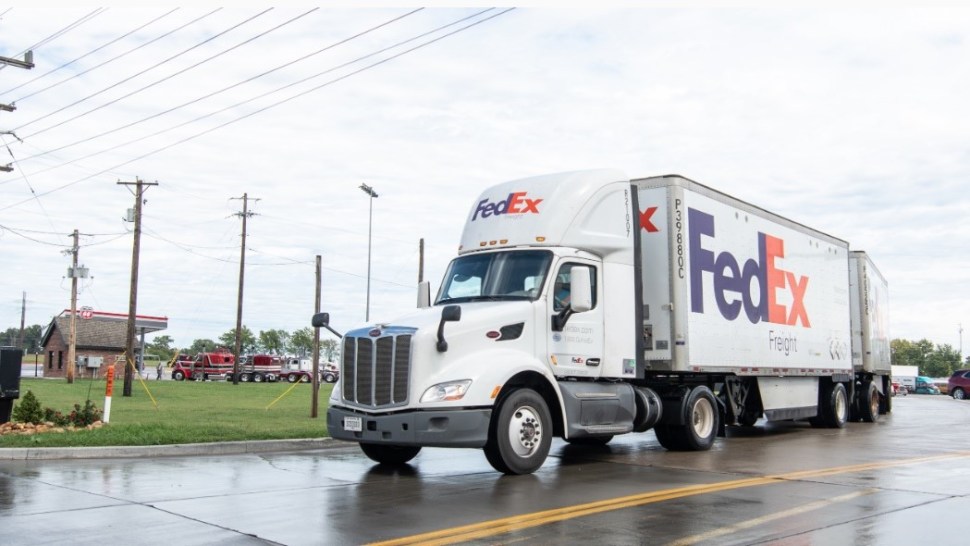
The nation’s largest less-than-truckload carrier FedEx Freight provided a framework for operations ahead of its June 1 spinoff from parent FedEx Corp. The separation will allow the carrier to approach the market with a narrowed commercial focus while unlocking shareholder value for both entities.
FedEx Freight’s management team outlined “medium-term” financial expectations at an investor day in New York City on Wednesday. It forecast compound annual growth rates of 4% to 6% for revenue and 10% to 12% for adjusted operating income. The guide implies high-20% incremental margins at the midpoints, using the expected 2026 fiscal year baseline of $8.7 billion in revenue and $1.1 billion in adjusted operating income (excludes $500 million in estimated spinoff costs).
Revenue growth is expected to come from a combination of yield and volume increases. Anticipated revenue increases, which are weighted toward higher yields, along with cost reductions, are expected to generate 300 basis points of adjusted operating margin improvement. That would move the company’s operating margin from roughly 12% currently to 15% over the medium term. (It noted a 50-bp near-term margin headwind from spin-related costs and fees associated with unwinding existing service agreements.)
Management signaled the possibility for “significant upside” over the longer term. Direct support costs as a percentage of gross profit will move from a ratio of roughly 70% currently to 60% in the medium term. The long-term goal is to generate 50 cents in operating income for each $1 of gross profit.
FedEx Freight has reached the hiring target for its dedicated LTL sales team, which now includes over 500 representatives. Like most national carriers, FedEx Freight is targeting small- and midsize shipper accounts, which typically produce higher margins. It’s also focused on the healthcare, grocery and energy (data centers) verticals, areas where other carriers have recently voiced success.
The company is modernizing contracts and pricing models to reflect a more LTL-specific operation. It said it has unwound 99% of its bundled-pricing agreements (agreements for customers using both parcel and freight services). It will honor current contracts through duration, “keeping customers whole” on their existing pricing agreements.
“As the largest pure-play LTL carrier in North America, we are combining our market-leading network scale, published transit times, and reliability with a differentiated service model to meet the evolving needs of our customers,” said John Smith, incoming president and CEO. … “FedEx Freight is moving forward from a position of strength and a renewed focus and flexibility to build on our competitive advantages, accelerate our growth trajectory, and unlock our full potential.”
The company outlined various optimization and technology initiatives.
It will continue to optimize its linehaul network and dock operations and refresh the fleet. It has already removed 5% of linehaul miles through efficiency initiatives over the past five years. It increased cube utilization by 12% over the past year. Since 2023, it has lowered its average tractor age from 5.6 years to 4.5 years, which improved fuel efficiency by 3%. Tech upgrades are expected to reduce manual touchpoints by 60% in the coming years.
Like other national carriers, FedEx Freight currently has 30% available capacity across its network. The availability will allow it to easily onboard new business wins.
Annual capex is forecast at only 5% of revenue. The allocation for the current fiscal year (ending May 31) includes equipment (45%), facilities (25%), technology (25%) and “other” (5%). It said its terminal footprint is “lease-heavy” and it will look to buy and own locations in key markets going forward.
The company expects to generate over $1 billion in free cash flow annually (implying a greater than 90% conversion rate). It will exit the June transaction with $4.3 billion in debt but expects to lower gross debt leverage to 2.5x within 12 months while maintaining an investment grade rating.
FedEx Freight background
FedEx’s (NYSE: FDX) LTL aspirations began in 1998 with the acquisition of Viking Freight. It acquired American Freightways in 2001 and Watkins Motor Lines in 2006. In 2011, it merged its national (Watkins) and regional (Viking and American Freightways) operations into one network offering priority and economy services.
FedEx Freight is now the nation’s largest LTL carrier with 40,000 employees, 365 terminals (26,000 doors) and 30,000 vehicles (17,000 tractors), generating approximately $9 billion in annual revenue.
Currently, 64% of revenue comes from its priority offering (national service in three days or less) with 32% coming from an economy service. Roughly 3% of revenue comes from its Custom Critical solutions. Of its 140,000 customers, the top 25 account for 17% of total revenue, and 90% of its revenue comes from customers it has worked with for at least a decade. By vertical, industrial markets represent the highest percentage of revenue, with transportation and logistics (3PL customers) and consumer rounding out the top-three sales channels.
Shares of FedEx Freight will be listed on the New York Stock Exchange under the ticker FDXF.
Shares of FedEx were up 4% at 12:50 p.m. EDT on Wednesday compared to the S&P 500, which was up 2.5%.
Brokerage Compliance Symposium
The day before F3. Every compliance issue you face - fraud exposure, carrier liability, FMCSA rules, cargo theft, insurance gaps - navigated by attorneys and operators defining best practices in a changing industry.
F3 Awards Dinner
The night before F3. FreightTech100 companies honored. FreightTech 25 and Shipper of Choice winners revealed live. Cocktail reception into dinner and live music - 300 industry leaders in one purpose-built room.
F3: Future of Freight Festival
Industry-defining keynotes, rapid-fire technology demos, and industry leaders networking in experiences across Chattanooga - plus the inaugural F3 Awards Dinner featuring the FreightTech and Shipper of Choice reveals.
The day before F3. Every compliance issue you face - fraud exposure, carrier liability, FMCSA rules, cargo theft, insurance gaps - navigated by attorneys and operators defining best practices in a changing industry.
The Signal at Chattanooga Choo Choo • Chattanooga, TN Register NowThe night before F3. FreightTech100 companies honored. FreightTech 25 and Shipper of Choice winners revealed live. Cocktail reception into dinner and live music - 300 industry leaders in one purpose-built room.
The Signal at Chattanooga Choo Choo • Chattanooga, TN Register NowIndustry-defining keynotes, rapid-fire technology demos, and industry leaders networking in experiences across Chattanooga - plus the inaugural F3 Awards Dinner featuring the FreightTech and Shipper of Choice reveals.
The Signal at Chattanooga Choo Choo • Chattanooga, TN Register Now