




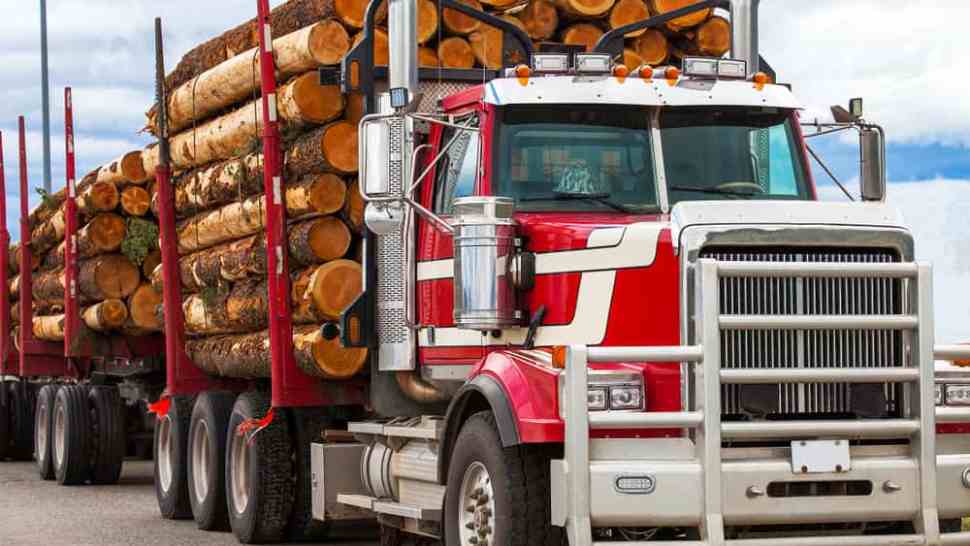
Timber haulers who took a hit from the COVID-19 pandemic are eligible for up to $125,000 from a pot of $200 million made available by the federal government.
The funding package announced this week by the U.S. Department of Agriculture – authorized as part of the pandemic relief bill passed in December 2020 – is aimed at giving relief to both loggers and truckers as part of USDA’s Pandemic Assistance for Timber Harvesters and Haulers program. The program is being administered by the department’s Farm Service Agency (FSA) in partnership with the U.S. Forest Service.
Truckers can begin applying for assistance on Thursday.
“We’ve heard from loggers and truckers whose livelihoods were significantly impacted this past year by the COVID-19 pandemic, and we are pleased that USDA can help alleviate some of the financial burden,” said Forest Service Chief Vicki Christiansen. “I encourage those logging and log-hauling businesses hardest hit by the pandemic to learn more about the assistance offered through this new program.”
To be eligible for payments, according to USDA, individuals or companies must be a timber harvesting or timber hauling business with 50% or more of gross revenue derived from one or more of the following:
- Cutting timber.
- Transporting timber.
- Processing of wood on-site on the forest land (chipping, grinding, converting to biochar, cutting to smaller lengths, etc.).
Payments will be based on gross revenue from Jan. 1 through Dec. 1, 2019, minus gross revenue received from Jan. 1 through Dec. 1, 2020, multiplied by 80%. FSA will issue an initial payment equal to the lesser of the calculated payment amount or $2,000 as applications are approved, USDA said. A second payment will be made after the signup period has ended based on remaining funds.
“Through no fault of their own, many logging businesses suffered financial losses due to mill closures brought about by the pandemic,” commented Deb Hawkinson, president of the Forest Resources Association. “The $200 million of financial assistance … will assist those businesses harmed the most to remain viable as markets improve.”
Hawkins pointed out that the forest products supply chain is interconnected among landowners, loggers, haulers and manufacturers. “To keep our forest healthy and productive, it is critical that the entire wood supply chain remains viable.”
Related articles:
Brokerage Compliance Symposium
The day before F3. Every compliance issue you face - fraud exposure, carrier liability, FMCSA rules, cargo theft, insurance gaps - navigated by attorneys and operators defining best practices in a changing industry.
F3 Awards Dinner
The night before F3. FreightTech100 companies honored. FreightTech 25 and Shipper of Choice winners revealed live. Cocktail reception into dinner and live music - 300 industry leaders in one purpose-built room.
F3: Future of Freight Festival
Industry-defining keynotes, rapid-fire technology demos, and industry leaders networking in experiences across Chattanooga - plus the inaugural F3 Awards Dinner featuring the FreightTech and Shipper of Choice reveals.
The day before F3. Every compliance issue you face - fraud exposure, carrier liability, FMCSA rules, cargo theft, insurance gaps - navigated by attorneys and operators defining best practices in a changing industry.
The Signal at Chattanooga Choo Choo • Chattanooga, TN Register NowThe night before F3. FreightTech100 companies honored. FreightTech 25 and Shipper of Choice winners revealed live. Cocktail reception into dinner and live music - 300 industry leaders in one purpose-built room.
The Signal at Chattanooga Choo Choo • Chattanooga, TN Register NowIndustry-defining keynotes, rapid-fire technology demos, and industry leaders networking in experiences across Chattanooga - plus the inaugural F3 Awards Dinner featuring the FreightTech and Shipper of Choice reveals.
The Signal at Chattanooga Choo Choo • Chattanooga, TN Register Now