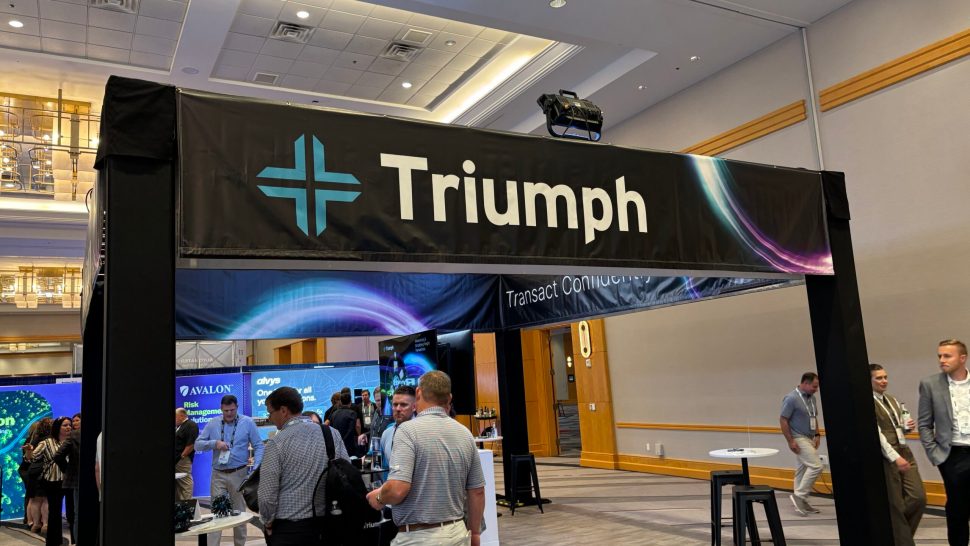
Freight contract bids once followed an annual cycle. In today’s supply-constrained market, some shippers are now repricing contracts as frequently as every 30 days. Triumph (NYSE: TFIN), the Dallas-based transportation finance and technology company, launched RFP Manager on Tuesday to help brokers keep pace with that compression.
The tool draws on real transaction and carrier payment data from the Triumph Network. According to Triumph, the network provides visibility into about 70% of North American brokered freight transactions and payments tied to more than 170,000 carriers. It then layers each broker’s own buying patterns on top at the lane level.
Ben Volkwyn, Triumph’s executive vice president and head of enterprise data and intelligence, said the product grew out of conversations with brokers who described contract pricing as harder than it used to be.
“Contract pricing is getting harder. RFP cycles are faster, the market is a lot more volatile, and traditional benchmarks just don’t always reflect what’s actually happening,” Volkwyn said. “RFP Manager brings real transactions and payment data into a workflow that brokers can use to make disciplined pricing decisions.”
From Yearlong Cycles to 30 Days
Volkwyn traced the compression to a supply-constrained market that has pushed rates up faster than brokers anticipated. Lack of available carriers is leaving shippers scrambling to keep contracts competitive.
“The market right now is very much supply driven,” he said. “Supply has been constrained to a large degree, and we see brokers pushing up rates a lot higher and a lot faster than anyone would have expected. As that has happened, it also causes shippers to be a little bit on the back foot and say, ‘Hey, how fast can I reprice for the next RFP to still be competitive and not get rejected?’”
The shift in timelines hasn’t been seen since the pandemic freight boom capacity crunch. “These cycles that tended to be even as far as 18 months have now gotten to the point where some cycles are on three-month cycles,” Volkwyn said. “I’ve recently even spoken to someone where it’s a one-month cycle.”
That pace leaves little room for the old approach. “That really narrows it down and makes it hard if you’re pulling a bunch of Excel spreadsheets trying to get the answer back as fast as you can,” he said. “By the time you get the answer back, the rates have already changed and the market has changed because it took you two weeks to put this together.”
Rethinking Freight RFP Management
Freight RFP management has long meant spreadsheets running thousands of lines, passed hand to hand through a pricing team, quote by quote. RFP Manager replaces that process with a structured workflow built on Triumph’s Rate Intelligence, returning pricing based on network transaction and payment data instead of manual lookups.
“What our tool does is not only make it a lot easier from an Excel spreadsheet perspective, but it already puts it inside the workflow,” Volkwyn said. “It runs through the process. It already allocates it to the correct columns and then provides you back the data that you require to price your RFP. It makes it a lot faster from a workflow perspective and also keeps it current.”
‘Fast Is Good. Accurate Is Better.’
Speed wasn’t the only goal, Volkwyn said.
“It is beyond just optimizing that workflow. It is also to ensure that the moment you do go through the workflow, you’re actually getting the right information back as accurately as possible,” he said. “It’s one thing to be fast, but it’s definitely better to be accurate.”
Aaron P. Graft, Triumph’s founder and CEO, tied that accuracy claim to the sheer volume of transactions running through the company’s payments network.
“Because Triumph audits and pays the largest volume of truckload freight transactions in North America, we can provide market insights based on actual transaction and carrier payment activity,” Graft said. “RFP Manager brings that intelligence into the bid process so brokers can price contracts with greater confidence at the lane level.”
Building the Flywheel
Volkwyn described RFP Manager as different from the benchmarks and load boards brokers have relied on, both of which lag current market conditions by design.
“The accumulation of data looks different too: benchmarks being historical averages, load boards being just posted and quoted rates,” Volkwyn said. “What we’re essentially building is that flywheel. This is the largest network of actual truckload transactions and payments. The market signal that you’re creating becomes a flywheel to brokers as well as us incorporating the broader capacity suite that we’ve got available today.”
The launch pairs RFP Manager with Triumph’s existing Capacity Intelligence product, which helps brokers identify reliable, repeatable capacity for freight they’ve already won. Both draw on the same underlying network.
Vetting the Carriers Behind the Data
Because Triumph’s network already touches carrier payments, Volkwyn said brokers gain a layer of confidence in who they’re doing business with, not just what the freight should cost.
“Within our network, we make sure that we have a holistic approach to what we follow through on,” he said. “Even when we do look at the network participants, we make sure that these transactions are all lined up back into the place that they’re supposed to be.”
Volkwyn stopped short of promising certainty.
“No model eliminates the uncertainty of contract pricing,” he said. “There’s certainly more uncertainty, but what does make the difference is better data organized in the right workflow that then helps these brokers make decisions with more context, discipline, and confidence.”
Brokerage Compliance Symposium
The day before F3. Every compliance issue you face - fraud exposure, carrier liability, FMCSA rules, cargo theft, insurance gaps - navigated by attorneys and operators defining best practices in a changing industry.
F3 Awards Dinner
The night before F3. FreightTech100 companies honored. FreightTech 25 and Shipper of Choice winners revealed live. Cocktail reception into dinner and live music - 300 industry leaders in one purpose-built room.
F3: Future of Freight Festival
Industry-defining keynotes, rapid-fire technology demos, and industry leaders networking in experiences across Chattanooga - plus the inaugural F3 Awards Dinner featuring the FreightTech and Shipper of Choice reveals.
The day before F3. Every compliance issue you face - fraud exposure, carrier liability, FMCSA rules, cargo theft, insurance gaps - navigated by attorneys and operators defining best practices in a changing industry.
The Signal at Chattanooga Choo Choo • Chattanooga, TN Register NowThe night before F3. FreightTech100 companies honored. FreightTech 25 and Shipper of Choice winners revealed live. Cocktail reception into dinner and live music - 300 industry leaders in one purpose-built room.
The Signal at Chattanooga Choo Choo • Chattanooga, TN Register NowIndustry-defining keynotes, rapid-fire technology demos, and industry leaders networking in experiences across Chattanooga - plus the inaugural F3 Awards Dinner featuring the FreightTech and Shipper of Choice reveals.
The Signal at Chattanooga Choo Choo • Chattanooga, TN Register Now