




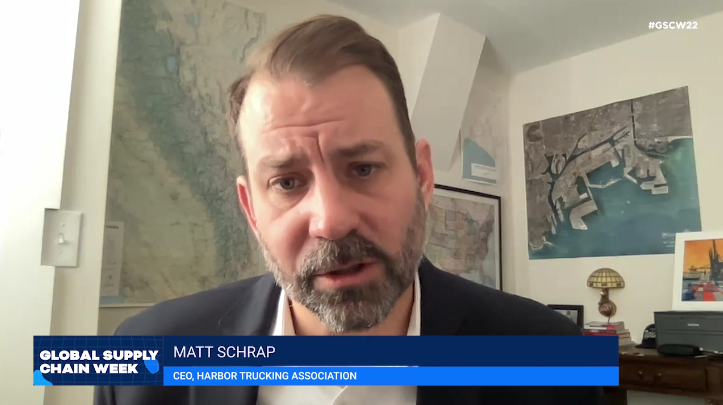
FIRESIDE CHAT TOPIC: Drayage challenges and opportunities at America’s West Coast ports
DETAILS: Port congestion issues have presented drayage carriers with a rapidly changing market and challenging operating conditions. In this fireside chat, Harbor Trucking Association CEO Matt Schrap and FreightWaves market expert Mike Baudendistel discuss how drayage carriers can optimize productivity and how West Coast ports can maintain their market share.
SPEAKER: Matt Schrap, CEO, Harbor Trucking Association
BIO: Prior to assuming the helm of Harbor Trucking Association in June 2021, Schrap was vice president of government programs for Velocity Vehicle Group, working closely with governmental organizations and assisting equipment owners with in-use regulatory compliance standards as well as public assistance opportunities for heavy-duty equipment turnover. Before his time at VVG, Schrap was director of environmental affairs for the California Trucking Association, where he worked on air quality regulatory programs and intermodal policy.
KEY QUOTES FROM SCHRAP:
“When we look at some of the productivity issues, it really has to do with either turn times or our ability to return these empty containers to free up these chassis to move the imports off the dock. That for us is the biggest issue that we’re dealing with right now.”
“We’re always looking for qualified drivers. No pun intended — these guys are in the driver’s seat. They are commanding some of the highest spot rates we’ve ever seen here in drayage.”
“We don’t really feel like there’s an acute driver shortage down here necessarily. We go back to the productivity issue: a lot of new entrants, still the same chassis restrictions, empty-container restrictions. Those are what’s preventing more turns from happening.”
“We’re struggling with some of the anti-dumping laws. Manufacturers are still catching up on back orders. They’re still looking for labor. There are still parts shortages. The supply chain, everybody’s affected by it, right? It’s ironic that the supply chain itself is so dependent upon the supply chain in order to be able to function. So, for us, it becomes this question of, are there enough chassis, or is there not enough chassis available at this point because they’re sitting under containers?”
“Yes, we need more chassis but we think it’s really a function of our ability to return empty containers. That’s what’s really eating up the chassis capacity.”
Subscribe to FreightWaves’ e-newsletters and get the latest insights on freight right in your inbox.
Click here for more FreightWaves articles by Joanna Marsh.
Related links:
Brokerage Compliance Symposium
The day before F3. Every compliance issue you face - fraud exposure, carrier liability, FMCSA rules, cargo theft, insurance gaps - navigated by attorneys and operators defining best practices in a changing industry.
F3 Awards Dinner
The night before F3. FreightTech100 companies honored. FreightTech 25 and Shipper of Choice winners revealed live. Cocktail reception into dinner and live music - 300 industry leaders in one purpose-built room.
F3: Future of Freight Festival
Industry-defining keynotes, rapid-fire technology demos, and industry leaders networking in experiences across Chattanooga - plus the inaugural F3 Awards Dinner featuring the FreightTech and Shipper of Choice reveals.
The day before F3. Every compliance issue you face - fraud exposure, carrier liability, FMCSA rules, cargo theft, insurance gaps - navigated by attorneys and operators defining best practices in a changing industry.
The Signal at Chattanooga Choo Choo • Chattanooga, TN Register NowThe night before F3. FreightTech100 companies honored. FreightTech 25 and Shipper of Choice winners revealed live. Cocktail reception into dinner and live music - 300 industry leaders in one purpose-built room.
The Signal at Chattanooga Choo Choo • Chattanooga, TN Register NowIndustry-defining keynotes, rapid-fire technology demos, and industry leaders networking in experiences across Chattanooga - plus the inaugural F3 Awards Dinner featuring the FreightTech and Shipper of Choice reveals.
The Signal at Chattanooga Choo Choo • Chattanooga, TN Register Now