
(The views expressed here are solely those of the author and do not necessarily represent the views of FreightWaves or its affiliates.)
Exposing the Risks Hidden in Plain Sight
At The Playbook, we believe the road to reform begins with transparency. That’s why, in partnership with The Freight Fraud Task Force, we’re launching a series of investigative spotlights aimed at uncovering and explaining the critical safety failures, fraud schemes, and oversight gaps that threaten lives and integrity across the freight industry. Our goal is simple—bring to light what’s often buried in crash reports, audit findings, and court filings, and make it plain for drivers, carriers, regulators, and the public. This case—centered on Hope Trans LLC and a fatal crash that claimed five lives—is not just a tragic event. It’s a window into systemic dysfunction, weak accountability, and regulatory tools left unused. And it demands your attention.
On June 28, 2025, a Hope Trans LLC tractor-trailer subcontracted to haul U.S. Mail for Covenant Logistics triggered a chain-reaction crash in a construction zone on Interstate 20 near Terrell, Texas, killing five people—including four members of the same family. Investigators determined the driver, Alexis Osmani Gonzalez-Companioni (27), allegedly fell asleep and never applied the brakes before impact. What began as a catastrophic fatigue event rapidly uncovered a wider pattern: hours-of-service (HOS) falsification, maintenance neglect, paperwork irregularities, and a forgery indictment tied to vehicle registration.
These facts, together with continued post-crash violations, fit squarely within the statutory standard for an Imminent Hazard Out-of-Service (OOS) Order under 49 U.S.C. § 521(b)(5) and 49 C.F.R. § 386.72—FMCSA’s most forceful safety tool designed for situations where continued operations pose a substantial likelihood of death or serious injury.
This article details the incident, the carrier’s history and inspection profile, relevant regulations, USPS oversight failures, historical FMCSA precedent, insurance constraints, and specific recommendations for immediate federal action.
Incident Overview and Crash Dynamics
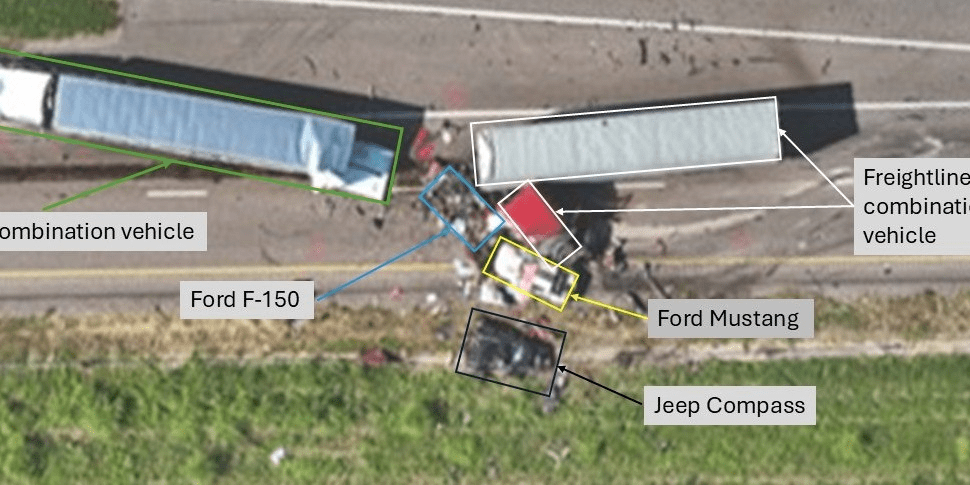
The westbound Hope Trans tractor-trailer approached a construction zone on I-20 where traffic had slowed. According to state investigators and local reporting, the driver allegedly fell asleep; data and scene evidence indicate no braking occurred before the truck struck traffic, igniting a multi-vehicle crash involving three commercial vehicles and four passenger cars. Five people died at the scene.
Construction zones require heightened vigilance: narrowing lanes, changing speed cues, and sudden slowdowns compress reaction time. The NTSB has repeatedly identified driver fatigue as a leading risk factor for severe CMV crashes and has urged stronger fatigue countermeasures for decades (NTSB safety materials). FMCSA’s Large Truck Crash Causation Study attributes driver fatigue as a factor in roughly 13% of large truck crashes (FMCSA research portal). The operational reality—night driving, long distances, deadline pressure—makes USPS mail runs particularly vulnerable when team-driver safeguards are ignored.
Takeaway: Fatigue in a commercial driver isn’t just a performance issue—it’s a lethal condition, especially in work zones where seconds matter. The lack of any braking before impact underscores how quickly driver incapacitation can escalate into a multi-vehicle fatal crash.
The 500-mile USPS Rule—and an Apparent Breach
The mail load originated near Atlanta, Georgia and ended in Texas—approximately 750 miles. Under U.S. Postal Service highway freight contracts, long-haul moves exceeding 500 miles are to be performed by team drivers, a critical fatigue control aligned to HOS requirements. The USPS Office of Inspector General (OIG) has warned in multiple audits that USPS fails to consistently verify team-driver compliance, particularly for long runs and subcontracted legs (USPS OIG Contractor Driver Safety). At the I-20 scene, the driver appears to have been solo, an apparent breach with profound safety implications—exactly the scenario this contract rule is designed to prevent.
Former Hope Trans drivers have described similar long-haul solo USPS runs and alleged routine log falsification to mask HOS excesses. These allegations suggest a systemic problem rather than an isolated lapse.
Takeaway: The USPS 500-mile team-driver requirement is not a suggestion—it’s a fatigue-prevention safeguard. When it’s ignored, especially on high-mileage night runs, the odds of a catastrophic fatigue-related crash increase dramatically.
Criminal Indictments and Legal Posture
On August 1, 2025, a Kaufman County grand jury indicted Gonzalez-Companioni on five counts of manslaughter and four counts of aggravated assault with a deadly weapon. He remains jailed on a $2.25 million bond. In a separate track, an unidentified Hope Trans company official was indicted for felony forgery related to a falsified vehicle registration (“cab card”)—a document that underpins the vehicle’s legal operation in interstate commerce. Forgery of operating credentials strikes at the integrity of safety oversight; it frustrates enforcement and undermines the chain of accountability FMCSA relies upon.
Carrier Profile: Inspection and Crash History
FMCSA SAFER records (USDOT 3556385, MC 1192879) portray a carrier with repeated safety control failures:
- 12 reportable crashes since 2021 (four with injuries, eight tow-aways; the June 2025 Terrell crash was the first with fatalities).
- 297 inspections in roughly four years.
- Equipment out-of-service (OOS) rate: 34.4% (vs. national average ≈ 22.3%).
- Driver OOS rate: 5.4% (vs. national average ≈ 6.7%).
Violation patterns include vehicle maintenance deficiencies, HOS noncompliance, driver fitness issues, and one substance-use event—a profile consistent with weak safety management controls. FMCSA’s Safety Management Cycle emphasizes that persistent violations across equipment, hours, and documentation usually indicate systemic failures in policies, training, monitoring, and corrective action (FMCSA SMS/CSA resources).
Takeaway: High OOS rates and repeat violations aren’t random—they’re proof of a broken safety culture. Numbers don’t lie.
Post-crash Violations: A Continuing and Current Danger
Disturbingly, inspections after the fatal I-20 crash revealed fresh violations, including:
- No proof of periodic inspection (49 C.F.R. § 396.17)—undermines assurance that the vehicle is roadworthy.
- Tire defects and underinflation ([§ 393.75])—increase blowout risk, braking distance, and loss-of-control probability.
- Failure to correct prior defects ([§ 396.9(d)(2)])—a direct indicator that management is not closing the loop on known safety hazards.
- Brake system defects, including abraded vacuum hoses down to cord ([§ 393.45])—raise the risk of brake fade or failure under load.
- No ELD duty status records and false HOS ([§ 395.8], [§ 395.8(e)])—mask fatigue risks; prevent oversight from identifying over-hours driving.
- Failure to review/certify ELD records ([§ 395.30(b)(1)])—signals absent or ineffective supervisory control.
- Speeding 11–14 mph over ([§ 392.2])—exacerbates stopping distances; in work zones, multiplies danger.
Each item is serious on its own; taken together—after a mass-fatality crash—they present a compelling picture of ongoing imminent danger, not a historical anomaly.
Takeaway: When a carrier continues breaking rules after killing people, the danger is not “past tense.” Immediate removal from the road is the only safe option.
Principal Place of Business (PPOB) and Chameleon-carrier Indicators
Hope Trans changed its PPOB from a Tacoma, WA coworking site to an address near Orlando, FL. Under 49 C.F.R. § 390.5T, a PPOB is not a mere mailing address: it must be a physical location where driver qualification files, inspection/maintenance records, and safety data are maintained and available for FMCSA inspection. Rapid address changes, shared-space PPOBs, and questionable record availability are classic chameleon-carrier signals—where unsafe entities rebrand, relocate, or reincorporate to shed negative histories.
Public records and reporting indicate the company’s owner has been associated with another carrier whose authority was revoked and whose address was tied to the back of a church—another bright-line risk indicator historically cited by both FMCSA and the Government Accountability Office (GAO) when describing chameleon tactics (GAO analysis of reincarnated carriers). The pattern here—questionable PPOB, revoked-authority affiliations, and safety performance—tracks with those historical markers.
The Law: FMCSA’s Imminent Hazard authority, criteria, and process
Congress granted FMCSA emergency authority to remove acute risks from the road immediately. Two instruments matter most here:
- 49 U.S.C. § 521(b)(5) (often cited with the “imminent hazard” label) (U.S. Code)
- 49 C.F.R. § 386.72 (procedural rule for imminent hazard orders) (eCFR)
Legal standard. FMCSA may issue an Imminent Hazard OOS Order when there is a substantial likelihood that death or serious injury will occur before a formal proceeding can conclude if operations continue. The standard focuses on forward-looking risk—not just what happened, but what is likely to happen next given the company’s conduct and controls.
Evidence FMCSA considers commonly includes:
- Fatalities or severe injuries linked to safety violations.
- Patterns of HOS falsification, maintenance neglect, or unqualified drivers.
- Post-crash violations indicating no corrective action.
- Identity/credential fraud (e.g., forged cab cards) that obstruct oversight.
- Management indifference to DOT rules (e.g., failing to fix cited defects, ignoring ELD review/certification).
Why Hope Trans meets (and exceeds) the standard:
- Five fatalities in a single, fatigue-linked crash.
- Twelve prior crashes, high equipment OOS, and a broad violation footprint.
- New serious violations after the crash—proof of ongoing risk.
- An indictment tied to forgery of registration documents—directly relevant to regulatory integrity.
- Credible driver testimony pointing to systemic HOS/log falsification and solo long-haul USPS runs.
Precedent. FMCSA has deployed imminent hazard orders in comparable or less egregious circumstances. Carriers and drivers have been shut down for combinations of falsified logs, maintenance defects, and post-crash failures—often with fewer fatalities than here. During the Obama administration, FMCSA used the authority aggressively, issuing as many IH orders in two years as in the prior decade, and conducting sweeping shutdowns of unsafe carriers (DOT briefing room summary).
Process. An IH order is effective immediately upon service. The carrier can request administrative review, but operations remain halted until FMCSA is satisfied that the imminent hazard has been abated (e.g., by overhauling management controls, verifying vehicle condition, retraining staff, or removing unfit personnel). The process is purpose-built to protect the public first and litigate later, if necessary.
USPS oversight gaps and their role in the risk chain
The USPS OIG has documented systemic weaknesses in contractor oversight, especially concerning long-haul routes, subcontractor monitoring, and team-driver requirements. Between 2018–2022, USPS contractor vehicles were involved in nearly 400 crashes causing ~90 fatalities, yet the number of contract terminations for safety remained zero (USPS OIG driver safety audit). Gaps include:
- No reliable, real-time verification that team drivers are actually used on 500+ mile routes.
- Inadequate tracking of subcontractors, allowing opaque chains of custody for mail and diffuse accountability for safety.
- Badge and facility access processes that, in some cases, do not align with robust background vetting.
- No integrated feed between USPS contractor management systems and FMCSA compliance data to flag rising-risk carriers in near-real time.
In the Hope Trans case, these gaps are not theoretical; they appear to have enabled solo operation on a 750-mile mail run—precisely the condition the USPS team-driver rule is meant to prevent.
Takeaway: Oversight failures at the shipper level can enable carrier noncompliance. Contracts must have real monitoring, real penalties, and real enforcement.
Insurance: public outcry, pending cancellation, and the legal limits
After the Terrell fatalities, public pressure mounted on State National Specialty Insurance Company—Hope Trans’s insurer—to pull coverage. The policy is now pending cancellation with an indicated effective date in October 2025. However, state insurance statutes (e.g., Florida Stat. § 627.4133) limit mid-term cancellations to defined causes (non-payment, fraud/misrepresentation, substantial change in risk) and require notice windows (10 days for non-payment; 45 days for other reasons). Similar guardrails exist in many states.
Result: even amid public outcry, an insurer cannot simply flip a switch and void a policy overnight. That is precisely why FMCSA’s imminent hazard tool exists—to interrupt active risk immediately, independent of insurance cycles.
Takeaway: Insurance action is slow by design. Regulatory action can—and should—move faster when lives are at stake.
Public-safety implications and industry fairness
Allowing a high-risk carrier to continue operating after a mass-fatality crash and new violations has consequences beyond the immediate hazard:
- Public safety: Every additional mile driven under a non-compliant safety regime increases the probability of another catastrophic event.
- Moral hazard: Leniency signals that severe noncompliance may be survivable as a business strategy.
- Market distortion: Compliant carriers that invest in safety bear higher costs; allowing unsafe carriers to operate undercuts responsible operators and erodes industry fairness.
- Institutional trust: FMCSA and USPS lose credibility when clear, enforceable standards are not enforced in the face of overwhelming evidence.
Recommendations
FMCSA
- Open an Imminent Hazard case now under 49 U.S.C. § 521(b)(5) and 49 C.F.R. § 386.72; serve an immediate OOS order based on the fatalities, post-crash violations, and evidence of systemic noncompliance.
- Require any reinstatement to be contingent on independent audits of safety management controls, verified corrective action on all equipment defects, and comprehensive HOS/ELD remediation.
- Flag and investigate potential chameleon-carrier affiliations and PPOB compliance.
USPS
- Implement real-time team-driver verification for 500+ mile routes (e.g., cross-checking ELD pairings and dispatch data).
- Integrate contractor and subcontractor rosters with FMCSA compliance feeds to trigger automatic holds on high-risk carriers.
- Update HCR contracts to include enforceable penalties and termination triggers for safety violations (e.g., IH orders, forged documents, HOS falsification).
Congress and State Partners
- Consider targeted amendments to permit expedited insurance termination upon an FMCSA Imminent Hazard finding, subject to due process, to close the timing gap between risk identification and risk removal.
- Provide FMCSA with additional resources for PPOB verification, identity analytics, and chameleon-carrier detection technologies.
Insurers
- Embed FMCSA SMS signals and post-crash findings into underwriting and mid-term review models; require demonstrable safety program maturity for continued coverage.
- Coordinate with regulators to establish transparent triggers (e.g., IH order served → policy action timeline) while preserving legal due process.
Takeaway: Everyone in the freight chain—regulators, shippers, insurers—has a role in closing the gap between identifying imminent danger and removing it from the road.
Final Word
Hope Trans LLC’s record—five fatalities in a single crash, a high equipment OOS rate, documented HOS and maintenance violations, post-crash noncompliance, an indictment for forged registration, and credible accounts of solo long-haul USPS runs—is precisely the scenario for which Congress created FMCSA’s Imminent Hazard authority. The standard is forward-looking: what is likely to happen if operations continue? Given the evidence, the risk of additional deaths or serious injuries is not speculative; it is substantial and ongoing.
FMCSA should issue an Imminent Hazard Out-of-Service order immediately. USPS should implement real-time compliance controls for long-haul mail transport, and insurers and lawmakers should align incentives and authorities to ensure that when a carrier presents an imminent hazard, it is removed from the road—now, not months later.
Report Freight Fraud or Safety Concerns
If you have direct knowledge of freight fraud, safety violations, or unsafe carrier practices, share your story here: Submit a Fraud Report
Brokerage Compliance Symposium
The day before F3. Every compliance issue you face - fraud exposure, carrier liability, FMCSA rules, cargo theft, insurance gaps - navigated by attorneys and operators defining best practices in a changing industry.
F3 Awards Dinner
The night before F3. FreightTech100 companies honored. FreightTech 25 and Shipper of Choice winners revealed live. Cocktail reception into dinner and live music - 300 industry leaders in one purpose-built room.
F3: Future of Freight Festival
Industry-defining keynotes, rapid-fire technology demos, and industry leaders networking in experiences across Chattanooga - plus the inaugural F3 Awards Dinner featuring the FreightTech and Shipper of Choice reveals.
The day before F3. Every compliance issue you face - fraud exposure, carrier liability, FMCSA rules, cargo theft, insurance gaps - navigated by attorneys and operators defining best practices in a changing industry.
The Signal at Chattanooga Choo Choo • Chattanooga, TN Register NowThe night before F3. FreightTech100 companies honored. FreightTech 25 and Shipper of Choice winners revealed live. Cocktail reception into dinner and live music - 300 industry leaders in one purpose-built room.
The Signal at Chattanooga Choo Choo • Chattanooga, TN Register NowIndustry-defining keynotes, rapid-fire technology demos, and industry leaders networking in experiences across Chattanooga - plus the inaugural F3 Awards Dinner featuring the FreightTech and Shipper of Choice reveals.
The Signal at Chattanooga Choo Choo • Chattanooga, TN Register Now