That story feels familiar to small carriers for a reason. Spot rates don’t move on a schedule, and they don’t follow clean rules. For years, the industry has tried to predict them with confidence — the turn is coming, capacity is tightening, just wait a few more weeks. After enough missed calls, you stop reacting. Not because you don’t care, but because experience has taught you how unreliable spot-rate predictions can be.
The truth is, spot rates are brutally difficult to forecast. Too many variables move at once — carrier exits, weather, fuel prices, demand shifts, FMCSA regulations — and they don’t move in straight lines. One week feels like a bottom, the next looks like a breakout, and then it all stalls again. Anyone who claims to know exactly when rates will rise is guessing, whether they admit it or not.
But here’s the part that still matters: just because spot rates are hard to predict doesn’t mean it’s useless to look ahead. You don’t forecast the market to be “right.” You do it to avoid being blindsided. You do it to recognize when pressure is building, when capacity is thinning, or when the load board is lying to you with short-term noise.
This update isn’t about calling the exact moment rates jump. It’s about reading the signals that move before rates ever do — and understanding what those signals have looked like over the last five years when the market actually changed. We’re going to walk through three charts that explain why spot rates feel stuck, why small spikes don’t mean much on their own, and what has historically needed to happen before small carriers feel real relief.
We’re staying strictly in spot market territory here. No contracts. No broker talking points. Just the same information a small carrier is exposed to every day when they open the load board — explained in a way that helps you prepare, not predict.
The Three Charts That Matter (And Why)
If you understand these three, you’ll read the spot market better than even some people talking about it online.
1. Outbound Tender Volume Index (OTVI)
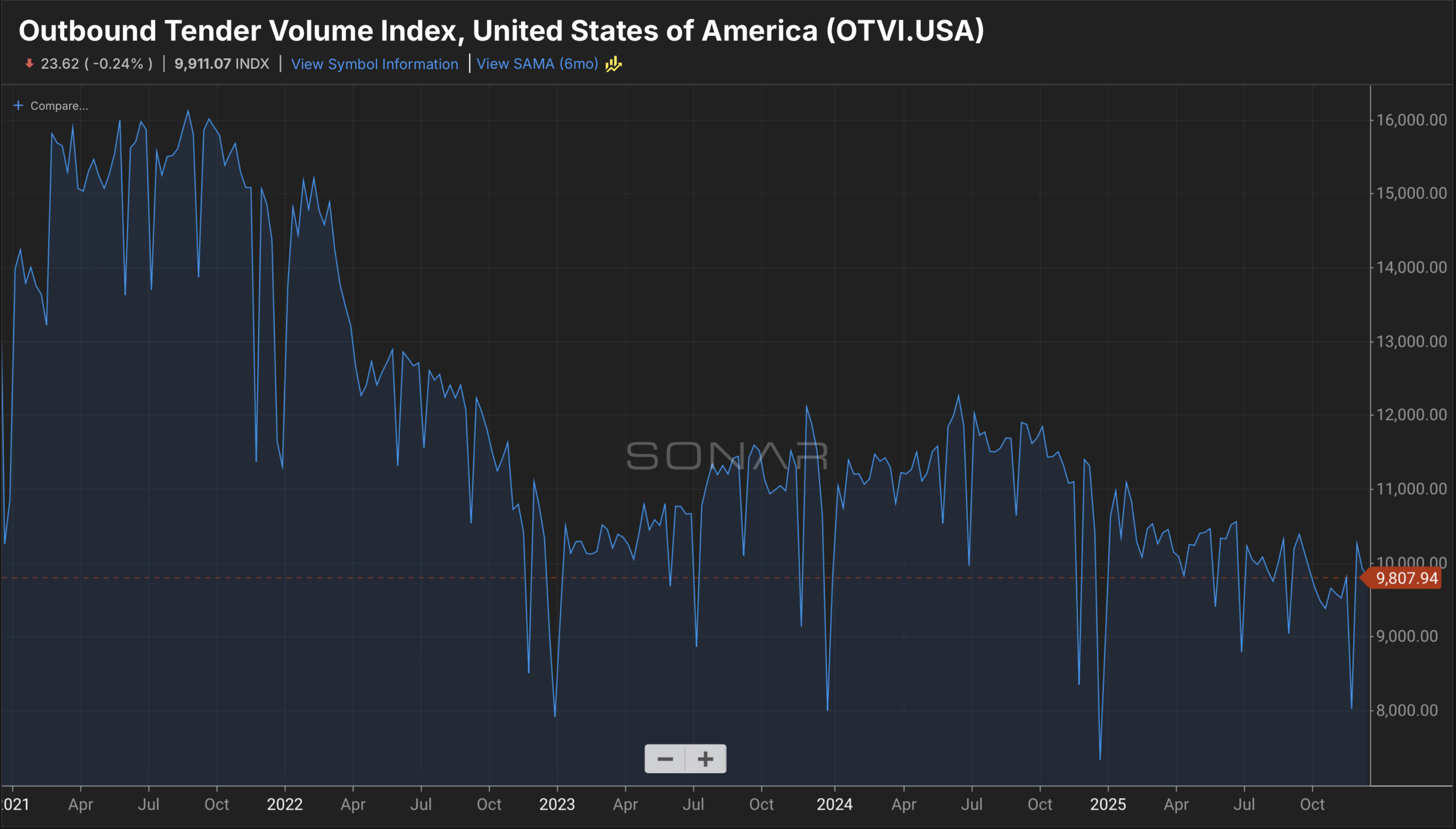
Think of this as: “How much freight exists.”
OTVI measures how many loads are being tendered into the market. More volume can be good — but only if capacity doesn’t outpace it.
Five-Year Context
- Volumes exploded during 2020–2021.
- They fell hard through 2022 as demand normalized.
- Since then, volume has mostly moved sideways, with brief seasonal spikes and sharp drops around holidays.
What Truckers Should Watch
- Sustained increases, not one-week pops.
- When OTVI rises and stays elevated for weeks, that’s the first ingredient for higher spot rates.
- Sudden dips (like the deep troughs you see on the chart) usually show up as dead load boards almost immediately.
Bottom line: Volume alone doesn’t fix rates — but without volume, rates don’t improve long term.
2. Outbound Tender Rejection Index (OTRI)
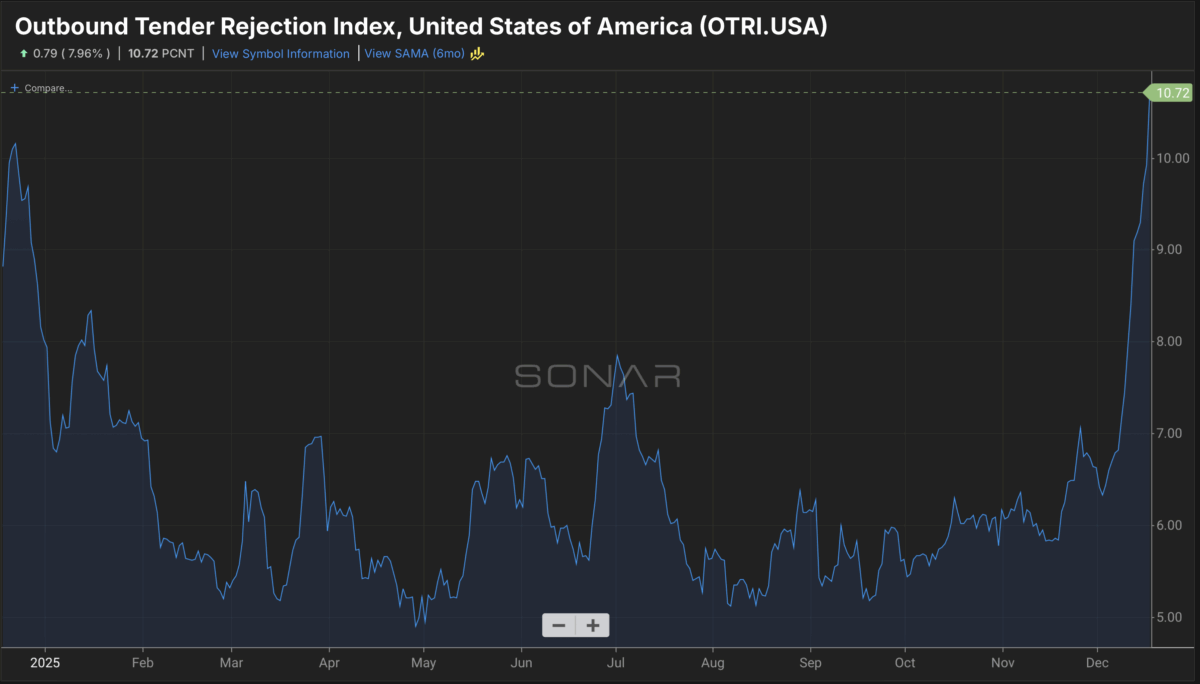
This is the most important chart for spot drivers. Think of OTRI as: “How tight trucks really are.”
OTRI tracks how often carriers reject loads. When rejections rise, it means trucks have options — and brokers start paying more to cover freight.
Five-Year Context
- 2021 was chaos. Rejections regularly lived in double digits.
- 2022–2024 trained carriers to expect low rejections.
- Recently, OTRI has pushed back above 10%, which is not normal for the last few years.
How to Read It
- Below ~5% → Oversupplied market, cheap freight.
- 5–8% → Balanced, fragile market.
- Above ~8–10% → Spot rates usually start moving.
But here’s the catch: A short spike doesn’t change your long term income. A sustained rise can.
Bottom line: If OTRI stays elevated for multiple weeks, brokers lose leverage — and the load board starts reflecting it.
3. National Truckload Index (NTI)
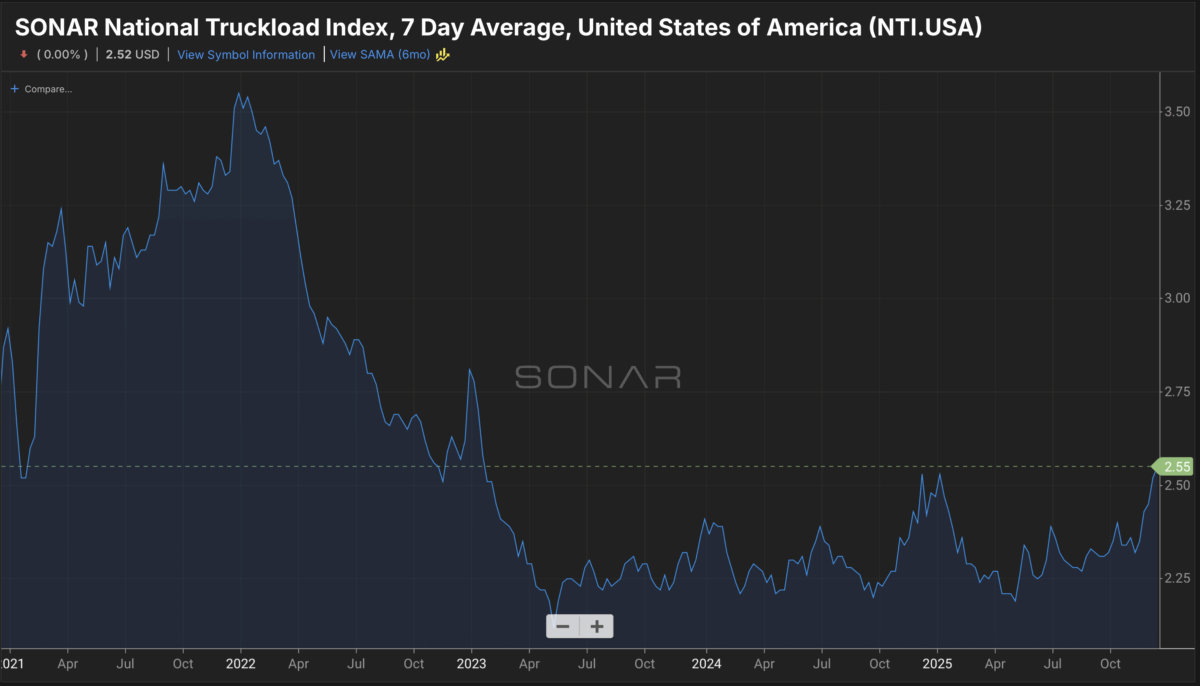
This is the scoreboard. NTI shows what spot rates are actually paying.
Five-Year Context
- Rates peaked during the pandemic surge.
- They bled down for nearly two years.
- Recently, NTI has stabilized and started nudging upward — but it’s not a breakout yet.
What Drivers Should Look For
- Flat NTI = the market is absorbing pressure without paying more.
- Slow, steady climbs usually follow sustained OTRI increases.
- Sharp jumps almost always require a real capacity crunch or demand shock.
Bottom line: NTI doesn’t lead. It follows. By the time everyone’s talking about it, the move already happened.
Putting the Three Together
Here’s the simple way to read them as a trucker:
- OTVI tells you if freight exists
- OTRI tells you who has leverage
- NTI tells you what you actually get paid
The reason the industry keeps crying wolf is because we often see only one of these move — not all three together.
Right now:
- Volume is stable, not booming
- Rejections have woken up
- Rates are cautiously responding
That’s not a supercycle. That’s a fragile turn, and fragile turns can fail if capacity floods back in too fast.
What to Expect Next (Without the Guessing)
If OTRI holds above the high single digits and volume doesn’t collapse:
- Load boards tighten and rates become more favorable
- Brokers get pushed to cover when rejections are up
- Good lanes improve first, bad lanes lag
If OTRI falls back quickly:
- This becomes another head fake
- Rates stall
- The wolf goes quiet again
Final Thought for Small Carriers
The market won’t flip overnight. It grinds. It tests patience. And it punishes anyone making decisions off headlines instead of signals.
You don’t need to predict the future. You just need to understand signals when things start shifting — and when it doesn’t.
Right now, the charts are talking. They’re not screaming yet.
Brokerage Compliance Symposium
The day before F3. Every compliance issue you face - fraud exposure, carrier liability, FMCSA rules, cargo theft, insurance gaps - navigated by attorneys and operators defining best practices in a changing industry.
F3 Awards Dinner
The night before F3. FreightTech100 companies honored. FreightTech 25 and Shipper of Choice winners revealed live. Cocktail reception into dinner and live music - 300 industry leaders in one purpose-built room.
F3: Future of Freight Festival
Industry-defining keynotes, rapid-fire technology demos, and industry leaders networking in experiences across Chattanooga - plus the inaugural F3 Awards Dinner featuring the FreightTech and Shipper of Choice reveals.
The day before F3. Every compliance issue you face - fraud exposure, carrier liability, FMCSA rules, cargo theft, insurance gaps - navigated by attorneys and operators defining best practices in a changing industry.
The Signal at Chattanooga Choo Choo • Chattanooga, TN Register NowThe night before F3. FreightTech100 companies honored. FreightTech 25 and Shipper of Choice winners revealed live. Cocktail reception into dinner and live music - 300 industry leaders in one purpose-built room.
The Signal at Chattanooga Choo Choo • Chattanooga, TN Register NowIndustry-defining keynotes, rapid-fire technology demos, and industry leaders networking in experiences across Chattanooga - plus the inaugural F3 Awards Dinner featuring the FreightTech and Shipper of Choice reveals.
The Signal at Chattanooga Choo Choo • Chattanooga, TN Register Now