The short answer
No. As of October 2026, new trucking capacity is not entering the freight market, even after a full year of elevated tender rejections. SONAR data shows tractors in new for-hire fleets fell to 19,520 in August, while the SONAR Truckload Rejection Index (STRI) held near 14%, about three times its 2023–2025 range.
In past cycles, high rejections pulled new trucks into the market within a few quarters. This time they haven’t. Operating authority counts are rising, but authorities don’t measure trucks. SONAR’s new Sitrep, The Authority Illusion, lays out the data.
Key takeaways
- New capacity is shrinking, not growing. Tractors in new for-hire fleets fell to 19,520 in August 2026, down about 14% from the first-half average.
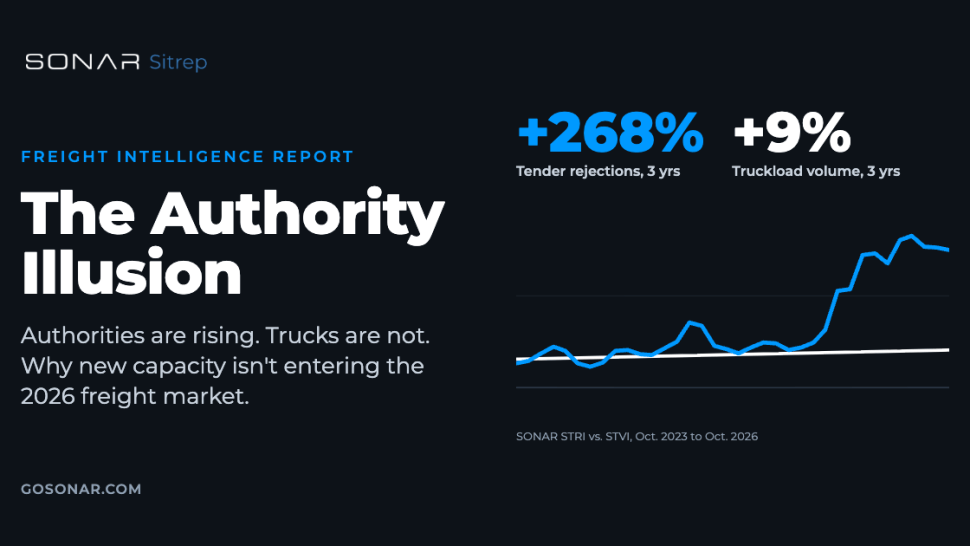
- Rejections are up 268% in three years. Volume is up 9%. The market is tight because trucks are leaving, not because freight is surging.
- Authority counts are misleading. Net authority additions hit five-year highs above 2,000 a week in August and September 2026, but much of that reflects FMCSA’s Motus system rollout. Estimated new grants ran about 17% below the first quarter.
- Fewer new carriers are actually starting. Only about two in three new interstate registrants buy liability insurance, down from more than nine in ten in 2019.
- Expect a tight market through early 2027. Rising insurance costs and a narrowing pool of compliant drivers are keeping new capacity out.
How is this freight cycle different from 2020–2022?
In the last cycle, new capacity answered the price signal. In this one, it hasn’t. When STRI spiked in mid-2020, tractors in new for-hire fleets started climbing within a couple of quarters and peaked in mid-2022 at about 47,000.
This cycle runs the other way. New-fleet tractors fell from that 2022 peak, bottomed in early 2025, ticked up in the spring, then flattened. STRI began rising sharply in fall 2025, yet new-fleet tractor counts have since turned lower. Total for-hire tractors fell by about 51,000 in August alone.
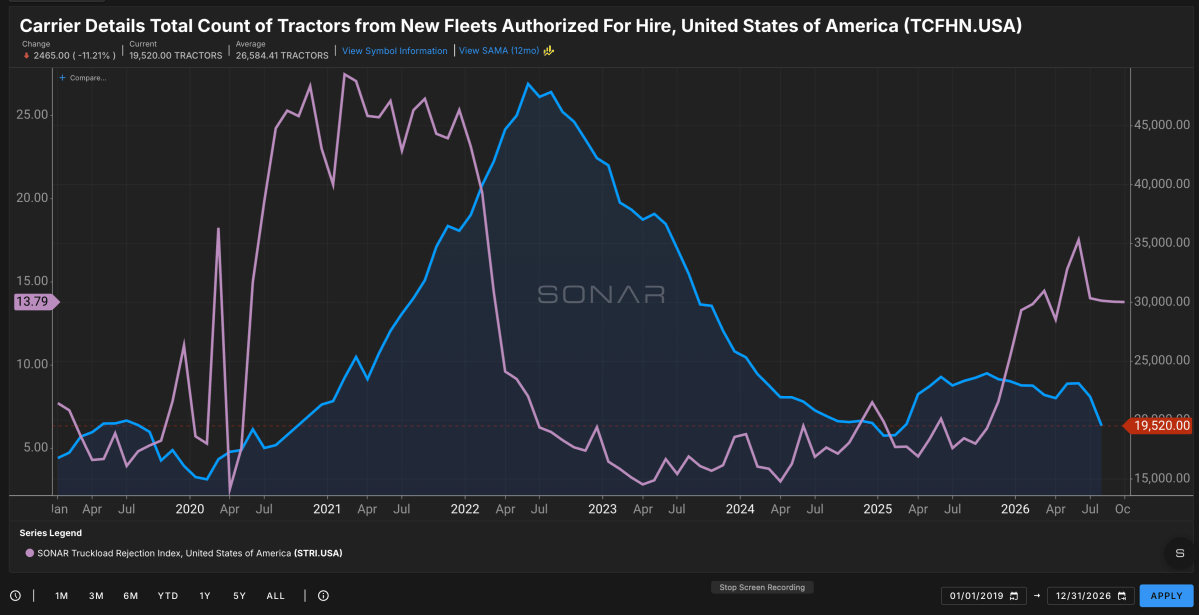
Tender rejections rising in 2025–2026 while tractors in new for-hire fleets fall.
Has truckload freight volume increased?
Barely. Over the three years ending October 2026, the SONAR Truckload Volume Index (STVI) is up 9%, while STRI is up 268%. At their early-summer 2026 peak, rejections were up more than 350%.
If demand were driving the market, those two lines would move together. Instead, carriers are rejecting nearly four times as many loads on roughly the same volume. That gap normally closes as new trucks enter and rejections fall back. It hasn’t closed. The American Transportation Research Institute (ATRI) reaches the same conclusion, describing 2026’s rate gains as a supply-side recovery.
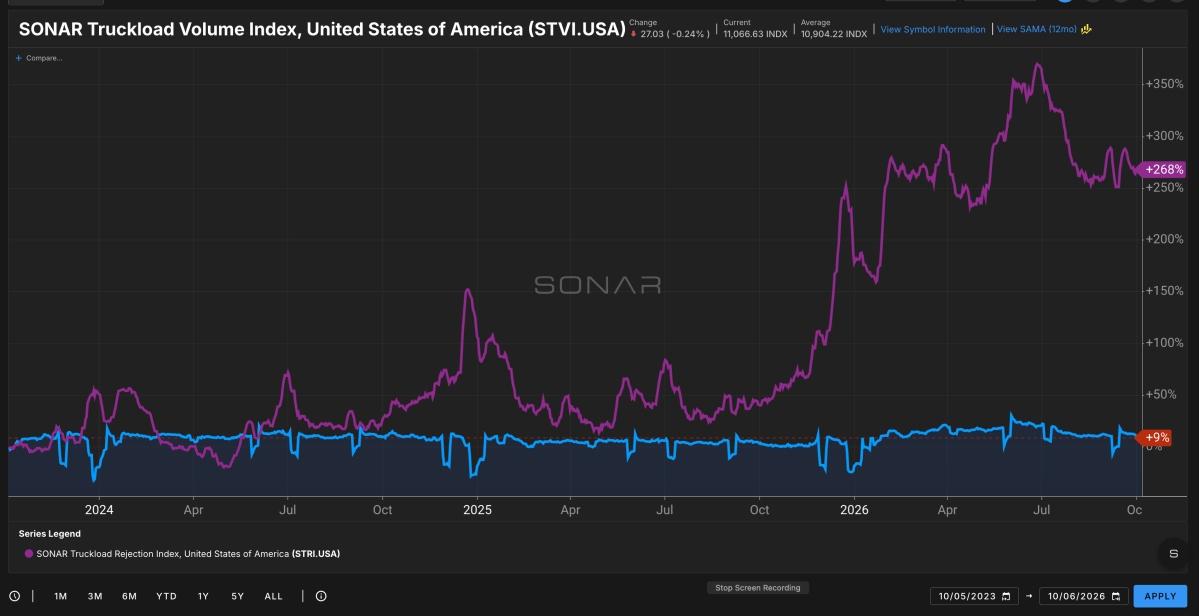
Truckload volume up 9% while tender rejections are up 268% over three years.
Why are trucking authorities rising if capacity isn’t?
Because an operating authority is permission to haul, not a truck. A one-truck owner-operator and a 5,000-truck fleet each count as one authority. From 2019 to 2022, total authorities rose 51% while for-hire tractors rose just 12%.
The 2026 jump is also largely administrative. Net authority additions topped 2,000 a week in late August and late September, the highest in five years. Over the same stretch, FMCSA’s new Motus registration system paused deactivations and cleared a backlog of applications and reinstatements. Net revocations turned negative for the first time since at least 2019, and estimated new authority grants ran about 17% below the first quarter.
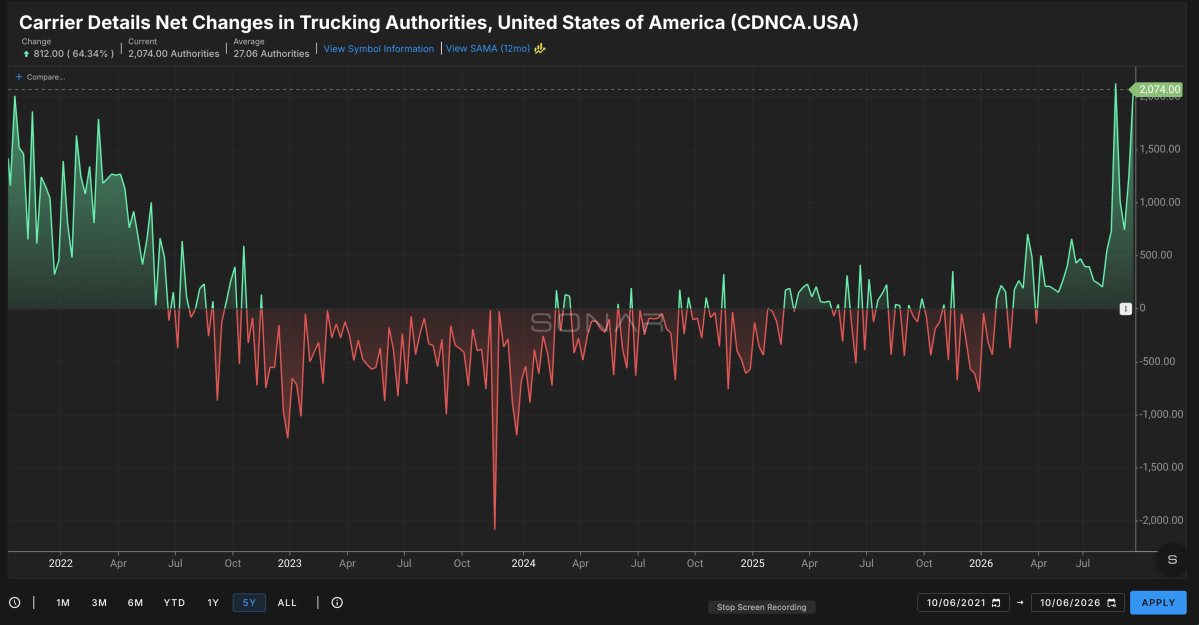
Weekly net authority additions spike above 2,000 in late 2026.
What’s keeping new trucking capacity out of the market?
Three pressures are raising the cost of entry at the same time.
- A narrower pool of compliant drivers. As of January 2, 2026, 202,345 CDL and permit holders were in prohibited status in FMCSA’s Drug and Alcohol Clearinghouse. A non-domiciled CDL rule effective March 16, 2026 could affect up to 194,000 drivers over time. English language proficiency enforcement now takes about 2,700 drivers out of service a month, according to SONAR data.
- Rising insurance costs. Liability and cargo premiums rose 3.9% in 2025 to about 10.6 cents a mile, even as crash rates fell, and kept climbing in early 2026, according to ATRI. For a small carrier, a lapsed policy means a revoked authority.
- Thin margins. Truckload operating margins were barely positive in 2025, which makes adding trucks hard to justify.
The largest carriers are feeling it too. In second-quarter 2026 results, Schneider called the market driver-constrained, and Knight-Swift and Werner said driver availability was limiting their fleets.
What should shippers expect over the next six months?
Expect the truckload market to stay tight through early 2027, with STRI well above the 4% to 6% range of 2023 through 2025. The fastest source of relief is parked trucks: ATRI found about 10% of carriers’ trucks sat without a driver in 2025. They return only if carriers can find compliant drivers to seat them.
The signals that will show the turn first:
- Tractor counts and new-fleet tractors rising for two or more consecutive months
- STRI falling while STVI holds steady
- First-time insurance filings, not authority counts, picking up
Frequently asked questions
Is trucking capacity growing in 2026? No. Measures of trucks actually running are falling: total for-hire tractors fell about 51,000 in August 2026, and new fleets reporting miles are at their lowest since early 2020. Only authority counts are rising.
What is a trucking operating authority? An operating authority, or MC number, is FMCSA’s permission for a company to haul regulated freight for hire across state lines. It says nothing about how many trucks the company runs or whether they are moving.
Why are tender rejections high if freight volume is flat? Because capacity has left the market. With fewer trucks and compliant drivers available, carriers reject more contracted loads even when volume barely changes.
What is the best indicator of real trucking capacity? Tractor counts, fleets reporting miles, and tender rejections. First-time insurance filings are a better gauge of new entry than authority or registration counts.
Why did net revocations turn negative in 2026? FMCSA’s Motus rollout paused USDOT deactivations and processed a backlog of reinstatements, so reinstatements outnumbered revocations. It was an administrative effect, not a wave of new carriers.
Read the full Sitrep
The Authority Illusion covers seven years of authority, tractor, insurance and registration data, a 2026 capacity scorecard, and the indicators shippers should watch instead. Read the full Sitrep inside FreightWaves Market Monitor or the SONAR platform.
For real-time tender rejections, volumes and carrier fleet data, subscribe to SONAR.
Sources: SONAR (STRI, STVI, TCFHN, TCFH, CDNCA, CDNR, ELPVOOS); ATRI, An Analysis of the Operational Costs of Trucking: 2026 Update; FMCSA Drug and Alcohol Clearinghouse Monthly Report, December 2025; Transport Topics, Schneider expects supply reduction momentum through 2026; FMCSA Licensing & Insurance and Company Census data.
Brokerage Compliance Symposium
The day before F3. Every compliance issue you face - fraud exposure, carrier liability, FMCSA rules, cargo theft, insurance gaps - navigated by attorneys and operators defining best practices in a changing industry.
F3 Awards Dinner
The night before F3. FreightTech100 companies honored. FreightTech 25 and Shipper of Choice winners revealed live. Cocktail reception into dinner and live music - 300 industry leaders in one purpose-built room.
F3: Future of Freight Festival
Industry-defining keynotes, rapid-fire technology demos, and industry leaders networking in experiences across Chattanooga - plus the inaugural F3 Awards Dinner featuring the FreightTech and Shipper of Choice reveals.
The day before F3. Every compliance issue you face - fraud exposure, carrier liability, FMCSA rules, cargo theft, insurance gaps - navigated by attorneys and operators defining best practices in a changing industry.
The Signal at Chattanooga Choo Choo • Chattanooga, TN Register NowThe night before F3. FreightTech100 companies honored. FreightTech 25 and Shipper of Choice winners revealed live. Cocktail reception into dinner and live music - 300 industry leaders in one purpose-built room.
The Signal at Chattanooga Choo Choo • Chattanooga, TN Register NowIndustry-defining keynotes, rapid-fire technology demos, and industry leaders networking in experiences across Chattanooga - plus the inaugural F3 Awards Dinner featuring the FreightTech and Shipper of Choice reveals.
The Signal at Chattanooga Choo Choo • Chattanooga, TN Register Now