




While shippers may not have seen significant air cargo savings quite yet because some airlines are tied up in fuel-hedging agreements, customers are expected to eventually realize lower costs in their freight bills. Some may even see the dissolution of fuel surcharges, industry experts say.
Recently, two Middle Eastern airlines announced they would end fuel and security surcharges, creating instead an all-in pricing strategy for cargo purchasing. Emirates SkyCargo said it would impose new pricing on European shipments in February and worldwide shipments by March, and Qatar Airways announced Jan. 12 that it would follow suit.
Reaction to the move has been positive, as the termination of surcharges leads to a more holistic picture of the true costs of moving air cargo, according to Nicolette van der Jagt, director general of the European forwarder group CLECAT.
“While we accept that air carriers offer different rate structures due to the impact of fuel prices on carriers’ operating costs, surcharges are ostensibly linked to the oil price,” she said in a statement.
“It remains notable that carriers have shown a greater tendency to increase surcharges in line with a rising oil price than to reduce them when the oil price has fallen. What we have seen is that additional surcharges for fuel costs tend to be ‘fixed’ and not to fluctuate on a large scale over time. This is of particular significance as the oil price drops below $50 per barrel for the first time since 2009,” she added.
The International Federation of Freight Forwarders Associations (FIATA) signaled that additional airlines might pick up on the trend, creating a more straightforward pricing system.
“Forwarders have, for a very long time, desired these surcharges be removed, as they are opaque and complex and, thereby, make it difficult to quote a definite price for air cargo transportation, which the shippers are able to understand,” the group said.
To paint the clearest picture of the price fall on jet fuel, Matthew Kohlman, a managing editor at Platts, a global provider of energy and commodity information, looked at pricing coming out of the Gulf Coast, where he said about half of the country’s jet fuel is produced.
On the last day of 2013, jet fuel traded at $126.24 per barrel, for a per-gallon cost of about $3. By the same time the following year, pricing had fallen to $68.17 per barrel or $1.62 per gallon. The low point actually occurred a few days before, on Dec. 22, when a gallon of jet fuel fetched $1.54. During the first few days of 2015, the price continued to fall from its year-end result, hitting $66.51 per barrel or $1.58 per gallon on Jan. 6.
On Jan. 9, the worldwide average cost for jet fuel stood at $65.80 per barrel, a 46.7 percent drop from the previous year, according to the International Air Transport Association’s Fuel Price Analysis. In the Middle East and African region, jet fuel was the cheapest at $62.40 per barrel; in North America, IATA measured an average price of $66.20 per barrel.
“A lower oil price has to be on the face of it good for the airlines — cost will come down,” Tony Tyler, IATA’s director general and chief executive officer, said during the organization’s Global Airline Media Day in Geneva in December. But he allowed that the drop won’t be immediate because of hedging.
Brian Pearce, IATA’s chief economist, added, “Airlines have been hedging their fuel bill, so the actual prices airlines pay won’t fall as a result of declining spot prices for a few months. Unambiguously, we would expect to see both travelers and shippers benefit from a decline in fuel prices.”
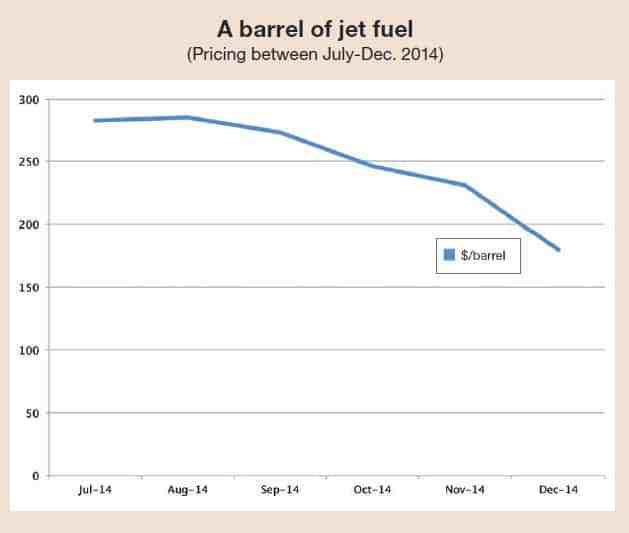
In early December, IATA put its per-barrel Brent crude prediction for 2015 at $85. The news was released as jet fuel prices dropped 40 percent over the previous six months.
“That’s more than double the 2004 price,” Tyler said of the 2015 prediction, “yet somehow it now seems cheap. There is no doubt that the recent fall in the oil price is a relief for airlines.”
Kohlman said the price for jet fuel started to decline after it hit $120.89 per barrel on Labor Day. Jet fuel had been hovering in the $118-$127-per-barrel range since the start of the year — in late February and early March, prices hovered above $127 per barrel for days at a time — but on Sept. 4, fuel started to decline quite rapidly.
“For the first few months, [jet fuel] followed along with crude’s gradual drop,” he said, noting that jet fuel and crude prices sometimes mirror each other but are very much their own entity. “In December, there was a sharper drop based on some of the jet market elements. I don’t think anybody in the jet market would have pegged it any more than anyone in the crude market would have.”
The price drop wasn’t created in a vacuum. In August, Kohlman said the New York market, which is a major beneficiary of Gulf Coast jet fuel, was stretched thin. There were outages in Canada, so extra demand from up North affected East Coast refineries. Kohlman also said there were some issues with pipelines. These issues combined with summer flights increased the price of jet fuel in the market, but shortly after they started falling.
 Source: Platts.
“A lot of people would say the typical hedging for airlines so far is about 30 percent — basically a third of the airline’s costs — going out a year and a half,” he said. “In the past, it used to be 40 or more percent going out twice that long.”
America’s status as a net exporter of jet fuel, which has been occurring since 2011, could lead to increased fuel costs for the country’s shippers. Exports “will keep the market up, which means more jet production, but it will also mean more goes overseas, which could pop up your jet prices,” Kohlman said.
Stability appears to have changed the airlines’ strategy. When prices were high, but maintained their costs, hedging didn’t make sense. But now, Kohlman said, some airlines might see the massive drop in jet fuel prices as an opportunity to increase their hedges.
Brandon Fried, executive director of the Airforwarders Association, said shippers who are concerned they are not seeing an accurate reflection of the recent drop in fuel prices should talk to their forwarders. Maybe, he said, the forwarder can push a little harder for a discount. But he added hedging in the industry makes it hard to know how much an airline is leveraged and when their own costs will come down.
“We would hope that we start seeing some more transparency and that the carriers would start passing the fuel savings on to the members,” he said. “Generally speaking, people are going to start questioning over time why those savings haven’t been passed on.”
With lower fuel prices, Fried said his small and midsized forwarders have seen significant cargo growth. He thinks this may be because the last few years have been difficult on volumes, but his members are reporting that 2014 was a better year than they even expected. Shippers are also returning to the airlines as they reconsider premium transportation services for moving their goods.
“I’m not saying that our global members aren’t going to have issues in other countries. But I think it’s a great time to be in the business,” he said. “I think the American shipper is once again back in business, and that’s exciting.”
The drop in fuel prices, however, could be seen as a trend working at odds with the push for alternative fuels, but Kohlman said airlines will still invest in new technology.
“They’re looking at everything they can,” he said, adding creating a more fuel-efficient fleet is still important. “I don’t think that will stop, just because jet prices have dropped by a third or more.”
The price of jet fuel, in fact, might not determine how rigorously airlines look into alternative fuels, Kohlman said.
“It may depend as much on interest rates as jet fuel costs because they need to borrow more cheaply” to pay for trials and other research, he said. “Those renewables are already more expensive, so maybe they can keep some momentum going because what they need is cheap borrowing costs to get going on these massive projects rather than cheap jet fuel.”
Fried said there can be a “disincentive” to look into alternative fuels now that the price of jet fuel is so low, but that a bit of caution is needed.
“As fast as it’s going down, it can go up just as quickly again,” he said. “A lot of this is predicated upon oversupply in the industry and what’s going on in other countries, and the reality is that when these prices start going up again, you’re going to wish we had the research and development that we were doing for a long time on alternative fuels. That is a big concern.”
This article was published in the February 2015 issue of American Shipper.
Brokerage Compliance Symposium
The day before F3. Every compliance issue you face - fraud exposure, carrier liability, FMCSA rules, cargo theft, insurance gaps - navigated by attorneys and operators defining best practices in a changing industry.
F3 Awards Dinner
The night before F3. FreightTech100 companies honored. FreightTech 25 and Shipper of Choice winners revealed live. Cocktail reception into dinner and live music - 300 industry leaders in one purpose-built room.
F3: Future of Freight Festival
Industry-defining keynotes, rapid-fire technology demos, and industry leaders networking in experiences across Chattanooga - plus the inaugural F3 Awards Dinner featuring the FreightTech and Shipper of Choice reveals.
The day before F3. Every compliance issue you face - fraud exposure, carrier liability, FMCSA rules, cargo theft, insurance gaps - navigated by attorneys and operators defining best practices in a changing industry.
The Signal at Chattanooga Choo Choo • Chattanooga, TN Register NowThe night before F3. FreightTech100 companies honored. FreightTech 25 and Shipper of Choice winners revealed live. Cocktail reception into dinner and live music - 300 industry leaders in one purpose-built room.
The Signal at Chattanooga Choo Choo • Chattanooga, TN Register NowIndustry-defining keynotes, rapid-fire technology demos, and industry leaders networking in experiences across Chattanooga - plus the inaugural F3 Awards Dinner featuring the FreightTech and Shipper of Choice reveals.
The Signal at Chattanooga Choo Choo • Chattanooga, TN Register Now