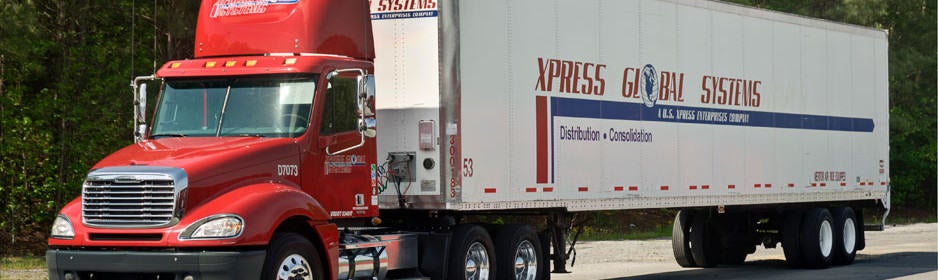
Aterian Investment Partners, a private equity firm from New York, announced its acquisition of Chattanooga-based Xpress Global Systems, LLC (XGS), an LTL carrier focused on carpet and other floor covering products. Panton Capital Holdings, an Atlanta-based private equity firm, was the seller in the deal, the financial details of which have not been publicly disclosed.
According to Pitchbook, Aterian’s portfolio is made up of “turnarounds, under-performers, distressed situations, non-core assets and other unique investment situations.” The PE firm raised $350M to close its III Round in August 2018.
In 2015, US Xpress (NYSE: USX) sold XGS to Panton, Mosaic Investments, Alcentra Capital and Brightwell Investments. Pitchbook reported that the new buyer Aterian’s average investment is $16.2M (including debt and equity).
To us, this deal, which was announced the Friday afternoon before Christmas, looks like a fire sale in which Aterian assumes XGS’s debt and acquires equity at a massive discount, returning pennies on the dollar to the previous owners. Again, details have not been confirmed by Aterian, but XGS has been struggling in recent years.
In 2016, Aterian Partners won the “Private Equity Firm of the Year” Award from the Turnaround Atlas. In our view, Aterian’s reputation as a turnaround specialist suggests that going forward, the focus will be on cutting XGS’s costs and replacing senior management.
At one point, XGS held an estimated 80% market share of the outsourced floor covering logistics segment and generated consistent profits every year from 2006 to 2015, while a wholly-owned subsidiary of US Xpress. The key to this profitability was a relentless focus on controlling costs in a very seasonal business and a large network of 28 service centers that specialized in handling rolled floor coverings like carpet and turf, which do not mix well with typical palletized freight.
Floor covering is a highly cyclical business tightly bound to residential construction activity; XGS initially tried to diversify its business by creating an airport-to-airport operation that never was able to compete against Forward Air (NASDAQ: FWRD), the dominant airport to airport linehaul provider. Shedding that business was necessary for XGS’ first turnaround in the 2000s.
Under Panton and Mosaic’s ownership, private equity investors inexperienced in LTL transportation attempted to operate the company and grow its revenues by diversifying XGS’s mix of business again. Unfortunately, combining multiple types of freight in the same distribution centers reduced the efficiency of XGS’s network.
XGS was also exposed to rapidly rising costs for purchased transportation, as it depends on truckload carriers to support its linehaul network. Unlike most LTL carriers, XGS did not have originating locations for freight across the US. Most of the freight that XGS handles comes out of two markets: North Georgia (Dalton) and Southern California. This, combined with the fact that carpet is “fugly” freight and doesn’t mix with other goods, makes it incredibly difficult to diversify its network beyond one-way purchased transportation.
XGS did rely upon local delivery drivers with its own fleet, which was leased to support carpet deliveries to installers and big-box retailers like Home Depot. The company leases the vehicles and in an environment where interest costs are rising, further exacerbates the inefficiency of the business.
Although LTL is not an easy space to operate within the trucking segment, it is somewhat puzzling how an asset-based carrier can struggle in a time where the carrier has flourished. After it was purchased in 2015 the economy and freight market did slow down noticeably in 2016, but made a strong recovery in the middle of 2017 and has been operating in record territory for most of 2018.

The Cass Freight Shipment Index shows the pattern of general freight volumes being soft in 2016 but 2018 has been a banner year. Carriers have also been able to increase rates significantly thorough this time which should offset any increases in purchased transportation XGS received.
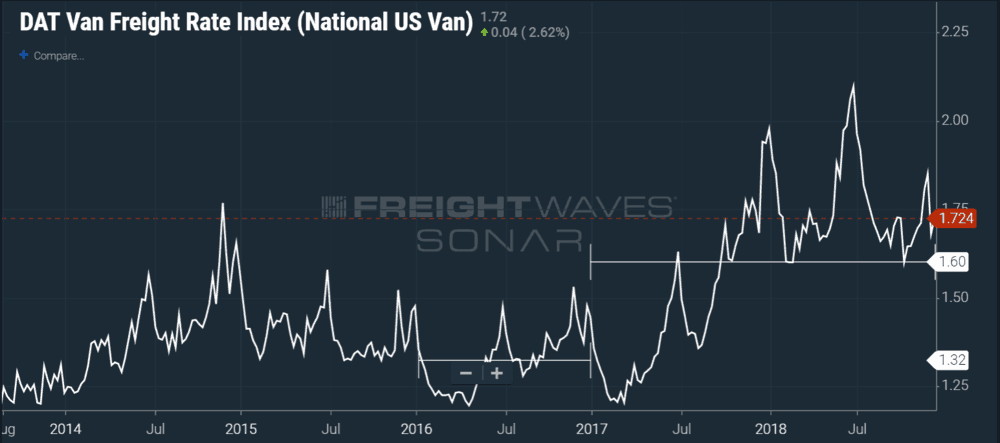
The DAT Van Freight Rate Index that measures dry van spot rates has averaged 17.5% higher in 2017-18 vs 2016. Keeping in mind both indices measure mainly truckload activity, the Producer Price Index for long distance LTL has also increased similarly – almost 18% since January of 2016.

Fuel price has increased 71% during this time. LTL fuel surcharges are not mileage based like most truckload carriers – they are percentages of base freight charges. This mechanic is highly favorable when fuel prices are increasing as most pricing is based off the time when fuel costs are lower. The surcharge is based on the DOE average price of diesel which had been increasing steadily since bottoming in February of 2016. This two and a half-year trend has reversed recently as the average price of diesel has been falling since mid-October. Declining fuel prices will not help the struggling company through the slower winter months.

Floor covering is heavily tied to construction and housing activity. These markets have been booming during the past several years. Housing starts are up 7.54% since November of 2015, peaking this past spring. One headwind that may continue to plague XGS in its new turnaround is a post-peak housing cycle with disappointing new build activity.
In an internal communication announcing the sale, XGS wrote, “Tough times don’t last, tough TEAMS do!” This will do little to reassure the more than 500 employees of their long-term jobs. With a turn-around PE firm taking over with a track-record of successful restructuring, the tough team might see fewer players and change out of the assistant coaches soon.
F3: Future of Freight Festival
Industry-defining keynotes, rapid-fire technology demos, and industry leaders networking in experiences across Chattanooga - plus the inaugural F3 Awards Dinner featuring the FreightTech and Shipper of Choice reveals.
Industry-defining keynotes, rapid-fire technology demos, and industry leaders networking in experiences across Chattanooga - plus the inaugural F3 Awards Dinner featuring the FreightTech and Shipper of Choice reveals.
The Signal at Chattanooga Choo Choo • Chattanooga, TN Register Now