




The United States’ marine economy contributed about $373 billion to the nation’s gross domestic product in 2018 and grew faster than the nation’s economy as a whole, according to statistics released Tuesday.
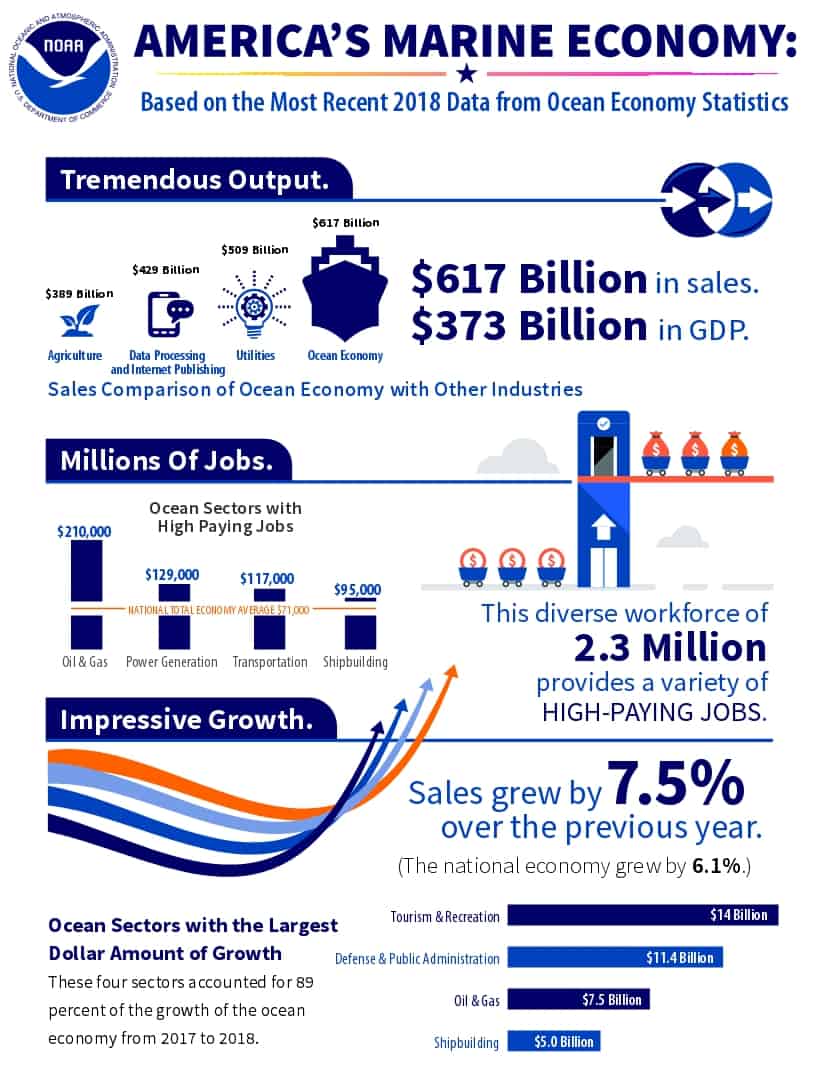
The statistics come from research conducted by two U.S. Department of Commerce agencies — the National Oceanic and Atmospheric Administration (NOAA) and the Bureau of Economic Analysis (BEA) — on 10 sectors representing businesses dependent on the nation’s oceans, coasts and Great Lakes from 2014 to 2018.
The agencies said marine-related GDP grew 5.8% from 2017 to 2018, faster than the 5.4% growth of the total U.S. GDP. Businesses included in the report also supported 2.3 million jobs in 2018.
“The information shows that the blue economy products and services were worth $617 billion in 2018,” said Nicole LeBoeuf, acting director of NOAA’s National Ocean Service, of the statistics hailed as the first of their kind highlighting the economic contributions of U.S. marine industries.
“It is nearly impossible for most of us to go a single day without eating, wearing or using items that come from or through our ports and coastal communities. This clear picture of our marine economy will help national policymakers, marine industries and investors make informed decisions about how to plan for the future, protecting our people, our economy and our environment for future generations,” LeBoeuf said during a press conference Tuesday.
Marine transportation and warehousing contributed $25 billion to GDP in 2018, up from $22.8 billion in 2014, according to the report.
BEA economist Ted Morgan said the economic impact of U.S. ports was embedded in the transportation and warehousing data but that their contribution had grown from about $10 billion to $11.5 billion from 2014 to 2018.
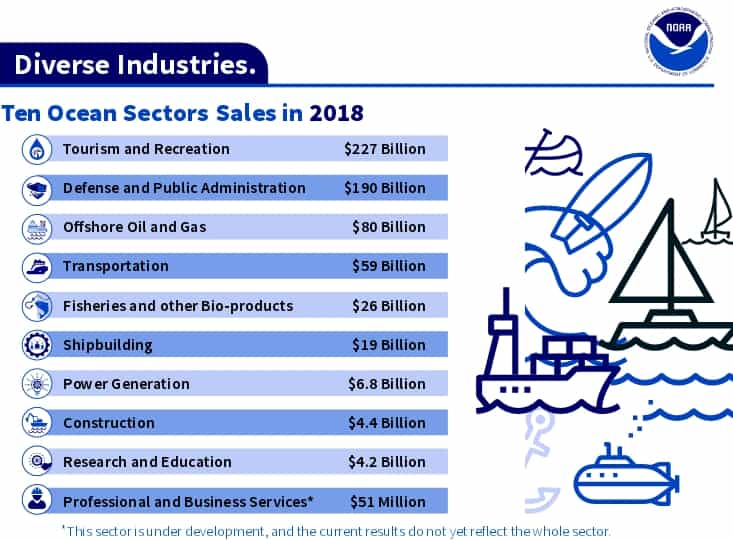
The marine transportation sector contributed $59 billion in total production in 2018, up 7.8% from 2017, the report said.
NOAA and BEA said the marine sectors making the largest contributions to the nation’s GDP were:
- Tourism and recreation, including recreational fishing, $143 billion.
- National defense and public administration, $124 billion.
- Offshore minerals, $49 billion.
- Transportation and warehousing, $25 billion.
- Living resources, including commercial fishing and aquaculture, $13 billion.
- Ship and boat building, $9 billion.
- Power generation, $4 billion.
- Research and education, $3 billion.
- Construction, $2.5 billion.
- Professional and technical services, $31 million.
Click for more FreightWaves articles by Kim Link-Wills.
Brokerage Compliance Symposium
The day before F3. Every compliance issue you face - fraud exposure, carrier liability, FMCSA rules, cargo theft, insurance gaps - navigated by attorneys and operators defining best practices in a changing industry.
F3 Awards Dinner
The night before F3. FreightTech100 companies honored. FreightTech 25 and Shipper of Choice winners revealed live. Cocktail reception into dinner and live music - 300 industry leaders in one purpose-built room.
F3: Future of Freight Festival
Industry-defining keynotes, rapid-fire technology demos, and industry leaders networking in experiences across Chattanooga - plus the inaugural F3 Awards Dinner featuring the FreightTech and Shipper of Choice reveals.
The day before F3. Every compliance issue you face - fraud exposure, carrier liability, FMCSA rules, cargo theft, insurance gaps - navigated by attorneys and operators defining best practices in a changing industry.
The Signal at Chattanooga Choo Choo • Chattanooga, TN Register NowThe night before F3. FreightTech100 companies honored. FreightTech 25 and Shipper of Choice winners revealed live. Cocktail reception into dinner and live music - 300 industry leaders in one purpose-built room.
The Signal at Chattanooga Choo Choo • Chattanooga, TN Register NowIndustry-defining keynotes, rapid-fire technology demos, and industry leaders networking in experiences across Chattanooga - plus the inaugural F3 Awards Dinner featuring the FreightTech and Shipper of Choice reveals.
The Signal at Chattanooga Choo Choo • Chattanooga, TN Register Now