XPO ups growth spending after Yellow’s downfall

A white XPO day cab pulling a white LTL trailer on a highway

Less-than-truckload carrier XPO saw service metrics improve in the third quarter even as it took on additional freight following Yellow’s shutdown.

A 0.4% claims ratio was the best in company history and its on-time percentage increased 8 percentage points. By comparison, XPO’s claims ratio was 0.7% in the second quarter and 1.2% two years ago. The improvements were realized alongside an 8% year-over-year (y/y) increase in shipments.

XPO (NYSE: XPO) reported adjusted earnings per share of 88 cents before the market opened Monday. The result was 25 cents better than the consensus estimate but 7 cents lower y/y. Adjusted EPS excludes transaction and restructuring costs.

Revenue in the company’s LTL segment increased 2% y/y to $1.23 billion. Tonnage per day was up 3% and revenue per hundredweight, or yield, increased 6% excluding fuel surcharges. The yield metric was aided by a 4% decline in weight per shipment. Pricing increased by 9% on contract renewals during the quarter, nearly double the increase booked in the second quarter.

Management said average shipments per day increased by more than 1,000 in each month of the quarter to over 54,000 in September. In total, average daily shipments were up 5% from the second quarter to the third quarter. Yield (excluding fuel surcharges) was 6% higher sequentially and weight per shipment was off just 2%.

The positive y/y volume trends continued in October with tonnage up 2.5% y/y and shipments 6% higher. Both volume metrics declined slightly from September levels but outpaced normal seasonal sequential trends.
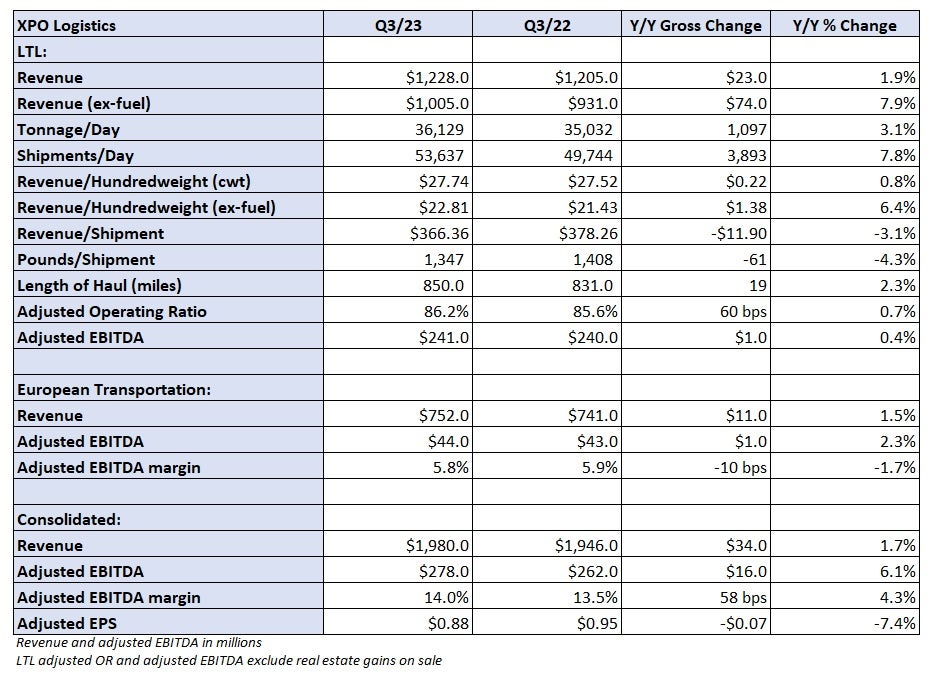
Table: Company reports

The LTL segment recorded an 86.2% adjusted operating ratio, which was 60 basis points worse y/y but 140 bps better sequentially. Favorable yield trends, improved service and cost management led to the improvement.

Purchased transportation expenses were down 230 bps as a percentage of revenue. The company reduced outsourced linehaul miles to 21.5% of total linehaul miles, which was 200 bps lower y/y. XPO is in the process of adding a few hundred driver teams and tractors with sleeper cabs to insource more linehaul miles. The goal is to reduce total outside miles by 50% over a six-year period ending in 2027.

Head count was down slightly y/y and labor hours were up less than 1% even though the carrier took on an 8% increase in shipments. An annual wage increase implemented in April was a headwind. Insurance and claims expenses were 100 bps lower y/y as well.

The company normally sees 310 bps of OR deterioration from the third quarter to the fourth quarter but expects to outperform that threshold by 100 bps this year. The unit saw 370 bps of sequential improvement versus seasonality in the second quarter. XPO noted that investing in incremental network capacity resulted in a 120-bp headwind in depreciation and amortization expenses in the third quarter. Additional hiring of sales professionals also presents a modest hurdle.

Yields are expected to continue to improve given the carrier’s improved service, which it says customers are willing to pay a premium for. Also, it will look to expand accessorial programs in certain verticals and add more local shipping customers, which carry better margins.

Shipments in its local sales channels increased by double digits in the third quarter.  

XPO plans to implement a general rate increase (GRI) to base rate tariffs in the first quarter of next year, which is on schedule with the time frame of a GRI taken earlier this year.

Fourth-quarter tonnage is expected to increase by a low-single-digit percentage and yield is expected to increase by a high-single digit percentage compared to the 2022 fourth quarter.

The company plans to increase capital expenditures from a range of 8% to 12% of revenue to 12% to 13% this year and will likely remain at the higher end of that range in the near term.

It broke ground on a central Florida service center last week. The site will add 60 doors and is part of the company’s larger plan to add 900 net doors by the first quarter of next year. XPO has added 531 new net doors toward the goal so far.

It has also added more than 1,000 tractors this year and plans to build more than 6,000 trailers at an in-house production facility.  

XPO’s European transportation segment recorded a 2% y/y revenue increase to $752 million and a 5.8% adjusted EBITDA margin, which was down 10 bps y/y.

Shares of XPO were up 16.1% on Monday at 3:20 p.m. EDT compared to the S&P 500, which was up 1.4%.

More FreightWaves articles by Todd Maiden

East Coast vs. West Coast: More imports shift back to Pacific ports

a photo of West Coast import port facility in LA-LB

In the perennial tug-of-war between West Coast and East Coast ports, the momentum has shifted yet again. Imports from Asia are starting to head back to America’s Pacific gateways.

East and Gulf Coast ports increased their market share in the years prior to the pandemic as the expanded Panama Canal allowed more cost-effective shipping service to Eastern states, which boast the highest population of consumers.

Asian cargo flows shifted toward Los Angeles and Long Beach, California, in the early stages of the pandemic due to shorter transit times. Then, after congestion clogged those ports, the pendulum swung back to the East. That trend was accelerated in the first half of this year by concerns over West Coast port labor unrest.

Now, the labor issue is resolved, Panama Canal water levels are restricting capacity utilization on transiting container ships bound for East and Gulf Coast ports, and both spot rate data and import data imply the West Coast is regaining some lost ground.

Trans-Pacific spot rates to both coasts have fallen double-digits from August’s peak-season highs, but rates to the West Coast have held up better than rates to the East Coast. The West Coast route has retained much more of the peak-season rate run-up that began July 1 and peaked in the third week of August.

This spot-rate differential is a positive indicator on volume flows to the West Coast, to the extent it’s not caused by differing levels of “blanked” (canceled) sailings to each coastline.

According to the Freightos Baltic Daily Index (FBX), China-West Coast rates averaged $1,563 per forty-foot equivalent unit on Friday, up 31% from June 30. In contrast, the FBX assessment of China-East Coast rates, at $2,213 per FEU on Friday, was essentially flat (up 1%) versus June 30.

chart of spot rates to ports by coast
Spot rate in USD per FEU. Blue line: China-West Coast. Green line: China-East Coast. (Chart: FreightWaves SONAR)

The Drewry World Container Index (WCI) put average Shanghai-to-Los Angeles spot rates at $1,961 per FEU for the week ending Thursday, still up 19% from the week ending June 29, prior to the seasonal upswing.

The WCI put average Shanghai-to-New York rates at $2,552 per FEU in the latest week — all the way back down to late-June levels.

chart of spot rates to ports by coast
Spot rate in USD per FEU. Blue line: Shanghai-Los Angeles. Green line: Shanghai-New York. (Chart: FreightWaves SONAR)

Independent analyst John McCown compiles data on imports to the top U.S. ports and analyzes volume trends.

“September had East/Gulf Coast ports underperforming West Coast ports for the second straight month, coming behind a streak of 26 straight months where the East/Gulf Coast ports overperformed,” McCown wrote in his latest monthly report.

Inbound volume at the top East and Gulf Coast ports fell 13.4% year on year (y/y) in September, while West Coast volumes rose 16.7%, equating to a 30.1-percentage-point spread in favor of the West Coast. The spread in August was 11.4 points in favor of the West Coast.

In contrast, the spread over the past 28 months averaged 11.3 points in favor of East/Gulf Coast ports.

chart of ports imports
(Chart: The McCown Report)

McCown also analyzed the sequential coastal shift by looking at three-month trailing average volumes. This average heavily favored the East/Gulf Coast ports from mid-2021 through this August, but has now reversed.

“In September, based on the trailing three-month figures, that difference flipped to the West Coast ports’ advantage [at a spread] of 8.2 percentage points,” said McCown.

chart of ports imports
(Chart: The McCown Report)

The nascent reversal of fortunes in the West Coast market is apparent in the latest monthly stats of the ports of Los Angeles and Long Beach.

Long Beach posted its best September ever in terms of overall throughput, with imports up 19.3% y/y. Long Angeles’ imports rose 14.3% y/y.

Los Angeles expects imports to remain healthy through the fourth quarter, with full-year throughput now predicted to be down 13% y/y. “That’s an unbelievably good comeback given that we were down 32% in Q1,” said Port of Los Angeles Executive Director Gene Seroka in a press conference on Oct. 23.

Seroka pointed to the improving market share of West Coast ports in recent months. “With more cargo coming back to the West Coast, it basically gets us back to where we were [in terms of coastal market share] prior to the port labor negotiations.”

Click for more articles by Greg Miller 

UPS rolls out Hyperlocal delivery service

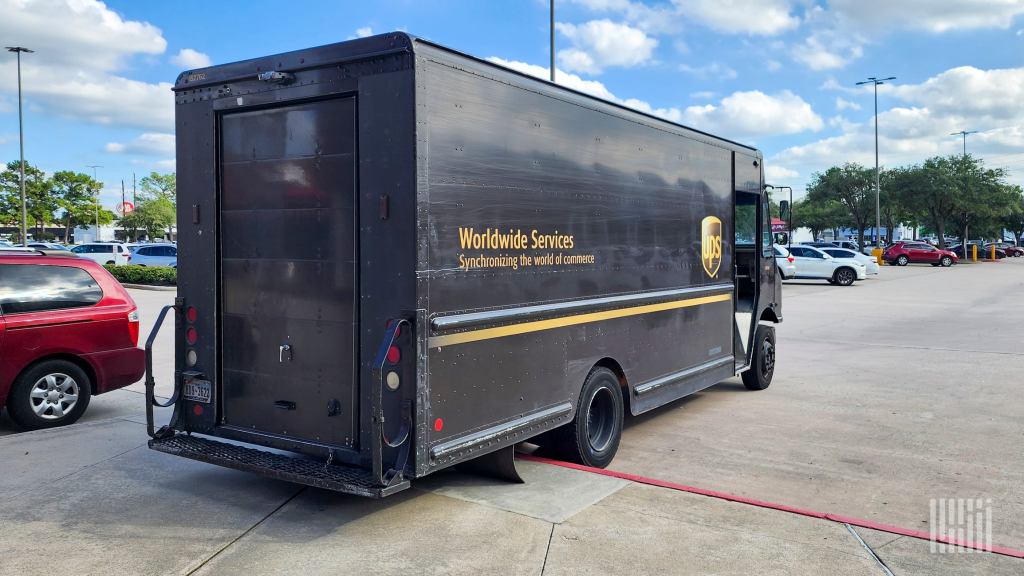
UPS Inc. said it has rolled out a product that will provide select customers with a “fast” next-day delivery option within a metropolitan service area.

The service, called Hyperlocal, was launched earlier this month, CEO Carol B. Tomé said last week on an analyst call. Tomé called it a fast next-day delivery option that would help UPS capture “profitable B2B and B2C volume.” She provided no further detail on the call, and the company declined to offer additional information afterward.

The new service resembles a reconstituted version of a UPS (NYSE: UPS) project launched about five years ago, according to a person familiar with the matter. Back then, the idea was to pick up local volumes from a retailer’s fulfillment center in the wee hours of the morning, transport the goods in time for UPS’ morning presort process and then deliver them to consignees the same day. 

UPS rival FedEx Corp. (NYSE: FDX) had a similar service, the person said. The two biggest users at the time were multi-lines retailer Target Corp. and electronics retailer Best Buy Co. The service had limited appeal because there had to be sufficient volumes moving within a specific geography to make it consistently work, the person said. UPS effectively let the program fade by 2019, in part because FedEx had captured Best Buy’s business, according to the person.

Earlier this year, Amazon.com Inc. (NASDAQ:AMZN) transformed its U.S. fulfillment and distribution network from a national hub-and-spoke model to eight regions. The change has shortened the distance between fulfillment and delivery and has made same-day deliveries a consistent part of Amazon’s value proposition, executives have said.

Scott Lord, who spent more than 18 years at UPS and today runs a consulting firm, said UPS’ objective at the time was to focus on markets where a shipper had a distribution center or a similar shipping location within 100 miles of the delivery address. “Late-night pickups would hit a sort (facility) early enough to go out for delivery the next day,” he said in an email.

The service was marketed for consumers and businesses to order as late as 9 p.m. for next-day delivery, Lord said.

Today, UPS has capabilities such as Roadie, a crowdsourced delivery platform, and Ware2Go, where small to midsize businesses can find available warehouse space aligned with their local delivery density. UPS can use these assets to transform the local experience into same-day delivery, perhaps within hours, Lord said.

As more shippers emphasize regionalization of their distribution networks, a same-day delivery offering could gain traction among a broader universe of receivers, whether they be businesses or consumers, he said.

A very WHAT THE TRUCK?!? Halloween

On today’s episode of WHAT THE TRUCK?!? Dooner is celebrating the spooky season with a rogue’s gallery of guests ready to ring in the holiday. 

Campbell University’s Sal Mercogliano talks about the scariest threats in shipping, including piracy, boat collisions and world war. 

Reed Loustalot, Charles Gracey, Justin Martin and The Rust Belt Kid assemble for Please Advise Summit 3. They’re breaking down the best and worst of the season. We’ll look at office parties, costumes, truck decorations, Halloween logistics, supply chain issues, candy price inflation, consumer spending, TQL reps singing “Hotel California” and more. 

Plus, UAW ends strikes at the big 3; who ships the most pumpkins; pumpkin eating hippos and more. 

Watch on YouTube

Visit our sponsor

Subscribe to the WTT newsletter

Apple Podcasts

Spotify

More FreightWaves Podcasts

Jack Cooper Transport named as Yellow suitor

The gates of a closed Yellow terminal in Houston

Auto hauler Jack Cooper Transport was named by Reuters as a bidder for Yellow Corp. in a deal that would pull the former less-than-truckload carrier from bankruptcy. While described as a “long shot,” the potential transaction is said to be garnering “increasing interest from the Biden administration.”

The Monday report follows recent letters from senators to Treasury Secretary Janet Yellen asking to extend the maturity date on a 2020 COVID-relief loan. The senators said an extension of the maturity date is required to facilitate Jack Cooper’s bid.

“By extending the maturity date of this loan, the interested parties would have the financing for their bid, and retain thousands of high-quality, jobs,” an Oct. 19 letter from Sen. Roger Marshall, R-Kan., stated.

Yellow’s $700 million term loan from the Treasury will mature on Sept. 30.

Details on what assets Jack Cooper would be buying have not been provided. Sen. Marshall’s letter referenced “interested parties attempting to make a ‘going concern’ bid for the company.”

However, Yellow ceased operations in late July and has terminated most of its employees, including 22,000 Teamsters. The company has no revenue-generating operations currently and its assets are set to be auctioned off in the coming weeks.

Further, it remains to be seen how a company of Jack Cooper’s size — 1,200 trucks according to Federal Motor Carrier Safety Administration data — could pull off such a transaction. Yellow’s estate is expected to reel in more than $2.5 billion, which would more than satisfy secured creditors that include the Treasury.

Yellow’s roughly 12,000 tractors and 35,000 trailers were approved Friday by a Delaware bankruptcy court for sale through auction houses. A preliminary $1.525 billion bid has been approved by the court as a starting point for the sale of the company’s more than 170 owned terminals.

The Treasury and a committee of unsecured creditors to the estate were said to have participated in negotiations of the agency agreement with liquidators, a bankruptcy court filing showed.

Jack Cooper is headquartered in Kansas City, Missouri, not far from Overland Park, Kansas, where Yellow was based before relocating executive offices to Nashville, Tennessee, last year. Its employees are also represented by the Teamsters.

Jack Cooper too filed for Chapter 11 bankruptcy. Shortly after filing for bankruptcy protection in 2019 it sold assets to longtime financial partner Solus Alternative Asset Management to reduce more than $300 million of debt. There has been no mention of Solus’ involvement in an offer for Yellow.

“We ask that Treasury indicate to the bankruptcy court that it is in the process of seeking the authority to extend the CARES Act loans which would enable rejoining the currently bifurcated asset at auction,” stated an Oct. 6 letter from Sens. Sherrod Brown, D-Ohio; Bernie Sanders, I-Vt.; and Tammy Baldwin, D-Wis., among others.

Inquiries to Jack Cooper, Solus and Marshall’s office were not responded to by the time of publication.

More FreightWaves articles by Todd Maiden

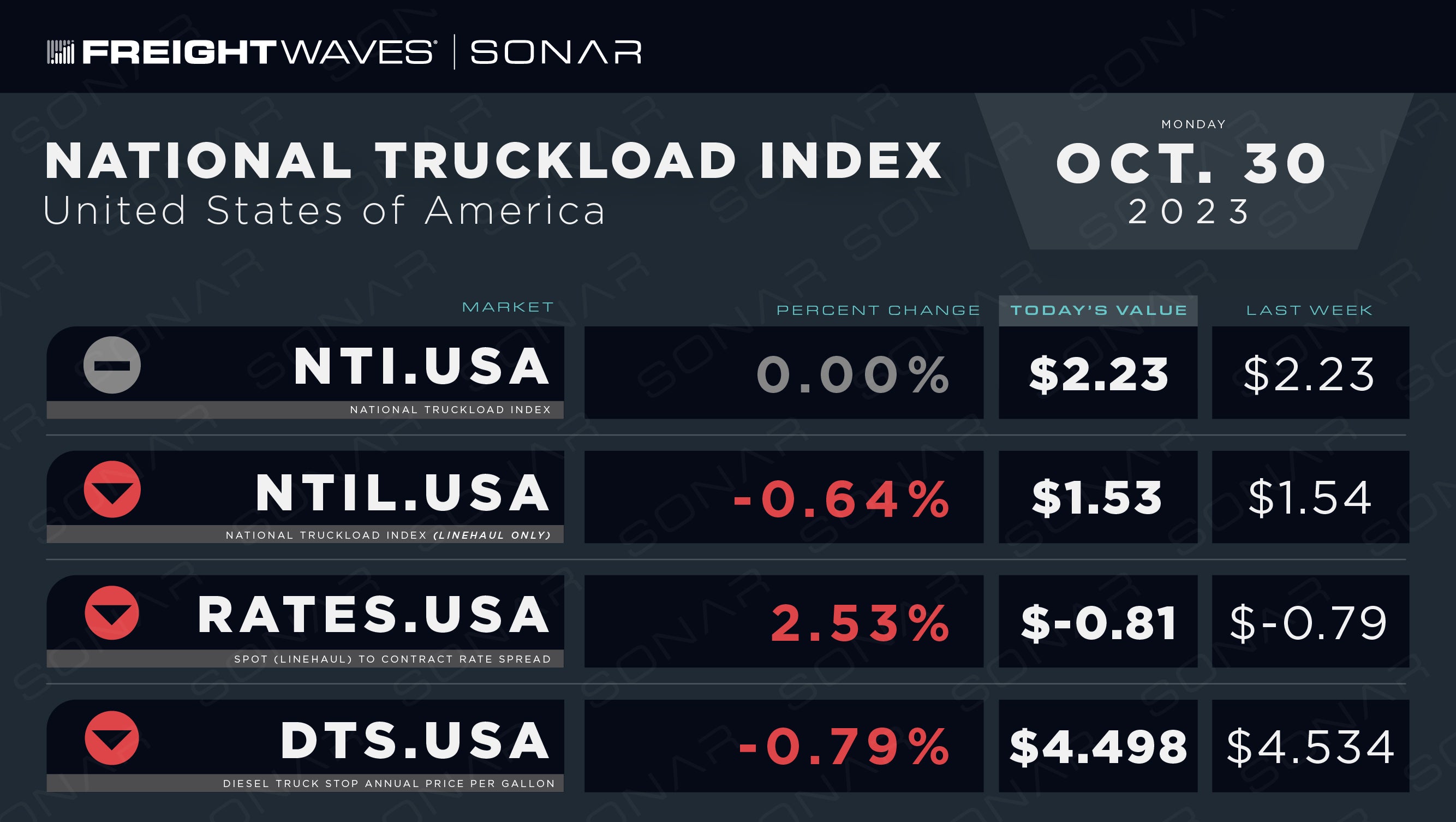
Weekly NTI Update: October 30, 2023


Learn more at SONAR.FreightWaves.com

XPO beats Q3 expectations

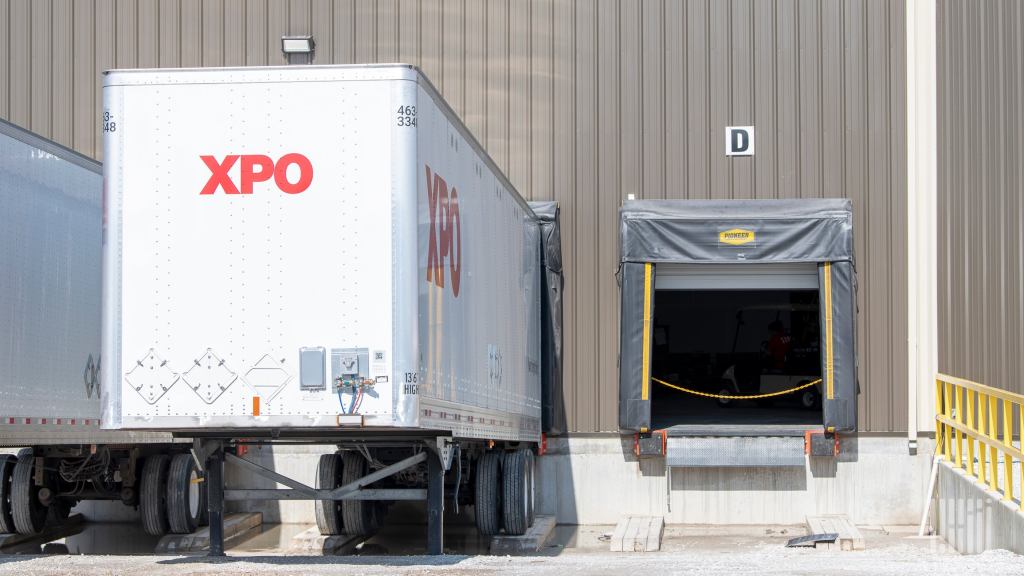
A white XPO LTL trailer loading at a facility

Less-than-truckload carrier XPO rode higher volumes and better pricing to a third-quarter beat on Monday.

XPO (NYSE: XPO) reported adjusted earnings per share of 88 cents before the market opened. The result was 25 cents better than the consensus estimate but 7 cents lower year over year (y/y). The adjusted number excluded transaction and restructuring costs.

“Our third quarter results exceeded expectations, with solid growth in revenue and profitability, and strong forward momentum,” said CEO Mario Harik.

Link to full story – XPO ups growth spending after Yellow’s downfall

Revenue in the company’s LTL unit increased 2% y/y to $1.23 billion. Tonnage per day was 3% higher and revenue per hundredweight, or yield, increased 6% excluding fuel surcharges.

Compared to the second quarter, XPO’s shipments per day increased 5%, in part due to Yellow’s exit. Yield (excluding fuel surcharges) was also up 6% from the second quarter. The segment recorded an 86.2% adjusted operating ratio, which was 140 basis points better sequentially.

The OR normally deteriorates by 230 bps from the second to third quarter. The company outperformed the mark by 370 bps.

“It’s exciting to take large steps forward across the business as we execute our plan. We’re making excellent progress, and I’m confident that we’re still in the early innings of realizing XPO’s full potential,” Harik continued.

XPO’s European transportation segment recorded a 2% y/y revenue increase to $752 million and a 5.8% adjusted EBITDA margin, which was down 10 bps y/y.

XPO will host a call at 8:30 a.m. EDT Monday to discuss third-quarter results.

Link to full story – XPO ups growth spending after Yellow’s downfall

Table” XPO’s key performance indicators

More FreightWaves articles by Todd Maiden

Daily Infographic: America’s freight railroads


To view more FreightWaves infographics, click here

Hawaiian Airlines welcomes new Amazon revenue stream

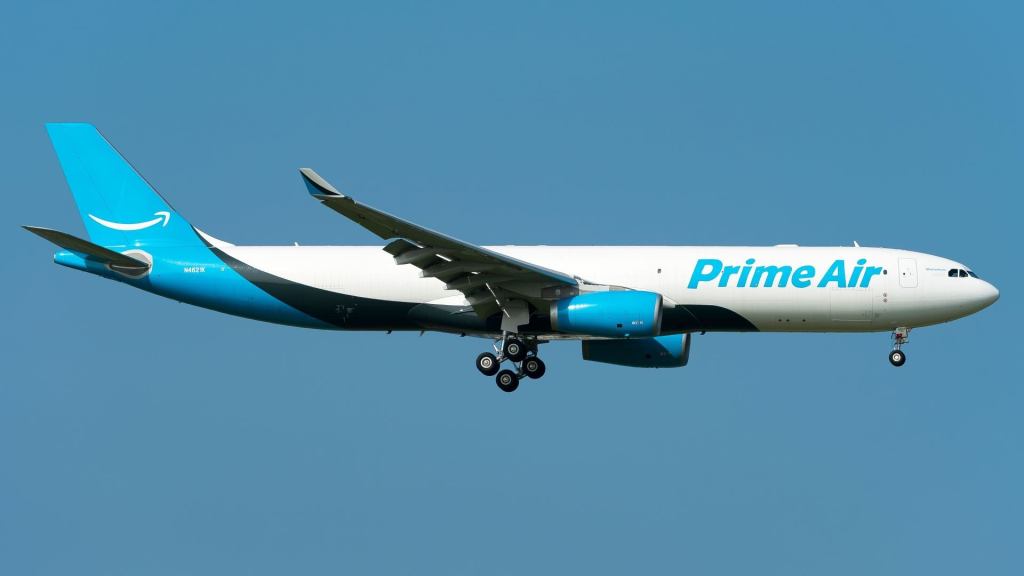
A light-blue tailed Amazon Prime cargo jet approaches airport with wheels down, side view.

The smooth debut of Hawaiian Airlines’ first freighter aircraft this month and the cash it, and sister aircraft, will generate from Amazon is a shot in the arm for an airline with losses that widened to $48.7 million in the third quarter from $9.3 million a year ago.

Hawaiian Airlines (NASDAQ: HA) began flying the Airbus A330-300 converted freighter  on Oct. 2 from the e-commerce giant’s air logistics superhub at Cincinnati-Northern Kentucky International Airport to the new West Coast hub in San Bernardino, California.  Amazon (NASDAQ: AMZN) plans to lease nine more of the widebody freighters — former passenger planes that are being overhauled to carry cargo containers — and turn them over to Hawaiian to operate on its behalf.

“It’s great to get into a place where, instead of just incurring startup costs and no revenue, we’re operating revenue flights and getting the business growing. Our on-time performance has been very good so far, which is crucial in this arrangement,” CEO Peter Ingram said in an analyst briefing following the company’s earnings release last Tuesday.

Launch costs for the A330 cargo jets include hiring new pilots and mechanics and training them.

Hawaiian is carrying about 25% more pilots than it did in 2019 for the same amount of capacity because of preparations to bring into service the A330s and a dozen Boeing 787 Dreamliners, the first of which is expected to begin passenger operations early next year. 

“As the capacity that we’re planning for comes online, our training bubble will deflate and pilot productivity will improve. We expect this improvement to grow throughout 2024 and decrease” unit costs by 50%, said CFO Shannon Okinaka.

Management said the marginal revenue produced by a single freighter during the fourth quarter isn’t material to earnings, but as the fleet grows the income statement in 2025 will include line items for the Amazon Air transportation work. 

Amazon is scheduled to add eight more A330-300 passenger-to-freighter aircraft in 2024 and the final one in 2025. Hawaiian pursued a relationship with Amazon to diversify its business.

Meanwhile, Hawaiian signed a seven-year contract with Lufthansa Technik for component maintenance, logistics support and establishing parts stockpiles for its Airbus A330 and A321 fleets at the airline’s main maintenance bases, including Los Angeles International Airport. The parts pooling arrangement covers the A330 freighters, as well as 24 A330s operated in passenger configuration. 

Hawaiian Airlines has been buffeted by a series of external circumstances that have slowed its recovery from the COVID crisis. Lost traffic due to the wildfires on Maui and a growing number of Airbus A321 aircraft sidelined by an engine manufacturing flaw are the latest setbacks. The company said the wildfires caused $25 million in lost revenue. 

In August, engine manufacturer Pratt & Whitney discovered defects with powder metal used to make geared turbofan engines and said hundreds of engines will need to be removed from aircraft for inspection over the next four years. The engine disclosure resulted in late flight cancellations. 

Hawaiian executives said they have two aircraft grounded now for engine issues and expect to have up to four out of service at any given time over the next few months. Going forward, the company will be better able to plan for missing aircraft and avoid cancellations. Pratt & Whitney will compensate Hawaiian for its failure to provide engine spares in recent months, but the agreement expires later this quarter.

Before that, Hawaiian had to cope with a handful of A321 narrowbody jets being out of service while Pratt & Whitney waited for parts to do engine maintenance; Boeing production snafus that delayed delivery of 787s ordered by Hawaiian; slow normalization of travel with Japan, a major market for Hawaiian Airlines, because the country was late to lift pandemic travel and health restrictions last year; Hawaii’s decision to virtually shut down travel for a long period; and delays and added costs associated with construction last year on the primary runway at Honolulu Airport, the airline’s main hub.

Hawaiian’s revenue per available seat mile fell 11.5% in the third quarter, with one point of deterioration attributed to reduced belly cargo because of the air cargo market’s cooldown from pandemic peaks. 

More FreightWaves/American Shipper stories by Eric Kulisch.

Subscribe to the American Shipper Air newsletter.

Amazon’s largest cargo jet makes debut

Orders for freighter aircraft slow ‘to a trickle’

Cummins predicts huge growth in natural gas engines

Workers with natural gas engines

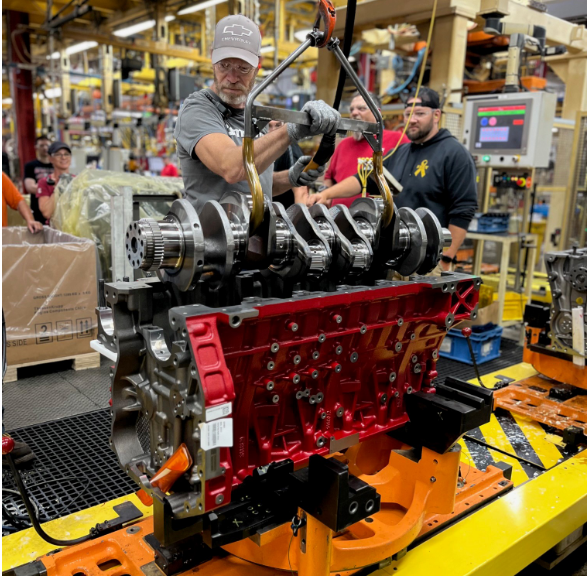
Cummins Inc. predicts its new 15-liter natural gas engine designed for heavy-duty and on-highway applications could lead to a five-fold growth in customers for the alternative powertrain. It overcomes complaints about low power and torque and can run on potentially net-zero carbon renewable natural gas (RNG).

“I’m not saying that this market will go 80% natural gas. But it’s no longer a niche,” Jose Samperio, Cummins’ executive director and general manager, North America On-Highway, told FreightWaves. “It becomes more mainstream for long-haul applications.”

Cummins’ strategy of making its next-generation 15-liter engine fuel agnostic — beginning with natural gas and followed by hydrogen and other fuels — is getting attention from OEMs and large fleets.

Jose Samperio, executive director and general manager, North America On-Highway, says Cummins could see a fivefold increase in natural gas engine sales. (Photo: Alan Adler/FreightWaves)

‘Exactly what we’re going for’

The X15N offers 400-500 horsepower and 1,450 to 1,850 pound feet of torque, comparable to the oomph of a diesel with a smaller carbon footprint.

“When the reference point is a 15-liter diesel and you hear drivers tell you that this engine drives amazing, that’s exactly what we’re going for,” Samperio said.

Werner Enterprises was first to sign on to test the X15N engine in January 2022. The engine powers the Shell Starship 3.0 experimental freight efficiency test truck. Knight-Swift is testing the engine in Southern California and reporting lower emissions of nitrogen oxides (NOx) and greenhouse gasses.

Paccar’s Peterbilt and Kenworth brands said in August they would offer the engine. More recently, Daimler Truck North America (DTNA) said in early October it would be an option for its market-leading Freightliner brand.

“Now you have a couple of brands recognizing the need. That’s why from a market perspective, less so from our side, but more from a market side, this is a great signal of it starting to become a real option,” Samperio said.

Expanding the market

A 15-liter offering expands the addressable market for natural gas. Natural gas traditionally accounts for about 2% of heavy-duty truck engines. 

“We were participating in half the market [with] a 12-liter product that couldn’t do the job of a 15-liter,” Samperio said. “Now we have a 15-liter that can do the job of a 15-liter and do the job of a 12-liter. Do some simple math. You’re essentially doubling your market presence.

“Without assuming that you’re going to gain share necessarily, but just market availability, you are in the 6, 7, 8% range.  We could see it in a few years from now developing into a potentially 10% market.”

Cummins’ 15-liter natural gas engine opens greater opportunities to be used in more trucking segments, (Photo: Cummins)

Fuel systems, too

Cummins debuted the X15N in China in 2020. The decision to bring the platform stateside led to a $452 million upgrade to its plant in Jamestown, New York. 

Enough customers indicated interest in a larger natural gas engine that Cummins greenlighted it for the U.S. Cummins is phasing out its 9-liter engine and 12-liter natural gas offerings. A 10-liter engine replaces those and will be capable of running on a range of fuels like the redesigned flagship X15.

“Based on what we are hearing, there are a number of fleets interested in the new 15L Cummins natural gas engine,” said Steve Tam, a vice president at ACT Research. “It is logical to conclude that at least some of this interest will likely result in purchases.”

In addition to the new engine, Cummins produces natural gas fueling systems — the tanks visible on the back or top of a cab or in a saddle format, depending on the vocational vehicle. 

“Fuel delivery is a big integral part of the entire system,” Samperio said. “We have tons of opportunities for integrating the product.”

A transitional solution

Natural gas is a lower-carbon alternative to diesel. Using renewable natural gas made from dairy waste and other non-petroleum feedstocks could drop its CO2 emissions into net-zero territory. However, because it burns and combusts in an engine chamber, it creates smog-forming NOx emissions.

The X15N expects to meet 2027 Environment Protection Agency standards for NOx. In the march to zero emission trucks, natural gas will fall away. But that could be decades from now.

“Natural gas can be a good transitional fuel,” said Johan Agebrand, Volvo Trucks North America (VTNA) director of product marketing. “Eventually, we all have to get to true zero-emission vehicles, which are going to be hydrogen or battery electric of some kind.”

VTNA adapts its own engines for a natural gas system from Westport Fuel Systems, a longtime joint venture partner of Cummins. Columbus, Indiana-based Cummins purchased Westport’s stake for $20 million in 2022 after their 10-year collaboration ended in December 2021. Six months earlier, Cummins purchased 50% of Momentum Fuel Technologies, a subsidiary of Rush Enterprises.

‘Bridge to a cleaner future’

Jason Skoog, a Paccar vice president and Peterbilt general manager, follows Samperio’s thinking about the potential expansion of the natural gas engine market. Peterbilt will offer the X15N in the second half of 2024.

“We already sell a bunch of natural gas business today,” Skoog told FreightWaves. “We have a couple of customers that run natural gas. And they do it because they feel it’s a bridge to a cleaner future.

“The 15-liter gives [natural gas] more of a long-haul application,” he said. “I think we will grow our sales on an annual basis. Are we going to double our sales of natural gas engines? Maybe not in the first year.”

Jason Skoog, a Paccar Inc. vice president and general manager of Peterbilt, sees greater adoption of the larger Cummins’ natural gas engine. (Photo: Alan Adler/FreightWaves)

A lot of those engines, like Knight-Swift’s pilot in California, will use RNG. It accounts for 97% of natural gas in the state and 69% nationally.

“From a well-to-wheels perspective, you can get there without making any sacrifices,” Sampiero said. “We have a big-bore engine participating in a new market, a new customer base, and we see all of the fuel suppliers investing not only on the distribution but also on the production of the fuel coming in.”  

Still, DTNA is careful about predicting future X15N adoption.

“We’ve had natural gas [offerings] since 2009-2010. We have a number of customers that set up their own infrastructure and utilize natural gas that’s been available and had success in running it,” said Greg Trienen, DTNA vice president, On Highway Market Development.

“We want to make sure we support those folks especially as we’re still in the infancy of finding the right mix of zero-emission and low-emission vehicles.”

A future of multiple powertrain offerings

As excited as Samperio is about growing the natural gas market, it is just one step on the path to Cummins’ 2050 goal of zero emissions in its engines. Half of all medium- and heavy-duty engines on U.S. roads are made by Cummins.

“Yesterday, diesel was fully dominant,” Samperio said. “But as we get into later in the decade and into the 2030s, it’s going to be a multi-technology environment where people are going to choose not only what’s best for their operations, but also what’s best from a sustainability perspective.”

If natural gas engines reach the 10% market share Samperio predicts, the customers may shift from the ones who buy it initially. Regions and rural areas where electric vehicle infrastructure lags might provide the future customers where fueling for natural gas may be more available broadly than electricity or even hydrogen.

“I don’t know that we ever will have one [powertrain] in the future,” Peterbilt’s Skoog said. “I think it’s going to take a variety of different modes including diesel to power the future, at least for the next couple decades.”

1 for 2: Cummins replacing 9- and 12-liter engines with new 10-liter

Cummins plans $1B+ investment in engine plants, hydrogen equipment

Cummins expands natural gas offerings with 15-liter engine

Click for more FreightWaves articles by Alan Adler.