NLRB joint-employer rule triggers fears of higher trucking costs

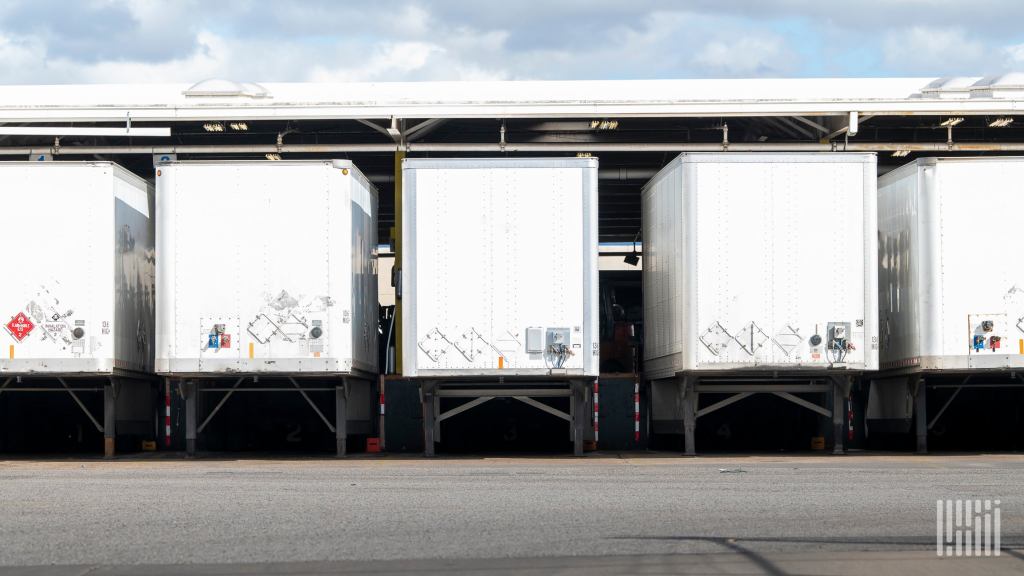
Trucks at warehouse

WASHINGTON — A change in how the National Labor Relations Board determines whether a company is considered a “joint employer” with another company could disrupt relationships among carriers while imposing higher costs on the trucking sector.

Under the new standard, issued by the NLRB on Thursday, a company may be considered a joint employer with another company if the two share one or more of the employees’ “essential terms and conditions of employment,” now defined exclusively as:

  • Wages, benefits and other compensation.
  • Hours of work and scheduling.
  • The assignment of duties to be performed.
  • The supervision of the performance of duties.
  • Work rules and directions governing performance of duties and grounds for discipline.
  • The tenure of employment, including hiring and discharge.
  • Working conditions related to the safety and health of employees.

In comments filed with the NLRB’s proposed rule last year, the American Trucking Associations was particularly concerned with including workplace safety and health as one of the determining conditions for a joint-employer relationship, given that many motor carriers have contractual provisions with other motor carriers that require compliance with federal health and safety standards.

“This will, of course, necessitate a wholesale review of those contracts due to the accompanying risk associated with being deemed the employer of another’s employees — especially when there is no or limited ability to control those employees,” ATA stated.

Asked to comment on the final rule, ATA stated that, “as expected, it largely reflects” what NLRB initially proposed.

“Although the Board recognized that requiring compliance with health, safety and other regulations does not alone constitute a joint employer relationship, there are still aspects of this rule that will limit flexibility for trucking businesses and our industry’s ability to keep the supply chain moving,” ATA stated.

Donald Vogel, a partner with the transportation law firm Scopelitis, Garvin, Light, Hanson & Feary, did not wholly agree with ATA’s assessment of the final rule. He pointed out that while the rule identifies a set of essential terms and conditions, it also states that “an entity need only share or co-determine a single term or condition to be considered a joint employer,” Vogel said.

“What is more, the entity will be implicated as a joint employer not only for the actual exercise of authority over one or more conditions of employment, but also for indirect and even unexercised authority.

“As such, if a contract exists which gives the putative employer the authority to exercise control even though that control is never exercised, under the new rule that contractual term will likely be enough to support a finding of joint employer.”

The NLRB’s change in what it considers to be joint-employer status also opens the door for employers being liable for each other’s unfair labor practices, as overseen by the National Labor Relations Act.

“More companies found to be joint employers could be pulled in and required to negotiate with a unionized workforce and face liability for unfair labor practices,” Vogel said. “So if you’re determined to be a joint employer and forced to bargain with a union over terms and conditions that didn’t previously apply, it’s going to increase your operational costs.”

The effective date of the new rule is Dec. 26, 2023, and the new standard will only be applied to cases filed after that date. The NLRB noted, however, that because it is classified as a major rule it is subject to congressional review, which could result in the effective date being postponed or the rule being withdrawn.


Click for more FreightWaves articles by John Gallagher.

Who’s the happiest driver on the road? — Taking The Hire Road

On this episode of DriverReach’s Taking The Hire Road, guest host Leah Shaver, president and CEO of the National Transportation Institute, chats with Beth Potratz, founder, president and CEO of Drive My Way.

Drive My Way is a trucking recruiting platform that has a mission to “empower drivers to live the life they want doing a job they love,” Potratz said.

In today’s climate of high turnover, recruiting efforts are often thought about in the short term.

“The spirit of recruiting hasn’t changed, but we’ve become deeply rooted in having so much work. Trying to tackle that work, we get into this cycle of administration, and it’s turned, unfortunately, over time, into a very transactional process. We’ve somehow taken [out] the human part of the process, the personalization,” Potratz said.

Drive My Way’s approach to retention is long term, aiming to help drivers find a job that will fit with their preferred schedules, locations, benefits and other preferences. To gauge what makes them happy in their careers and lives, the company asked drivers directly in a survey.

This iteration of the Lifestyle and Job Happiness Survey will appear in print in the Monday edition of Women in Trucking’s Redefining the Road magazine, but Potratz shared some of the results in this episode. 

One interesting point is the differences in expectations between different ages and at different points in drivers’ careers.

Potratz wants carriers to take note: Three out of five of the drivers who most desired better communication from management were in their careers for less than two years.

“We have to communicate with people, have genuine conversations and recognize that what we’re doing is impacting folks’ lives,” she said.

Another statistic that begs further digging is that driver pay climbed dramatically since 2019, but drivers are less satisfied with their pay today than in 2019.

Potratz believes this has to do with the nature of how jobs have changed from before to after the COVID-19 pandemic, which impacts their ability to make money. She named long wait times as an example. 

“I think it’s the relationships between what they’re being paid for and what the added expectations are that come with that. Whether they’re spoken or unspoken, drivers want to know not ‘what am I going to make’ but ‘what do I have to do to get that.’ People are anxious to post what you could possibly make, but nobody talks about all the variables that could impact you not making that,” she said.

Finding ways to put a company’s best foot forward to attract drivers can be difficult for recruiters and leaders. But Potratz recommends transparency with drivers. This is especially important regarding what the pay is and how it’s calculated.

These days drivers are also interested in the company’s equipment, their commitment to safety, flexibility for time off, whether they’re going to have inward- and outward-facing cameras and whether their speed is going to be governed. They want to know their autonomy and the expectations going into a job so they know how much control they’re going to have and what they’re going to be required to do.

Retaining drivers means being willing to be flexible and fluid to their changing needs. Potratz recommends drivers try to speak to management about new needs that may arise and possible solutions before they jump companies.

She often tells drivers: “You need to take control of your career, you’re the only one who knows what you need. If you’re not willing to step up and have that conversation at least with your current carrier [or] explore if there’s any flexibility or any other options, then the only one who loses in that scenario is you.”

Drivers might be able to be moved to other routes and schedules or even an office where they might have more predictable schedules.

When it comes to the market, at least, anywhere a driver goes they’re going to be faced with the same challenges. On the leader’s side of the coin, Potratz emphasized the importance of communication.

“What really differentiates one leader from another is your ability to step up and have those conversations with the team and be honest and talk about what everybody is feeling and experiencing from all of their different viewpoints and different roles they have,” she said.

Click here to learn more about Drive My Way.

More from Taking The Hire Road:

For better retention, focus on what’s controllable

Fleetworthy’s mission for manageable compliance

Boosting the bottom line with compliance and wellness

Mysterious fog caused one of Tennessee’s deadliest crashes 33 years ago

FreightWaves Classics is sponsored by Old Dominion Freight Line — Helping the World Keep Promises. Learn more here.

On Dec. 11, 1990, an unusual weather event caused one the deadliest crashes in Tennessee history when a dense fog fell near Calhoun, Tennessee.

The 99-vehicle pileup caused 12 deaths and 42 injuries, according to the Chattanooga Times Free Press. It began in the southbound lane of Interstate 75 when an unusually dense fog fell rapidly, reducing visibility to almost nothing in a very short time. 

According to the official highway accident report from the National Transportation Safety Board, the fog came from settling ponds and steam emitted from the Bowater paper mill nearby. The weather forecast for the day was sunny and mild with temperatures in the 60s and no evidence of fog on its way.

The fog fell so fast witnesses said it was like throwing a blanket onto a windshield, said the newspaper article. Bradley County Deputy Bill Dyer was the first on the scene and originally couldn’t even find the crash because the fog was so dense. He drove so far that he reached an area outside of his jurisdiction and had to turn around, according to Chattanooga’s News Channel 9.

Eventually, Dyer found the crash when a man walked out of the fog pleading for help. 

“A man stumbled out of the fog towards my police cruiser,” Dyer recounted. “His face was bloody and he was about to collapse. As I got out to help him, I started hearing the sound of metal crunching, just one right after the other. It was coming from north of the bridge over the freeway, but I couldn’t see anything. I stabilized the victim and started running toward the sounds I was hearing.”

“And then,” he says, “I heard the screams.”

Within those 99 vehicles that continued to pile up over the course of hours that day were numerous 18-wheelers. One woman, Becky Isbill, was able to escape her damaged car just before another vehicle sideswiped her vehicle and slammed into the back of a wrecked 18-wheeler. Quickly after that, another 18-wheeler crashed into the back of the car, killing two people.

Heart-breaking stories similar to Isbill’s piled up like the wreckage on the interstate.

In the days after the tragedy, the gruesome accident made an impact on safety protocols in Tennessee. After the wreckage was cleaned up, which took days, the Tennessee Department of Transportation installed a system to warn drivers with flashing lights and lowered speed limits when fog is detected. The system is still in place today. Advancements have been added to the system with HD cameras that have 360-degree rotation and zoom capabilities. That $6.8 million upgrade came in 2006, according to the Chattanooga Times Free Press

Many of the victims have experienced post-traumatic stress symptoms and pray nothing like this ever happens again. Authorities hope so too and created a protocol to shut down the highway if fog like that ever appears again. Today, these improvements are working to save lives and create a safer highway experience.

FreightWaves Classics articles look at various aspects of the transportation industry’s history. Click here to subscribe to our newsletter!

Have a topic you want us to cover? Email bjaekel@www.freightwaves.com.

Heartland books Q3 loss, cuts unprofitable customers and lanes

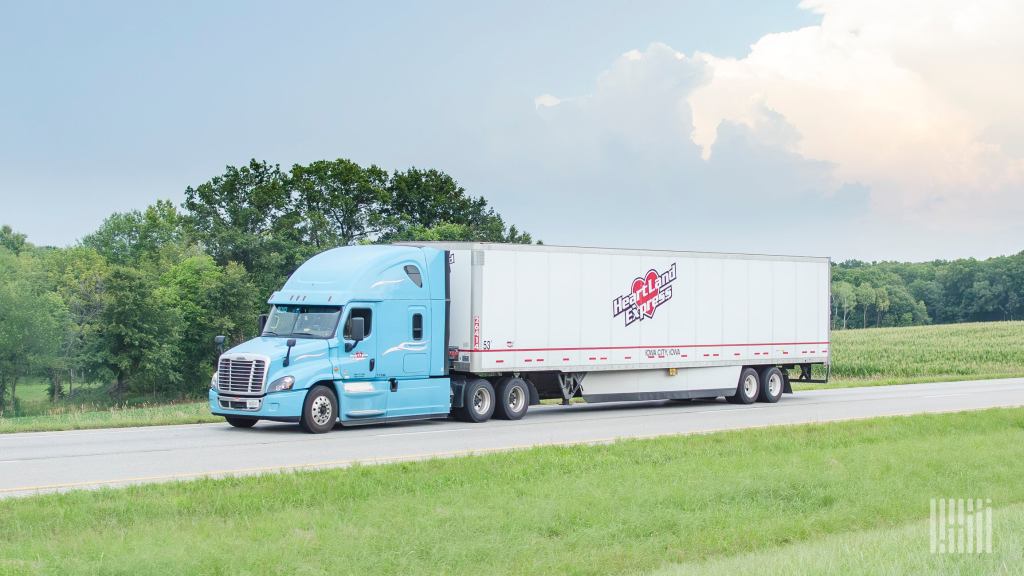
A powder blue Heartland Express tractor pulling a white Heartand Express 53-foot trailer

Heartland Express booked a net loss for the 2023 third-quarter, saying the outcome was the result of a “weak freight environment” as well as “strategic operational changes implemented.”

The North Liberty, Iowa-based truckload carrier has run into difficulty integrating the operations of Contract Freighters Inc. (CFI) and Smith Transport during a freight recession. Heartland (NASDAQ: HTLD) acquired both fleets in a relatively short window last year and, like the rest of the industry, has seen freight fundamentals deteriorate since.

Heartland reported a net loss of 14 cents per share Thursday, which was worse than a consensus EPS estimate of 8 cents and well below the year-ago result of 31 cents. Gains on equipment sales were nearly $6 million lower year over year (y/y), which was a 5 cent headwind. Increased interest expense from debt used to fund the acquisitions was a 4 cent hurdle during the period.

The company expects very little benefit from gains on sale in the fourth quarter compared to gains of $4.1 million last year.

Heartland “targeted unprofitable customers and lanes of freight that were not acceptable for the long term profitability of our organization,” CEO Mike Gerdin said in a news release.

No time frame was provided as to when operations would improve.

“These decisions, while difficult, were made to set a course for the future to ensure that we are prepared to capitalize on stronger freight demand with more efficient operations in the future,” Gerdin continued. “We cannot continue to provide our premium level of service at unprofitable or unsustainable rates.”

Table: Heartland’s key performance indicators

Heartland reported an 8% y/y increase in revenue during the quarter to $295 million. Excluding fuel surcharges, revenue was 11% higher y/y but down 5% from the second quarter. The increases were tied to the acquisition of CFI, which only provided a one-month contribution to the year-ago result.

Heartland does not provide operating metrics for utilization and pricing.

The carrier recorded an adjusted operating ratio of 102.4%, which was 1,870 basis points worse y/y.

Most expense lines as a percentage of revenue increased. Salaries, wages and benefits as well as depreciation and amortization each increased by more than 450 bps. Rent and purchased transportation expenses were 280 bps higher.

Legacy operations and the Millis Transfer fleet, which was acquired four years ago, operated at an 89.9% OR through the first nine months of the year. Smith and CFI combined for a 101.6% OR over that period.

Prior to the transactions, it wasn’t uncommon to see Heartland post low-80s ORs.

“We will continue on our path for future operational improvements and cost reduction measures at all four operating brands and remain confident that we can improve our consolidated operating results over time to align with our historical operational expectations,” Gerdin said.

The company ended the quarter with $20 million in cash, a $26 million decline from the second quarter, and $344 million in debt and finance lease obligations, a $5 million reduction over that period. It has an untapped credit line with $88 million in borrowing capacity available.

Cash flow from operations was $125 million in the first nine months of 2023.

Shares of HTLD were off 6.7% at 3:33 p.m. EDT Thursday compared to the S&P 500, which was down 0.9%.

More FreightWaves articles by Todd Maiden

Covenant Logistics hopeful despite no expected demand increase in Q4

Management at Covenant Logistics Group praised the company’s third-quarter performance in a weak freight market but still expects to see depressed load volumes across the trucking industry over the next several months.

Chattanooga, Tennessee-based Covenant (NASDAQ: CVLG) reported third-quarter earnings after the market closed Wednesday. Company officials held a conference call to discuss the results with analysts on Thursday.

“We are optimistic that the trough of the freight cycle is behind us but remain cautious about the rate at which we will see improvements,” Paul Bunn, Covenant’s president and chief operating officer, said during the call.

Bunn said inventory destocking by its retail customers — which has reduced demand for shipping — could be ending as stores look to rebound over the next several quarters.

“I think that the destocking is behind us and hopefully in the next six months, we believe we can get in some sort of more normalized restocking pattern,” Bunn said. “If fuel prices stay high, hopefully capacity continues to exit the market, maybe in the next six to nine months, we’ll get this thing back in balance a little bit.” 

The truckload transportation services provider reported adjusted earnings per share of $1.13 in the third quarter, 1 cent lower than the Wall Street consensus estimate and 26% less than the same period in 2022.

Covenant’s total revenue in the third quarter was down 7.4% year over year to $288.7 million. Total freight revenue decreased 5% y/y to $253.3 million.

The company operates four business segments: expedited, dedicated, warehousing and managed freight transportation.

Warehousing was the only segment that had higher y/y results during the quarter, producing a 14.8% y/y increase in freight revenue to $25 million.

Covenant officials said third-quarter results in its dedicated segment benefited from the acquisition of Huntsville, Arkansas-based poultry hauler Lew Thompson & Son Trucking, acquired in April for $100 million.

“One of the things that we’ve brought to [Lew Thompson & Son Trucking] in terms of growth potential is something they’ve never had before. … [G]etting outside of that wheelhouse of their region is something that they have not done before,” said Tripp Grant, executive vice president at Covenant. “I do think that there is lots of opportunity. I’d be hesitant to kind of give numbers right now, because we’ve got a lot of things in the pipeline. But it’s a feather in our cap next year with just the opportunities that I believe that we have with Lew Thompson.”

Covenant officials also said cost reduction and stock repurchase initiatives — such as reducing tractor fleet counts across its business segments, lowering costs per mile and selling off underperforming assets — have helped improve margins and cash flow during recent quarters.

Covenant repurchased $30 million of stock in the first quarter of 2022 and made an additional $75 million stock repurchase in the second quarter of 2023.

“Since Jan. 1, 2022, we have repurchased $110 million of stock, paid $10 million of dividends and had three very creative acquisitions for $156 million,” Grant said. “[We have] paid out a total of $275 million that are moving the business and the valuation forward. In turn, we’ve had to sell underperforming capital, two terminals for $40 million and $56 million that weren’t producing a return on investment. We’ve seen the truck counts come down over the previous quarters. We’re selling off underperforming capital to help finance these things that are producing above-market returns on invested capital.”

For the fourth quarter, Covenant officials expect revenue and earnings to experience a small decline sequentially due to cyberattacks on a major customer and the ongoing United Auto Workers strike, which has temporarily depressed load volumes, Bunn said.

“There’s less work in Q4 with all the holidays,” Bunn said. “I think we’ll be down sequentially, but I still think it’ll be a nice fourth quarter. It’ll be a modest decline.”

An analyst also asked Covenant officials about the company’s stock performance over the past several years, whether they feel undervalued by the market and would consider taking the company private again.

“We can’t talk about going private or anything like that, but that’s why we have a board: to talk about all the issues that are there and we’re busting our butts,” said Chairman and CEO David Parker. “Two or three years ago, when we started down this road of where we should be in the market … somebody’s going to love us, Wall Street can love us, we’re going to love our staff, we bought back 25% of the company, and we’re doing a great job. This team is doing unbelievable, I could not be any more excited about what the group is doing. I think Wall Street will reward us. I think one day that it will wake up and say, ‘They are doing well,’ and we will get rewarded.”

Shares of Covenant were down 4% on Thursday at 3:30 p.m. EDT.

Click for more FreightWaves articles by Noi Mahoney.

More articles by Noi Mahoney

Covenant Logistics sees Q3 revenue slip in weak freight market

Borderlands: Cargo theft trends changing as supply chains shift to border regions

Texas DPS ends truck safety inspections after $1.9B impact

Brokers should use technology to stand out this RFP season

The current freight recession has created a market characterized by an overabundance of capacity and a stubborn lack of demand. While the market remains depressed, industry experts have noticed signs of an impending rebound in the mid-term future.

“The national Outbound Tender Reject Index (OTRI) topped 4% [in August] for the first time since early January, when it was recovering from the holiday period,” FreightWaves market expert Zach Strickland reported in late August. “While 4% is still indicative of a very loose market, the timing and direction of the OTRI are signaling that the softest conditions may be in the rearview mirror.” 

This high-frequency data — housed in FreightWaves SONAR — aligns with what logistics leaders are seeing in real time.

“Freight news is abuzz with the forecasted bounceback of the market in mid-2024, but shippers still have the upper hand in the market,” Trucker Tools CEO Kary Jablonski said. “Carrier authority revocations are finally slowing down, though, so we expect to see spot and contract rates climb in the future.”

While these indications of a freight market shift are heartening for carriers, their strongest impacts will not be seen until well after the conclusion of the next bid season. 

In order to win bids this season, brokers and carriers will need to prove their technological prowess. Shippers have high expectations for carriers and meeting those expectations without an ample suite of modern solutions is no longer possible. 

“You need to be able to demonstrate that you are using the most up-to-date tech possible to help you comply with their scorecard,” Jablonski said. “Shipper scorecards are stringent and visibility is paramount to providing great service.”

Trucker Tools offers a suite of solutions designed to ramp up compliance percentages and provide next-level visibility. One of the company’s most recent innovations — Text to Track — ties into the company’s innovative waterfall tracking approach in order to better achieve that goal.

“Waterfall tracking” means that a visibility provider, like Trucker Tools, automatically assigns the best available tracking method to each individual load based on information provided when the track was created and what the company already knows about the carrier.

“We want to meet them where they are. This benefits the broker because they don’t have to figure out how to best track a given driver,” Trucker Tools product manager Jarret Stowe said. “We will automatically try ELD tracking, app tracking and then our new Text to Track method without any broker interaction required.”

The method works. In the first two weeks, Text to Track customers have seen a 4% increase in their compliance ratings, according to Stowe.

This cutting-edge approach to tracking can be combined with Trucker Tools’ other tech-driven solutions — including real-time digital freight matching — to help companies stand out.

With the company’s digital freight matching tools, brokers can take on more freight during peak season without increasing head count with features like smart negotiations or Book It Now

Beyond excellent visibility, brokers will also need to have rock solid carrier management solutions in their arsenal this year. 

“Carrier relationship management is paramount in driving successful RFPs and bids,” Jablonski said. “With fraud on the rise, the best way to keep your network and freight secure is to continue investing in your core, trusted carrier base. Working with the best tracking and visibility partners can help you provide best-in-class service levels to shippers.”

Trucker Tools offers a comprehensive carrier relationship management platform, allowing brokers to engage with a whole new network of carriers while building stronger relationships with their existing partners. 

Overall, Trucker Tools can help brokers achieve 75% more offers on their loads while growing their carrier network up to 20x and achieving 90% compliance. That is the power of modern technology.

“This is a competitive industry and staying up to date with new technology can help you stand out in a crowded field,” Jablonski said. “Technology is not about replacing people, it’s about empowering them to work smarter and more efficiently, freeing up their time to build business.” 

Click here to learn more about Trucker Tools.

Truckers on high alert after spree shootings in Maine

Welcome to the WHAT THE TRUCK?!? Newsletter presented by AIT. In this issue, shooting spree in Maine has drivers on edge.

Shooting spree in Lewiston


X

Tragedy Wednesday evening all hell broke loose in Lewiston, Maine, when a gunman went on a rampage at multiple locations. NBC News reports, “At least 18 people are dead and 13 others are injured after shootings at a bar and a bowling alley.”

Although initial reports said that a Walmart distribution center was a shooting location, that has proved to be inaccurate. We now know the gunman staged his attacks at Just-In-Time Recreation bowling alley and Schemengees Bar and Grille.

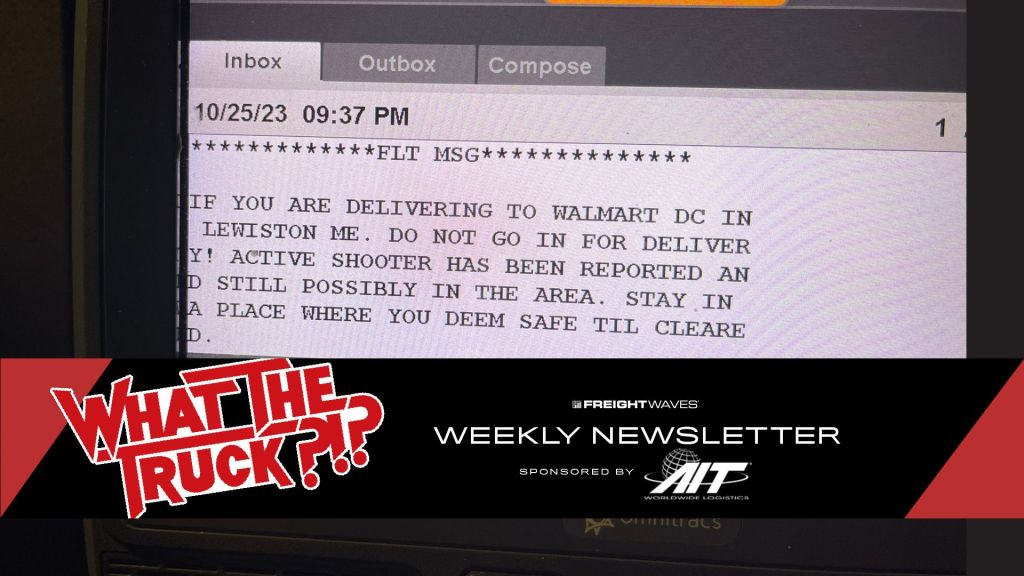
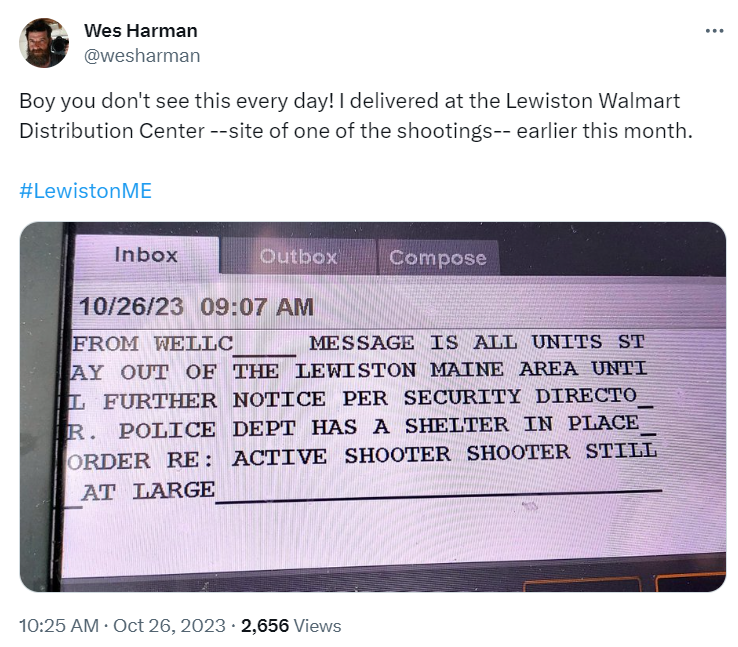
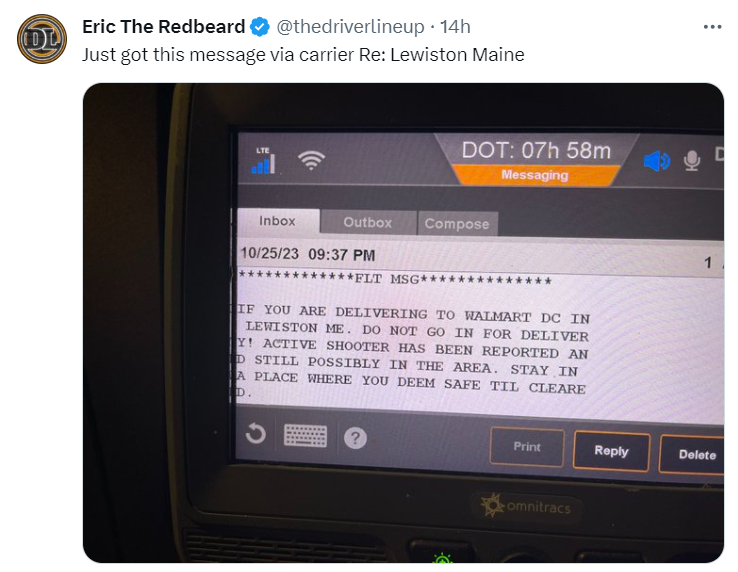
Last night area residents were ordered to shelter in place while truckers in the area were put on high alert via messages over their Qualcomms.


X

“I delivered drop and hook to that Walmart 48 hours ago. F**king hell.” — Trucker Eric The Redbeard on X

On the loose — Police are conducting a manhunt for 40-year-old Robert Card, who they say is on the run. CNN reports, “[Card] previously reported mental health issues and hearing voices and threatened to shoot up a National Guard base in the state, Maine law enforcement officials said.”


X

BOLO — With the whereabouts of the shooter unknown, keep your drivers and employees in the area on high alert.

“What Lewiston Maine says to us drivers is there is NOWHERE that is ‘safe’ from this kind of shit. You can’t be sitting at a truck stop in the middle of nowhere thinking you’re away from the flack any more.” — Trucker Eric The Redbeard on X

As for where Card could be, that’s as of yet unknown. CNN spoke to Clifford Steeves, who knows the shooter. He told them, “He would be very comfortable in the woods.”

“I know that the people of Lewiston are enduring immeasurable pain. I wish I could take that pain from you, but I promise you this, we will all help you carry this grief. I ask Maine people to join me in offering our comfort to the families and friends who have lost someone and in offering our prayers for a swift recovery to the people who are healing in Maine hospitals today.” — Maine Gov. Janet Mills

Our thoughts are with the victims and anyone who may be in harm’s way while a spree killer is on the loose. Be vigilant and be safe out there.

WTT Friday

The logistics launching NASA’s next Commercial Crew mission On Friday’s episode of WHAT THE TRUCK?!?, NASA Kennedy Space Center’s Brian Berry talks about the logistics launching NASA’s next Commercial Crew mission. In this role, he ensures mission readiness and certification prior to launch, and coordinates real-time operations for the CCP Mission Support Team throughout the mission. This includes dry dress rehearsal, launch, docking, docked period at the International Space Station, undocking and return.

Diablo Freight Ventures’ Tyson Lawrence talks about overcoming failure in freight. Lawrence went from a failed brokerage to building one that he sold to GlobalTranz. He’ll share how to pivot and when to pivot when faced with big challenges, the best environment to build and create a freight brokerage, and how to stay financially solvent in this operating environment.

F3 descends upon Chattanooga in just 12 short days. FreightWaves’ Haley Fazio is here with a preview of what’s going down at the Future of Freight Festival in the Scenic City this November. Need tickets? Use code F3WTT right here.

Plus, latest news and trends.

Catch new shows live at noon ET Mondays, Wednesdays and Fridays on FreightWaves LinkedIn, Facebook, X or YouTube or on demand by looking up WHAT THE TRUCK?!? on your favorite podcast player.

Now on demand

Convoy sold; theft of 2 million dimes; escalating truck insurance

Broker purge, portable urinals and AI for DOT compliance

Tweet @ Dooner

Subscribe to the newsletter

Subscribe to the show

Apple Podcasts

Spotify

YouTube

TikTok

Twitter

Or simply look up WHAT THE TRUCK?!? on your favorite podcast player. 

All FreightWaves podcasts can also be found on one feed by looking up FreightCasts wherever you get your podcasts. 

Don’t be a stranger,

Dooner

Loaded and Rolling: ATRI finds congestion cost trucking $94.6B

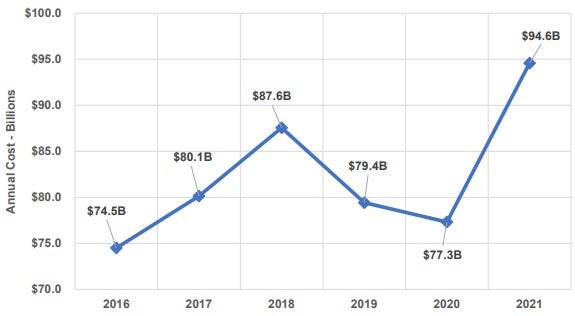
ATRI: Cost of congestion to trucking hits $94.6 billion

(Source: ATRI)

On Wednesday the American Transportation Research Institute (ATRI) released its latest Cost of Congestion study showing U.S. highway traffic congestion added $94.6 billion in costs to the trucking industry. The study notes the states of Nevada, Louisiana, Georgia and California saw the largest increases. 

FreightWaves’ John Gallagher writes, “ATRI’s 2021 congestion costs — based on the cost-per-hour to operate a truck, average truck highway speeds and the most recent truck volume data — were 22.4% higher than 2020’s and 27% higher than the 2016 baseline. During that same five-year period, the Consumer Price Index, a measure of inflation, increased 12.9%, ATRI noted.”

The report adds that delays increase trucking operational costs including driver compensation, fuel, repair and maintenance. Lower utilization and slower transit from congestion caused trucking costs to increase at twice the rate of inflation during 2021. Breaking down the data, the study noted that when distributing the overall costs to all registered tractor-trailers, the annual added cost came in at $6,824 per truck, or 3% of the revenue generated per truck in 2021.

Knight-Swift highlights U.S. Xpress integration

(Source: Knight-Swift)

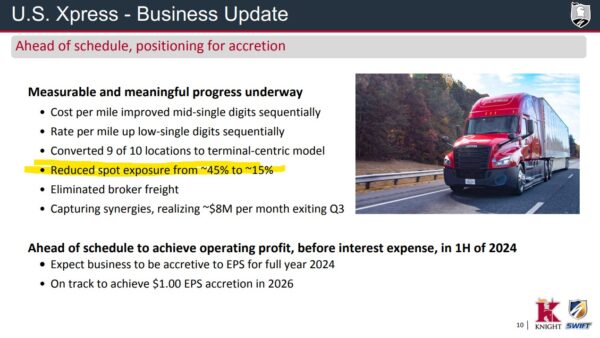
Truckload carrier Knight-Swift’s third-quarter earnings release updated the progress on turning around U.S. Xpress, which was recently acquired by the company and closed in June. One major challenge involved getting USX’s spot exposure back to industry norms. Knight-Swift noted in a slide deck that its spot exposure was reduced from 45% to 15%. Typical large, nationwide truckload carriers prefer a spot-to-contract exposure of around 10%.

Part of this change involves adjusting the fundamental business model of USX. During the earnings call, David Jackson, president and CEO said, “U.S. Xpress is rolling out a decentralized terminal-based operating model similar to Knight-Swift where there is P&L accountability at the local level with far more personal driver interaction. Nine out of the 10 locations have been converted from places to park to operating terminals.”

Jackson noted that the bottom of the freight market cycle remains but there are early signs of market sensitivity when either truckload supply leaves the market or an incumbent carrier can no longer honor lower rates. He added, “However, we are not seeing enough of that kind of activity or enough supply leave and/or enough strength in volumes to move rates to a meaningful inflection position right now.”

Market update: Gradual improvement for October For-Hire Trucking Index

(Source: ACT Research)

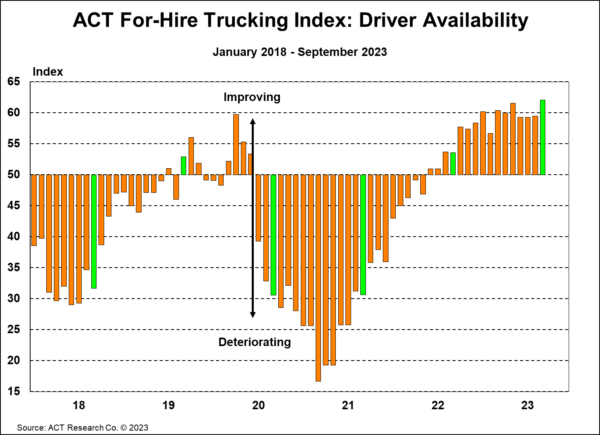
On Tuesday, ACT Research released results for its October For-Hire Trucking Index, suggesting a gradually improving freight market. Notably, the driver availability index saw an all-time record high of 62 index points for September. An index reading over 50 indicates an expansion while a reading below 50 signals a contraction. 

The report notes: “Fleets continue to see a large influx of drivers, unprecedented in our survey’s relatively brief history. We believe the source of these drivers is the challenged owner-operator market, which tends to rely on spot rates. With the scars of being unable to find drivers, or lure them away from stimulus money with the pandemic still fresh, employers across the economy are focused on labor retention.”

Truckload pricing recorded a 9.2-index-point improvement in September, to 48.5 seasonally adjusted as rates stabilize and capacity rebalancing continues. Volumes dipped 4.9 points to 49.5 compared to August’s reading of 54.4. The report is optimistic for future freight volumes in spite of declining consumer savings rates and private fleet growth, which have been headwinds for for-hire trucking volumes.

FreightWaves SONAR spotlight: More strikes, longer wait times for automotive

(Chart: FreightWaves SONAR)

Summary: On Tuesday, the United Auto Workers expanded its ongoing strike to a crucial General Motors plant in Arlington, Texas, following GM’s reporting of its third-quarter earnings. The Arlington Assembly plant includes around 5,000 workers who produce the Cadillac Escalade and Escalade ESV, GMC Yukon and Yukon XL, and Chevrolet Tahoe and Suburban SUVs.

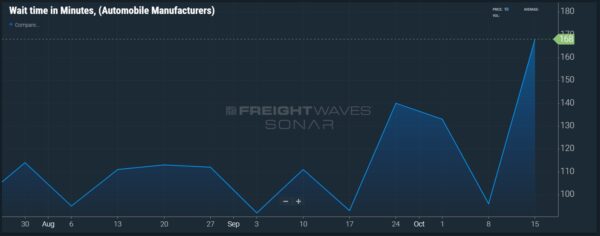
The ongoing strikes against the Detroit Three automakers appear to be causing higher-than-average wait times for automobile manufacturers, measured by the FreightWaves SONAR Wait Time index (WAIT). As of Oct. 15, a truck spent an average of 168 minutes at a shipper or receiver for loading or unloading, compared to a pre-strike average of 110 minutes.

The total impact of these lost automotive freight volumes is important for carriers exposed to these disruptions. Specialized automotive carriers are at the most risk from a prolonged strike, with either specialty equipment for transporting or an inability to replace the contracted automotive volumes on such short notice. Van outbound tender volumes remain muted as October draws to an end, down 285.91 points or 3.43% from 8,329.66 points on Sept. 24 to 8,043.75 points.

Convoy’s shutdown exposes the desperate state of trucking (FreightWaves)

Death from overfunding: An obituary for Convoy (FreightWaves)

New data shows 14% decline in large-truck fatalities (FreightWaves)

Nikola claws back $165 million from founder Trevor Milton (FreightWaves)

How long will the capacity correction take? (FreightWaves)


Covenant Logistics Group sees Q3 revenue slip in weak freight market (FreightWaves)

The hidden costs of manual LTL shipment life cycle management

The digital era has ushered in innovative technology solutions to complex problems the supply chain has historically faced. While businesses have digitized their operations, too often data remains siloed between various systems and programs. This creates disconnects, requiring manual processes to complete and connect workflows and the resulting communication and information flow to customers. 

Shippers still managing their businesses using individual carrier websites or through internal isolated systems are limiting their potential to save money, grow efficiency, increase customer service and redirect resources to revenue-generating activities. This prevents them from enjoying the full benefits of shipment life cycle automation.

When processes and data are siloed, it requires a sizable chunk of employees’ time and attention to complete tedious tasks, such as retrieving rate quotes, scheduling pickups, tracking shipments and retrieving documents. Not only do these processes create a slower, less-than-optimal customer experience, but they also reduce internal productivity. 

When shipping KPIs miss the mark, it can result in late delivery and missed appointment fines, delayed payments for improper invoice match or late proof of delivery. These take a toll on businesses in overall profitability, lost wages and opportunity costs when time could be redeployed elsewhere. Further, manual entry can introduce errors that take additional time and effort to resolve.

Shippers want and need to proactively manage their business, which includes ensuring smooth delivery for customer satisfaction. They require quick notifications from carriers when something goes wrong with shipping. With manual processes, however, that is not always possible.

“LTL carriers are managing the movement of goods for thousands of shippers every single day. Although there are some exceptions, the expectation that an LTL carrier will call a shipper when a shipment is delayed is generally unreasonable,” said Brian Thompson, chief commercial officer at SMC³, a trusted transportation data and solutions provider with 88 years of expertise.

Application programming interfaces and electronic data interchange connections are both prevalent for their ability to bridge the complete shipment life cycle and provide shippers with complete visibility into the status of each shipment, making it possible to receive real-time updates, from pre-shipment to final delivery.

For example, using an electronic bill of lading (eBOL) API service to transmit shipment information and details eliminates a carrier’s need to manually enter the shipment information into the carrier’s billing system from the paper BOL. This electronic transfer of information saves the carrier effort while ensuring the information entered is complete and accurate, improving the likelihood of successful on-time delivery of the shipment.

“Eliminating manual processes on the shipper’s side, connecting to your carriers through API services can save the carrier manual labor, reduce errors and elevate the shipper to ‘shipper of choice’ status by reducing the carrier’s cost to serve,” Thompson said.

SMC³’s LTL API solutions help connect and streamline shippers’ services, closing the gaps in a shipper’s processes to remove inefficiencies. SMC³ does this by connecting the shipper’s system with the carrier’s freight management system to digitally communicate and transfer critical information about the shipper’s freight moving with that provider.

Using all of SMC³’s API services, shippers and logistics services providers (LSPs) can manage their shipments across their entire life cycles, from quote to invoice. Shippers can obtain rate quotes, schedule pickups, preassign a progressive routing order (PRO) number to the shipment before pickup, take advantage of a PRO number management service, and track and provide customers with the status of a shipment in transit. It can also retrieve document images, including the BOL, invoice, weight and inspection certificate or proof of delivery. 

Express Logistics, a leading third-party logistics provider specializing in LTL, experienced the productivity benefits that SMC³’s APIs offered its business. Though Express had adopted another provider’s API services, performance and service gaps prevented Express from realizing the full benefits of LTL APIs. Express opted for SMC3’s APIs and experienced a significant improvement.

“Because of our partnership with SMC³, we are now able to rate 100% of our LTL carriers via API. We’ve simplified our core process for building and maintaining contracts, which gave us the ability to utilize this additional labor in other key business areas,” said Dianne Giltner, director of operations at Express Logistics.  

Additionally, Giltner said, “SMC3’s LTL APIs gave us the ability to move from manual processes, separate from a TMS, to automatically managing excessively lengthy accessorials. This provides our customers with complete quotes and accessorial visibility on the front end, saving time and resources and reducing accessorial invoice surprises.” 

Carrier Logistics, a transportation management logistics software provider, also noted the ease of executing critical transportation processes through SMC³’s APIs.

“Quoting became automated and could be done without human intervention,” said Ben Wiesen, president of Carrier Logistics. He added that “single-button dispatching replaced lengthy manual entry of orders in the carrier portals.”

While API integrations are invaluable, working with the right API provider is paramount to maximize opportunity and eliminate issues that can sometimes occur in these integrations, such as inconsistencies and technical issues caused by varying attributes, data requirements and business rules across carrier services. 

For example, complications can arise from simple variances in field length. Some carriers may allow for 64 characters in a field while others allow for 256 characters. When the character limits are exceeded, some carriers cut the message at the character limit, while others return an error message. Information critical to the service performance can be lost when messages are truncated.

SMC³ standardizes these connections so a shipper can connect to SMC³’s API services and immediately connect to the shipper’s stable of carriers.

“Standardization greatly accelerates the process of connecting to carriers,” Thompson added. “It is vital for shippers to connect to their carrier networks efficiently and reliably so their operations and processes do not suffer.”

SMC³’s approach to working with shippers and LSPs focuses on delivering creative problem-solving and adding unparalleled business value. SMC3 offers both API and EDI technology. If a shipper has invested significant infrastructure in EDI and requires a hybrid solution, EDI and API can be tapped to connect the shipper to the carrier, to ensure the flow of reliable, timely data. SMC³ has the ability to customize in a way that matches the shipper’s preference and provides a complete solution.

Contact your sales rep at SMC³ or complete the “additional information” form on its website to get information about SMC³’s LTL APIs and how they can reduce the hidden cause of manual LTL shipment life cycle management for your organization.

UPS reports higher volume diversions due to labor unrest

UPS Inc. said Thursday that more daily volumes were diverted to rivals during volatile contract negotiations with the Teamsters union than it expected and that it has recaptured about 40% of the lost business.

The Atlanta-based company said that about 1.5 million daily parcels were diverted due to customer concerns over a possible Teamsters strike that never materialized. That is higher than the company’s original diversion estimate of 1.1 million parcels. 

About 600,000 parcels have returned to the network, with roughly half of that coming from chief rival FedEx Corp. (NYSE: FDX), UPS executives said. FedEx, for its part, has said it captured about 400,000 daily diverted UPS packages and has retained the lion’s share of them.

UPS’ (NYSE: UPS) low-water point came in August, when average daily volumes were reported down 15% year over year (y/y). CEO Carol B. Tomé told analysts Thursday that the August numbers reflected in part customers’ desire to wait until the Teamsters contract was fully ratified in early September before returning volumes to UPS. For the quarter, average U.S. daily volumes dropped 11.5% y/y, UPS said.

The five-year contract added about $500 million to UPS’ third-quarter costs, company executives said. Union wage rates rose 11% in the third quarter as part of what is expected to be a significant compensation bump in year one of the contract. UPS has said that 46% of the overall compensation increases is front-loaded into the first year.

Average daily volume in August was approximately 16 million parcels, according to UPS. That has risen to about 19 million as of October, the company said. Along with volume diversions, UPS had to manage through reduced demand for deliveries as customers ship less due to a slowing economy and more consumers returning to stores, as well as U.S. consumers shifting their spending from goods to what has become known as “experiences.” 

Tomé said the U.S. consumer remains healthy but is “spending their dollars differently.” 

In a stark reflection of the round turn the U.S. package delivery business has taken since the end of the massive surge in pandemic-related online ordering, UPS’ U.S. package volumes are back to pre-COVID levels, Tomé said.  

In response to a query as to whether the pace of diversion may slow down heading into peak season because customers may be reluctant to disrupt their operations during the cycle, Tomé said customers want to return to UPS before the peak because of its “superior service” and that UPS has not incurred any material expense in winning back diverted business. 

At the same time, the company backed off earlier projections that y/y volumes would return to flat by the end of 2023, saying there will still be a single-digit deficit as the calendar turns.

A bumpy ride in Q3

UPS didn’t sugarcoat the difficult macro environment affecting its global operations. International markets remain weak, and in some cases were weaker than the company originally thought would be the case during the quarter. Overcapacity on international trade lanes had the added effect of reducing UPS’ margins, executives said.

The overcapacity problem is most pronounced in the U.S. domestic package segment. In total, the market has the equivalent of 110 million parcels of daily capacity, according to estimates from ShipMatrix. That doesn’t include capacity that Amazon.com Inc. is likely to add as it expands its Amazon Shipping service to include daily pickups, ShipMatrix said. By contrast, average daily volumes are currently estimated to be about 69 million, the consultancy said.

ShipMatrix expects peak parcel volumes to be down 7% to 9% from 2022 levels. In response to slowing demand, parcel shippers are resisting the full seasonal delivery surcharges that the carriers are demanding, according to Satish Jindel, ShipMatrix’s CEO. Instead of paying a per-package surcharge of, say $1.50, shippers may offer to pay a third of that or even less, he said. 

Jindel said the expected peak weakness is part of what is evolving into the most challenging environment for parcel carriers in years as overcapacity collides with slowing demand. He also criticized UPS’ plans to hire up to 100,000 seasonal workers, saying the expected holiday demand doesn’t justify the added labor expense. UPS never discloses how many seasonal employees it actually hires for peak.

Given the macro headwinds, the diverted volumes and the higher operating costs from the Teamsters contract, UPS expected the third quarter to be a bumpy ride. And it was. Systemwide, revenue fell 12.8% to $21.1 billion from year-earlier levels. Operating profit of $1.3 billion was down 47.7% y/y. Adjusted diluted earnings per share was $1.57, down 47.5% from a year ago but 1-5 cents a share higher than consensus estimates.

UPS’ three business units felt the headwinds. The domestic business, its largest, posted an 11.1% revenue drop to $13.6 billion and a near $1 billion drop in adjusted operating margin to $665 million. Deferred air revenue dropped 19.6% y/y, which ShipMatris said reflected the long-planned wind down of business from Amazon, UPS’ largest individual customer and a huge user of its deferred air services.

International revenue fell to $4.26 billion from nearly $4.8 billion in the year-earlier quarter. Adjusted operating profit dropped to $675 million from just over $1 billion. Average daily volume fell 6.6% amid continued weakness on Asia and Europe trade lanes.

Supply Chain Solutions, which encompasses all of UPS’ non-package operations, posted revenue of $3.13 billion, a 21.4% decline, due to lower volumes and margin weakness in freight forwarding and truck brokerage, partially offset by growth in the unit’s health care business.