On Episode 691 of WHAT THE TRUCK?!?, Dooner is joined in studio by Redwood’s vice president of sourcing and author Gubio Henrique. They’re talking about his new book “Insights To Nearshoring.” We’ll find out the good, the bad, the winners, the losers and what’s happening now in this emerging space.
CtrlChain CEO and founder Giovanni Gubbels talks about turning assumptions into data-driven decisions.
Northland Trucking Risk Control’s Anthony Slamar is passionate about driver training and improvement. He talks about how to turn truck accidents into teachable moments.
Plus, another freight heist in California; United Boeing loses wheel during takeoff; how American Truck Simulator is recruiting real drivers; Chattanooga Airport’s $28 million expansion; is daylight saving time killing us; and more.
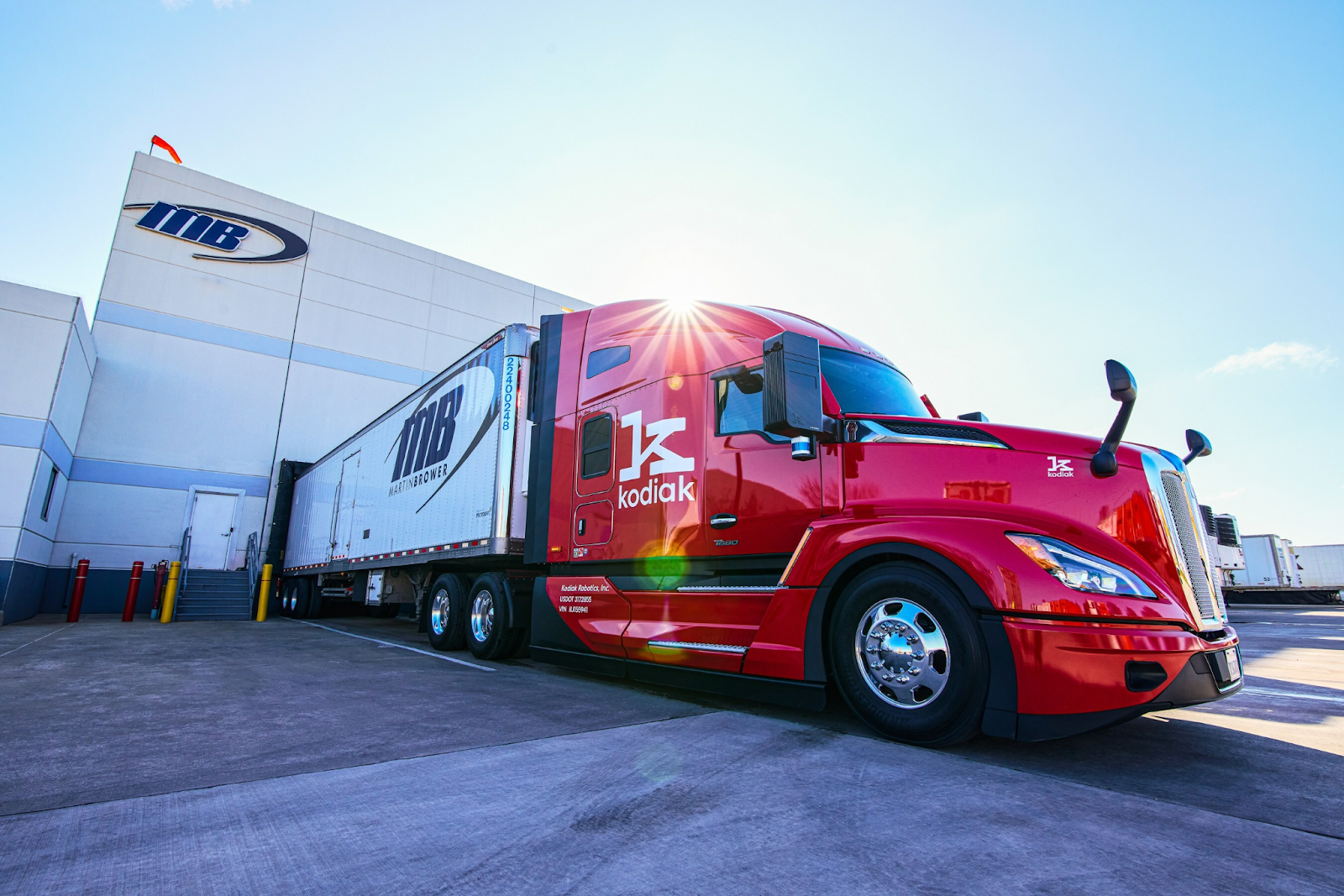
Big things are happening between Dallas and Oklahoma City and it’s not a tornado. Kodiak Roboticshas partnered withThe Martin-Brower Co. to bring temperature-controlled freight to quick-service restaurants using Kodiak’s autonomous trucks.
The duo has been working together since July 2022 and has completed more than 600 autonomous deliveries. In this specific instance, the route between Dallas and Oklahoma City is considered a “shuttle lane,” and the autonomous trucks are taking goods from hub to hub for local drivers to complete the final delivery.
“Your next order of fries may have traveled on a Kodiak truck,” said Don Burnette, founder and CEO at Kodiak. “Autonomous trucks are well-suited to the difficult work of long-haul driving, while allowing our partners’ local drivers to handle last-mile deliveries and provide a personal touch for customers. Martin Brower’s shuttle lane model is an ideal application for Kodiak that enables us to demonstrate the value of our technology within our customers’ existing networks.”
Temperature checks
(Photo: Shutterstock)
A second life could be in the works for an old abandoned vertical farming operation in Pittsburgh. The Braddock building, home of the abandoned operation, could become a state-of-the-art food manufacturing and cold storage facility, according to the latest proposal for redevelopment.
The current building owner, RDC Design + Build, is making the move to have a cold storage facility because there is a large need for food production and cold storage facilities in the region, but also because the existing vertical farm has processing features that can be modified to become food-grade. RDC hopes to have the conversion complete at the end of this year.
Food and drugs
(Photo: Business Wire)
Coming to the local deli aisle is the newest plant-based offering from Oscar Mayer. The Kraft Heinz Not Co. debuted the new NotHogDogs and NotSausages. This is the first plant-based offering from Oscar Mayer and is the first joint venture between Kraft Heinz and TheNotCo.
According to a Kraft Heinz news release, “The United States plant-based market is projected to skyrocket from $8.3 billion in 2023 to $19 billion by 2030. However, plant-based hot dogs and dinner sausage links remain underdeveloped and under-consumed within the broader plant-based meat category.”
The innovation will start rolling out at stores later this year, potentially in time for summer barbecue season. The jury might still be out on taste, but there is one thing we’ll have to figure out with this development. Is a plant-based hot dog a sandwich?
Cold chain lanes
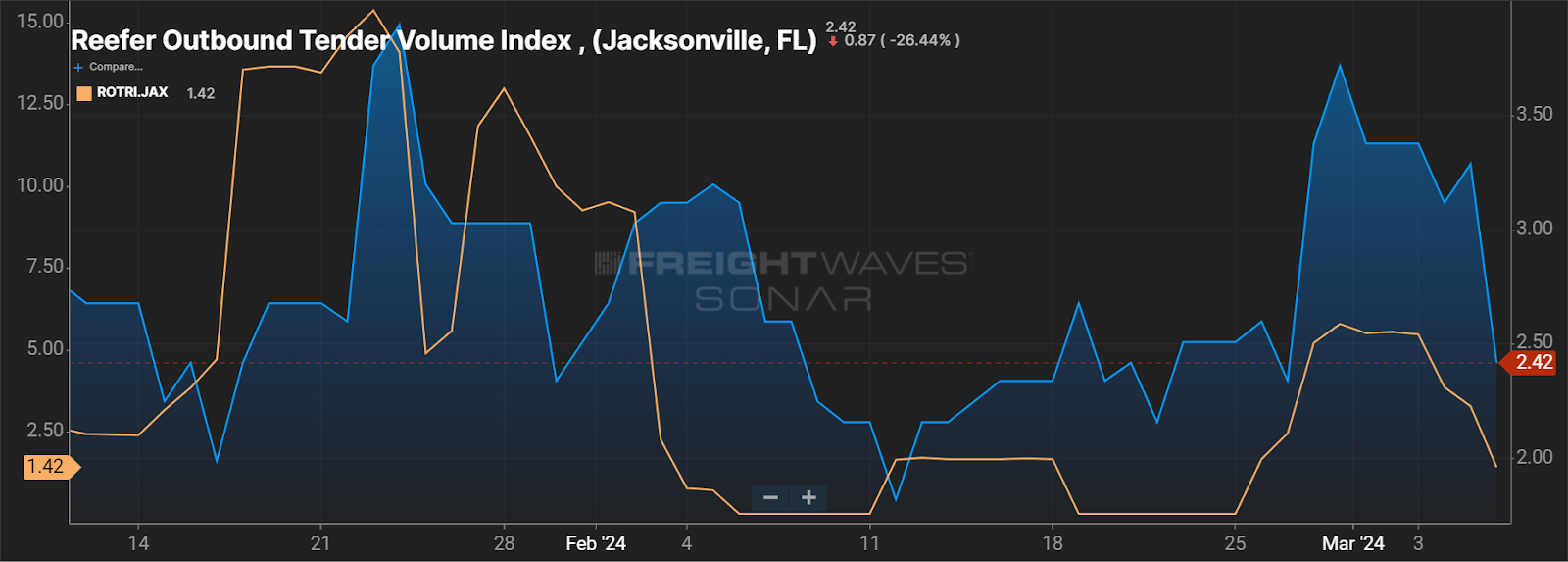
SONAR Tickers: ROTVI.JAX. ROTRI.JAX
Capacity is Jacksonville, Florida, is loosening. Both reefer outbound tender rejections and reefer outbound tender volumes have dropped substantially in the past week: volumes by 28.4% and rejections by 380 basis points.
Rejections dropping to under 2% essentially means just about any load is getting picked up, which is great for shippers but not so great for carriers looking to run at a profit. Ultimately this is a perfect opportunity for shippers looking to save on transportation costs early in the year but less than ideal for carriers.
Wanna chat in the cooler? Shoot me an email with comments, questions or story ideas at moconnell@www.freightwaves.com.
See you on the internet.
Mary
If this newsletter was forwarded to you, you must be pretty chill. Join the coolest community in freight and subscribe for more at www.freightwaves.com/subscribe.
Recent shows highlight CPG companies’ concerns
More suppliers, more supply chain complexity
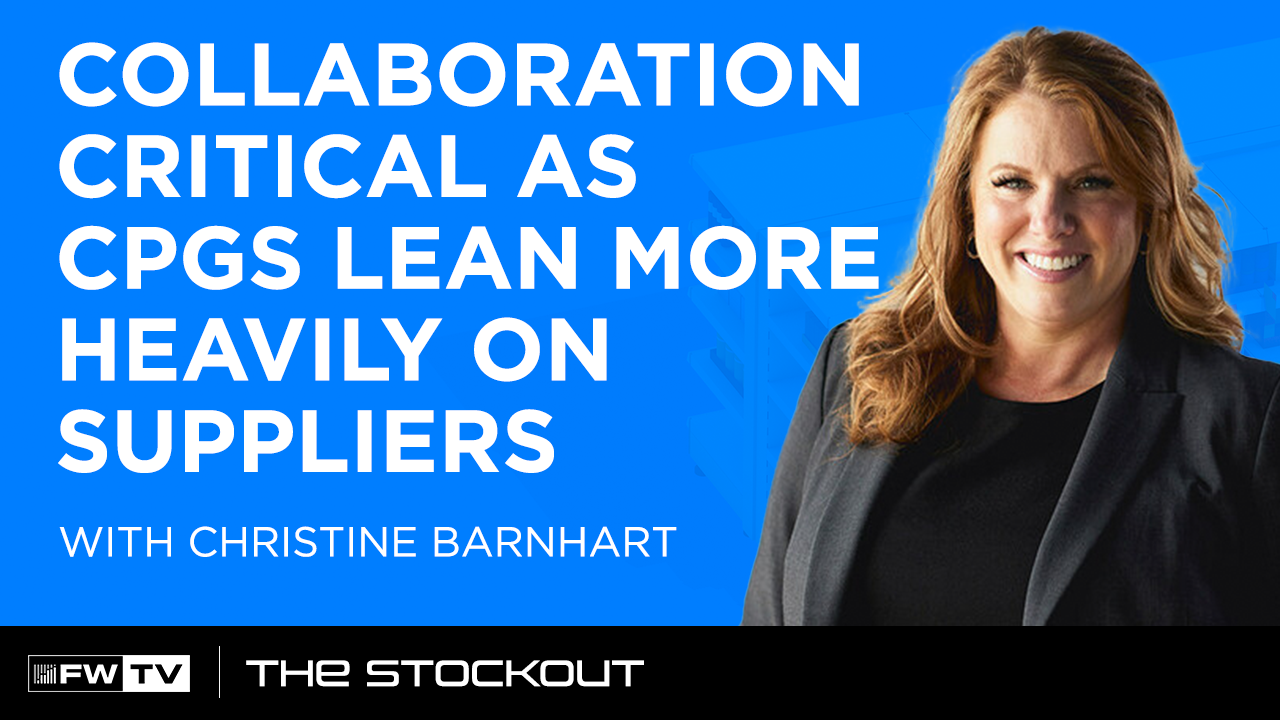
Monday on The Stockout show, Grace Sharkey and I interviewed Christine Barnhart, chief marketing and industry officer of Nulogy.
(Photo: FWTV)
Nulogy is a company that helps consumer packaged goods companies manage data that is coming from suppliers, especially third-party contract manufacturers and co-packaging companies. While contract manufacturing and outsourced packaging were areas of great focus during the pandemic in the context of CPG demand surges, outsourced services are growing on a secular basis, according to Barnhart. Contract manufacturing and co-packaging are generally more expensive on a per-unit basis than performing those functions in-house, but offer the advantage of flexibility.
(Photo: FWTV)
For instance, a consumer packaged goods company could produce a baseload of volume in-house and use contract manufacturing for seasonal surges. Utilizing contract manufacturing is also ideal for startups or new product introductions where demand is highly uncertain. Bringing more third-party suppliers and contractors into the mix creates more room for supply chain disruptions if data is not adequately shared across suppliers. Improved supply chain data sharing helps consumer packaged goods companies right-size inventories and focus their promotional activity.
Watch Monday’s show here or get caught up on past episodes here.
A turn in the freight market may be coming
(Photo: FWTV)
On last week’s The Stockout show, Grace Sharkey and I interviewed Tracy Meetre, chief commercial officer of Sunset Transportation. While highlighting uncertainty related to consumer demand and the pace of transportation capacity exiting the market, Meetre’s best estimate is that the freight market could turn in carriers’ favor roughly at the end of this year’s third quarter.
Her recommendations for shippers to position themselves for a coming market turn include increasing the number of carriers in the routing guide and dealing with at least two brokers. In addition, she says shippers can make themselves preferred customers by keeping payment terms to carriers relatively short — something that Sunset Transportation does to support its ability to source capacity. Other topics on Monday’s show include warehousing availability and international/cross-border supply chains.
Aggressive pricing by small drayage carriers is keeping a lid on rates
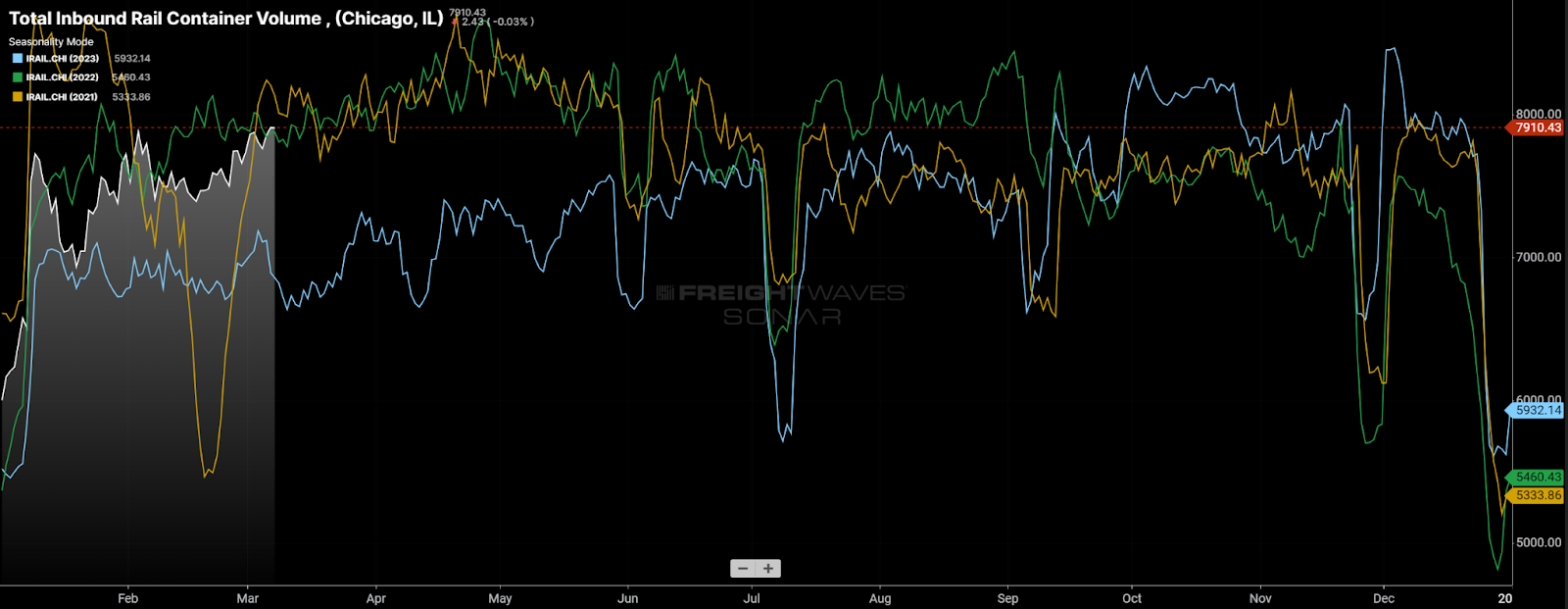
SONAR inbound intermodal volume into a particular market provides insight into drayage demand in the coming days. Inbound intermodal volume is forward-looking because it is based on the date the container is in-gated at the origin rail terminal — typically a few days ahead of reaching the destination terminal. Drayage is a highly fragmented market, which makes drayage pricing opaque, but a forward look at demand helps carriers be more nimble with timely adjustments to pricing.
Chicago inbound containerized rail intermodal volume (all container sizes) for 2024, 2023, 2022 and 2021 shown in white, blue, green and yellow, respectively. Chart: FreightWaves SONAR.
Drayage carriers have told us in recent days that they have seen the smaller drayage companies price too aggressively for market conditions, in their view, which is keeping rates low. On the bright side, demand has been strong, particularly supported by imports and associated international intermodal volume (which includes 40-, 20- and 45-foot containers). The SONAR chart above shows why drayage carriers in Chicago should be busier than they were at this time last year. While still below 2022 levels, inbound loaded Chicago intermodal volume (includes containers of all sizes) is up 9.7% year over year since Jan. 1. That is being driven most heavily by inbound Chicago loaded international intermodal volume (primarily 40-foot containers), which is 18.1% above 2023 levels, year to date.
SEC smackdown and SuperTruck news overwhelm convention dispatches
The annual Work Truck Week and American Trucking Associations Maintenance & Technology Council pile on stakeholder-specific dispatches each March. But this week bigger stories originated outside the convention halls in Indianapolis and New Orleans.
The Securities and Exchange Commission in Washington is as good a starting point as any.
Lordstown Motors gets an SEC comeuppance
Nearly three years after Hindenberg Research set its sights on Lordstown Motors Corp., accusing the former special purpose acquisition company of inflating orders and other shenanigans, the SEC charged the now-bankrupt company with misleading investors about the sales prospects of its Endurance electric pickup truck aimed at commercial fleets.
“We allege that, in a highly competitive race to deliver the first mass-produced electric pickup truck to the U.S. market, Lordstown oversold true demand for the Endurance,” Mark Cave, associate director of the SEC’s enforcement division, said in a Feb. 29 news release.
“Exaggerations that misrepresent a public company’s competitive advantages distort the capital markets and foil investors’ ability to make informed decisions about where to put their money.”
Day traders who bid up Lordstown shares to meme stock status in 2020 and 2021 would likely give that statement a loud amen.
The SEC’s settled order found that Lordstown violated certain anti-fraud, proxy and reporting provisions of federal securities laws. Without admitting or denying the SEC’s findings, Lordstown agreed to a cease-and-desist order and a fine of $25.5 million — if the bankruptcy court approves.
Clark Schaefer Hackett and Co., which audited Lordtown’s books before and after it went public via SPAC merger with DiamondPeak Acquisition Corp. in October 2020, agreed to pay more than $80,000 in penalties and interest and clean up its act by improved processes and procedures.
The Lordstown Endurance might have new life as a LandX vehicle under Lordstown founder Steve Burns, but the SPAC-backed startup Lordstown agreed to pay the Security and Exchange Commission $25.5 million for misleading investors. (Photo: Lordstown Motors)
Enriched founder Steve Burns missing from penalties
Noticeably absent from the SEC action was Lordstown founder and former CEO Steve Burns, who converted his post-SPAC holdings into more than $61 million. He used $10 million of that to purchase the company’s Endurance assets out of bankruptcy.
According to a TechCrunch article in January, Burns has started a new company called LandX Motors featuring an electric pickup strikingly similar to the Endurance.
There was no sign of Burns at Work Truck Week in Indianapolis, where he lurked two years ago as Lordstown pitched the truck to curious attendees. LandX had no presence at the show this week.
About those batteries…
With Volvo Group acquiring the battery assets of Proterra Inc., it’s unclear whether Proterra customers Nikola and Daimler Truck North America’s Freightliner Custom Chassis Corp. will continue to get batteries from Proterra as a standalone company under the Swedish truck maker.Volvo said when it closed on the $210 million acquisition Feb. 1 that it “intends to run Proterra as a going concern and deliver to selected customers.” It did not name those customers. The company is keeping its customer list to itself, a Volvo Group spokesperson said in an email Thursday.
Indications are FCCC and Nikola are still in queue. But they expect to pay more for the same lithium-ion batteries used in the FCCC MT50e Class 5-6 walk-in vans and Nikola’s Class 8 fuel cell electric vehicle (FCEV).
Nikola, meanwhile, is testing batteries from Chinese supplier Contemporary Amperex Technology Co. Ltd. (CATL), the market leader in batteries for electric vehicles. Nikola needs replacements for fire-prone batteries that led to an August recall of 209 Class 8 electric trucks.
A deal could be near. Nikola said on its Q4 earnings call Feb. 26 that it remains on track to begin returning recalled trucks to owners by the end of March and complete returns by late Q2 or early Q3. Nikola also could substitute CATL battery packs for Proterra packs in the Tre FCEV that currently contain two Proterra battery packs.
GM expands commercial fuel cell horizons for SuperTruck 3
How one company can be both a leader and a laggard in hydrogen fuel cells is hard to grasp. Consider General Motors. The company demonstrated its first fuel cell vehicle — the GM Electrovan — in 1966. It was loaded with cryogenic hydrogen and oxygen tanks and an electrolyte reservoir behind the middle bench seat.
The GM fuel cell Electrovan, circa 1966. (Photo: GM)
It conducted a multiyear demonstration program with 119 Chevrolet Equinoxes in the late 2000s and built an imposing Chevrolet Colorado-based ZH2 prototype for evaluation by the U.S. Army last decade.
The Chevrolet Colorado-based ZH2 prototype fuel cell electric truck evaluated by the U.S. Army. (Photo: GM)
GM has yet to produce a fuel cell vehicle for sale since forming a manufacturing joint venture with Honda Motor Co. in 2017. Fuel cell stack production planned “around 2020” got under way in February, a delay partially due to the pandemic.
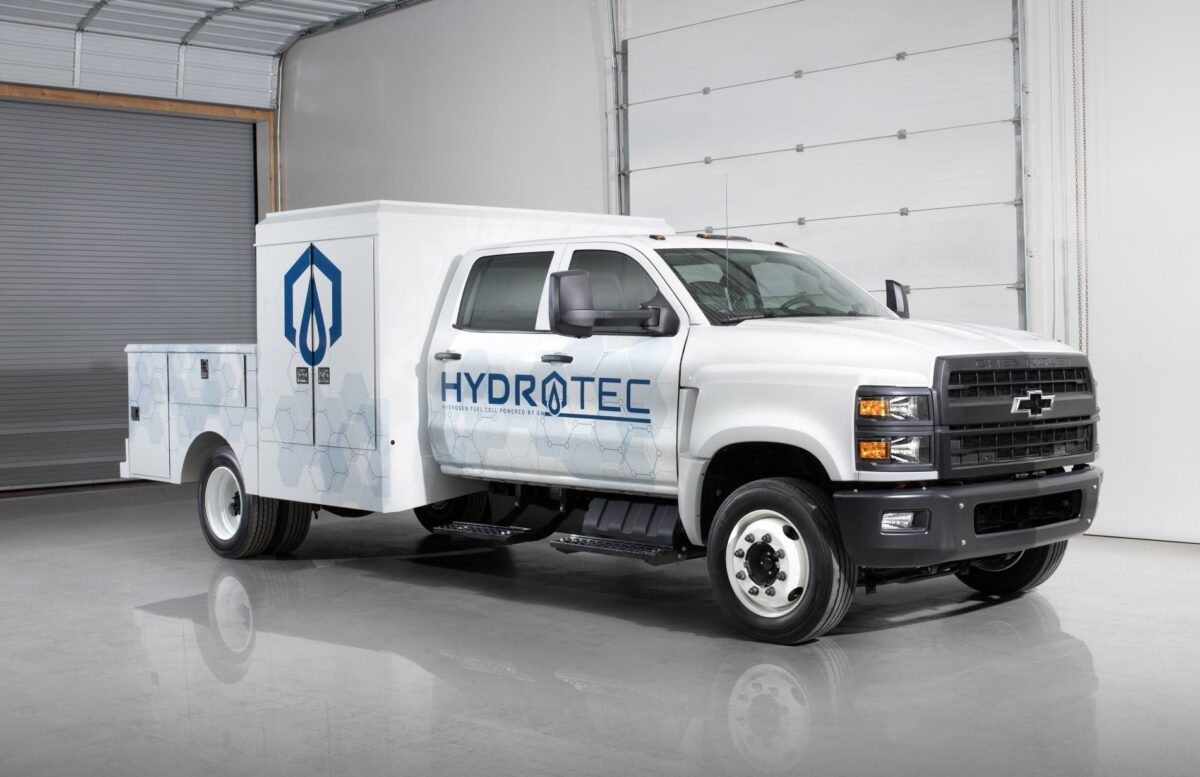
This week, GM became the first to offer specifics on its entry in the hydrogen fuel cell-focused SuperTruck 3 program. It will outfit a frame similar to the 2024 Chevrolet Silverado 5500 MD with fuel cell systems in partnership with Southern Co., a Georgia-based gas and electric distributor. The fuel cell trucks will be used as shop vehicles at Southern Co. worksites.
DOE provides $26 million for medium-duty fuel cell project
GM is getting $26 million from the Department of Energy’s SuperTruck 3 program and the Hydrogen and Fuel Cell Technologies Office. It is footing the rest of the total $65 million pilot project with partners.
GM and Southern also are working with Oslo, Norway-based Nel ASA, a maker of electrolyzers, to produce hydrogen from water and electricity. An integrated hydrogen microgrid for fueling infrastructure includes a stationary fuel cell-based mobile power generator.
“GM’s advanced fuel cell technology gives these trucks a competitive edge against their diesel counterparts, with comparable towing and payload capabilities,” said Charlie Freese, GM executive director Global Hydrotec.
The Chevrolet Silverado MD 5500 upfit with hydrogen tanks that will be used by Southern Co. as part of the SuperTruck 3 pilot program focused on fuel cells. (Photo: GM)
Speaking of SuperTruck
Each of the major heavy-duty OEMs participating in the SuperTruck 2 program put up significant freight efficiency numbers, sometimes by applying innovations that otherwise sat unused because of a lack of internal support.
The North American Council for Freight Efficiency (NACFE) took a deep dive into the trucks in the cost-sharing program whose technologies sometimes find their way into future products.
“Each of these five teams succeeded in innovating complete tractor-trailer systems capable of exceeding freight efficiency performance improvements of more than 100% versus each team’s Model Year 2009 baseline diesel tractors with standard 53-foot dry van box trailers,” NACFE wrote.
Considering the tractor and trailer as a single unit — visible in the sweeping aerodynamic-focused designs — results in “significantly better performance improvements than more piecemeal approaches looking at optimizing individual systems.”
Many tractor-trailer system efficiency gains apply to all powertrain choices. Reducing the energy required to move freight over a distance means less operational cost. For example, a 30% improvement in miles per gallon would make a 300-mile battery-electric vehicle capable of going 400 miles between charges.
Electric charger gap between cars and trucks – 60,000 to 10
As the keynote speaker at Tuesday’s Green Truck Summit kicking off Work Truck Week, Mary Aufdemberg, Daimler Truck North America’s general manager, product strategy and market development, confirmed what the audience knew: Diesel is not going anywhere for a long time. But she also revealed the first three locations for medium- and heavy-duty public charging sites for battery-electric trucks in the $650 million Greenlane infrastructure joint venture.
Briefly noted …
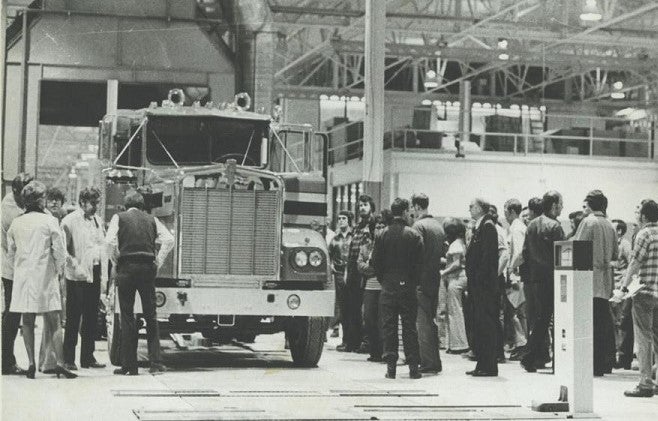
Cake and candles for Kenworth’s Chillicothe, Ohio, assembly plant, which celebrated its 50th anniversary on Monday. The plant has built 782,000 trucks since opening in 1974.
Kenworth’s first truck at the Chillicothe, Ohio, plant in March 1974. (Photo: Kenworth)
Hyliion Holdings is off the clock for a potential delisting of its stock from the New York Stock Exchange, surpassing 30 consecutive trading days with a share price above $1.
Nikola hired Thomas Okray, a veteran of several public company CFO positions, as its chief financial officer. He’ll earn a $695,000 annual salary plus other perks.
Volvo Group delivered 145,395 trucks in 2023, up 200 from a year earlier, including 1,977 electric trucks — 256% more than in 2022.
Truck Tech episode No. 57: Powertrain deep dive into new Volvo VNL
The headline number is 10% greater fuel efficiency. Volvo Trucks North America Marketing Manager for Powertrain Duane Tegels explains in the latest Truck Tech podcast how that was accomplished.
That’s it for this week. Thanks for reading and watching. Click here to get Truck Tech via email on Fridays. And catch the latest in major events and hear from the top players on “Truck Tech” at 3 p.m. Wednesdays on the FreightWaves YouTube channel.Your feedback and suggestions are always welcome. Write to aadler@www.freightwaves.com.
BlueGrace Logistics acquires Evos Smart Tools
BlueGrace Logistics, one of the largest 3PLs in the United States, has acquired optimization platform Evos Smart Tools, which the company says will benefit customers by streamlining logistics.
optimization platform that helps shippers boost resources and lower costs through advanced algorithms, Florida-based BlueGrace said.
Evos Smart Tools, based in Oregon, provides transportation software tools and expertise to shippers. The technology can be used alone or integrated into third-party rating engines.
BlueGrace plans to integrate Evos into its BlueShip platform for real-time optimization and will sell the SaaS platform as a stand-alone product, the company said.
“Our BlueGrace Managed Logistics clients use technology to ensure every shipment is optimized for efficiency and profitability, in turn giving them sustainable growth and a competitive advantage in the marketplace,” BlueGrace founder and CEO Bobby Harris said in a news release. “Adding Evos to our proprietary SaaS portfolio will benefit our current customer base, and future ones looking to streamline the logistics life cycle.”
The company said the acquisition of Evos will help BlueGrace customers by:
Maximizing resources.
Enhancing shipping efficiency.
Minimizing unnecessary shipments.
Offering detailed route planning.
ArcBest again swaps freight for better yields in February
ArcBest continued to execute a freight swap during February, replacing transactional shipments with more freight from key accounts. The actions led to another decline in tonnage, which was mostly offset by higher yields that are supportive of margins, a Friday filing with the Securities and Exchange Commission showed.
The company’s asset-based unit, which includes less-than-truckload operations, reported a 3% year-over-year (y/y) decline in revenue per day during February, an improvement from a 7.3% decline in January. Tonnage was 14% in the month (down 18% in January), with revenue per hundredweight, or yield, increasing by 13% in both months. The yield increases were nearly double the increase the carrier booked in the fourth quarter.
Table: Company reports
By comparison, ArcBest’s (NASDAQ: ARCB) asset-based revenue was down just 0.2% y/y in the fourth quarter. However, the company has tougher first-quarter tonnage comparisons than other carriers after it onboarded spot business last year to keep its network full and maintain head count to avoid an arduous rehire process when the market turned. The LTL industry got a shot in the arm last summer when Yellow Corp. (OTC: YELLQ) shut down. Following Yellow’s exit, better freight opportunities have allowed ArcBest to replace those spot loads.
Severe winter storms in January as well as lower diesel fuel prices, which dictate fuel surcharge revenue, are also weighing on the y/y revenue comps.
Year-over-year volume growth at core accounts accelerated again in February.
“Despite the softer freight environment, core shipments and tonnage for February 2024 increased on a year-over-year basis by approximately 13% and 8%, respectively, an improvement compared to January 2024’s year-over-year results,” the filing read.
Shipments and tonnage from core accounts increased 8% and 6% y/y, respectively, in January.
Weight per shipment was down approximately 10% y/y in both months due to smaller order sizes and mix changes. Lower shipment weights are amplifying the higher yield metrics.
ArcBest normally sees 400 basis points of margin deterioration from the fourth to the first quarter. The company was noncommittal on the expected sequential progression this year given the harsh weather as well as several cost headwinds and tailwinds. It noted “strong” pricing discipline and “cost reduction efforts and productivity improvements” as favorable levers.
“While most of our February metrics have shown improvement on a year-over-year basis when compared to January, the freight environment remains soft,” the filing stated. “We are well-positioned to capitalize on opportunities as the freight market improves and demand increases.”
The company’s asset-light unit, which includes truck brokerage, reported a 10% y/y decline in revenue per day during February as shipments increased 13% but revenue per shipment was down 20%.
Revenue per day was down 15% y/y in January.
Board wants to make M&A easier
ArcBest’s board recently proposed an amended certificate of incorporation requiring just a simple majority approval from shareholders for mergers and acquisitions. The prior requirement was two-thirds approval. Shareholders will vote on the amendment at the company’s annual shareholders meeting on April 26, a Monday filing said.
The change would make it easier for ArcBest to be acquired or merge with another entity. A year ago, speculation ramped that the company may be an acquisition target after Montreal-based TFI International Inc. (NYSE: TFII) revealed it held a 4% equity stake in ArcBest.
Deutsche Bank (NYSE: DB) analyst Ben Mohr said it’s unlikely a deal is pending.
“The bottom line is we don’t think these developments have much, if any, read across implications with respect to M&A. But rather an evolution in corporate governance matters,” Mohr said in a note to clients Thursday evening.
ArcBest’s Monday filing also said the board already lowered the voting requirement to amend the bylaws from 75% to a majority.
Jobs report: Truck transportation employment flat; warehouse jobs drop again
Jobs in the truck transportation sector mostly treaded water in February while warehouse jobs continued their long slide, according to the monthly report from the Bureau of Labor Statistics.
In the truck transportation sector, the loss of 300 jobs was the smallest one-month change up or down since August 2022, when an increase of 300 jobs was recorded. The total for February was 1,551,200 jobs.
More significantly, on a seasonally adjusted basis, the January figure of 1,551,500 jobs was down 4,200 jobs from the original number reported by the BLS. The most recent December figure was adjusted downward as well, by 1,500 jobs, to a “final” December figure of 1,551,800 jobs.
The combination of the small downward move between January and February and the larger downward adjustment between December and January means that the February total of 1,551,200 jobs is 600 fewer than where it stood in December.
(The BLS reports job figures for three months, with the first two eligible for revision for two months before they become “final.” But they are not completely final, as all months are subject to a significant revision when the January report is released each February.)
The February total was down down 28,300 jobs since a year ago. But with some strength in November and December, the job total is up 3,000 jobs since October.
David Spencer of Arrive Logistics noted the lack of significant upward and downward movement in recent months. “Relative stability in employment levels have been the theme, with total employment fluctuating up and down in a window of a few thousand jobs,” Spencer said in an email to FreightWaves. “This stability is likely a result of the relative stability in the truckload demand environment we have seen over this period driven by strong consumer spending and a rundown of inventories that has retailers returning to just in time ordering patterns.”
On the warehouse side, employment numbers are across-the-board ugly. They’ve dropped 11 of the past 13 months; the 6,800 jobs lost from January to February was just the seventh-biggest total of those 11, with the low-water mark coming in March of last year when 30,000 jobs were lost. The February total of 1,758,700 jobs is 183,500 jobs fewer than the high-water mark of 1,942,200 jobs set in May 2022.
Among other data in the report:
Mazen Danaf, the senior economist at Uber Freight, highlighted the hours worked by nonsupervisory employees in long-distance trucking. Data for specific subsectors of truck transportation are on a one-month lag. Danaf said that weekly figure for January fell “sharply” in the past year to 40.3 hours, which was close to the level of April 2020, the depth of the pandemic. Taking out April 2020, that number had not been that low since 2003, Danaf said.
Monthly data on truckload employment has been inching lower. In January, it reached 544,300, the lowest level since May 2022. A year ago, it was 551,300 jobs.
While there has been focus on recent layoffs and furloughs at some of the nation’s Class 1 railroads, there was little sign of it in the report. Seasonally adjusted rail employment declined to 152,800 jobs, down just 200 jobs from 153,000 jobs a month earlier. It was also down from a revised December figure of 153,100 jobs. Rail employment is still slightly above the 151,400 jobs where it stood a year ago, but most critics of rail hiring practices would say it should be significantly higher to generate greater customer service.
The not seasonally adjusted numbers for truck transportation showed a sharper drop in employment than what happened with the more widely followed seasonal numbers. Not seasonally adjusted truck transportation came in at 1,524,500 jobs, down by 5,100 from January. What was particularly stunning was the downward revision between December and January. December’s “final” number for truck transportation jobs on a not seasonally adjusted basis was 1,557,800 jobs. The drop to the revised January figure was 28,200 jobs.
Shannon Gabriel, the vice president of the leadership solutions practice at TBM Consulting, looked at the numbers in trucking and warehousing through a different lens: the number of people trying to get in the field and the openings posted elsewhere.
“In the past 30 days, there have been 138,209 supply chain requisitions listed on LinkedIn,” Gabriel said in an email to FreightWaves. “While truck, water, and rail transportation jobs were just marginally down in February, compare those openings to 45,455 technology/software openings, which are positions we know continue to be plagued with layoffs. In contrast, there were only 233,256 resumes posted within the supply chain field on Indeed (past 30 days), while technology had an overwhelming number of resumes at over 1,400,000.”
Job totals in the BLS report mask what Gabriel said were the “dynamics occurring within the supply chain.”
“The demand to hire remains strong,” she said. “The war on talent can cripple the number we are expecting each month, but that doesn’t equate to it being negative.”
Carriers’ pricing power slipping amid continued Red Sea conflict
The first fatal Houthi attack on a commercial vessel happened earlier this week, claiming three lives. The attacks in the Red Sea have created diversion around the Cape of Good Hope across all of the major container shipping companies, as they opt for the safety of crews and cargo at the expense of shorter transit times.
The result of the diversion has been a surge in global container spot rates of over 200% in a matter of weeks. Rates have reached levels well in excess of what was experienced through the vast majority of 2023. Much of the initial surge, like with the COVID-19 pandemic, was created by the uncertainty of the attacks, both in duration of the conflict as well as severity. As container ships were rerouted around the Cape of Good Hope, transit times ballooned, adding upward of two weeks to transits.
From China to the Netherlands, connecting the major Asian ports to the Port of Rotterdam, the largest port in Europe, transit times have increased by 4.27 days or 10% compared to the same time last year, according to FreightWaves SONAR Container Atlas. While that is a fairly sizable increase, the bigger increase comes from the project44 Ocean Port Pair Delays, which are up 2.54 days compared to the same period last year at 9.5 days. The combination of the two — scheduled transit times of 37.7 days and delays adding 9.5 days — equates to a total transit time of 47.2 days. In comparison, during the week of Oct. 16, scheduled transit times were 32.85 days and delays were just over one day, bringing total transit times to just under 34 days. Total transit times from China to the Netherlands have increased by 39% since the early stages of the Red Sea conflicts.
What does that have to do with ocean spot rates?
Longer transit times mean that container ship companies have to reposition their capacity appropriately to service the same levels of demand. Additionally, shippers are having to act earlier, especially in Europe, to offset the risks of further delays in transit.
This combination of rebalancing of capacity and an effective pull forward of demand creates an environment in which ocean carriers are able to push spot rates up, effectively protecting capacity for contracted shippers.
However, since the initial surge, which also coincided with the pull forward associated with the Lunar New Year, global ocean spot rates have lost momentum.
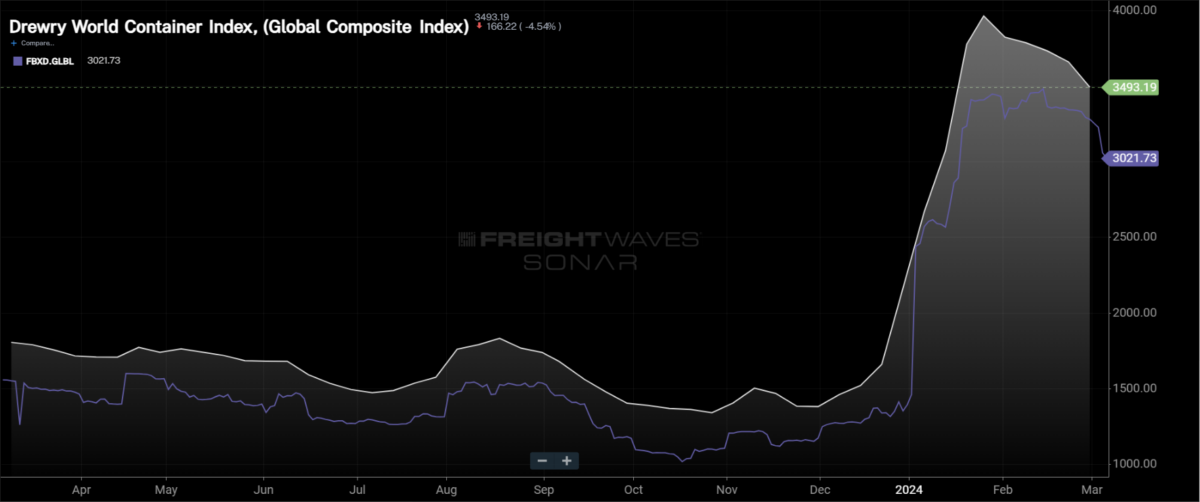
FreightWaves SONAR. Drewry World Container Index – Global Composite (white) and Freightos Baltic Daily Index – Global (blue) To learn more about FreightWaves SONAR,click here.
The Drewry World Container Index – Global Composite fell by 4.54% over the past week to $3,493.19 per forty-foot equivalent unit. The Freightos Baltic Daily Index – Global fell by 8.2% to $3,021.73 per FEU.
These declines are an indication that the recovery from China out of the Lunar New Year might be more drawn out as opposed to a swift increase in demand as manufacturing ramps back up.
With the momentum stalling for the ocean carriers, the question now becomes: When will general rate increases be announced and will they be sticky?
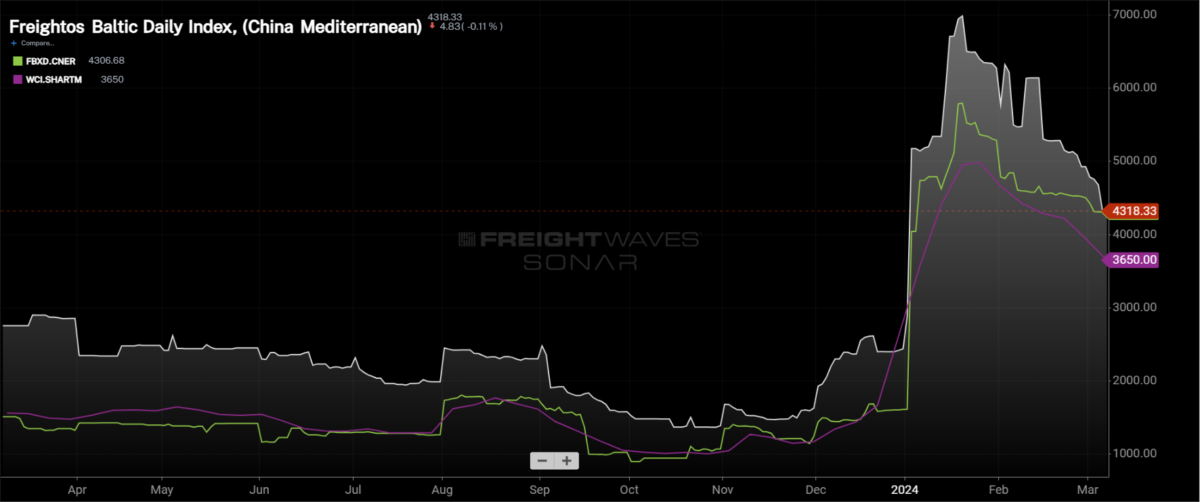
FreightWaves SONAR. Freightos Baltic Daily Index from China to the Mediterranean (white), Freightos Baltic Daily Index from China to Northern Europe (green) and Drewry World Container Index from Shanghai to Rotterdam (pink) To learn more about FreightWaves SONAR,click here.
With the declines happening across the globe, it is important to understand how individual trade lanes are being affected.
In Europe, the declines have varied by destination. The Freightos Baltic Daily Index from China to the Mediterranean dropped by 12.4% over the past week to $4,318.33 per FEU, the lowest they have been this year. The Freightos Baltic Daily Index from China to Northern Europe is down far less, falling 4.4% over the past week to $4,306.68 per FEU.
The Drewry World Container Index from Shanghai to Rotterdam dropped by 7.5% over the past week to $3,650 per FEU.
As with the global composites, the two indices are in agreement that spot rates from China to Europe are declining.
FreightWaves SONAR, Inbound Ocean TEUs Volume Index for the Port of Long Beach, 2024 (white) and 2023 (blue) To learn more about FreightWaves SONAR,click here.
Along the trans-Pacific, ocean spot rates took a more severe step lower, which is likely an indicator of softer demand following the Lunar New Year.
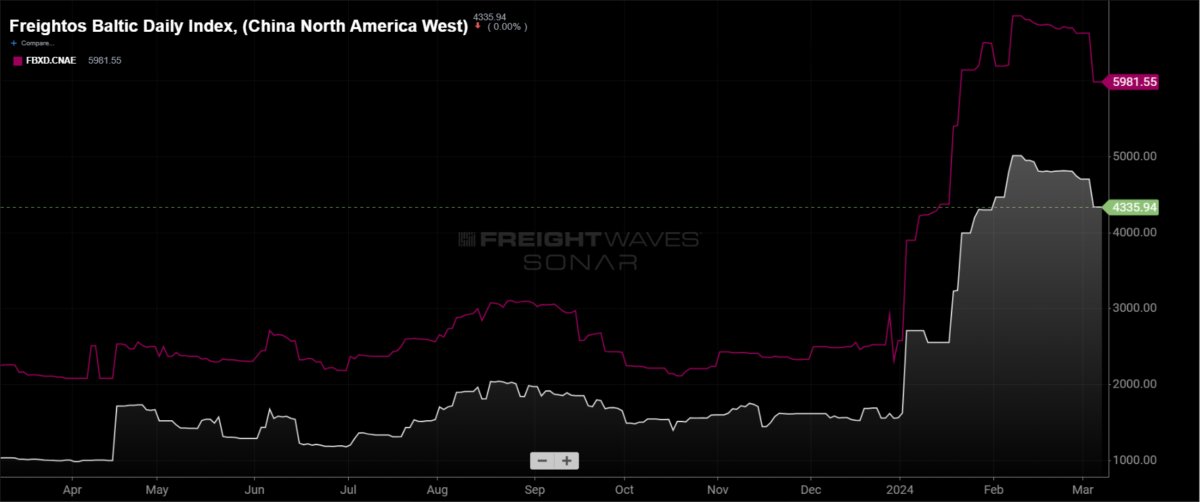
The Freightos Baltic Daily Index from China to the North American west coast fell by 7.8% over the past week to $4,335.94 per FEU, the lowest level in over a month. The Freightos Baltic Daily Index from China to the North American east coast dropped by 9.7% over the past week to $5,981.55 per FEU.
The Drewry World Container Index from Shanghai to Los Angeles fell by 4.8% over the past week to $4,272 per FEU. The Drewry World Container Index from Shanghai to New York fell by 6.2% over the past week to $5,458 per FEU.
With all the indices across the major trade lanes in agreement that ocean spot rates are in decline, what’s the next move for ocean carriers to prevent spot rates from returning to 2023 levels?
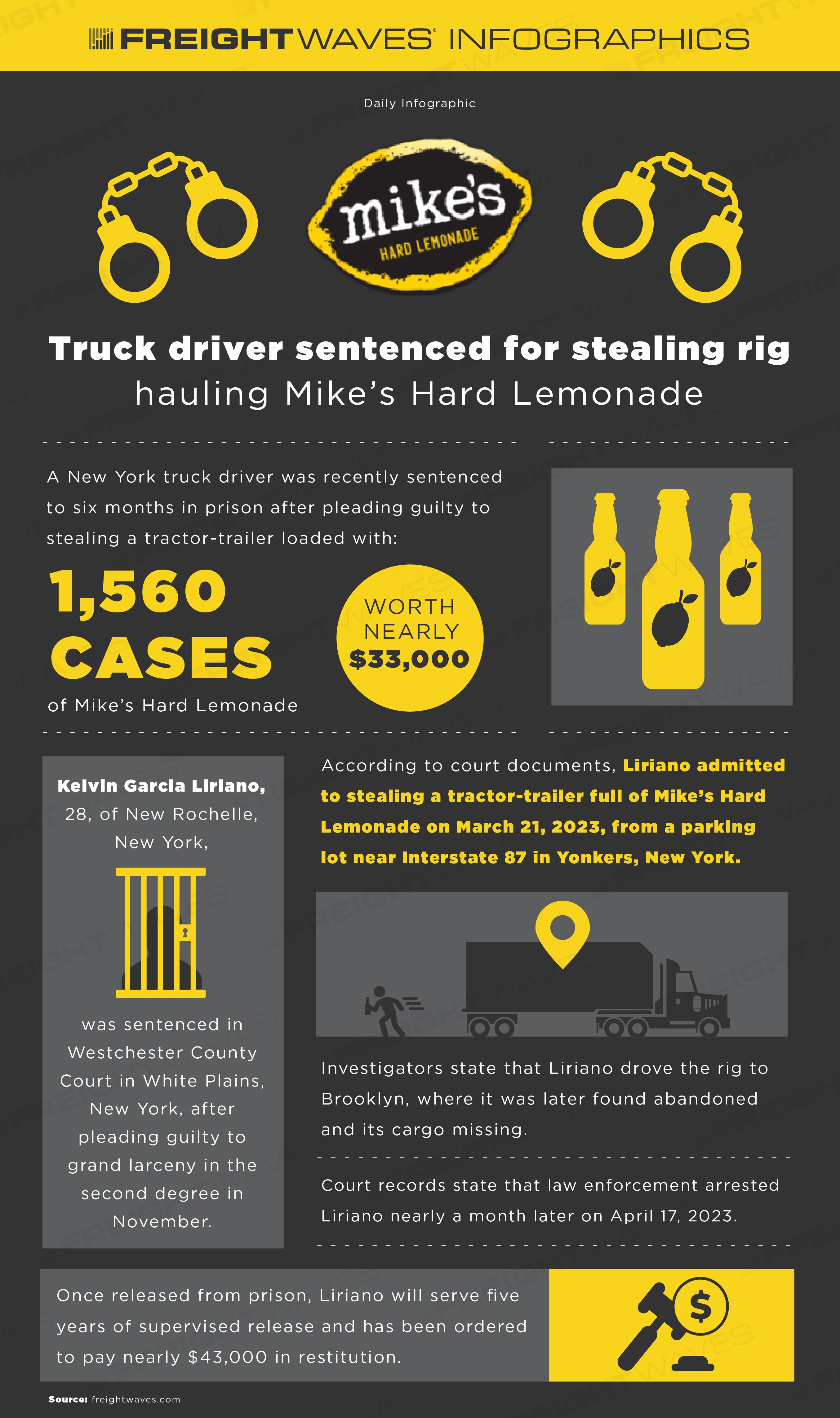
Daily Infographic: Truck driver sentenced for stealing rig hauling Mike’s Hard Lemonade
To view more FreightWaves infographics, click here
Virginia logistics company files for Chapter 7 bankruptcy
Trucking, logistics and truck stop chains are collectively owed millions of dollars after a Virginia-based logistics firm recently shuttered operations and filed for bankruptcy liquidation.
TBL Logistics, headquartered in Appomattox, Virginia, filed its petition on Feb. 29 in the U.S. Bankruptcy Court for the Western District of Virginia.
In its filing, TBL Logistics listed its assets and liabilities as between $1 million and $10 million. The company stated that it has up to 49 creditors and maintains that no funds will be available for unsecured creditors once it pays administrative fees.
Christopher Bradner and Melinda Bradner are listed as the owners of TBL Logistics, a small, family-owned trucking firm, which hauled refrigerated and oversize loads.
As of publication, the Bradners’ attorney, Stephen E. Dunn, had not responded to FreightWaves’ request for comment.
Several companies are among TBL Logistics’ creditors. They include Motive Technologies of Dover, Delaware; Love’s Travel Stops of Oklahoma City; and the IRS, although no amounts are given.
According to the Federal Motor Carrier Safety Administration’s SAFER website, TBL Logistics’ common carrier authority was granted in June 2021, and its operating authority was revoked in January 2024. The company had four power units and seven drivers before ceasing operations after TBL Logistics’ Bodily Injury Property Damage Coverage (BIPD) was canceled on Jan. 20. The company had two injury crashes over the past 24 months, according to the FMCSA data.
A creditors meeting is scheduled for March 26.
Do you have a news tip to share? Send me an email or message me @cage writer on X, formerly known as Twitter. Your name will not be used without your permission.