The Houthis sank a ship. But their attacks may be less disruptive for now

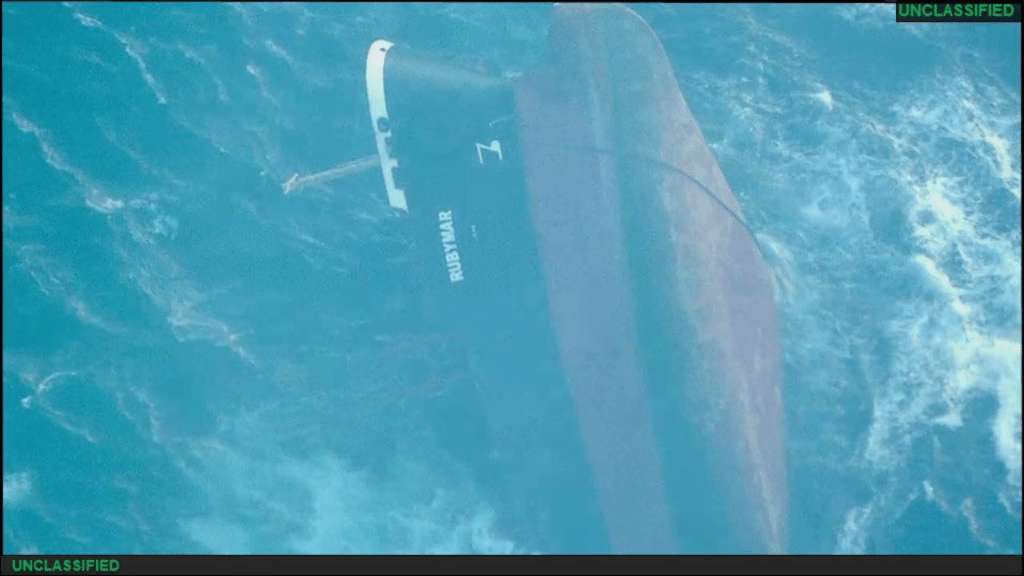
Rubymar, a Belize-flagged, UK-owned bulk carrier, sank in the Red Sea on March 2 after being struck by a Houthi anti-ship ballistic missile on Feb. 18. It had been taking on water since the attack.

Over the past few months, the Red Sea has shifted from a highly trafficked maritime passage to something more like a battleground. Attacks on cargo vessels by Houthi rebels have threatened both regional stability and the arteries of global commerce.

On March 2, the Rubymar finally sank. The cargo ship had been targeted by Houthi militants on Feb. 18 and had been taking on water in the days since. It’s the first vessel lost to the Houthi attacks in and around the Red Sea, which began in November 2023. This incident, which has led to a multimile oil slick and the submerging of 21,000 metric tons of fertilizer, not only highlights the immediate environmental hazards but also casts a long shadow over the security of a key conduit for international trade.

But is it possible that the worst of the damage has already been done, at least when it comes to trade?
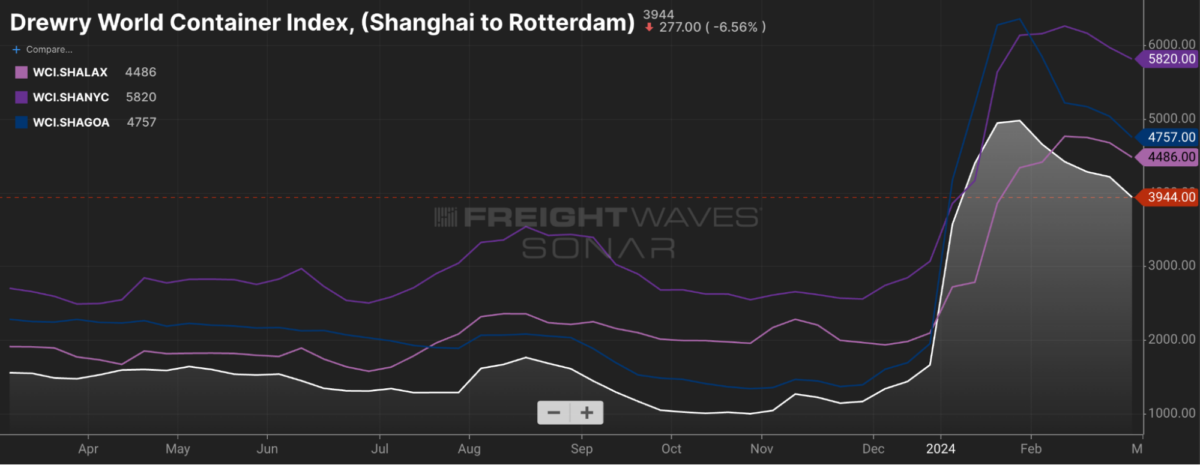
Source: FreightWaves SONAR. Drewry World Container Index, Shanghai to Rotterdam (WCI.SHARTM), Shanghai to Los Angeles (WCI.SHALAX), Shanghai to New York (WCI.SHANYC) and Shanghai to Genoa (WCI.SHAGOA).

Houthi attacks have undoubtedly added a new layer of complexity and risk, not to mention heightened danger for crews, but their effect on commerce may be starting to wane.

To be sure, the longer container spot rates stay elevated above late-2023 figures, the more cost shippers and consumers will bear, while container lines remain the beneficiaries. Drewry’s World Container Index Global Composite price is still more than 150% higher than it was at the end of October 2023. But it’s also dropped by more than 10% since late January.

However, well-connected supply chains have the ability to change course like rivers. And the tactics employed by the Houthi rebels — namely, the use of missiles and drones to target vessels it sees as aligned with Israel — may be more like a large rock thrown from the bank than a full-stop dam.
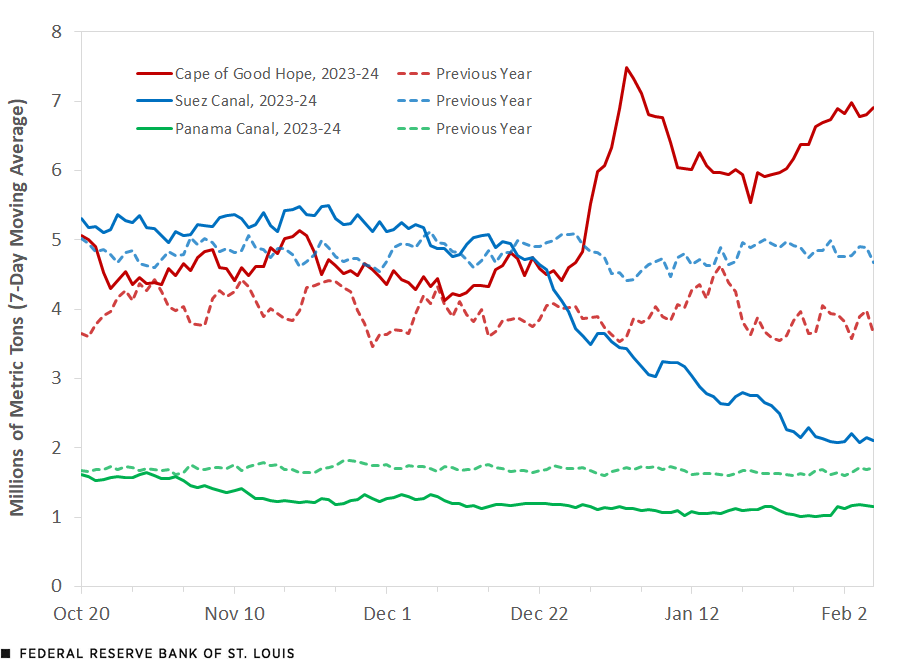
Source: IMFPortWatch’s Daily Chokepoint Transit Calls and Trade Volume Estimates.

The decision by many shipping operators to reroute their vessels more safely around the southern tip of Africa does introduce significant delays and additional costs. It has affected timelines for the delivery of goods and exacerbated logistical challenges in a global economy grappling with the aftermath of the pandemic and other ongoing geopolitical conflicts.

But now, ocean freight is clearing post-Chinese Lunar New Year backlogs, and then it will enter its slow season, just in time to alleviate the capacity that’s been soaked up from longer transit times.
“And while rates should still remain above normal levels as long as diversions continue and carriers pass on higher costs, the European Shipping Council estimates that ocean rates and surcharges for Red Sea diversions are far outstripping these increased costs faced by carriers,” wrote Judah Levine, head of research at the Freightos Group, in an outlook blog last week. “This assessment, together with pessimistic outlooks for European ocean volumes this year, also points to the likelihood of ocean prices coming down from current levels.”
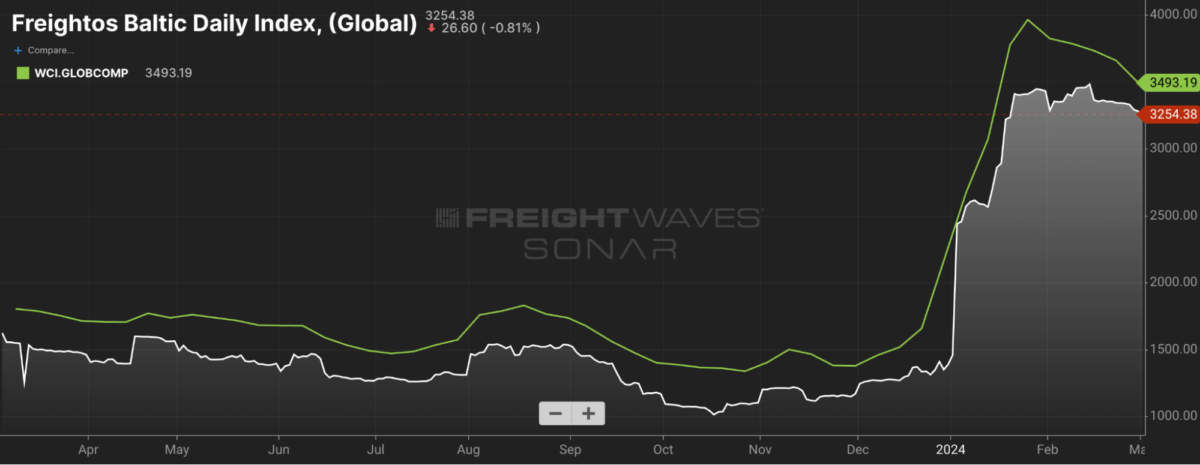
Source: FreightWaves SONAR. Freightos Baltic Daily Index, Global (FBXD.GLBL) and Drewry World Container Index, Global Composite Index (WCI.GLOBCOMP).

This analysis puts U.S. retaliatory measures into some context. As of last week, the U.S. had conducted airstrikes against 230 Houthi targets in Yemen, Deputy Assistant Secretary of Defense Daniel Shapiro said in a Senate Foreign Relations Committee hearing. 

It does matter that despite the destruction of numerous Houthi weapons, the attacks continue. The efficacy of U.S. countermeasures, against a backdrop of continued hostilities and the potential for escalation, remains a subject of scrutiny and debate.

Neither should the environmental repercussions of incidents like the sinking of the Rubymar be overlooked. Continued attacks could cause ecological damage to the Red Sea’s unique marine ecosystems and the industries that rely on them, like fishing.

But for the time being, global supply chains appear to be reallocating resources effectively, as evidenced by spot rates continuing to fall despite idle capacity tightening. Unless the Red Sea holdups lead to a massively costly capacity crunch in the coming months, it is unlikely the U.S. will feel pressured to up the ante.
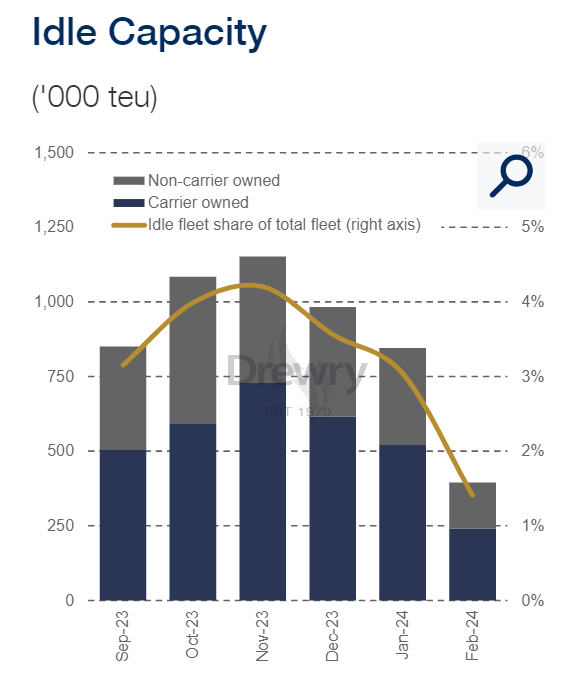
Source: Drewry Idle Capacity Index.

On Monday, a series of explosions claimed by the Houthis resulted in a fire onboard the Liberia-flagged MSC SKY in the Arabian Sea. No casualties were reported, but it stands as the most serious assault so far in March. Here’s what the past few months have seen:

February 2024

The first attacks of the month were on Feb. 6 with the targeting of the Star Nasia and Morning Tide, leading to minor damage to the former. The aggression continued with attacks on the Star Iris and Pollux, both resulting in minor damage but no casualties. The most severe incident was on Feb. 18 when the Rubymar suffered catastrophic damage in the Bab el-Mandeb strait, necessitating a crew evacuation.

This period also saw attacks on the Sea Champion, Navis Fortuna and MSC Silver II, among others.

January 2024

The first attack of the year was on Jan. 10, when a barrage of unmanned aerial vehicles and missiles targeted naval forces. There was no reported damage due to effective countermeasures. The St. Nikolas oil tanker’s capture the following day marked a further escalation by Houthi forces.

Throughout the month, various commercial and military vessels, including the USS Laboon, Gibraltar Eagle, Zografia and others, faced missile and UAV attacks.

December 2023

December saw missile strikes on the Unity Explorer, Number 9 and Sophie II on Dec. 3. All sustained minor damage. A combined missile and UAV attack on Dec. 11 targeted the Strinda and the French Navy’s Languedoc, causing onboard fires and other damage.

The month also witnessed hijacking attempts and further missile and UAV strikes against vessels like the Ardmore Encounter, Maersk Gibraltar and Al Jasrah, demonstrating the Houthis’ sustained capability and intent to disrupt maritime traffic.

November 2023

The Houthis began their operations in November with the capture of the Galaxy Leader, transforming it into a tourist attraction in Hodeidah, Yemen. The crew’s whereabouts are still unknown.

The CMA CGM Symi and Central Park also encountered UAV and missile threats, narrowly avoiding severe damage. These initial incidents signaled a shift toward direct action against maritime assets, posing a new level of threat to international shipping and regional security.
12-month story: Crude oil prices move slightly lower, but diesel falls further

The small decline in the Department of Energy/Energy Information Administration diesel price this week is notable mostly when a look into the past is undertaken. 

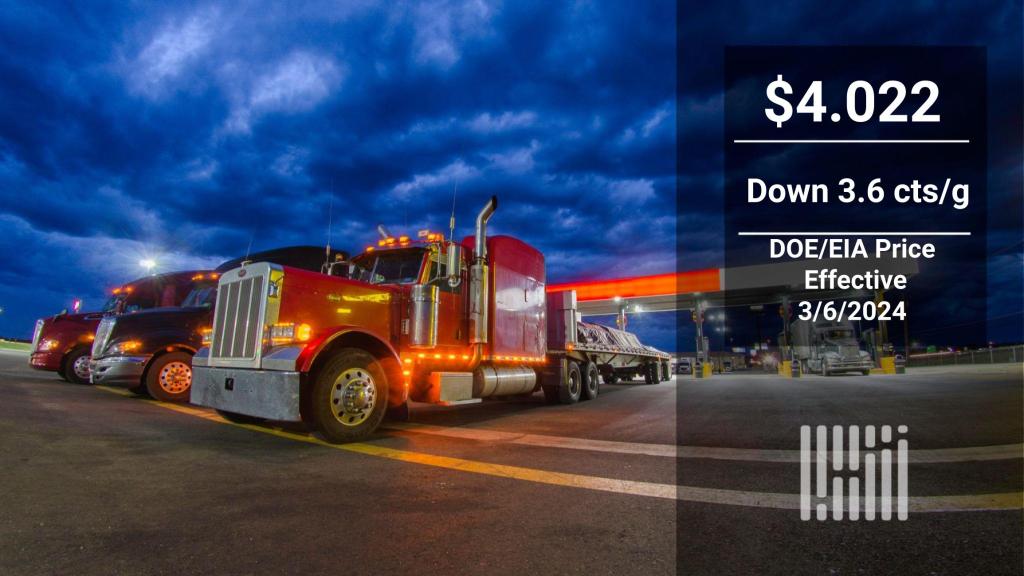
The price published by DOE/EIA that is used for most diesel surcharges was $4.022 per gallon effective Monday, a drop of 3.6 cents a gallon from a week earlier. In the last three weeks, the price has been unchanged, down 5.1 cents a gallon and then followed by this week’s decline. 

Fifty-two weeks ago, on March 6, 2023, the DOE/EIA price was $4.282 cents a gallon, 26 cents more than Monday’s price.

But Monday also was the time for another comparison: the price of crude now versus a year ago.

On March 6, 2023, West Texas Intermediate (WTI) settled at $80.46 a barrel, though the price of WTI just prior to that data had been holding relatively firm at levels less than $80 a barrel. 

A year later on Monday, the WTI settlement was $78.74 a barrel. That means that over 12 months, against a background of OPEC+ implementing significant cuts in output — when U.S. production soared more than 1 million barrels a day to 13.3 million barrels a day, and when countries like Guyana and Brazil saw their own output climb as well — the only thing that happened is that the price of the U.S. benchmark crude declined about 2.2%.

Brent, the international crude benchmark, settled Monday at $82.80 a barrel, a drop of 4% over the last 52 weeks.

But the retail price of diesel as measured by the DOE/EIA price was down 6% after posting this week’s number. 

This is good news for diesel consumers because the diesel market expressed as a spread against crude has, for several years now, been significantly higher than historic norms. And when that situation prevails in the commodity market, it eventually makes its way down to the pump, with retail diesel unable to take advantage of all the decline posted in the crude market.

Comparing the price of Brent and ultra low sulfur diesel on the CME commodity exchange Monday produces a spread of about 67.5 cents a gallon. A year ago, that spread was about 83.5 cents a gallon. The narrowing of that spread back toward more historic norms is one of the reasons why the retail price of diesel has fallen more in the past 52 weeks than what the price of crude has done.

There is no single reason why that spread has narrowed. A year ago, the market was coping with uncertainty over Russian supplies of diesel one year after the invasion of Ukraine. Those supplies have mostly returned to normal.

A bullish factor is that inventories are tighter than a year ago, as indicated by the 12-month spread on the forward curve for ULSD on CME. 

A year ago, about 4.75 cents a gallon separated the first month ULSD contract from the contract 12 months out. When the front month is higher than the out months, it is a structure called backwardation, and it occurs when inventories are tight and the most sought-after barrel in the market is the one that can be delivered the quickest. 

But the 12-month backwardation Monday was about 20.4 cents a gallon, suggesting tighter inventories worldwide. And yet the spread between crude and diesel has softened during the last year. 

Supply of refining capacity has been bearish for diesel. There has been new refining capacity that has come online worldwide, most notably the giant Dangote refinery in Nigeria. But closer to home, just about a year ago, ExxonMobil (NYSE: XOM) brought on 250,000 barrels a day of new refining capacity at its refinery in Beaumont, Texas, which also may be contributing to softer diesel margins. 

Renewable diesel (RD) capacity is rising in the U.S. as well. And while some new renewable diesel projects are occurring at former integrated refineries that have closed, with the end result being that the renewable diesel quantities being produced are not offsetting the conventional diesel output lost, the fact is that those closures were often several years ago and the new RD capacity has been coming online now, with more growth to come this year.

Put those factors together and you get a situation where while the ride has been wild, the reality is that the crude market is pretty much now about where it was a year ago. That can’t really be said about diesel.

More articles by John Kingston

ACF spurs small gain in zero emission drayage trucks at Port of Long Beach

If truckers haul bread and cakes, is their business baking or trucking?

Live on stage: The complex relationship between a trucking job and life

Borderlands Mexico: Developer bullish on industrial real estate on border

As nearshoring attracts more manufacturers to prime sites in Mexico, real estate firm Meor is betting big on continued demand for industrial space along the border.

Meor, a real estate developer based in Mexico City, announced its search for U.S. equity partners to help fund a $1.7 billion plan to develop a multiphase portfolio of 13 industrial projects along the U.S.-Mexico border.

The developer hired Chicago-based Cushman & Wakefield (NYSE: CWK) to help it find equity partners to fund the projects, which will total over 18 million square feet. Cushman & Wakefield is a global real estate research and services firm.

“The Mexico industrial market has experienced unprecedented growth in recent years driven by both the headlining tailwinds of nearshoring and the exponential growth of e-commerce,” Ernesto Sanchez, Cushman & Wakefield’s vice president of institutional equity, debt and structured finance, said in a news release. “This is a robust industrial development portfolio of best-in-class industrial parks that will be strategically positioned in several of Mexico’s strongest industrial markets to service both existing, expanding users and new entrants alike.”

Mexico was the top overall U.S. trading partner in 2023. The country’s trade with the U.S. rose 2.5% year over year to $798 billion last year, boosted by exports of gasoline and other fuels and imports of passenger vehicles.

According to Meor, the vacancy rate for industrial space in key Mexican locations along the border is around 1%, with demand outstripping available locations.

Meor is seeking partners for an initial investment of $300 million to build a 5.7 million-square-foot industrial park in Tijuana, Mexico.

The Tijuana industrial park will be a five-phase project constructed on the “last land-site of scale in proper Tijuana,” according to Cushman & Wakefield. The project will have a total capitalization of nearly $700 million once completed.

Tijuana is the largest city in the Mexican state of Baja California and is just across the border from San Diego. It has nearly 2.3 million people.

Foreign companies looking to diversify their supply chains have increasingly been choosing Mexican border states in recent years.

One of the biggest beneficiaries of the evolving global trade flows has been the so-called Cali-Baja mega-region, the border area connecting Southern California and the northern portion of Baja California.

From January through September, foreign direct investment reached $1.1 billion in Baja California, accounting for 3.6% of the national total, which placed the state ninth among the 32 states in Mexico in attracting foreign direct investment across the country, according to Mexico’s National Institute of Statistics and Geography.

More than 950 maquiladora factories currently operate in Baja California, of which 621 are in Tijuana. A maquiladora is a factory in Mexico run by a foreign company and exporting its products to the country of that company.

In addition to Tijuana, Meor plans to initially develop an industrial park in Monterrey, Mexico, about 135 miles south of Laredo, Texas.

After the initial phase of developments in Tijuana and Monterrey, Meor aims to construct industrial and logistics parks in the Mexican cities of Ciudad Juarez, Guadalajara, Mexicali and Torreon.

Ciudad Juarez, which lies across the border from El Paso, Texas, is expected to be the largest single project, accounting for about 37% of the total 18.3 million-square-foot portfolio.

“This is a very special opportunity for a U.S. capital partner/investor to establish a long-term, programmatic relationship with Meor, a premier developer with deep ties to the highly competitive and relationship-driven Mexico market,” Rob Rubano, executive vice chair at Cushman & Wakefield, said in a statement. “Meor offers extensive development experience, having completed nearly 100 projects encompassing 10.2 million-square-feet since 2006.”

More articles by Noi Mahoney

Texas-based customs broker expands cross-border footprint

Shifting supply chains boost trade in California-Baja mega-region

Mass furloughs reported at BNSF Railway operations in 4 states

Saia sees 19% jump in February shipments

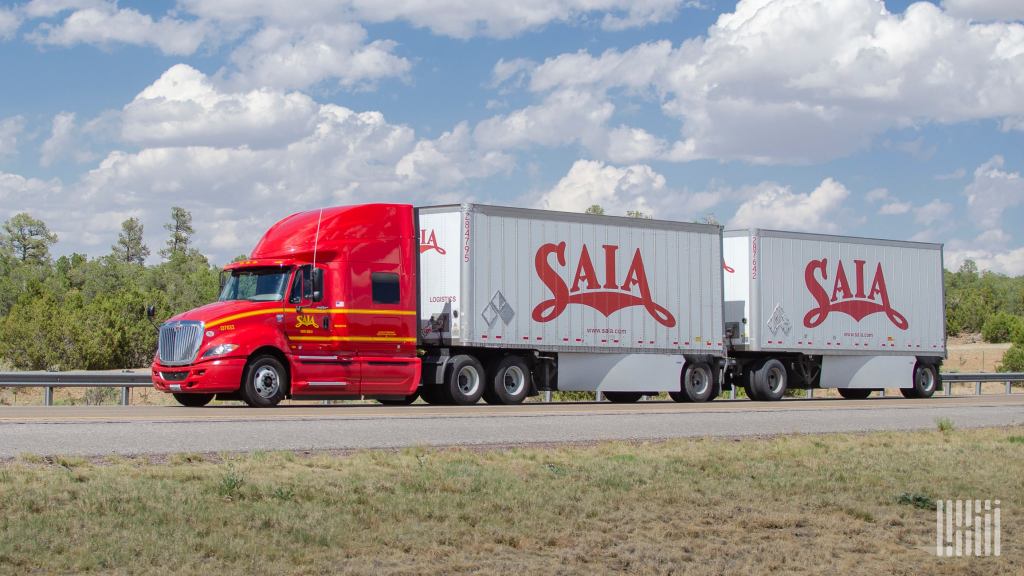
A red Saia tractor pulling two Saia trailers

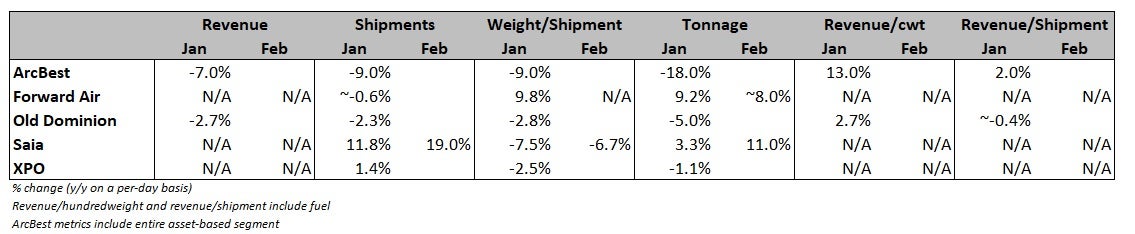
Less-than-truckload carrier Saia Inc. reported an 11% year-over-year (y/y) increase in tonnage per day during February. The increase was the combination of a 19% jump in shipments, which was partially offset by a 6.7% decline in weight per shipment.  

The y/y per-day growth rates accelerated from January, when the carrier’s shipments increased 11.8% and tonnage was up 3.3%. Inclement weather in January led to a larger-than-normal number of terminal closures during the month. Saia (NASDAQ: SAIA) also had an easier tonnage comp in February (down 7.6% last year), which was twice the decline that was logged in January 2023.

The February increases were a little better than the fourth quarter, when shipments were up 18% y/y and tonnage increased 8%.

March is a big month for LTL carriers and volumes in the period will dictate results for the first quarter. The month also provides a strong indication on demand for the full year.

Saia doesn’t provide any revenue-based metrics like yields or revenue per shipment in its intraquarter updates, however, management said on its fourth-quarter call in February that it expects revenue per shipment to increase by a low-single-digit percentage in 2024.

The company is executing a big growth plan this year. A $1 billion capital expenditures outlay includes roughly $550 million for real estate. The budget includes the 28 terminals it recently acquired from bankrupt Yellow Corp. (OTC: YELLQ) as well as other additions and expansions. In total, it expects to grow its net door count by 12% to 14% this year.

The bulk of the remaining budget will be used to purchase tractors and trailers.

Other carriers like ArcBest (NASDAQ: ARCB), Old Dominion (NASDAQ: ODFL) and XPO (NYSE: XPO) are expected to provide updates for February in the coming days.

Table: Company reports

More FreightWaves articles by Todd Maiden

UPS adds twin-bay maintenance hangar at Worldport hub

A brown-tail UPS jumbo jet takes off on a clear day.

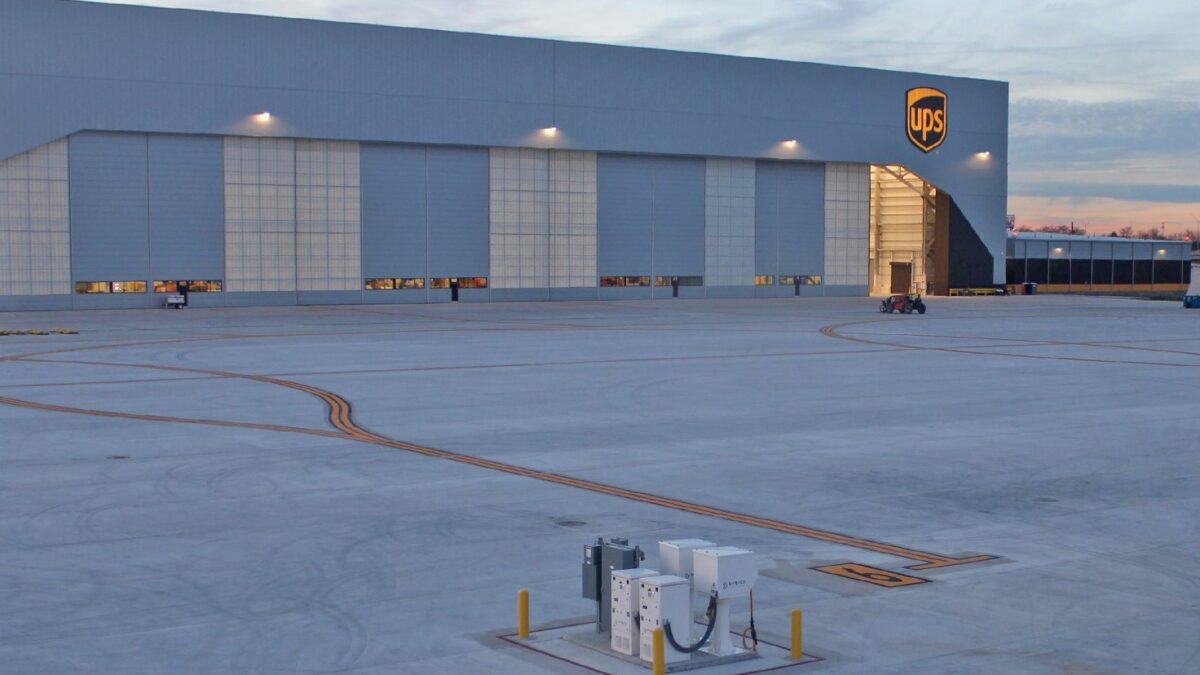
UPS Airlines will open by April a 275,000-square-foot hangar at its Worldport hub in Louisville, Kentucky, that is large enough to park two Boeing 747-8 cargo jets side by side, according to the company.

UPS (NYSE: UPS) invested $220 million in the new facility, which triples the maintenance footprint in Louisville for the largest plane in the UPS fleet, spokesperson Michelle Polk said. The integrated logistics company currently uses a hangar that can fit one 747 freighter. 

The two extra work bays will support service checks, regular maintenance and engine changes for the UPS fleet, which runs from Boeing 757s on the standard size, to widebody Airbus A300s, Boeing 767-300s and MD-11s, and 747s on the large end. Outside ramp space will be able to hold several aircraft.

A new maintenance hangar at the UPS Worldport air hub is undergoing final fitting and will start servicing aircraft in April. (Photo: UPS)

Having more service bays will increase UPS’ ability to quickly return aircraft to service flying goods around the world, said Polk. 

A $78 million expansion of UPS’s Global Aviation Training Center is also near completion, said Polk. The training facility will house eight high-tech flight simulators for training pilots, as well as classrooms and offices. 

The UPS Worldport is a massive transshipment facility that handles about 360 inbound and outbound flights per day and processes more than 2 million daily packages from countries around the world.

Click here for more FreightWaves/American Shipper stories by Eric Kulisch.

Twitter: @ericreports / LinkedIn: Eric Kulisch / ekulisch@www.freightwaves.com

Air cargo growth to start the year less than meets the eye

Riding trucking’s waves: Freight market cycles and the driver pool – Taking the Hire Road

On a recent episode of Taking the Hire Road, guest host Leah Shaver, president and CEO of The National Transportation Institute, welcomed Avery Vise, vice president of trucking at FTR, for a conversation about the data behind trucking, the economy and the labor market. 

Vise has long been tuned in to the data that showcases how the trucking industry is performing today — and where it may be headed tomorrow. In fact, he hosts FTR’s weekly Trucking Market Update podcast, where he explores some of those data points on a regular basis.

Looking at both general employment data and trucking-specific metrics, Vise stressed the importance of considering the most recent numbers in context.

On the whole, the U.S. unemployment rate has been under 4% for the past two years, which is historically very low. At the same time, new headlines announcing major layoffs seem to appear on a near-daily basis.

Frequent layoffs could be having a muted impact on the unemployment rate due, largely, to an influx of new job opportunities hitting the market at the same time. Still, Vise advised listeners to consider that even a low unemployment rate represents a large number of people.

A 4% unemployment rate means that over 6 million people in the U.S. are currently unemployed. Additionally, Vise pointed out that unemployment calculations are not based on the total working age population, but rather on the Bureau of Labor Statistics’ estimation of the amount of that population that consider themselves to be in the workforce to begin with. This means that the number of officially unemployed people and the number of working age people without jobs are different.

Several statistics come into play when assessing the state of employment in the trucking industry specifically. One of the ways to visualize hiring is via the number of Drug & Alcohol Clearinghouse preemployment queries being completed.

Queries have dropped somewhat, with December 2023 numbers coming in 5% lower than December 2022. Vise expects queries will remain somewhat suppressed throughout the year, indicating fewer drivers being screened for new jobs. It is important to note, however, that numbers from the past two years were elevated.

While the trucking industry has shed some capacity, the majority of that can be attributed to the small fleet closures. Overall fleet size in the larger companies has actually grown, according to Vise.

“We see a large number of primarily small carriers exiting the market, but the drivers displaced by that have, for the most part, found jobs elsewhere in the industry,” Vise said.

Recent trucking employment data shows a 1.5% drop from May 2023, according to Vise. Still, that is 4.6% ahead of February 2020 in terms of general freight truckload employment. This indicates that any decline in truckload employment is happening at a crawl, not a nosedive.

This will likely continue to reign true for at least several months.

“Active truck utilization is roughly 89%, which is below the 10-year average of 92%,” according to Vise. “We don’t expect utilization to get back to even the average until early next year.”

Vise did note, however, that certain factors — including the cooling of inflation and a reduction in interest rates — could influence consumers to spend more money, thus generating increased demand and shortening that timeline.

Ultimately, the current state of trucking falls in line with the age-old cyclical expectations that characterize the industry. Eventually, what goes around will indeed come back around.

Sponsors: Career Now Brands, The National Transportation Institute, Infinit-I, Workhound, Asurint, Transportation Marketing Group, Seiza, Drive My Way, DriverReach, F|Staff, Trucksafe

ACF spurs small gain in zero-emission drayage trucks at Port of Long Beach

Even with regulators shelving California’s Advanced Clean Fleets (ACF) rule for at least a few months, the first data released by the Port of Long Beach suggests how the drayage industry was getting ready for its launch at the start of this year.

How the data is interpreted is a classic case of whether the glass is half-full or half-empty.

When the ACF was expected to kick in Jan. 1, with its biggest impact hitting first in the drayage sector, the most significant rule was that no new vehicles with internal combustion engines (ICE) could be submitted to the state’s drayage registry.

Although the ACF is not being enforced while questions of its legality play out, the Long Beach data shows its impact.

There were 111 zero-emission vehicles (ZEVs) registered at the port last July. By January, that had exactly doubled, to 222.

That doubling might argue in favor of a half-full glass for the transition to ZEVs. But the raw numbers of vehicle moves could argue the other way.

In July, 0.5% of all drayage moves within the port were with a ZEV. In January, that figure had more than doubled — but was still just 1.16%. Given the ACF’s anticipated implementation, such increases would be expected.

But the data also supports the expectation that faced with a Dec. 31 deadline after which no new ICE vehicles could be added to the state’s drayage registry, there would be a surge in new registrations of ICE vehicles.

In July, the number of trucks registered with the port was 21,585. It stayed below 22,000 for the next three months but then climbed to 22,267 in November and 24,013 in December. In January, the number declined by 67, to 23,946.

Overall, the growth between July and December was 2,428, so the growth in ZEVs was less than  5% of that increase.

The sharp increase in the number of all trucks available to service the port did not occur against a backdrop of rising demand that could explain such a higher number. The number of moves in October recorded a recent peak at 376,672. But in January, total moves were 331,979, and they had dropped below 300,000 in December.

Data from the adjacent Port of Los Angeles for January shows that only 1% of the vehicles with access were battery electric, with three hydrogen vehicles in the system. Battery electric vehicles accounted for 1% of all port moves; the port of Los Angeles monthly report does not provide data out to two decimal points as Long Beach does.

Phase-outs begin next year

One aspect of the ACF that did not factor in any number change between 2023 and 2024 was the eventual requirement to phase out vehicles after they reach certain age or mileage thresholds.

Matt Schrap, the CEO of the Harbor Trucking Association, the trade group that represents the drayage community, noted that the requirement that a drayage vehicle be retired after it reaches the end of what the state calls its “useful life” kicks in at the start of 2025 when mileage data is to be reported to the state. All vehicles prior to a 2010 model year are already banned.

The rule is that a truck must be retired when it reaches the later of either 13 years since the model year that the engine was certified for use by the California Air Resources Board, or the date when the vehicle exceeds mileage of 800,000 miles or 18 years. So if a vehicle reaches 800,000 miles in 11 years, it can stay on the road until the 13-year mark. If it hits 18 years but hasn’t reached 800,000 miles, it has to be taken off the road.

Noel Hacegaba, the chief operating officer of the Port of Long Beach, said the port’s recent numbers align with the expected impact of the regulation. “It’s more than likely that a large part of the increase in trucks in the registry is due to what everybody expected to be the December 31 deadline to register these internal combustion engine trucks,” he said in an interview with FreightWaves.

Hacegaba said the port did not have a ZEV target number for the end of 2024 but that the market has “two major levers” that should help propel growth.

One is the combination of federal and state incentives to get a fleet to buy a ZEV that costs more than $400,000 instead of just continuing to run an ICE vehicle, since a new ICE vehicle won’t be able to be admitted to the drayage registry once the ACF is enforced.

The second is the continued installation of charging infrastructure. Hacegaba ticked off projects in or near the port that he said are adding to that capacity “literally on a daily basis.”

“We’re confident that we’re going to continue to see that incremental growth in the years ahead,” he said.

Funding for the infrastructure has come in part from the Clean Truck Fund Rate, which applies a $10 fee for every twenty-foot equivalent unit that goes through the port, except those carried on a ZEV. Hacegaba said in the first 22 months of the program, the port has collected roughly $70 million to be used for charging infrastructure development.

Echoing the half-empty/half-full debate, Hacebaga said of the ZEV versus ICE vehicle numbers at the port, “When there are 15,000 trucks that regularly visit the port, it’s clear that we still have a long way to go. But the incremental growth in zero-emission vehicles just within the first year is certainly encouraging to us.”

That 15,000 is the approximate number of “active” vehicles in the latest Port of Long Beach report, as opposed to the registry of total vehicles.

Why the ACF is sidelined for now

The reason why the ACF is not being enforced now is that CARB decided in November it needed a waiver for ACF from the Environmental Protection Agency. CARB had argued for months it did not need such a waiver, but a lawsuit filed by the California Trucking Association insisting it did seems to have changed the agency’s mind. CARB said it would not enforce ACF until there was clarity on the waiver. But that news came late in the cycle.

When CARB announced the delay in the ACF, it also signaled it was holding the door open to retroactive enforcement of some provisions. That could mean any new ICE vehicles registered in 2024 because of the ACF enforcement delay will need to be withdrawn from the drayage registry when the law comes back into force.

Waivers from the EPA to California allowing it to exceed federal rules are virtually always granted. Such a waiver has been granted for the Advanced Clean Trucks rule, the sister regulation to ACF that is aimed at truck manufacturers.

Schrap said he believes the data on new ZEV vehicles entering the registry reflects vehicles that were ordered “a long time ago” and that they are likely to be coming into larger fleets.

“I feel like it’s a bubble frankly and that while yes, there’s deployment happening, we’ll see slower growth from here on out,” Schrap said.

He came back to a theme he has sounded before. In stark contrast to Hacegaba’s optimism about charging infrastructure, Schrap sees the opposite.

In particular, the hope that hydrogen-fueled vehicles would provide a notable contribution to the ZEV fleet is one that Schrap said is foundering on the lack of hydrogen refueling infrastructure.

“There have been a significant amount of cancellations [of various types of ZEV trucks] because there’s no refueling infrastructure,” Schrap said. 

By contrast, the Hacegaba outlook remains cautiously positive.

“If you would have asked me back in 2017 when this 2035 goal was first established, it was a very daunting goal back then,” Hacegaba said, referring to the 2035 deadline by which all drayage vehicles must be ZEVs. “But thanks in large part to some of the regulations and some of the goals established statewide across California, there’s momentum and there are incentives statewide for these manufacturers to start mass producing these trucks. So the operating environment is creating some momentum.”

More articles by John Kingston

If truckers haul bread and cakes, is their business baking or trucking?

Deadline near for filings as Werner seeks review of nuclear verdict

Live on stage: The complex relationship between a trucking job and life

Lax oversight of trucking contractors plagues Postal Service

US Postal Service long-haul truck on the highway.

WASHINGTON — Lax oversight by the U.S. Postal Service of the trucking companies, brokers, and drivers it contracts could be contributing to accidents and deaths on the nation’s highways, based on the results of a new safety report.

The audit, released on Friday by the Postal Service’s Office of Inspector General (OIG), was requested by Congress last year following a Wall Street Journal investigation into safety violations and fatal crashes involving long-distance carriers that haul mail for the agency.

The Postal Service does not track accidents and fatalities involving its trucking contractors, the OIG audit revealed, and therefore auditors were unable to provide Congress with a complete set of accident data.

Analyzing official but incomplete data from the Federal Motor Carrier Safety Administration, the OIG identified 373 accidents resulting in 89 fatalities directly related to 43 on-duty contractors servicing Postal Service trucking contracts.

“These 43 contractors were associated with Postal Service contracts totaling about $1.34 billion between October 2018 and December 2022,” according to the audit. “We determined that the Postal Service had not terminated any contracts with trucking companies involved in accidents or fatalities prior to March 2023.”

While the agency told OIG that it is taking actions to remedy the problem – including starting to remove contractors with an FMCSA “conditional” safety rating, the lack of established policies to track and monitor accident and fatality data from its truck contractors “limits the Postal Service’s visibility into contractor safety performance,” the OIG stated. “This deficiency could allow unsafe drivers to transport mail and put other motorists at risk.”

Brokers left on their own

The audit also found that 14 of the 15 contracting and administrative officers interviewed did not know when trucking companies hired for highway contract routes (HCRs) used a subcontractor. In addition, brokers for the agency’s freight auction contracts – used to purchase extra capacity when contractors can’t fulfill HCRs – were not required to obtain approval or inform the Postal Service of subcontractors they hire.

“The Postal Service relied on the broker to complete subcontractor authorization and vet the subcontractor, but those results are not required to be reported to the Postal Service,” the audit stated. “The onus is on the broker to ensure the subcontractor is in compliance with Postal Service policies.”

Another significant deficiency found by the OIG: the Postal Service did not require comprehensive vetting of drivers for 241,006 freight auction trips in FY22 and FY23, which led to some of those drivers not being vetted at all.

“Postal Service processes do not provide any information about driving history records and allow drivers without any background screening access to the mail,” the audit noted. “As the volume of routes selected via the freight auction process continues to rise, using a weak screening process could lead to unqualified drivers transporting mail, compromising security of mail and safety of motorists.”

Regulations coming?

The OIG issued seven recommendations based on its findings, including developing a reporting system for subcontractors and putting in place a formal process to verify driver history.

In a statement to the Truck Safety Coalition, which has been pressuring the Postal Service to make reforms on behalf of crash victims, U.S. Rep. Gerry Connolly, D-Va., said the report “confirmed several of our worst fears about contract trucking practices at the United States Postal Service.”

Connolly, who has pushed for reforms in Congress, plans to introduce the “Mail Traffic Deaths Reporting Act,” legislation that would require that Postal Service truck contractors and subcontractors report to the agency all crashes in which they are involved that result in injury or death not later than three days after the crash.

“I have met with the victims of these trucking accidents. They want to be seen,” Connolly said. “The report calls out for legislative action, and we are going to answer that call.”

Click for more FreightWaves articles by John Gallagher.

How much does it cost to recover a semi that almost fell off a bridge? – WTT

On Episode 689 of WHAT THE TRUCK?!?, Dooner is joined by Dad of Two Roadside to discuss the semi truck that almost went over the Clark Memorial Bridge last Friday. How much does it cost to recover a truck after an accident like that? We’ll find out. Plus, we’ll learn how towing works for drivers stuck at Donner Pass.

Hydrogen semis are starting to hit the highway this year. We’ll meet Hyzon Motors CEO Parker Meeks to learn the latest about the company’s zero-emissions truck. Hyzon has recently delivered four of its fuel cell trucks to Performance Food Group. We’ll find out why that’s just a start. 

UP Partners has released its 2024 Edition of “The Moving World Report: Macro and Micro Trends in Mobility.” Co-founder Cyrus Sigari breaks down the trends driving the global economy. 

Whimsy Intermodal CEO Matt O’Mara dives into the latest trends in drayage and at the ports, and tells us how the market is shaping up for spring.

Travelers’ Scott Cornell talks about challenges for the transportation industry in 2024.

Plus, tumbleweeds take over Utah; rock slides in Peru; and Texans band together after wildfires.

Watch on YouTube

Subscribe to the WTT newsletter

Apple Podcasts

Spotify

More FreightWaves Podcasts

Ushering in convergence: Unified supply chain platforms are key in 2024

By Bart De Muynck

The views expressed here are solely those of the author and do not necessarily represent the views of FreightWaves or its affiliates.

Global supply chains are facing a complex landscape in 2024, marked by disruptions, evolving consumer demands and technological advancements. In this dynamic environment, companies are increasingly seeking convergence: the seamless integration and optimization of disparate processes and systems across their supply chains. This is where unified supply chain platforms come in, playing a pivotal role in driving this much-needed approach.

These platforms are important for different reasons. First, supply chains have become a lot more dynamic, circular and real time, and old, siloed applications that work in a linear chronological way cannot keep up with the speed the world moves at in 2024. Second, supply chains have historically been fragmented, with data and operations siloed in separate systems. This creates a multitude of challenges from disconnected systems that impede visibility into inventory levels, order status and potential disruptions throughout the supply chain. This lack of transparency hinders proactive decision-making and hampers responsiveness to fast market changes and global disruptions. Multiple systems often also lead to redundancies, data inconsistencies and manual workarounds, resulting in operational inefficiencies and increased error rates. Finally, collaboration between internal teams and external partners like suppliers and logistics providers becomes cumbersome when information flows through diverse and incompatible systems.

Unified supply chain platforms offer a solution by integrating various functionalities within a single platform, facilitating data exchange and workflow automation. They drive convergence through centralized data management, as they act as a single source of truth, consolidating data from disparate systems like inventory management, transportation management, yard management and warehouse management. This enhances visibility across the entire supply chain, empowering real-time decision-making and proactive planning. Not only is the data streamlined, but the unified supply chain automates manual tasks and workflows, eliminating redundancies and streamlining information flow. This improves efficiency, minimizes errors and ensures consistency across various operations. Unified platforms also provide a centralized platform for collaboration between internal teams and external partners. This fosters transparency, facilitates communication and enables seamless information sharing across the entire supply chain ecosystem.

And finally, we should not underestimate the impact these technology platforms have on the people working through these processes. In times when talent is scarce and under threat from big competition, having technology solutions that improve lives can augment a company’s talent attraction and retention.

We have heard for many years about resilience, which became even more important during the COVID years. At the start of COVID, resilience was the ability to buy inventory and deliver products while manufacturing plants were shutting down, ports and distribution centers closed, and lead times increased dramatically. But this came at a high cost as transportation costs dramatically increased and shippers were buying inventory where they could find it. This could be categorized as “resilience at any cost.” But this type of resilience is simply not sustainable. U.S. business logistics costs increased by 19.6% in 2022, the highest-ever increase. And 50% of the increase was due to inventory carrying costs.

In 2024 there is a clear focus on cost management. Companies want even greater resilience, which means being dynamic and agile — both of which require connectivity and real-time data. But we need to be able to reduce cost to improve profitability. Companies can’t continue executing their operations at these high fulfillment costs with high inventory, fulfillment and transportation costs. We need smarter systems that helps us execute smarter.

Improved visibility across the supply chain allows for proactive risk management and faster response to disruptions, minimizing their impact and ensuring business continuity. Streamlined workflows and automated processes translate to cost savings, reduced cycle times and optimized resource allocation, leading to overall operational efficiency. Enhanced visibility and real-time tracking capabilities enable companies to fulfill orders efficiently and provide accurate delivery timelines, leading to improved customer satisfaction. There also needs to be a greater focus on the ecosystem of solutions between the planning systems, the execution applications, visibility platforms and other data solutions.

In 2024, a unified approach to supply chain management is no longer a luxury but a necessity. By embracing unified supply chain platforms and the convergence they enable, companies can navigate the complex global market, build “profitable” resilience and remain competitive in the ever-evolving landscape. This is not just a technological solution but a strategic investment that paves the way for a more efficient, transparent and customer-centric future for supply chains.

In 2024, a unified approach to supply chain management is no longer a luxury but a necessity. By embracing unified supply chain platforms and the convergence they enable, companies can navigate the complex global market, build “profitable” resilience and remain competitive in the ever-evolving landscape. This is not just a technological solution but a strategic investment that paves the way for a more efficient, transparent and customer-centric future for supply chains.

    Look for more articles from me every week on FreightWaves.com.

    Bart

    Look for more articles from me every week on FreightWaves.com.

    Bart De Muynck is an industry thought leader with over 30 years of supply chain and logistics experience. He has worked for major international companies, including EY, GE Capital, Penske Logistics and PepsiCo, as well as several tech companies. He also spent eight years as a vice president of research at Gartner and, most recently, served as chief industry officer at project44. He is a member of the Forbes Technology Council and CSCMP’s Executive Inner Circle.