Flexport launches the Convoy Platform

Almost four months after acquiring the technology and IP of shuttered digital truck brokerage Convoy, Flexport has launched the Convoy Platform.

The slimmed down technology platform aims to offer small carriers access to freight, while offering shippers and brokers real-time competitive rates, shipment visibility and on-time performance, Flexport officials said.

“Today’s launch of the Convoy platform furthers Flexport’s product vision to build a true one-stop-shop to ship any product, in any quantity, between any two places in the world,” Flexport CEO Ryan Petersen said in a news release. “As a neutral, end-to-end supply chain platform, we’re able to bring together every party in global logistics with one common mission: Make global commerce so easy there’s more of it.”

Flexport is a digital global supply chain solutions provider based in San Francisco. The company acquired Convoy’s technology and IP in November, after the latter shut down on Oct. 19.

Convoy and Flexport have had a partnership since at least 2021. Flexport customers, through its Convoy integration, were able to gain broader access to domestic truck transportation and gain a more thorough view of their shipping costs.  

In 2022, Convoy had over 1,000 employees and a valuation of $3.8 billion. Former Convoy CEO and co-founder Dan Lewis attributed the company’s fall to a freight recession over the past year coupled with tighter capital markets.

As part of the acquisition, a small number of Convoy employees joined Flexport, which did not take on Convoy as a company or its liabilities. Terms of the acquisition were not disclosed.

For shippers, the launch of the Convoy Platform offers Flexport customers more full truckload carrier options. There are more than 400,000 truck drivers and 80,000 carriers in the Convoy network. 

Flexport plans to expand Convoy’s offerings for brokers in the second quarter of this year. Brokers will soon have access to capacity backed by fraud detection technology and ongoing automated predictive performance scoring and quality control.

“It’s long been Flexport’s belief that no single company can provide a solution to every problem in global logistics, and we are committed to using technology to create a more collaborative, transparent and reliable freight ecosystem for all,” Bill Driegert, Flexport’s executive vice president and head of trucking, said in a statement.

The Convoy Platform will enable carriers to find and book loads from vetted brokers and shippers, as well as provide 24/7 access to the load board in the Convoy app. Carriers can also request hassle-free detention and lumper fees, track their fleet, and manage their load paperwork in the app.

More articles by Noi Mahoney

Trump-supporting truckers boycott loads to New York City

Border bridges blocked as former rail workers seek back pay

329 layoffs hit freight-related firms in Texas

Video review services change the game for carrier risk mitigation

White tractor trailer truck driving toward camera

These days, dashcams do much more than record events on the road and in the cab. Dashcams can detect accelerometer-triggered events to relay back to a carrier in real time, and AI-powered dashcams take it to the next level with the ability to alert a carrier to everything from distracted and fatigued driving to speeding and failure to obey the rules of the road. This gives carriers a newfound ability to exonerate drivers in the event of a crash, as well as proactively prevent accidents and promote safety within their organizations. 

Some of the top driver behaviors linked to future crash likelihood include the very behaviors, which are violations, that an AI-powered dashcam detects. According to the American Transportation Research Institute’s 2022 report on Predicting Truck Crash Involvement, examples of these predictors include a failure to yield right-of-way violation, a failure to obey traffic sign conviction, and a reckless/careless/inattentive/negligent driving conviction. 

But fleets — even modest-sized ones — generate a vast amount of data exposing unsafe driving behaviors. AI-powered dashcams can detect many more instances than a vehicle’s electronic control module (ECM) and electronic logging device (ELD) alone. 

All unsafe behaviors must be coached to reduce risk, so many carriers turn to a video review service (VRS). Outsourcing the review of unsafe driving alerts can help a carrier maximize the return on a dashcam-driven coaching system by handing the video clip screening process to experts.

From a legal standpoint, large amounts of unchecked information — like what could be generated from safety devices — can work against a carrier in negligent supervision claims resulting from an accident. 

“A plaintiff’s attorney will subpoena anything that should have been reviewed by the carrier, including data showing unsafe driving behavior,” said Mark Schedler, senior editor of transport management at J. J. Keller & Associates Inc., the transport industry’s trusted safety and compliance expert since 1953. 

Reviewing alerts and video footage to find situations that warrant training requires time and attention, and it can quickly become overwhelming for safety compliance departments. 

“The underlying reason to consider a VRS is risk reduction and to help the carrier uphold their ‘duty to act’ and resolve their drivers’ unsafe behaviors that put the public at risk. Carrier safety management controls, or policies and procedures that support the safety program, must account for and require people to act on all unsafe driving data that a carrier ‘should have been aware of,’” Schedler said. 

Because a competent VRS is staffed with experienced individuals who review all alerts, they can quickly identify the instances that deserve immediate attention, which isn’t always possible with limited carrier staffing and inexperienced reviewers. 

“If you’re approaching a driver to talk about something that happened weeks ago, it’s not very effective. If something happened on the road today, you’d want to acknowledge that with the driver in the next couple of days at the latest to say, ‘Here’s what we would have preferred that you do. Here’s the plan for corrective action training,’” said McHenry Johnson, senior client success manager at J. J. Keller & Associates. 

While companies use dashcams to quickly address unsafe driving events after they happen, carriers should also want to use them as a coaching mechanism to mitigate risk and lower insurance costs. These reasons were what drove Enviro-Eze Transport Inc., a Canadian transportation and logistics provider, to seek out a dashcam and VRS partner. It wanted to know the full story behind unsafe driving events, which required both driver-facing and street-facing capabilities and AI-powered alerts. 

Enviro-Eze – a premier provider of transportation and logistics services out of Southwest Ontario –  decided on J. J. Keller’s VideoProtects AI-powered dashcam and the J. J. Keller Video Review Service after exploring two other options. Jeff Rooyakkers, operations manager at Enviro-Eze, said that in the first year of using VideoProtects and the J. J. Keller Video Review Service, the company was able to dramatically cut its driver cellphone usage and detect and mitigate numerous unsafe driving behaviors. 

“When we implemented VideoProtects, our distracted driving was corrected almost immediately,” Rooyakkers said.

This included immediate intervention, such as in the case of one driver the system identified as fatigued. Based on the driver’s eye movements, the system recorded the event and sent a text message to Rooyakkers. He was able to call the driver immediately and instruct him to pull over to rest. 

“If you’re truly reading the documents you’re getting, watching the videos, and looking at the statistics from the VRS, you can’t predict when that accident is going to happen, but you can definitely predict that that driver is going to have an accident,” Rooyakkers said. “We use coaching tools here and training tools to help eliminate that and hopefully prevent it in the future.” 

How a VRS works 

A VRS screens videos so that only scored events are passed along to carriers. Auditors will dismiss anything they deem as a false positive or a low level, which greatly reduces the number of events a carrier has to review and allows them to only focus on the issues they are concerned with. 

“We have a scoring system that all of our auditors use, so you know it will be consistent. We meet with each company to tweak that so if there are certain things that they’re more concerned about, we’re going to focus on those,” Johnson added about J. J. Keller’s Video Review Service

Beyond mitigating behavior that puts drivers at risk, Rooyakkers added that their VRS sends out driver report cards to drivers, which contain only “real numbers from real videos that have been watched by real people.” This helps build trust with drivers.

“If a driver has an issue with a scorecard, they can come to me. We can pull all their videos and go through them, and I guarantee you every single one they look at will be accurate because they’ve been reviewed,” Rooyakkers added. 

Best practices for dashcam and VRS implementation 

Before carriers implement a video review service, Schedler recommends they participate in a test period of two to three months. This period allows the carrier to trust that their VRS partner is capturing the events most important to the carrier.

“The carrier has to trust the video review service. “A carrier that thinks the VRS provider is hammering them with unnecessary or irrelevant videos feels like their time is wasted. On the other hand, not receiving enough videos could make a carrier feel as though they are missing videos that could create risk.’” Schedler said. 

This test period is also critical to ensure drivers are on board with a new safety tool measuring their behavior. Enviro-Eze was intentional about their approach to the introduction of cameras. The company informed drivers of their decision to install cameras and alleviated concerns by installing dashcams one by one to get drivers comfortable with the idea. 

“It’s hugely important to make sure that the driver understands that these are not put in for a negative reason. These are put in as a coaching and learning tool,” Rooyakkers said. 

J. J. Keller’s Video Review Service helps clients using Encompass Video Event Management and VideoProtects Video Management get the most from their dashcams. J. J. Keller’s team ensures smooth implementation by evaluating the driver and system behavior to substantiate a carrier’s primary risk events, fine-tune camera settings, and discuss the scoring system. They regularly review driver events, make training recommendations, stay on top of recordkeeping functions, and more. 

“Both regular meetings, regular touchpoints, and just having someone you can rely on if questions come up can make a huge difference,” said Johnson.

Daily Infographic: What are the most common reasons freight is rejected?


To view more FreightWaves infographics, click here

Texas factoring company files for bankruptcy liquidation

Texas-based factoring company Genesis Network Telecom filed for bankruptcy liquidation on Wednesday.

Genesis Networks Telecom Services LLC, also known as Genesis ATS (GNET), headquartered in San Antonio, filed its petition in the U.S. Bankruptcy Court for the Western District of Texas.

Founded in 2005, the company offered financing solutions for small and midsize companies. It lists its assets as up to $50,000 and its liabilities as between $100 million and $500 million, according to the petition filed Wednesday. Genesis Funding, which states on its website that it’s a “one-stop shop for fast financing,” has up to 49 creditors and maintains that no funds will be available for unsecured creditors once it pays administrative fees.

FedEx Supply Chain Logistics of Carrollton, Texas, and Arris Solutions Inc. of Austin, Texas, are listed as creditors, although no amounts are listed in the bare-bones petition.

According to court documents, GNET, which was founded by James Goodman, has been involved in a number of lawsuits over the past three years, including a Chapter 7 filing involving one of its affiliates, Arris Solutions Inc. The suit, filed by FedEx against GNET in October 2023, alleges the company engaged in a “protracted and multifaceted scheme to defraud the company of more than $67 million dollars.”

Tina Younts is listed as the executive assistant on the bankruptcy petition. 

A creditors meeting has been set for March 19.

Do you have a news tip to share? Send me an email or message me @cage_writer on Twitter. Your name will not be used without your permission.

Ex-Slync CEO Chris Kirchner guilty of wire fraud, money laundering

Tech battle: Samsara sues Motive Technologies for patent infringement, false advertising

Click for more articles by Clarissa Hawes.

West Coast leads latest surge in US container imports

The start of 2024 is bringing with it significant growth in volumes at top U.S. ports.

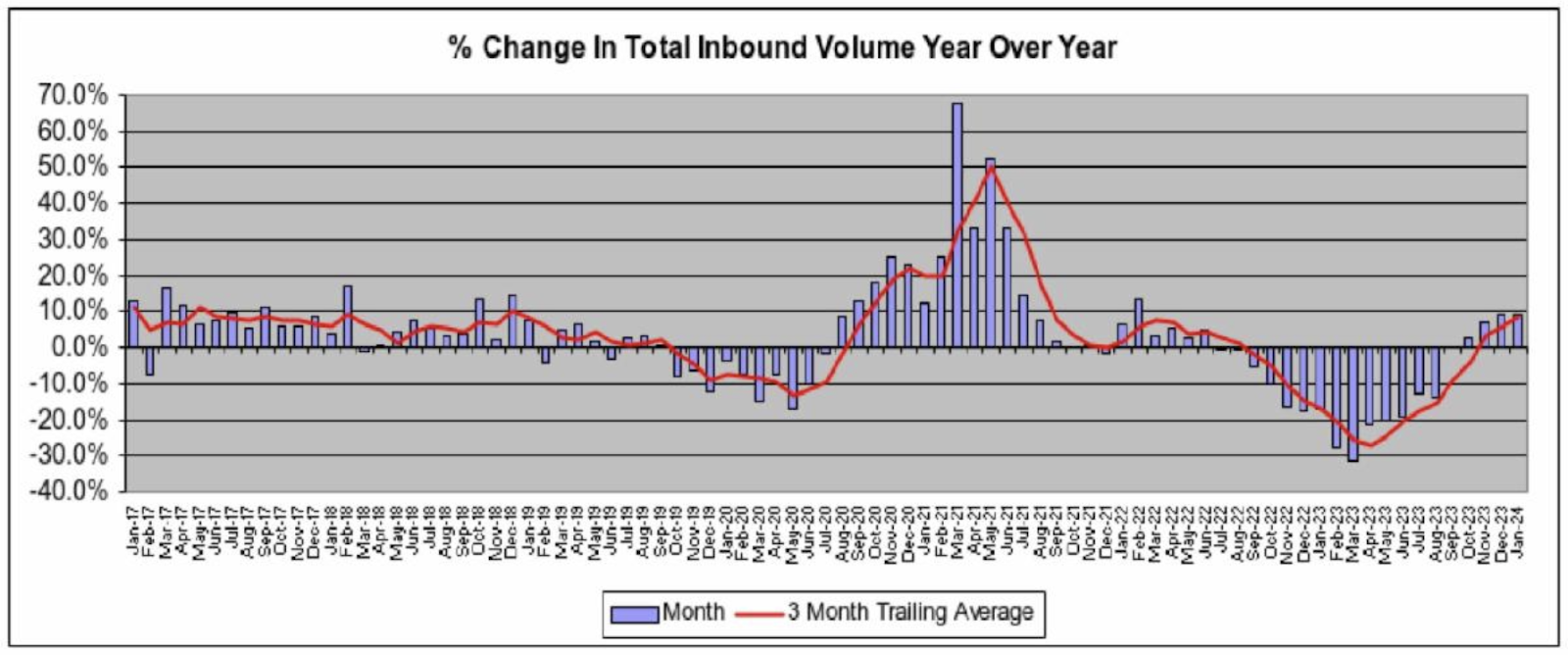
January witnessed a 9.2% year-over-year increase in inbound containers. This rise represents the latest reading in four consecutive months of growth, a beacon of positive momentum after a challenging period dominated by the post-pandemic downturn.

“We are now completely back to year over year changes being driven by underlying economic activity, as we are past the periods where such changes were driven by difficult earlier comparisons,” wrote John D. McCown, an independent analyst who compiles imports data on the top U.S. ports, in his latest monthly report.

Source: “The McCown Report, Top 10 US Ports.” Percent Change in Total Inbound Volume Year Over Year.

For 15 tumultuous months, the top U.S. ports grappled with declines in y/y volume, a direct fallout from the COVID-19 U.S. import surge. The recent jump in inbound volumes suggests a turning tide, with the industry charting a course back toward stability and growth.

The increase in January’s inbound volume, building on an 8.9% rise in December, reflects robust demand for tangible goods and underscores the resilience of the economy in the face of adversity.

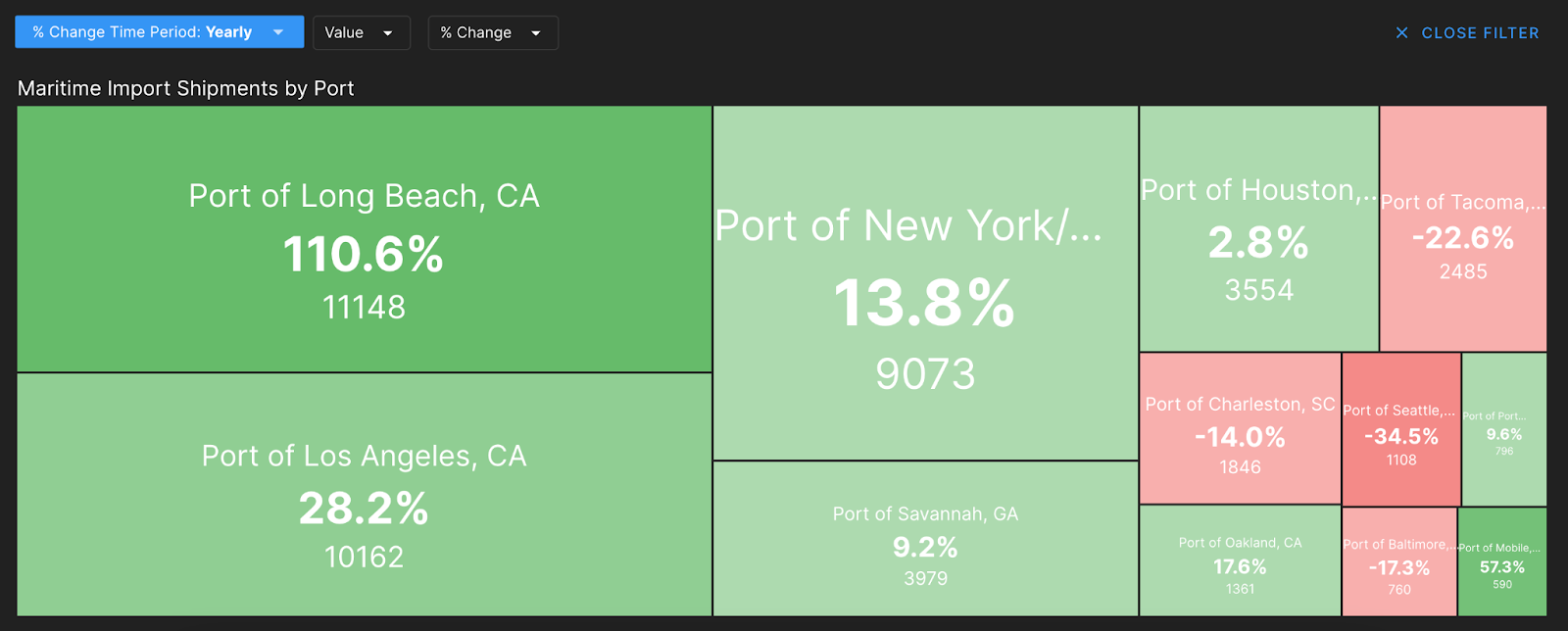
Source: FreightWaves SONAR. Maritime Import Shipments by Port — Tree Map.

Coastal shifts and performance

The maritime landscape of 2024 has started with a resurgence at West Coast ports, particularly Long Beach, California, which alone heralded a 23.5% surge in January. This significant upswing to a 17.7% increase across the West Coast marks a reversal from the pandemic’s aftermath. 

(Note that figures in the chart are for daily y/y changes in late February and are included primarily to show the latest trends. Percent changes should not be relied upon as definitive for how the full month of February will end up.)

During the height of global disruptions, shippers increasingly favored the East and Gulf coasts in a bid to circumvent the logistical quagmires plaguing the West. However, recent trends indicate a return to pre-pandemic preferences, signaling a robust recovery and renewed confidence in West Coast capabilities.

The East and Gulf coasts painted a different picture, with a modest 2% increase in volume. Notably, Charleston, South Carolina, saw an 8.3% downturn, underscoring the uneven nature of the recovery across the nation’s maritime gateways. This disparity raises important questions about the underlying factors driving these regional performances.

While the West Coast’s rebound could be attributed to a confluence of improved efficiencies and strategic shifts, the East and Gulf coasts’ slower pace suggests potential challenges in maintaining the pandemic-era momentum.

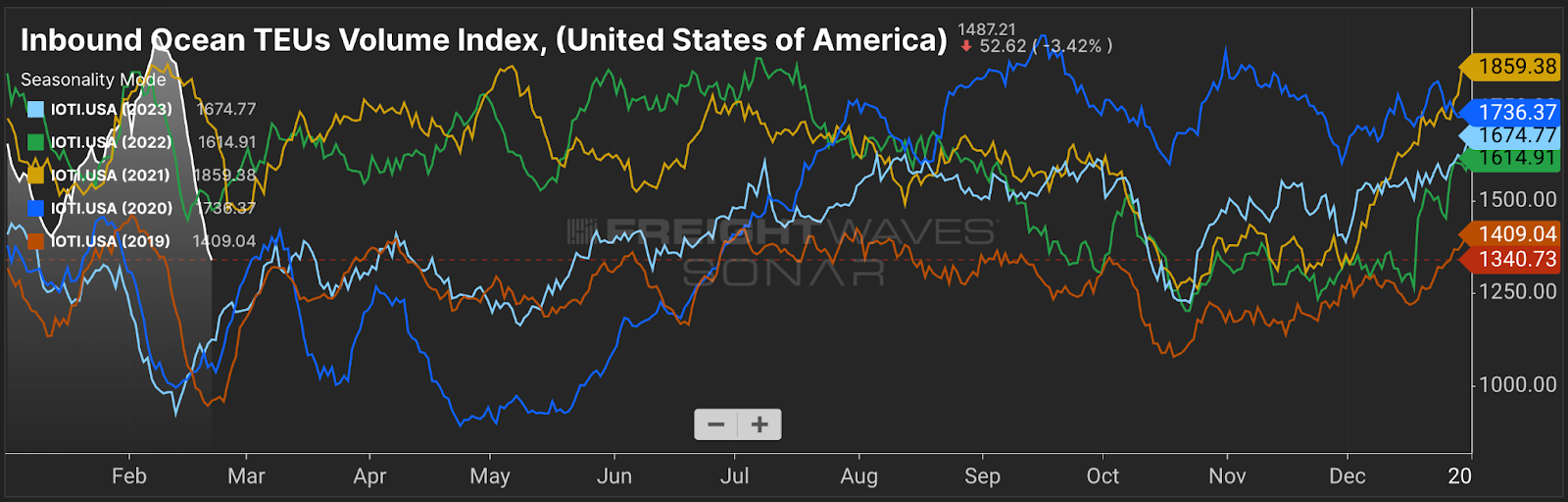
Source: FreightWaves SONAR. Inbound Ocean TEUs Volume Index (all ports to U.S., seasonal over 5 years).

Long-term growth and economic implications

The white line on the chart above, indicating the Inbound Ocean TEUs Volume Index (IOTI.USA) for the United States in 2024, shows significant seasonal demand, even though the drop during this Lunar New Year appears markedly steeper than in previous years.

The overall higher trajectory of the 2024 line, even after the Lunar New Year adjustment, points to a sustained demand for imports, hinting at a hopefully positive outlook for trade volume growth through the year.

January’s inbound load data, showing a 4% increase over the same month in 2019, marks a significant step toward pre-pandemic trade patterns. This translates to a compounded annual growth rate of 0.8% over five years, which is at least a steady trajectory. Such resilience in trade volumes is a welcome sign for North American freight providers.

The upward trend, however, does unfold within a context of moderated growth expectations. The projected annual future growth of approximately 2.7% signifies a recalibration of the trade sector’s outlook, adjusted for a landscape reshaped by geopolitical tensions, supply chain realignments and evolving market dynamics. It’s a promising rate, but it also trails the pre-pandemic 10-year average growth rate of 3.8%.

Ports act as barometers for economic health, with their performance offering insights into broader economic trends and shifts in trade patterns. These trends not only reflect the immediate impacts of pandemic-related disruptions but also signal longer-term structural shifts in trade routes and supply chain strategies.

As trade volumes continue to recover and adapt to these new realities, the focus will increasingly shift toward enhancing port efficiency, diversifying trade routes and investing in sustainable logistics solutions.

State of Freight takeaways: Is a weak February the bottom of the cycle?

The word that Craig Fuller used to describe the freight market in February: “abysmal.”

That was one of the initial observations in FreightWaves’ February State of Freight webinar. But could it be that the month marked a low point in the long freight recession?

Here are five takeaways from Wednesday’s webinar. 

Another tough month in the freight market

Fuller, FreightWaves CEO, said he had spoken to several trucking executives who had a high exposure to the spot trucking market, and that it had been “a pretty abysmal February.” But that’s when the possibility that the end of the cycle had arrived came up.

“One of them said that this was sort of the beginning of the end of the cycle,” Fuller said. “So it’s the big washout and I think that’s a fair statement.”

The “washout” is the exit of capacity that the market has been waiting for since the beginning of 2023. Predictions of a stronger market by the end of last year never came true, and there was wide agreement in the trucking sector that it was stubborn capacity sticking around that was bringing about a freight recession that would not end.

The February market perspective comes after signs of an upturn in January, Fuller said. And he pointed to an unusual cause for part of it: tax refunds.

“A lot of folks that have been impacted by inflation are getting a surge of money, and they’re spending that in January,” Fuller said. “And we don’t seem to be repeating that in February, March and April.”

The end result is that “as bad as February may feel, I think the reason it feels worse is because things were on the up and up,” Fuller said. The hope, he said, is that “we’re bouncing off the bottom.” But he added that he did not foresee a return to the lows of last May. “I think we’re actually in pretty good shape.”

Capacity continues to bleed out

One of the reasons for that optimism: the continuing decline in net trucking authorities, as shown in the CDNCA.USA chart in FreightWaves SONAR.

Fuller reviewed the number of motor carrier authorities in recent years, going back to the weak freight market of 2019, followed by “this massive build and growth in authorities during the COVID cycle.” Authorities collapsed after that, and Fuller said they remain in a “churning-out phase, which is actually positive for the fleets because it means there are less participants in the market.”

“I doubt we’ll see expansion in 2024,” he said. At one point, it could be argued that the number of authorities was 90,000 more than was needed.

Zach Strickland, FreightWaves’ director of freight market intelligence, said the loss of capacity “still has a long way to go” but that net revocations of motor carrier authorities are trending lower.”

Spot vs. contract and what it means

Fuller said the relationship between spot and contract rates is key, and what is happening now suggests a market that is returning to normalcy.

In a normal market, spot rates might be about 20 to 35 cents per mile less than contract rates, “so it’s cheaper to go spot.” But during the strongest days of the COVID bull freight market, it became more expensive to book freight in the spot market than the contract market.

When that happens, Fuller said “it was an opportunity for carriers to make a lot of money by shifting capacity” into the spot market. But when spot rates collapsed in the second quarter of 2022, according to Fuller, “shippers said, ‘Hey, I don’t have to honor my contract rates so screw it. I don’t care if the carriers get upset at me. That’s not going to matter anyway because I don’t need them.”

But Fuller said with spot and contract rates now more in alignment, as the lagging contract rates adjust to the new reality, it’s a sign of “rational behavior.” With the two rates, contract and spot, normalizing their relationship, “it starts to suggest that the recovery in the freight markets is back and the market is starting to act rationally,” Fuller said. 

But that behavior might not hold. Fuller said when the rates start to normalize, it could result in situations where carriers reject contract freight and turn to the spot market that has gotten up off the canvas. “Carriers now have options to actually do what the shippers could have done last year, and that’s go find something more financially rewarding.” If that happens, the rejection rates can “skyrocket,” he said.

California’s weather issues

With another atmospheric river pounding the Golden State, it raised the question: What does this mean for produce season?

Strickland said — after admitting “the produce season fascinates me” — that the heavy rains in the state are not just a flooding issue, but can delay planting as well. “Those harvests can get delayed because the fields are too wet to plant,” Strickland said. The result is that normal seasonal flows get “pushed out,” or even worse, crops can be ruined by the excessive wetness. 

The refrigerated season for California produce usually runs from late March through July, Strickland said. That’s when disruption in the markets from the rains could take place, “and I think it’s going to happen,” he added.

That disruption means that the demand for freight ends up being in a smaller window. “The sense of urgency is higher,” Strickland said, and that could create profitable opportunities for produce carriers.

How are earlier calls looking right now? And what does it mean for brokers?

A listener on the webinar asked whether Strickland and Fuller were sticking to earlier bearish predictions heard at the Future of Freight Festival from November in Chattanooga, when the State of Freight for that month was held live.

Fuller said at that time, he was thinking there might not be a turnaround until early 2025. “We’re constantly getting new information here and we’re bringing it in,” Fuller said. “But yes, I have become more bullish. But it’s not dramatically different. I wouldn’t say it’s a quarter ahead, but maybe two quarters.”

The shifting of margins is not good news for already beleaguered brokers, Fuller said. The spread between contract and spot rates, which are now normalizing, is “where the brokerage margin lives.” When spot rates invert to lower levels less than contract, “they make a lot of money because they’re able to charge high premiums,” Fuller said. But a compression in the rates results in tighter margins, “and we see brokers lose in this part of the cycle.” Conversely, it’s that sort of spread that gives more power to carriers, he added. 

More articles by John Kingston

Teamsters ousted at Dr Pepper Wisconsin, face off against Anheuser-Busch

FMC upholds ruling upending current chassis pool system

Live on stage: The complex relationship between a trucking job and life

US targets Chinese-made container cranes in spy crackdown

ZPMC gantry cranes

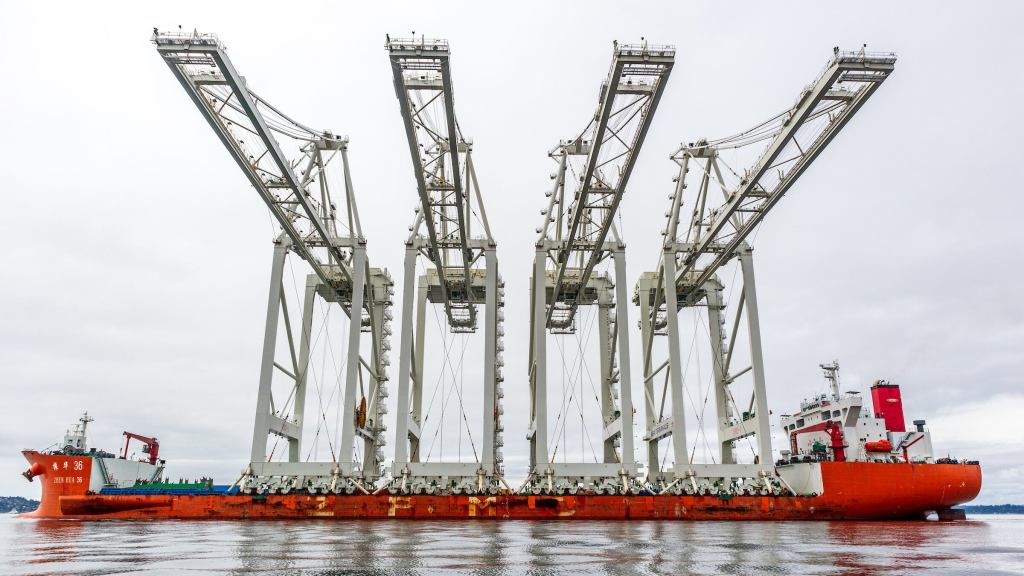
Owners and operators of over 200 Chinese-made container cranes at U.S. ports will be subject to new cyber-risk management requirements aimed at reducing China’s ability to spy on America’s domestic supply chains.

The U.S. Coast Guard on Wednesday announced that owners or operators of Chinese manufactured ship-to-shore (STS) container gantry cranes may now obtain copies of Maritime Security Directive 105-4, which spells out required cyber-risk management actions related to the cranes.

The directive contains security-sensitive information, so it cannot be made available to the general public, according to the Coast Guard. The agency wants owners and operators of the cranes to immediately contact their local captain of the port or district commander for a copy of the directive.

The Coast Guard explained in the notice that the prevalence of such cranes around the country — and the technology that comes with them — is the motivation behind the directive. STS gantry cranes manufactured by China account for nearly 80% of the STS cranes at U.S. ports.

“By design, these cranes may be controlled, serviced, and programmed from remote locations, and those features potentially leave PRC [People’s Republic of China]-manufactured STS cranes vulnerable to exploitation, threatening the maritime elements of the national transportation system,” the Coast Guard warned.

“As such, additional measures are necessary to prevent a [security incident] in the national transportation system due to the prevalence of PRC-manufactured STS cranes in the U.S., threat intelligence related to the PRC’s interest in disrupting U.S. critical infrastructure, and the built-in vulnerabilities for remote access and control of these STS cranes.”

At a White House briefing on Tuesday, Coast Guard Rear Adm. John Vann, who heads the agency’s cybercommand, said that his teams have “assessed cybersecurity or hunted for threats” on 92 of the cranes so far.

“Those assessments determine the cybersecurity posture, and the hunt missions actually look for malicious cyberactivity on the cranes,” Vann said. “We’ve almost canvassed about 50% of the existing cranes,” he added, but did not state whether security concerns were discovered on those cranes.

A related advisory by the U.S. Maritime Administration, also issued on Wednesday, points out that China’s ZPMC (Shanghai Zhenhua Heavy Industries Co. Ltd.) has the largest share of the STS crane market worldwide, by sales revenue.

“These cranes may, depending on their individual configurations, be controlled, serviced, and programmed from remote locations. These features potentially leave them vulnerable to exploitation,” the advisory states.

The advisory lists guidance and mitigation measures for ports, vessel operators and shippers for protecting data at risk of being hacked in a cyberattack.

Part of larger maritime cyberagenda

The Coast Guard’s new requirements are part of a major initiative announced by the White House on Wednesday broadening the agency’s powers to address cybersecurity risks at U.S. ports as terminal operations rely increasingly on automation.

“These systems have revolutionized the maritime shipping industry and American supply chains by enhancing the speed and efficiency of moving goods to market, but the increasing digital interconnectedness of our economy and supply chains have also introduced vulnerabilities that, if exploited, could have cascading impacts on America’s ports, the economy, and everyday hard-working Americans,” according to a White House fact sheet.

An executive order signed by President Joe Biden gives the Coast Guard the authority to control the movement of vessels suspected of being cyberthreats to U.S. maritime infrastructure, along with the authority to inspect suspicious vessels and facilities.

In addition, reporting of cyber incidents by vessels, ports and terminals operators — which so far has been voluntary — will become mandatory.

“Evidence of sabotage, subversive activity, or an actual or threatened cyber incident involving or endangering any vessel, harbor, port, or waterfront facility, including any data, information, network, program, system, or other digital infrastructure thereon or therein, shall be reported immediately to the Federal Bureau of Investigation, the Cybersecurity and Infrastructure Security Agency (for any cyber incident), and the Captain of the Port, or to their respective representatives,” the executive order states.

Additional cybersecurity requirements for U.S.-flagged vessels, ports and container terminal operators, including minimum requirements for cybersecurity plans, are part of a Coast Guard proposed rule published on Wednesday.

Click for more FreightWaves articles by John Gallagher.

Bid season off to bumpy start, trucking heads say

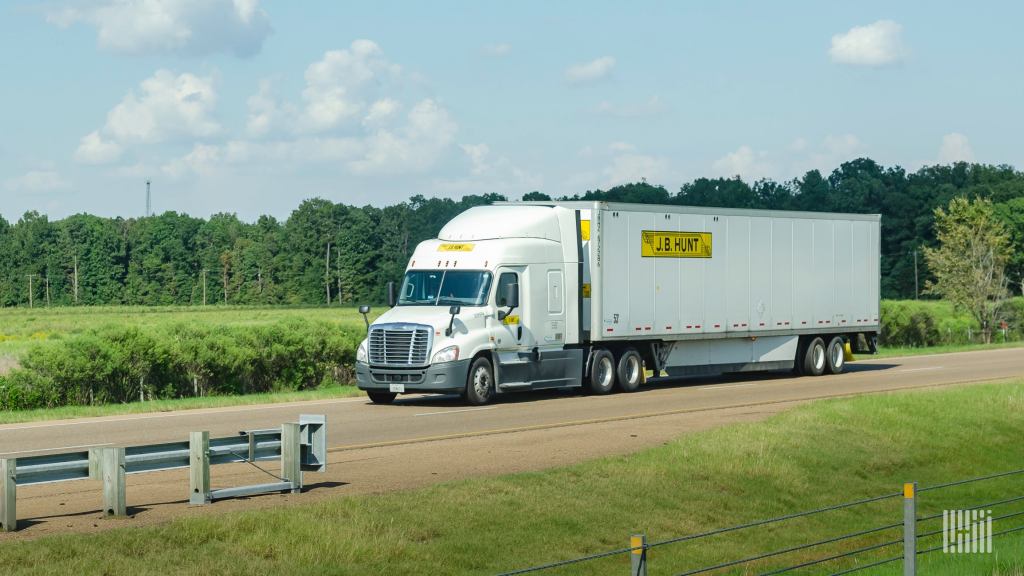
A white J.B. Hunt sleeper tractor pulling a white J.B. Hunt dry van trailer

A bout of harsh winter weather temporarily pushed truckload metrics higher in January, but fundamentals have receded back to trough levels, carriers said at a pair of investor conferences this week.

J.B. Hunt Transport Services (NASDAQ: JBHT) said its intermodal volumes have not been as strong as the increases reported at the ports of Los Angeles and Long Beach in January, where volumes were 20% higher year over year (y/y), or at its primary rail partner BNSF (NYSE: BRK-B), which witnessed a similar surge. The company also said that bid season for its intermodal and asset-light truck offerings has been “very competitive,” implying pricing remains under pressure.

The comments surprised the market on Tuesday as J.B. Hunt’s stock fell 5.7% compared to the S&P 500, which was down 0.6%. By midday Wednesday, the stock had recouped some of the loss, up 1.9%.

“Pricing in the one-way parts of our business … are unsustainable. The market has to give,” J.B. Hunt President Shelley Simpson said at Barclays investor conference on Wednesday. “Our cost and the inflation around our cost in the lowering price environment just does not bode well from a market perspective.”

Simpson said both intermodal and TL negotiations have been tougher than expected so far and that brokerage conversations have been difficult, but as expected. She said it’s tough to say when the freight recession will end, noting it’s month 21 of the downcycle (defined as spot rates below carrier costs), three months longer than the average downturn.

J.B. Hunt has completed just 20% of its annual contract negotiations.

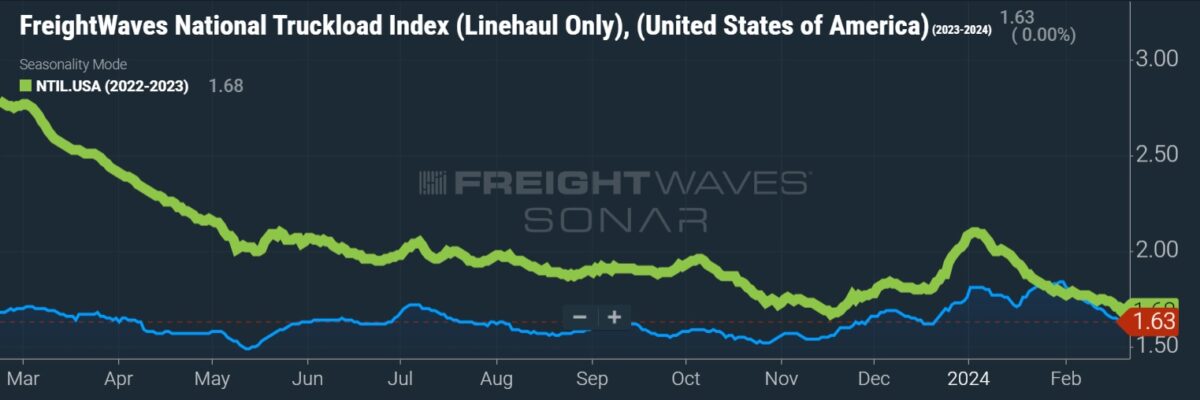
Chart: (SONAR: NTIL.USA). The National Truckload Index (linehaul only – NTIL) is based on an average of booked spot dry van loads from 250,000 lanes. The NTIL is a seven-day moving average of linehaul spot rates excluding fuel. Spot rates are currently 3% lower y/y. To learn more about FreightWaves SONAR, click here.
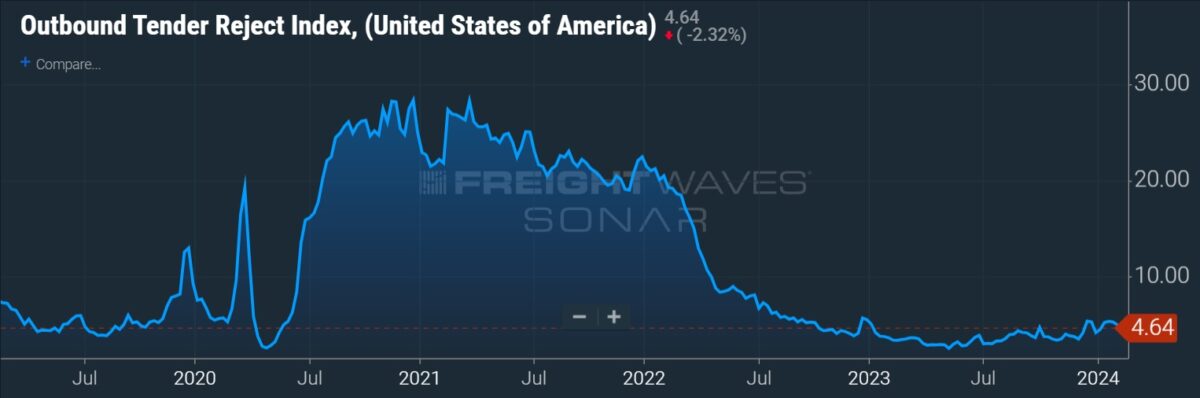
Chart: (SONAR: OTRI.USA). A proxy for truck capacity, the Outbound Tender Reject Index, shows the number of loads being rejected by carriers. Carriers are currently rejecting less than 5% of all loads tendered under contract compared to cycle highs of more than 25%.

Management from Werner Enterprises (NASDAQ: WERN) classified bid season for its one-way offering as “very competitive” as well. It said it has worked through less than 20% of its total bids and that “only a handful of bid events” have been finalized.

The comments came Wednesday at Citi’s investor event.

Werner saw a lift in spot rates in its one-way segment during January as winter storms forced operators to temporarily park trucks in some regions. However, the improvement in rate was offset by weaker equipment utilization and incremental costs associated with operating under harsher conditions.

Werner’s one-way fleet currently has a mid-teen-percentage exposure to the spot market.

Its dedicated business, which accounts for two-thirds of the company’s total fleet, is seeing pressure on contract renewals but to a lesser degree as most contracts are indexed to consumer price and labor cost data sets. Also, the contracts are three to five years in duration, limiting downside to the current rate environment. Total truck demand within dedicated accounts has stepped lower as industry capacity remains abundant.

Indications from Werner’s customers show inventories are largely in line with demand for now. The carrier said none of its customers are signaling a need for “what-if” stock, but management believes some may again contemplate a just-in-case approach given a higher frequency in geopolitical events disrupting supply chains.

Werner has guided for its total TL fleet count to be down 3% to flat y/y in 2024. It said its truck brokerage business will likely see a “steady floor through February,” traditionally the weakest month of the year, with some seasonal improvement by spring.

Management said they will look to tender rejections and changes in spot rates as signs of an inflection. It expects some improvement in the spot market during the second quarter.

Shares of WERN were up 0.7% at 2:27 p.m. EST Wednesday compared to the S&P 500, which was off 0.4%.

More FreightWaves articles by Todd Maiden

Norfolk Southern defends makeup of its board, mum on possible CEO change

Norfolk Southern Corp. on Wednesday defended the composition of its board of directors and did not address the fate of CEO Alan Shaw, who is the subject of an activist group’s efforts to remove him and replace him with Jim Barber, a former top UPS Inc. executive.

In a lengthy letter to shareholders, the Atlanta-based Eastern railroad (NYSE: NSC) said that it has maintained an “ongoing process” of board refreshment, noting that six directors have been appointed to the board over the past five years. 

There will be more turnover this spring, when two directors, Mitchell Daniels Jr. and Michael Lockhart, retire following Norfolk Southern’s annual meeting, which has not been officially scheduled but is expected to take place in May.

On Tuesday, Ancora Group Holdings, which has amassed a $1 billion stake in the railroad and has agitated for change at the board and top management, proposed a fresh eight-person slate of directors. It proposed that Barber, who retired from UPS in December 2019 as its COO, be chosen to replace Shaw. Ancora has also proposed that Jamie Boychuk, a former top executive at CSX Corp., be appointed as COO, replacing Paul Duncan.

“Since receiving Ancora’s nominations, members of both the board and management team have held multiple discussions with representatives of Ancora to better understand their views and communicate Norfolk Southern’s perspectives on the execution of our strategy,” the Norfolk Southern letter stated.

The railroad said that its board is “composed of highly qualified, independent directors” who bring “expertise in areas relevant to our business.”

Norfolk Southern said it appointed current directors Christopher Jones as chair of its Safety Committee, succeeding Lockhart; and Jennifer Scanlon as chair of the Governance and Nominating Committee, succeeding Daniels. Jones’ appointment became effective Sept. 1, 2023, and Scanlon’s will become effective at or before Daniels’ retirement.

The railroad said that it grew its intermodal business, its most service-sensitive segment, by 5% year over year in the fourth quarter of 2023. “We also significantly improved train velocity and dwell [time] in the fourth quarter [of] 2023, with both metrics reaching their best levels in several years. We achieved these improvements despite the network disruptions we experienced last year,” the letter stated.

It said that the board “regularly evaluates its composition and will continue its careful review of Ancora’s nominees with a focus on advancing our goal of building the safe, reliable, and resilient railroad our customers and shareholders expect.” The board said it will present its formal recommendation on the nominees in the company’s definitive proxy statement, which will be filed with the Securities and Exchange Commission and mailed to all shareholders eligible to vote at the 2024 annual meeting.

Are truckers really boycotting New York? – WTT

On Episode 684 of WHAT THE TRUCK?!?, Dooner is breaking down the New York trucker boycott. We’ll find out how a video from a driver in Chicago caused the media to run with the story. Is it even real? Is anyone participating and is it impacting freight?

HD Drayage & Container Services’ Hope Allen shines a light on port volumes; drayage on the East Coast; building a company; and the power of training.

REPOWR’s Jake Battles shares the ins and outs of the trailer market. Battles tells us how his company is turning idle assets into cash.

Industry adviser Jim Coffren teaches us carrier vetting tips, tells us why retail is like “Jurassic Park” and discusses if it’s ever OK to scream at your boss.

Plus, $500 parking fines; remote control semitrucks; trucking a house; pickleball barges; and a Somali pirate-hunting cruise.

Watch on YouTube

Visit our sponsor

Subscribe to the WTT newsletter

Apple Podcasts

Spotify

More FreightWaves Podcasts