How to electrify millions of trucks; doom spending and freight hangovers – WTT
On episode 681 of WHAT THE TRUCK?!?, Dooner is joined by Zeem Solutions founder and CEO Paul Gioupis. Zeem just cut the ribbon on its charging depot in Inglewood, California. We’ll find out why Gioipis thinks this is the first step toward electrifying millions of trucks in the state.
Uber Freight has released a Scheduling API pilot for the Scheduling Standards Consortium’s Technical Standard. What’s all that mean? Raj Subbiah, head of product at Uber Freight, tells us why this is a leap forward in streamlining operations for all stakeholders in the freight ecosystem.
It isn’t just trucks that are facing pressure from environmental interests. Container shipping is also in the crosshairs. VesselBot founder and CEO Constantine Komodromos takes a look at the data behind containership emissions.
How important are owner-operators to the brokerage model? Are carrier vetting tools a solution if they harm legitimate carriers? Able Transport founder and CEO Liz Wayne answers these burning questions and more.
Plus, Super Bowl loser supply chain and spot market hangover cured?
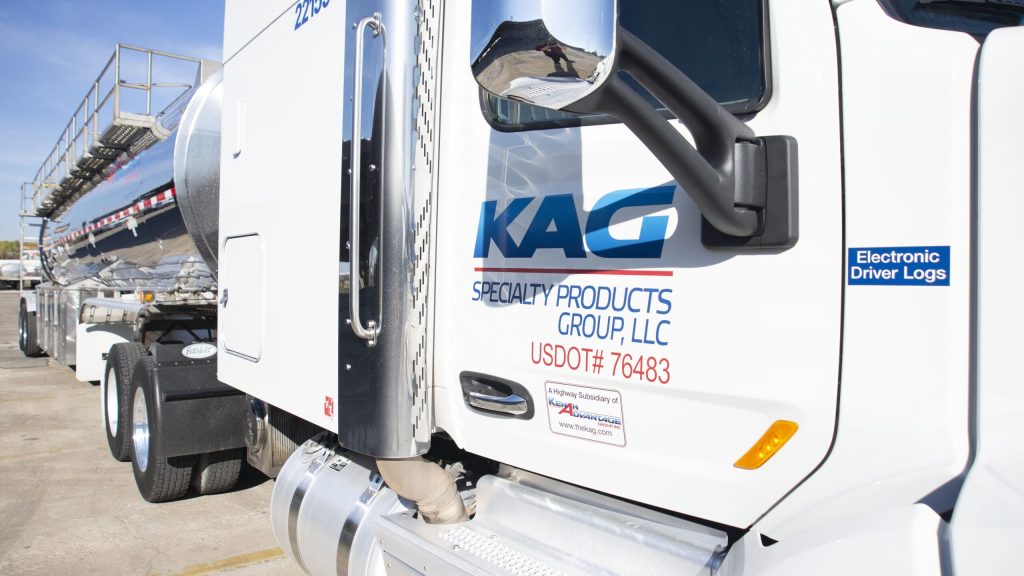
Kenan Advantage Group acquires plastic resins hauler
Kenan Advantage Group (KAG) said Monday it has acquired Northern Dry Bulk for an undisclosed amount.
Clare, Michigan-based Northern Dry Bulk primarily hauls and stores plastic resins used in the automotive, packaging and electronics industries. The carrier serves the U.S. and Canada out of two terminals with a fleet of 36 tractors and 91 trailers.
The company’s drivers, technicians and operations staff will now be part of KAG.
“The acquisition of Northern Dry Bulk establishes a definitive entrance into the dry bulk transportation business for our company and perfectly aligns with our strategic growth initiatives to expand into new end markets,” said John Rakoczy, executive vice president of specialty products at KAG.
North Canton, Ohio-based KAG is the largest tank trucking company in North America. It operates 300 terminals throughout North America, providing bulk transportation of fuels, energy products, chemicals and food products.
“In 1994, we started with one truck and a simple plan — to provide unmatched customer service. … By joining forces with KAG, both our current and future customers will benefit from our shared knowledge, geographic footprint, and assets in a marketplace positioned for significant growth opportunities,” said Tom Kunse, owner and president of Northern Dry Bulk.
Despite dim outlook, January imports grew at fastest pace in 7 years
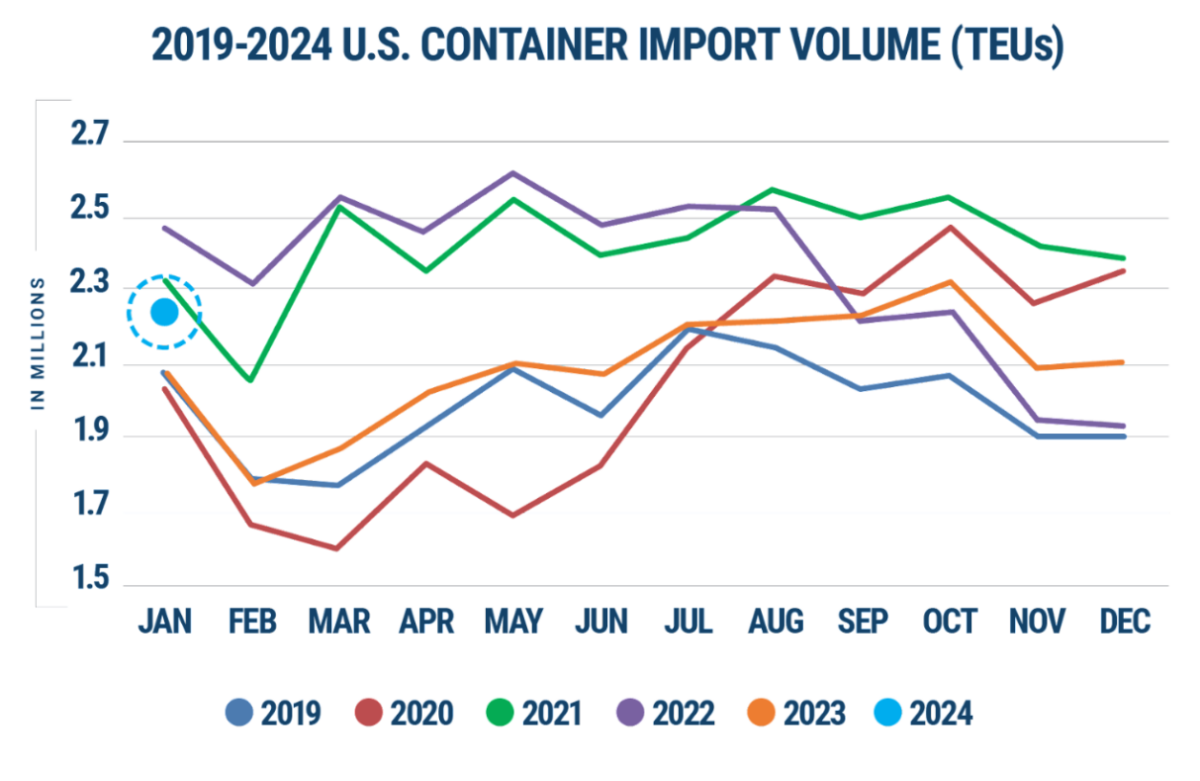
With geopolitical tensions rising around the Suez Canal and water levels dropping at the Panama Canal, one could be forgiven for expecting U.S. imports to fall in January. But, according to new data from Descartes, they were shockingly robust.
The U.S. imported 2,273,125 twenty-foot equivalent units of containerized goods in January, up a surprising 7.9% from December and 9.9% year over year, said Descartes (NYSE: DSGX) on Thursday. This 7.9% gain marks the largest month-over-month growth for January since 2017.
(Chart: Descartes Datamyne)
January is not typically the most active month for containerized imports, though it does benefit from the run-up to China’s celebration of Lunar New Year. During the two-week holiday, which began on Saturday, nearly all manufacturing plants and port facilities shut down.
In the weeks leading up to Lunar New Year, then, there is a rush to get goods from China closer to their final destinations. A 14.9% m/m rise in Chinese imports indicates seasonal trends are playing out as usual, very much unlike 2023’s anemic performance.
This inference, however, was not wholly true to reality.
East Coast performance was a mixed bag
According to Descartes data — which is derived from U.S. Customs filings and differs from official port data — imports to the Port of New York and New Jersey rose 23,138 TEUs, or 6.8%, in January versus December.
There were some other bright spots on the East Coast, albeit at smaller ports like that of Norfolk, Virginia, where volumes rose 6,087 TEUs or 5.1% m/m, and Baltimore, which saw TEUs rise 1,558 for a 3.4% m/m gain.
But the remainder of ports along the East and Gulf coasts saw sluggish activity in January. The Port of Savannah, Georgia, suffered a slight m/m dip of 360 TEUs or 0.2%, while import volumes at the heavyweight Port of Houston declined by 6,042 TEUs or 3.6% m/m.
It was little surprise that ports in Southern California felt the lion’s share of the surge in Chinese imports. Descartes data shows that imports to Long Beach, California, were up 48,054 TEUs or 15.1% m/m in January, while volumes at the nearby Port of Los Angeles were up 77,085 TEUs or 21.1% m/m.
This growth was enough to secure the lead for market share among major West Coast ports, where the top five saw their share of containerized imports rise to 43% (up from 39.7% in December), while the top East and Gulf Coast ports’ share fell to 42.4% (versus 44.9% in December).
Warning signs for the year ahead
Besides the ongoing disruptions at the Suez and Panama canals, Descartes noted some risk factors that could weigh on growth in 2024, which has thus far continued to surpass the pre-pandemic levels of 2019.
The labor agreement between the International Longshoremen’s Association (ILA) and the United States Maritime Alliance (USMX) will expire at the end of September. Last November, ILA leadership cautioned its members that “the union will hold firm on its pledge not to extend the contract,” citing the touch points of automation and wage increases, and that “members should prepare for the possibility of a coast-wide strike in October 2024.”
Other considerations mentioned by Descartes were the health of the U.S. economy, rising port transit wait times and the possibility of new COVID subvariants hitting vital links in the supply chain, particularly in China.
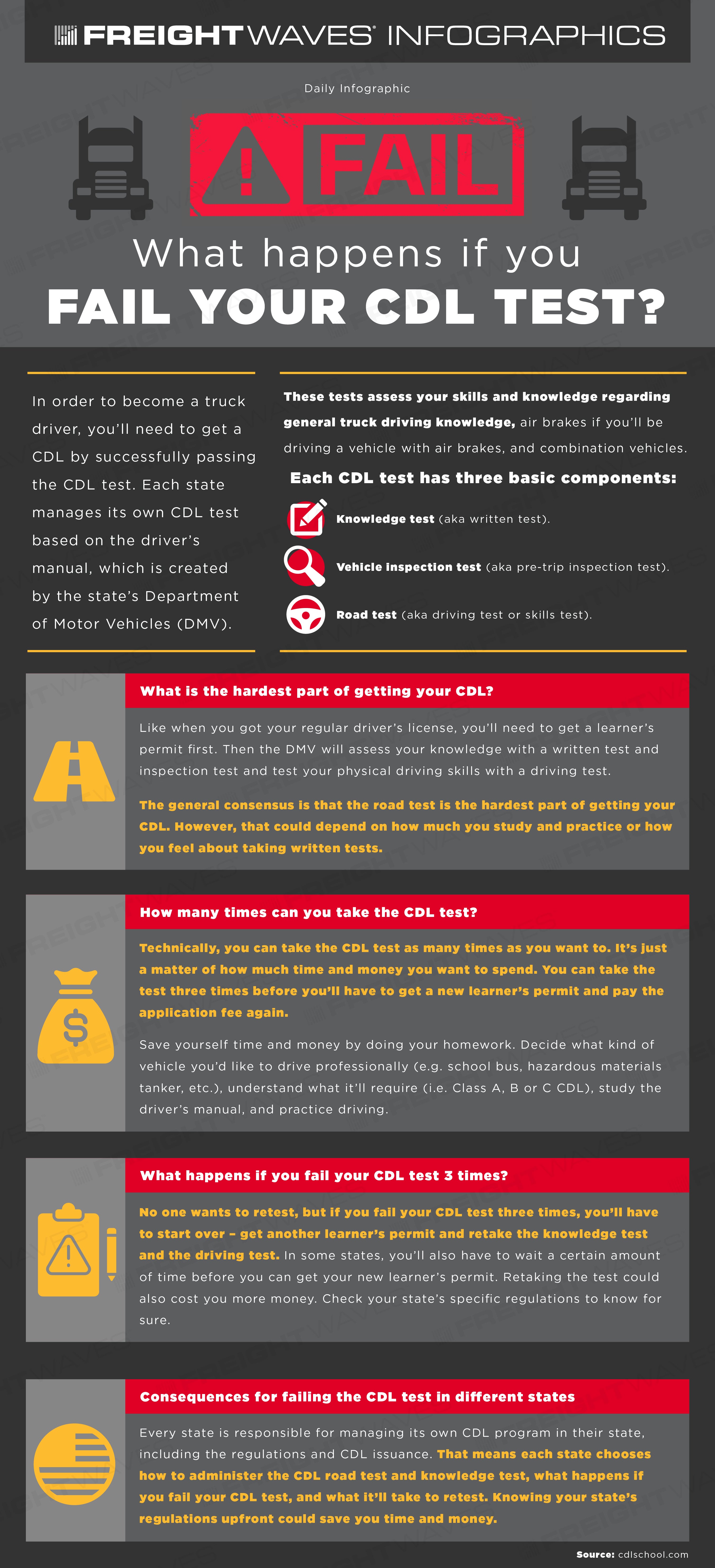
Daily Infographic: What happens if I fail my CDL test?
To view more FreightWaves infographics, click here
Air cargo growth to start 2024 less than meets the eye
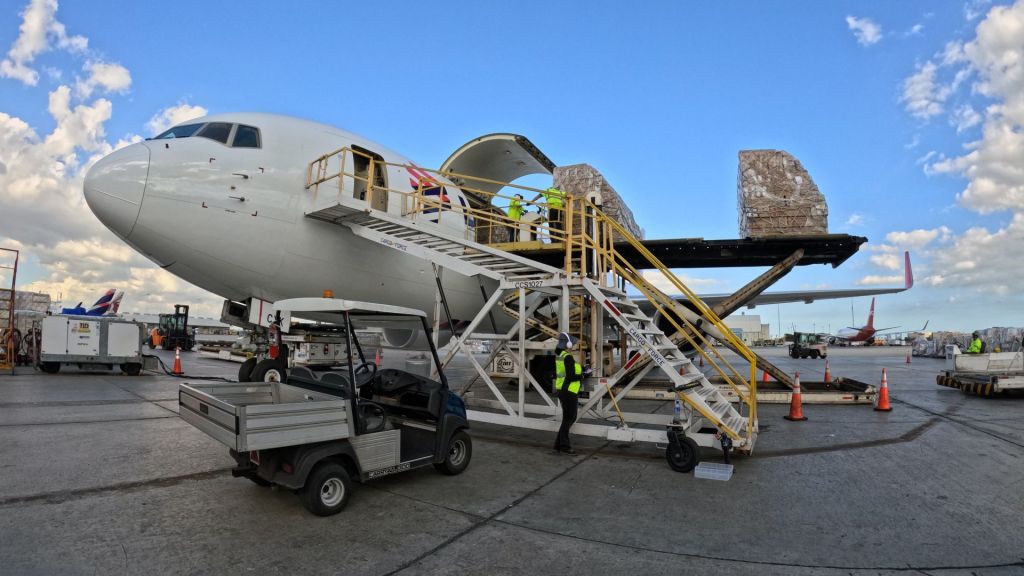
Air cargo volume growth at the end of 2023 has carried over into a normally quiet shipping period for reasons that include retailers finally rebuilding inventories, an early Chinese New Year, flower demand for Valentine’s Day and longer ocean transits as vessels avoid the Red Sea shortcut from Asia because of rebel attacks.
Demand grew more than 10% year over year (y/y) in January, when shipment activity usually dies down from the year-end holiday rush, according to researchers Xeneta and WorldACD. During the first week of February, tonnage and rates continued to inch forward, other data providers reported. But demand gains are not universal, with regions experiencing strong growth bringing up the global average.
It should be noted this year has an advantage because January growth came against a low floor in 2023 and that Chinese New Year occurred earlier than this year’s start on Feb. 10. Chinese exporters push out shipments a couple of weeks before closing factories for the long holiday, which means there were about 10 days with very limited airfreight movement out of China in January 2023.
The positive development builds on momentum since early September that culminated with volumes growing about 10% — the biggest year over year increase in two years. The International Air Transport Association (IATA) said airfreight traffic, factoring in distance traveled, fell 1.9% for the full year, an improvement from the prior estimate of a 3.8% decline that was driven by the market surge after nearly 18 months of decline and doldrums.
Estimates for airfreight growth range in 2024 from 2% to 5%, but the continuing influx of passenger widebody capacity, especially in the Asia-Pacific region, as airlines reset after the pandemic is expected to put pressure on load factors and rates. Xeneta said the amount of space filled on airliners fell three points in January to 56%.
IATA’s latest report showed global cargo capacity was 11.3% higher at the end of 2023 than a year earlier. Passenger belly space increased 36% for the full year, while capacity from all-cargo aircraft dipped marginally.
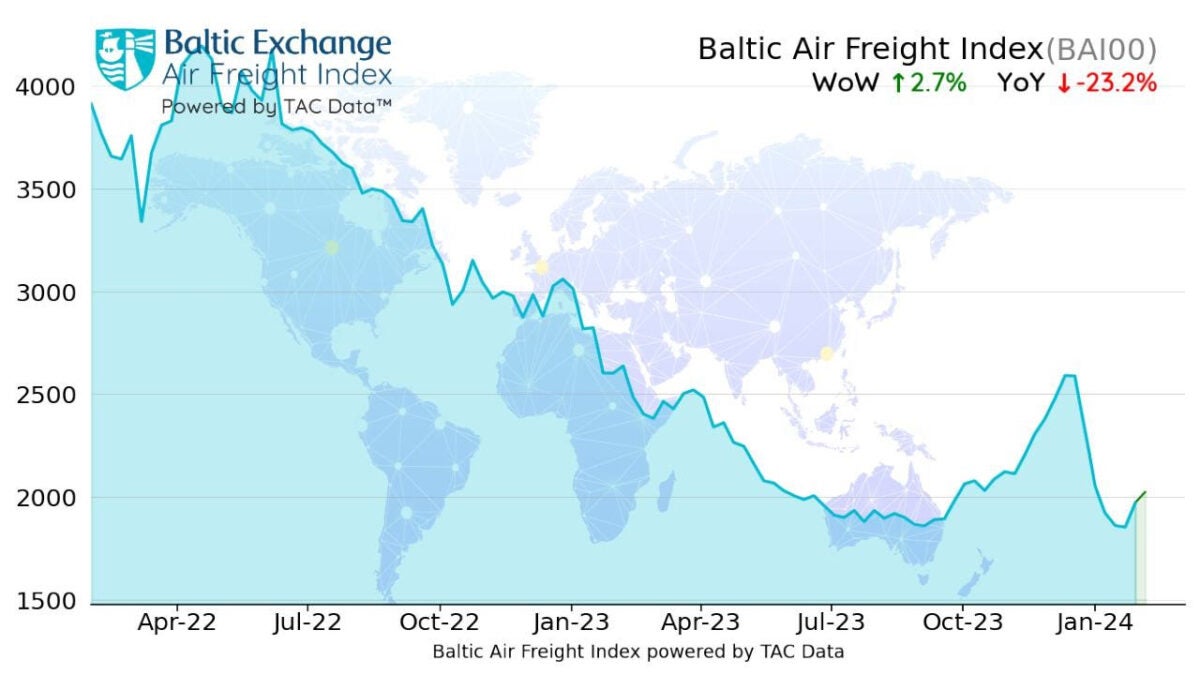
After dipping to start the year, rates have climbed the past three weeks ahead of Chinese New Year. The price to ship goods by air is down 23% y/y compared to down 29% a month ago. The pace of decline has slowed from 38% y/y in January 2023. Outbound lanes from Hong Kong and Shanghai to Europe were the biggest gainers, a likely effect of the Red Sea disruption to ocean traffic, with rates nearly caught up to last year’s level.
Prices are expected to dip as pre-Lunar New Year demand for ocean and air freight eases. Some freighter flights to China and Taiwan have been suspended during the pause in production. Demand will tick up when Chinese factories reopen around Feb. 26, but in March container shipping will go into its slow season, which means cargo owners will feel less pressure to utilize air transport.
The threat on Red Sea shipping lanes has had a modest effect on air cargo rates so far despite accounts of shippers converting some merchandise transport from ocean to air, or hybrid sea-air moves, because of slower transit times and fears of container shortages in Asia. Some shippers are utilizing transcontinental rail service from China to Europe as an ocean alternative. Container shipping prices have tripled in the past two months, but airfreight has been more stable. A large surplus in ocean and air capacity means an uptick in airfreight isn’t materially impacting short-term rates, experts say.
“We saw a relatively strong January from a volume perspective, but the market fundamentals have not changed. This is not consumers buying more, it is likely linked to Red Sea disruption as well as the upcoming Lunar New Year and some indicators that the general cargo market is busier than expected,” said Niall van de Wouw, Xeneta’s chief airfreight officer. “However, the consensus seems to be that this will not produce a long-term positive effect on airfreight. Once the initial nerves and uncertainty subsides, stability will return once shippers simply accept that ocean freight may just take two weeks longer, causing the need for airfreight to then dwindle.”
Xeneta said it observed an unusual surge in air cargo volumes from China and Vietnam to Europe for three consecutive weeks in January, surpassing even their peak season highs in November and early December. That resulted in spot rates from Northeast Asia to Europe rebounding by 11% to $3.42/kg in the last week of January.
Freightos, another price reporting agency, published data showing China-North America rates climbed 14% in the past week to more than $6/kg and are slightly higher than in early December. And while China-Northern Europe prices dipped, Middle East-to-Northern Europe prices are still 20% higher than in mid-January, possibly reflecting some ocean to sea-air shift.
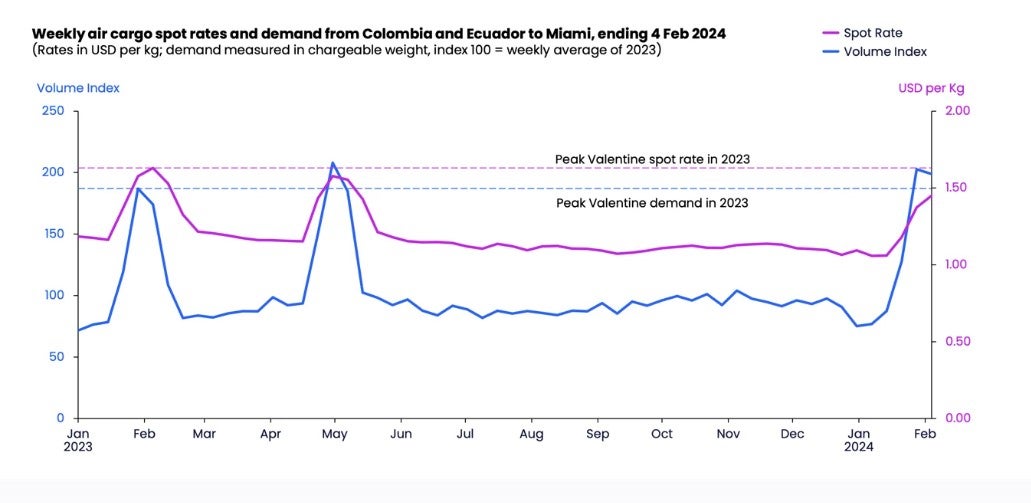
The flower trade ahead of Valentine’s Day drove a spike of more than 55% in volumes from Central and South America to North America since late January, according to WorldACD. Latam Group said it moved a record 25,000 tons — equivalent to 575 million flower stems — from Colombia and Ecuador to North America and Europe in a 21-day period, a 36% increase compared to the same period last year. The airline said it increased flight frequency and temporarily leased two additional Boeing 767s, for a total of 21 freighters, to meet the high demand during the peak season.
Demand in the U.S. for flowers remains robust for Valentine’s Day. (Source: Xeneta)
In the week ending Feb. 4 the air cargo spot rate from Colombia and Ecuador to Miami increased by 37% to $1.45 per kg compared to three weeks prior, just before the start of the peak season. Despite carriers increasing capacity through additional flights, it has not been enough to keep pace with the surge in demand, as measured by the chargeable weight, which soared 128%, Xeneta said. Capacity increased by 81% in the same period.
Looking Ahead
The macroeconomic outlook is mixed and analysts say 2024 is likely to be a transition year from the freight recession, with the real recovery occurring in 2025.
Many European economies are at or near recession levels, with higher inflation than in the U.S., while the Chinese economy has slowed below its historical trend. Industrial production and new export orders continue to stagnate in many parts of the world.
On the positive side, U.S. freight and warehousing activity is starting to revive from a nearly two-year recession, thanks to the resilience of the U.S. economy. Containerized imports posted their highest month over month growth for January in seven years, according to Descartes Datamyne, a data analytics firm. Meanwhile domestic transportation prices increased for the first time since June 2022 and retailers appear to be restocking after a busy holiday shopping season and spending the past year working off excess inventory, according to the latest Logistics Managers Index. Retailers have mostly returned to the just-in-time inventory model that existed before the pandemic, which should provide more steady demand for freight transportation, including airfreight.
According to the Wall Street Journal, the average warehouse vacancy rate across the United States reached 5.2% in the fourth quarter, a steep rise from 4.6% the previous quarter and a sign that retailers have sold off surplus inventory.
RXO looked to be avoiding the worst of the freight market, but no more
When RXO came out with its first-quarter earnings for 2023, its performance was clearly superior to those of its brokerage peers, and it looked like the company might have found the magic sauce to handle a weak freight market.
But the latest quarterly report from the stand-alone 3PL had landed with a thud, a declining stock price and some reductions in Wall Street analyst recommendations on the company.
The scorecard for Friday was that RXO (NYSE: RXO) stock closed down 2.27%, or 47 cents, to $20.28. The intraday low was $19.85.
However, that closing price is still above the company’s one-month low ($19.50, recorded Thursday), its three-month low ($17.50, on Nov. 10) and its 52-week low ($16.94, on Nov. 1). RXO’s stock price had been trending higher, up about 15.4% in the past three months. It’s now essentially flat for the past 52 weeks.
Thursday’s earnings report led to several actions by Wall Street analysts who follow the company.
Ken Hoexter at Bank of America Merrill Lynch (NYSE: BAC) cut BoA’s rating on RXO to neutral from buy. Its price objective had been $25 per share, but Hoexter reduced it to $22.
Bascome Majors at Susquehanna Financial Group kept his negative rating on RXO but reduced Susquehanna’s price target to $15 from $18, which already was exceeded at current levels.
At TD Cowen (NYSE: TD), the team led by Jason Seidl maintained its rating of Market Perform. But in a positive move that could be seen as somewhat mixed, it raised its price target to $19.50 — but only because it sees the company’s Enterprise Value multiple to earnings before interest, taxes, depreciation and amortization rising in 2025, which won’t be commencing for a little less than 11 months.
In a post-earnings-call interview with FreightWaves, RXO Chief Strategy Officer Jared Weisfeld said RXO historically has been able to produce brokerage margins in the “midteens.” At 14.8%, the performance in the fourth quarter was not that far from that level.
“We’ve consistently generated best-in-class gross margins, but it obviously depends on where you are in the cycle and whether you’re at peak or trough,” Weisfeld said. He added that there have been periods in RXO’s history, including when it was part of XPO and not a stand-alone company, when brokerage margins were in low double digits, “but you’ve also seen that get in excess of 20%.”
He said the corporate gross margin at RXO — 18% in the latest report — was above 20% in 2022, when there was a perfect margin divergence for brokers: falling spot rates feeding capacity into contractual business booked during the strong market of 2021.
Public data beginning with the fourth quarter of 2022 shows a fairly stable corporate gross margin: 19.5% in that final three months of 2022, when contractual business would have been catching up to the decline in spot rates, and then four quarters in 2023 with a corporate gross margin of 18.8%, 18.6%, 17.7% and 18%, respectively.
“I think the message there is that we have consistently strong corporate gross margins over time,” Weisfeld said.
In its comments, TD Cowen said the 14.8% gross margin posted by RXO in its brokerage operations missed the TD Cowen forecast by 120 basis points.
Merrill Lynch said the 14.8% was a 310-bps deterioration year on year, and 50 bps less than the analyst’s target.
During the earnings call, CEO Drew Wilkerson and Weisfeld said several times that RXO expects enough capacity to bleed out of the market by the second half of the year that a turnaround is likely.
But for a 3PL, that raises the reverse issue of what RXO and others benefited from in 2022: Spot rates will be rising, but contract rates will have been established during the weak days of 2023.
Weisfeld said it’s already starting to happen. “Spot pricing relative to the costs for the carriers is not sustainable, which is why you’re starting to see spot pricing move higher,” he said. In discussion of how the first weeks of 2024 went for RXO, Wilkerson said on the conference call, “Brokerage gross margin compression continued into January, and we anticipate that will impact the first quarter.”
Weisfeld said RXO “always honors its contractual rate.” How it will deal with rising spot rates alongside contractual rates established in a weaker market, Wesfield said, is that “a successful broker is going to be able to pivot to the spot market faster than anybody else.”
“If you look at our history, what’s made us successful is our contract business,” Weisfeld said. Wilkerson said on the call that contract volume was 80% of the company’s business in the fourth quarter.
RXO believes, Weisfeld said, that when it successfully services its contract customers even during times when the direction of spot rates is unfavorable relative to contract business, “then we’re going to get rewarded on behalf of our shippers with project freight, minibids, spot volumes, and that’s what we’ve seen.”
But it was mostly the negative aspects of a turning market that were featured by the Susquehanna post-earnings report on RXO. Its outlook for the company “took another step down into 1Q24 as gross margins get ‘squeezed’ by rising cost of capacity (some of this weather), pressured pricing to customers, and more profitable spot volume still rare.”
“Yes, investors are justified in being anxious about how quickly RXO can pivot to higher-priced spot business when the market turns, but management’s actions of taking costs out at the low point of a deeply challenged cycle out of their control are prudent,” Susquehanna wrote.
The reference to cost cutting was from the comments of CFO James Harris. He said on the earnings call that annualized run rate savings in 2023 were $32 million, and an additional $25 million in operating expenses is expected at RXO this year.
Weisfeld expressed optimism that the cost cuts will position RXO to be able to navigate a rising spot market for securing capacity against a backdrop of contract business set at a lower rate.
“What we’re doing is optimizing the cost structure for when that market inflection eventually occurs,” he said. And Weisfeld reiterated the timeline: “We think based on everything we’re seeing in our data base and everything that we’re hearing from our customers, based on our view of the macro economy, we can see that recovery will start to begin in the second half of the year.”
A going concern bid for the remaining assets of bankrupt Yellow Corp. appears to be back on the table. A ballot sent to local union heads asks members to agree to settle their WARN Act claims against Yellow with the acquiring company, Next Century Inc. The plan would swap the claims for equity in the startup and potentially recall as many as 14,000 former Yellow workers.
The ballot, a copy of which was obtained by FreightWaves, references all Yellow operating companies — YRC, New Penn, Reddaway and Holland. If the plan is approved, the Teamsters union would be able to settle the claims on behalf of its members, “contingent on them [Next Century] acquiring assets of Yellow Corporation as [a] going concern.”
The claim was brought against the estate on behalf of workers after Yellow filed for bankruptcy. It alleged the company failed to notify employees 60 days in advance that they were being terminated.
Yellow has maintained in court filings that it was trying to save the business but that conditions deteriorated quickly, leaving it little time to make the required filings. Court documents have shown Yellow’s shipments declined rapidly in the days leading into a planned strike by workers over the company’s missed benefits payments. The strike was ultimately averted when plan administrators agreed to extend health care benefits for employees, but by then the damage was done.
In lieu of their claim against the estate, employees would receive $20,000 in preferred shares with a coupon rate of 7%. Employees not getting hired back by Next Century would have the right to convert those shares to a $9,250 note, which would be repaid in seven installments by the new company, starting in September and ending March 2025.
The vote would not impact priority claims employees have for items like vacation and sick pay.
Sources close to the matter said a Teamsters freight local in Georgia met with drivers from Holland on Saturday to access member interest.
An integral part of Amico’s prior offers included extending the maturity date on a $700 million COVID-relief loan made to Yellow in 2020. Next Century would have assumed that debt as part of a larger financing package to fund the acquisition. Some senators supported the plan, which aimed to rehire roughly 15,0000 of Yellow’s 22,000 Teamsters employees.
Yellow announced Monday it had repaid the $700 million loan along with $151 million in interest. A Thursday filing with a Delaware bankruptcy court showed it had repaid all secured creditors, including the holders of its bankruptcy financing using proceeds from two terminal auctions, which netted nearly $2 billion.
Yellow’s estate is now working to settle unsecured claims, which include pension withdrawal liability claims totaling more than $7 billion, the WARN Act claims and more than 200 personal injury claims.
Through court filings, Yellow has contested the amounts of the withdrawal liabilities, saying that any amount due would be “far below $1 billion.” It claims Central States Pension Funds and other multiemployer pension funds it contributed to are now fully funded following more than $80 billion in distributions from the American Rescue Plan Act of 2021.
It has also said the WARN Act claims are invalid given the company’s sudden closure. A dispute resolution process has been established to settle the injury claims.
An omnibus hearing scheduled for Wednesday is expected to shed light on the status of several of these items.
No update has been provided on the sale of Yellow’s 46 owned and 118 leased terminals, many of which Amico presumably is attempting to purchase. The estate is also in the process of liquidating roughly 12,000 tractors and 35,000 trailers.
Details on Amico’s new financing plan have yet to emerge.
Sources said Yellow and one adviser to the creditors are opposed to the deal. They also said Amico has garnered written letters of support from some large potential customers.
Next Century, the Teamsters and Yellow hadn’t responded to requests for comment at the time of this publication.
Borderlands: Zerio focused on technologizing global supply chain security compliance
Borderlands is a weekly rundown of developments in the world of United States-Mexico cross-border trucking and trade. This week: Zerio focused on technologizing global supply chain security compliance; Port Houston welcomes new Latin America shipping container service; Tesla auto parts supplier expanding Texas logistics operation; and Korean EV parts maker opens factory in Mexico.
Zerio focused on technologizing global supply chain security compliance
Miguel Olivo, co-founder and CEO of Zerio, said the idea for the company came about when a relative who works for a trucking company had security compliance issues with a load they were moving between Mexico and Texas.
“He said they were having trouble finding paperwork for a container that was stopped at the border,” Olivo told FreightWaves. “He was like, ‘You should really look into this because everybody that we know, down here in the Rio Grande Valley, they still use paperwork for everything.’”
Founded in 2019, Zerio is a cloud-based compliance platform that enables manufacturers, importers, exporters and carriers to implement and manage international supply chain security programs.
Miguel Olivo, co-founder and CEO of Zerio.
Zerio’s software is designed to meet requirements for cross-border freight certifications such as Customs-Trade Partnership Against Terrorism (C-TPAT) in the U.S., Partners in Protection (PIP) in Canada and the Authorized Economic Operator (OEA) program in Mexico.
C-TPAT serves as sort of a TSA Pre-Check for freight moving across international borders. Carriers and shippers that receive that designation can move more quickly across international lines due to their classification under C-TPAT. PIP and OEA serve as similar designations for cross-border operators in Canada and Mexico.
“This is the first time I heard of the C-TPAT program. I started researching and spending some time with trucking companies in the valley,” Olivo said. “We talked to other friends that are in transportation on both the Mexican side and the American side of the border. Everybody’s telling us C-TPAT is a big deal.”
Zerio’s platform enables real-time visibility by using an integrated set of tools built to streamline compliance, evidence collection, risk management and audits.
Zerio recently received an investment from Matt Silver, the founder and former CEO of Forager. Silver recently launched Cargado, a new venture aimed at creating a seamless platform for U.S.-Mexico cross-border logistics.
Olivo, who has been working in the tech industry since 1998, had recently spent time in Canada and Europe working on other projects. He said he realized that there were security compliance requirements that transporters needed in almost every country.
“It dawned on me that there were these programs that every country had, and because we spent time in Europe and Canada, we realized, ‘Why don’t we just build this sort of global system that manages compliance for these programs?’” Olivo said. “‘We’ll start with the U.S. and Mexico, but this is a global problem.’ Every border, every country has these programs, so we spent months just really reading about what these programs were, how they started, all of this research before we actually built anything.”
Olivo said after talking with trucking companies, cross-border operators and manufacturers, they realized that international compliance is an enterprise level problem.
“This is when we started designing an enterprise-size solution for it,” Olivo said. “We realized this is a global opportunity.”
Zerio’s platform manages C-TPAT, PIP and OEA program requirements, controls and evidence in one place, aimed at reducing time to compliance.
“One of the questions that we asked our prospects is that you guys have been running your security compliance on pencil and paper for 20 years, right? The question is, how are you going to be running it for the next 20, the exact same way?,” Olivo said. “If digitizing security compliance is important to you, than Zerio is a company working on this solution.”
Port Houston welcomes new Latin America shipping container service
The new service is a line from the east coast of South America to the Gulf of Mexico and the U.S. It includes eight 2,800 twenty-foot equivalent unit vessels, according to a news release.
Haifa, Israel-based ZIM (NYSE: ZIM) is a global container liner shipping company with operations in more than 90 countries serving approximately 34,000 customers in over 200 ports worldwide. ZIM was founded in 1945.
“We are excited to introduce a brand new Latin American service from the U.S. Gulf owned and operated exclusively by ZIM,” Daniel Sutton, ZIM’s senior vice president of Gulf Pacific, said in a statement. “The ZGT Service continues our ongoing expanded Latin American network and will provide excellent transit times from Houston to the east coast of South America, while also providing service to our Central American, Caribbean and west coast South America customers.”
Tesla auto parts supplier expanding Texas logistics operation
US Farathane recently leased more than 260,000 square feet at the GTX Logistics Park in Georgetown, Texas, according to the Austin Business Journal.
The Detroit-based company designs and manufactures plastic injection-molded components for various industries such as automotive, electronics and the commercial trucking sector.
US Farathane currently has a manufacturing facility in Austin, Texas, which opened in 2012. Company officials did not say when they would move into GTX Logistics Park, a 231-acre development that includes a 409,822-square-foot, cross-docked industrial building.
Georgetown is located about 28 miles north of Austin.
Connecticut-based Atlas Holdings acquired US Farathane in April. According to a news release about the acquisition, US Farathane’s customers include Tesla, General Motors, Ford, Stellantis, Toyota, Honda and Rivian.
Korean EV parts maker opens factory in Mexico
LS e-Mobility Solutions has opened an automotive parts factory in Durango, Mexico, according to The Korea Times.
The plant comes with a production capacity of five million EV relays and four million battery disconnect units annually.
The company said the facility is aimed at being a strategic base for the supply of electric vehicle components for automakers in North America. Officials for TLS e-Mobility Solutions said they hope to achieve sales of $524.85 million at the facility by 2030.
LS e-Mobility Solutions is based in Cheogju-si, South Korea. The company’s customers include Volvo, General Motors, Renault and Stellantis. In addition to Mexico, the company has factories in China and South Korea.
Chart of the Week: Carrier Details Net Changes in Trucking Authorities – USA SONAR: CDNCA.USA
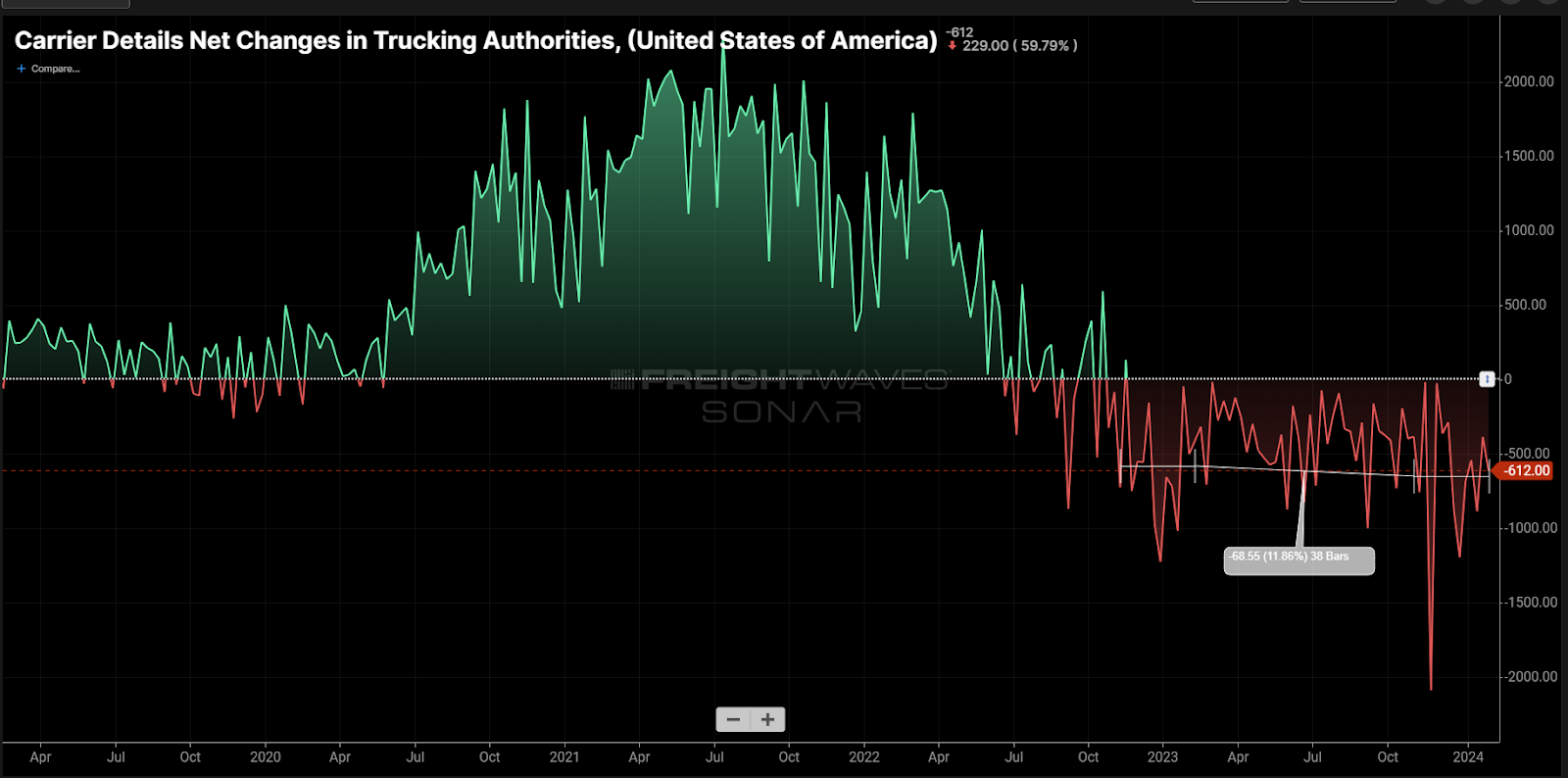
Since the start of November, net active truckload operating authorities have dropped by 9,000 — an approximately 12% increase over the same period last year, according to Carrier Details’ analysis of Federal Motor Carrier Safety Administration data.
The operating authorities measured here are Motor Carrier of Property authorizations. These are specific to for-hire truckload companies, which can represent any number of trucks.
Over 92% of the operating authorities represent carriers that have fewer than 20 trucks in their fleet. So one authority can be a single truck or 5,000 trucks — the latter being in the gross minority. Point being, this data is heavily skewed toward small operators.
Measuring available capacity is one of the most challenging things to do in the trucking industry due to the aforementioned extreme fragmentation. While we can measure the total number of operators and their fleet sizes, it does not mean they are available to service the existing freight demand.
Some carriers may specialize in certain commodities like produce or limit themselves to a single region. They also may lack the visibility to know where all the available freight is. Freight demand itself is very dynamic and prone to extreme seasonal and economic cycle fluctuations.
The best data points to view when trying to see capacity’s effectiveness in the U.S. are tender rejection and spot rate averages – the former being more precise than the latter.
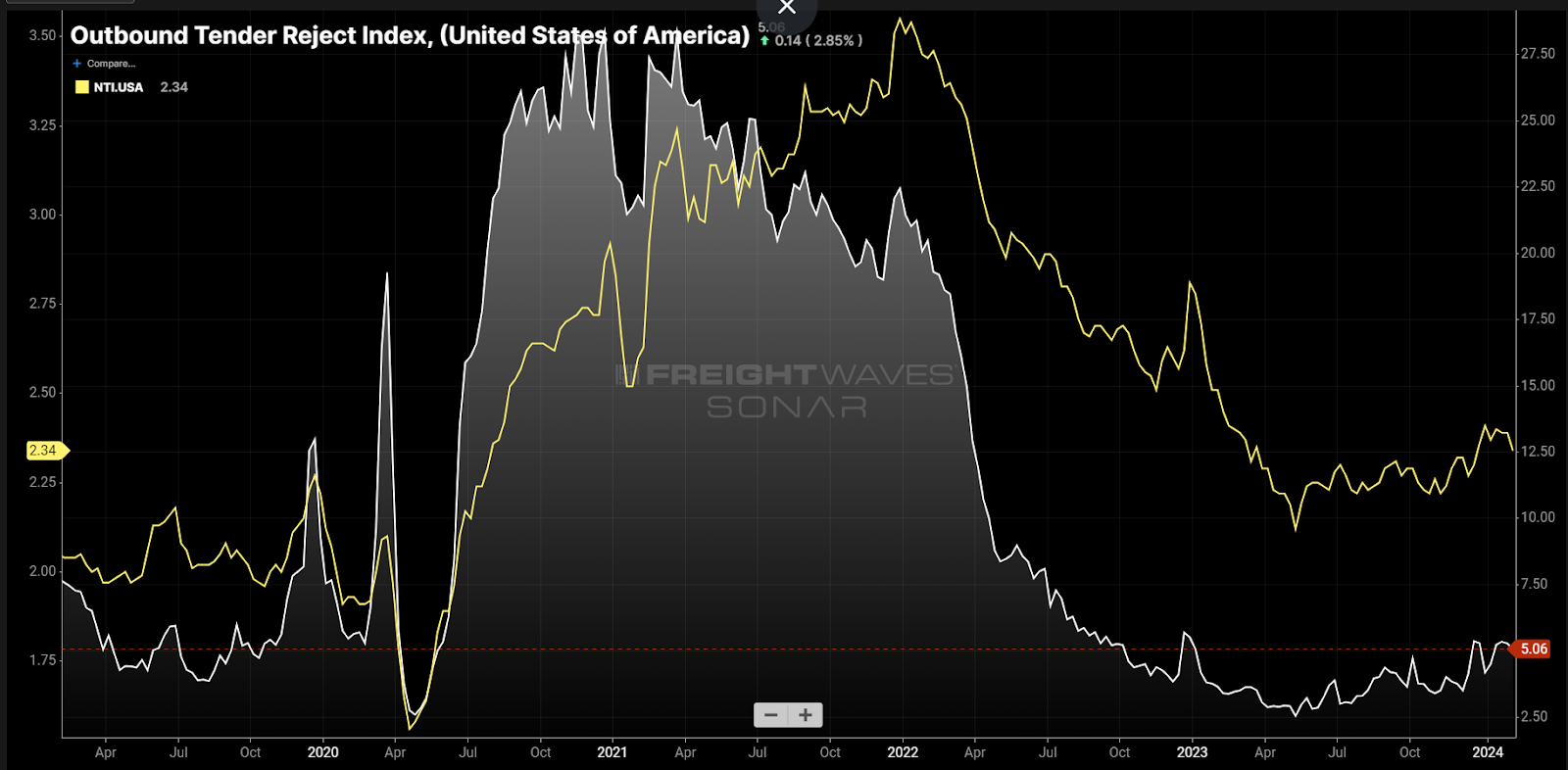
Looking at the past five-year history of the national tender rejection rate (OTRI) and dry van spot rate (NTI), both are low compared to the pandemic years of 2020-21. There does appear to be a slight upward trend that started in the spring of last year, however. This tells us that capacity is slowly becoming less available, though still abundant.
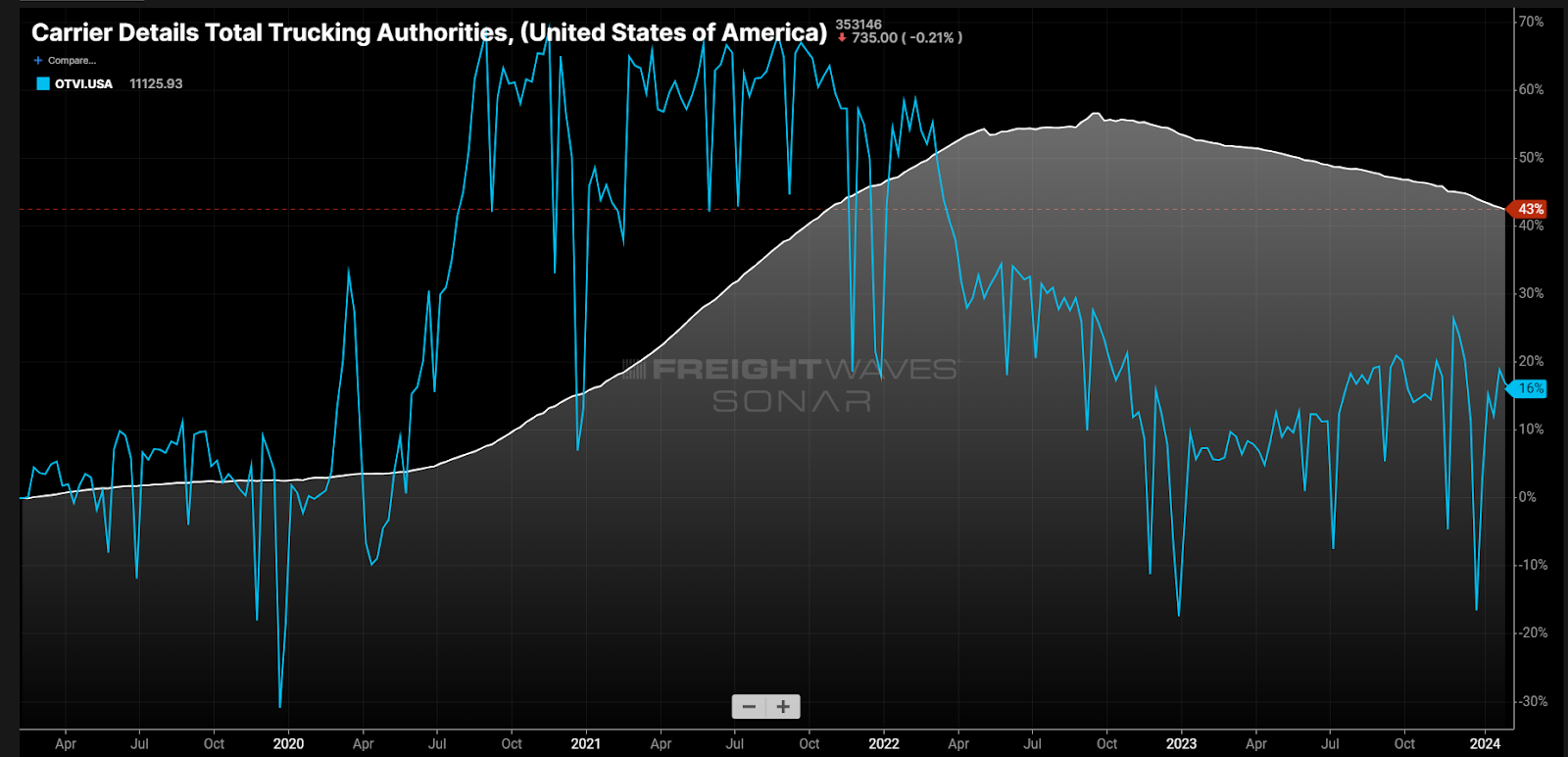
The purpose of looking at the net changes in authorities data is to see the direction and rate of capacity growth or deterioration. The current level of deterioration is historically fast, meaning the truckload market has the increasing potential to flip to a much tighter environment without much notice.
Looking at a chart of total operating authorities (supply) and the national tender volume index (demand), the demand side moves much more quickly and is more volatile than the supply side. This is due to the length of time the decision and equipment acquisition/sale process is for the supply side of the market.
If demand remains somewhat stable, the supply could fall right through it due to the momentum and opacity of the market.
The biggest question at the moment is, when will this happen? It is nearly impossible to predict with any precision due to carrier positioning and network incongruencies with demand, although it does appear increasingly likely in the next 12 months. From a shipping perspective, it would be ill-advised not to begin preparation. Even if the market does not flip this year, it is wise to prepare.
Some of the strategies that hedge against freight market volatility include:
Carrier/route guide diversification.
Private fleet growth.
Increasing dedicated service.
Dynamic pricing that moves with the market (Cost plus/Index-linked contracts).
All of these strategies may cost more in the short term but hedge against dramatic, budget-destroying events.
Perhaps the better question to ask is, how long will the next period of disruption last?
About the Chart of the Week
The FreightWaves Chart of the Week is a chart selection from SONAR that provides an interesting data point to describe the state of the freight markets. A chart is chosen from thousands of potential charts on SONAR to help participants visualize the freight market in real time. Each week a Market Expert will post a chart, along with commentary, live on the front page. After that, the Chart of the Week will be archived on FreightWaves.com for future reference.
SONAR aggregates data from hundreds of sources, presenting the data in charts and maps and providing commentary on what freight market experts want to know about the industry in real time.
The FreightWaves data science and product teams are releasing new datasets each week and enhancing the client experience.