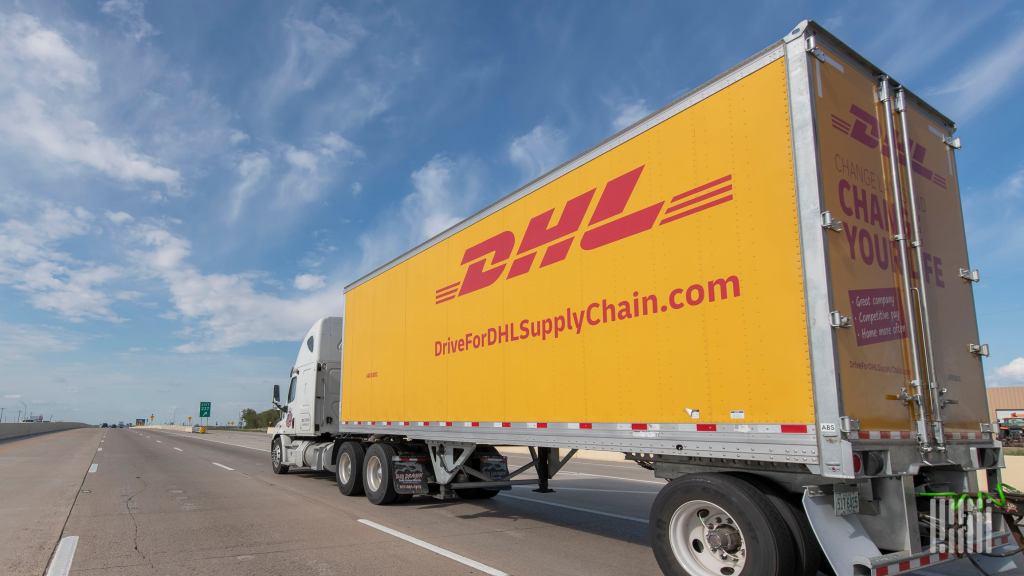
Peak season is multiplying: How can logistics respond?

By Tim Robertson, CEO DHL Global Forwarding Americas

The views expressed here are solely those of the author and do not necessarily represent the views of FreightWaves or its affiliates.

The logistics industry has undergone significant changes over the years, responding to numerous evolutions in consumer demand.

For decades, the logistics industry had a seasonality to it, with the period from the late summer to late fall known as the busiest time for suppliers. Today we are seeing a new trend, one of multiple peaks spaced more evenly throughout the year. We are moving from a landscape dominated by a single mountain to one with an expansive mountain range.

This is a change from what has historically been true. In the past, peak season came once a year, representing a significant increase in commercial and transportation activity around the winter holidays. During this period, logistics companies had to work hard to increase freight volumes, ensure timely deliveries and optimize operational efficiency. Advance planning, effective coordination and specific logistics strategies were all key to meeting this spike in demand while maintaining service quality.

But the world has been changing rapidly. New patterns were emerging in consumer behavior, globalization, e-commerce and supply chain dynamics even before the pandemic, which further accelerated these trends. Technological advances and socioeconomic shifts have driven new consumer expectations and preferences; people are shopping, and shipping, differently from how they did before 2020.

One of the results of this has been an apparent end to our traditional view of peak seasons, suggesting the need for a major overhaul in how logistics providers plan their years.  

Changing consumer habits

The unprecedented growth of e-commerce is one of the pandemic’s most obvious long-term impacts for the logistics industry. With limited options for in-store shopping and businesses of all sizes scrambling to offer consumer-friendly ways to shop online, it was no surprise that e-commerce spiked during the pandemic.

Even with in-store options available once again, IMF data shows that the online share of total spending is still above what it would have been without the crisis overall, with some countries showing much larger proportional increases than others.

With this greater emphasis on e-commerce, we may see new peaks in demand arising from various factors, including major trade events, widespread sales or special promotions that drive consumer demand. For example, the Institute for Supply Management estimates that Amazon’s July 11-12 Prime Day event drew about 150 million shoppers, creating around 100,000 temporary jobs in the United States months before the year’s traditional peak season.

Just like all other industries, logistics has felt the effects of these changes. Now, the challenge lies in successfully adapting to them.

Adapting to a new landscape

If we look at these trends together, it is easy to see how the idea of a single annual peak season could become irrelevant. Increased incentives for consumers to make online purchases throughout the year will naturally lead to numerous, and perhaps less predictable, peaks at new times.

To adapt to these new annual patterns, logistics companies will need to focus on what they can control and find ways to help customers comfortably navigate an uncertain and volatile market. This will make flexibility critical. Solutions that allow businesses to quickly change their shipping plans will help companies respond to new and changing needs. And whatever services providers offer, the ability to support customers during this challenging time will certainly be key to providers’ and customers’ success.

Technology has provided many tools to help us in this. The Internet of Things, AI and data analytics can all enable greater efficiency in logistics management, helping companies adapt to new peaks in demand.

DHL recently upgraded its myDHLi tool to not only support responsive tracking, quoting and booking, but also use AI to predict shipment times more accurately. And this is just one of the ways technology can help logistics providers support their customers in this new and evolving world.

Even now, we should expect to see the traditional year-end peak. But with general trends in consumption patterns, e-commerce and globalization pointing to spikes in demand for logistics services throughout the year, we can be sure that the world will need efficient supply chains more than ever. Now, it is the logistics industry’s responsibility to use the tools around us and rise to the challenge so we can keep things moving for us all.
Radiant Logistics looks for back-half 2024 inflection

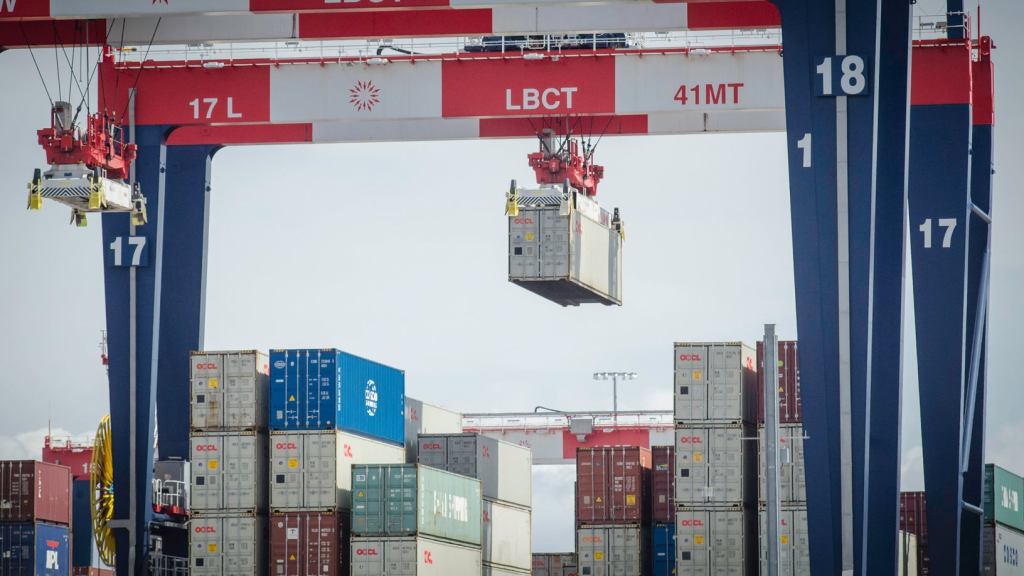
An ocean container being lifted in the Port of Long Beach

Management from 3PL Radiant Logistics said Thursday it was hopeful for a demand turnaround in the second half of 2024, noting it has seen some lift in ocean container traffic.

“We remain optimistic that we are at or near the bottom of this cycle and would expect markets to begin to find their way to more sustainable and normalized levels towards the back half of calendar 2024,” said Bohn Crain, founder and CEO, in a news release.

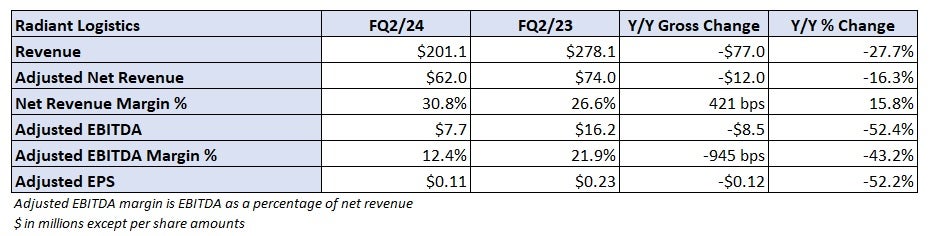
Radiant (NYSE: RLGT) reported adjusted earnings per share of 11 cents for its fiscal second quarter ended Dec. 31. The result was 2 cents ahead of the consensus estimate but 12 cents lower year over year (y/y).

The Renton, Washington-based company reported revenue of $201.1 million, which was 28% lower y/y. Revenue net of purchased transportation expenses was 16% lower. Adjusted earnings before interest, taxes, depreciation and amortization of $7.7 million was 52% lower y/y.

Radiant generated $12.1 million in cash flow from operations during the period. The company is debt-free and had $32.9 million in cash on hand at the end of the quarter. It has nothing outstanding on a $200 million credit facility.

The company said it will continue to acquire independent agent stations as well as nonaffiliated 3PLs.

Radiant announced Wednesday the acquisition of Doral, Florida-based Select Logistics and Select Cartage, which have been working under Radiant’s Adcom Worldwide brand. Operating as Select, the business provides freight forwarding services to the cruise line industry.

Financial terms of the transaction were not disclosed, but management said on a Thursday call with analysts that most agent station conversions produce an EBITDA run rate of $500,000 to $2 million. It believes Radiant could acquire one station every quarter.

It acquired operating partner Daleray in October.

The company repurchased $3.1 million in stock during the first six months of its fiscal year and said it will continue to repurchase shares moving forward.

Table: Radiant’s key performance indicators

More FreightWaves articles by Todd Maiden

FleetCor’s Q4 revenue and profit rise y/y but miss analysts’ estimates

FleetCor Technologies Inc. announced its fourth-quarter and full-year financial results for 2023 after the market closed Wednesday, reporting increases in revenue and earnings.

The business and fuel payments firm’s fourth-quarter revenue increased 6% year over year (y/y) to $937 million, while earnings per share increased 10% y/y to $4.44.

FleetCor missed Wall Street quarterly revenue and earnings estimates of $968.4 million and $4.47 per share.

Ron Clarke, chairman and CEO, said fourth-quarter revenue came in softer than expected.

“Fourth-quarter revenue did finish a bit weaker than we outlooked 90 days ago, but fortunately our earnings flow through was quite a bit better than expected,” Clarke said during a call with analysts on Wednesday. “These kind of weak spots, soft spots are either timing-related, weather-related, and we’ve kind of reached the end of, kind of bottomed out as we head into our 2024 guide. So hopefully, not surprising us again.”

FleetCor (NYSE: FLT) is an Atlanta-based provider of fuel card and payment products for businesses, including the commercial transportation industry.

The company reported fleet transaction revenue of $108 million in the fourth quarter, a 19% y/y decrease. Officials said they were affected by delays in gift card shipments, softness in lodging and corporate payments, and lighter late fees across the North America fleet segment.

“In the U.S., softness in small fleets and the impact from our shift away from micro clients continue to affect our sales and revenue results,” Tom Panther, FleetCor’s chief financial officer, said during the call. “The shift to higher credit quality clients also impacted late fees, which were down 38% from the fourth quarter of 2022. While the decline in late fees is a drag on our revenue growth, it has resulted in a similar decline in bad debt expense, so essentially a wash.”

The company’s vehicle payments segment recorded net fourth-quarter revenue of $497.8 million, a 4.4% y/y increase.

The U.S. generated 56% of FleetCor’s revenue during the quarter at $525 million, followed by Brazil at $143 million and the United Kingdom at $108 million. 

The company’s full-year 2023 revenue was $3.8 billion, a 10% y/y increase compared to 2022. Net income increased 3% y/y to $981.9 million in 2023, while adjusted EPS increased 6% y/y to $13.20.

Full-year earnings before interest, taxes, depreciation and amortization was up 13% y/y to $2 billion.

“From an economic perspective, we are not assuming a recession nor meaningful economic improvement in overall business activity,” Panther said. “Our forecast for the year is based on the consensus economic outlook in our markets, which generally calls for modest economic growth and lower interest rates in the second half of the year. We expect fuel prices to be a headwind in the first quarter.”

Panther said the company expects fuel prices to average $3.65 per gallon, which is a blend for the prices of diesel and unleaded.

FleetCor’s 2024 full-year guidance calls for revenue of $4.08 billion and EBITDA of $2.2 billion.

FleetCor will be rebranded to Corpay in March. Officials also expect recently introduced products such as its fuel and business card offerings Corpay One, Comdata Connect Card and Corpay Complete to drive revenue growth this year.

“The key is what’s the reception? Does the market like these three or four things that we’ll put in front of them?” Clarke said.

During the fourth quarter, FleetCor repurchased about 600,000 shares at an average price of $2.54 per share or $143 million. For the year, the company repurchased 2.6 million shares for $690 million.

Clarke said in 2024 FleetCor expects to repurchase $800 million shares of the company throughout the year.

FleetCor TechnologiesQ4/23Q4/22Y/Y % Change
Total Revenue$937M$883M10%
Vehicle payments segment:
Revenue$499M$501M(0.4%)
Net/revenue per transactions$2.58$3.31(22%)
Fleet transactions$108.5M$127.5M(19%)
Earnings per share$4.44$4.0410%
FleetCor’s key fourth-quarter performance indicators.

More articles by Noi Mahoney

329 layoffs hit freight-related firms in Texas

Goodyear Tire ordered to pay $4M in back pay to Mexican workers

FBI alleges Mexican cartel, Canadian truckers part of drug ring

RXO touts performance even as numbers show impact of weak freight market

Although the financial performance at RXO improved from the third to the fourth quarter of 2023, the year-to-year comparisons showed a stark downturn, which led analyst Brandon Oglenski from Barclays to ask a question on the 3PL’s earnings call with analysts.

RXO (NYSE: RXO) management on the call was mostly upbeat. CEO Drew Wilkerson kicked off the hourlong chat by saying, “Our model delivered outperformance for 2023.”

But Oglenski, according to a transcript of the call, was focused more on the quarter-by-quarter numbers that steadily declined at RXO for the first three quarters of 2023 before a small upturn in the fourth.

“I hope this doesn’t come off the wrong way,” Oglenski said, before noting that brokerage profitability has been stagnant. “I think we’re back to maybe the lowest approach even [than] where we were in early 2020. So help put in context that comment about growing profitable loads relative to consolidated results.”

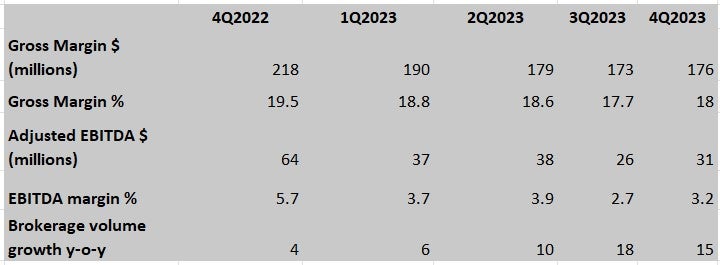
The actual numbers are that gross margin at RXO was $218 million in the fourth quarter of 2022 and declined the next three quarters to reach $173 million in the third quarter. It improved to $176 million in the fourth quarter. The fourth quarter of 2022 was the first full quarter the company reported after being spun off from XPO (NYSE: XPO).

Gross margin percentage of 19.9% in the fourth quarter of 2022 also declined the next three quarters, down to 17.7% in the third quarter, before rising to 18% in the final quarter of 2023.

Wilkerson’s response was essentially that the market was tough but that RXO was doing better than its peers. “We’re putting up best-in-class volume growth, and we’re doing that with best-in-class margins,” he said. “Now in the bottom part of the cycle, you do feel pressure on your gross profit per load.” 

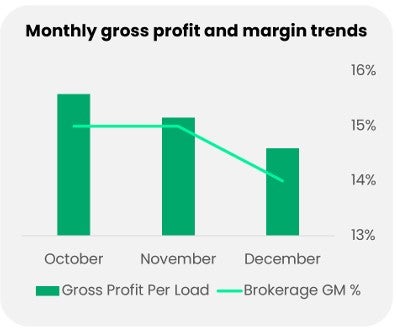
RXO does not disclose precise gross profit per load data. However, a graphic in presentation slides released with the earnings shows a slide throughout the fourth quarter, from between 15% and 16% in October to between 14% and 15% in December.  

Wilkerson described that metric as “one of the biggest levers that we watch for where we’re going long term. … We’re confident that we’re making the right investments that allow us to operate at the best gross margin percentage with strong volume growth,” he added.

In his comments to kick off the call, Wilkerson touted several positive numbers beyond those in the accompanying table. Brokerage productivity, which RXO measures as loads per head per day, was up more than 15%. In the 15% growth in brokerage volume, truckload was up just 11% but LTL rose by 45%. “We again broke records in our brokerage business this quarter,” Wilkerson said, citing quarterly loads per day and total volume hitting new high-water marks.

Full truckload business was 84% of all volume, Wilkerson said.

RXO’s brokerage contract volume was up 23% year over year in the fourth quarter. The company cited “a strong brokerage sales pipeline, which has increased in size by 24% since the fourth quarter of 2022.” The prepared statement released in conjunction with the earnings said RXO expects brokerage volumes “to continue to grow on a year-over-year basis in the first quarter of 2024.”

Jared Weisfeld, RXO’s chief strategy officer, said the company’s “late-stage pipeline” of new business is up 24% year over year and 90% on a two-year comparison. 

Investors were negative on the RXO earnings. At approximately 3:30 p.m., RXO stock was down 8.27% to $20.62. Its low for the day was $19.50.

RXO’s stock price had been riding relatively high recently. In the past three months, including Thursday’s performance, it had risen 18.4%. But its 52-week high wasn’t all that long ago: $24.33 on Dec. 27.

Earnings calls with analysts that take place in the second month of the ongoing quarter have the advantage of having a full month on the books to assess current market conditions, and several analysts asked how things were going for RXO in the first quarter. The answer generally was, not great but not that much worse.

Weisfeld said weather had an “acute impact” on performance in January. Some areas were “severely impacted” by weather, with the impact in weather-affected areas two or three times what it was in other parts of the country.

But he added that the bottom appears to have been reached. “We have seen some relief in the last week or so in terms of gross profit per load.”

In separate comments on the January market, Wilkerson said the first two weeks of January traditionally produce downward pressure on gross profit per load and percentage. “We saw that, but it actually was worse than what we anticipated,” Wilkerson said. He cited the Midwest and Southeast as areas particularly hit.

Wilkerson described conditions RXO faced in January. “We had hit the bottom of where the carriers were operating at, so there was no room to pull down carrier costs, and we’re operating in what is largely contractual volume,” he said. Hoping to work good margins in the spot market to offset that is possible, but as Wilkerson noted, “There aren’t a lot of spot loads out there in the market today.”

The numbers released by RXO showed the company’s total revenues were $1 billion, down from $1.1 billion in the fourth quarter of 2023. 

That’s a 9% decline in revenue. That was strikingly close to the drop of just over 9% posted by the North American Surface Transportation segment at C.H. Robinson (NASDAQ: CHRW). Digital brokerage Uber Freight’s (NYSE: UBER) 12-month decline was 16.8%.

On an adjusted basis, RXO’s net income dropped to $7 million from $33 million a year ago. Its adjusted earnings before interest, taxes, depreciation and amortization was $31 million, down from $64 million a year earlier, and its adjusted EBITDA margin was 3.2%, down from 5.7% a year earlier.

James Harris, RXO’s CFO, said the “base case” for the company is that a freight market recovery would be emerging in the second half of the year. “Clearly, Q1 Is below where we expected it to be,” Harris said. If the second half of the year does show a recovery, Harris said, “we’re very confident we’ll grow that EBITDA in the back half of the year.”

More articles by John Kingston

Uber Freight’s revenue and EBITDA still weak

14-year-old case that brought ABC test to New Jersey was just settled

C.H. Robinson’s Q4 sees little improvement in shift at top of brokerage unit

XPO and Saia stock go to the moon

Welcome to the WHAT THE TRUCK?!? Newsletter brought to you by Dynamic Logistix. In this issue, XPO and Saia stock skyrocket; Super Bowl logistics; train vs. truck; and more.

We are so back

X

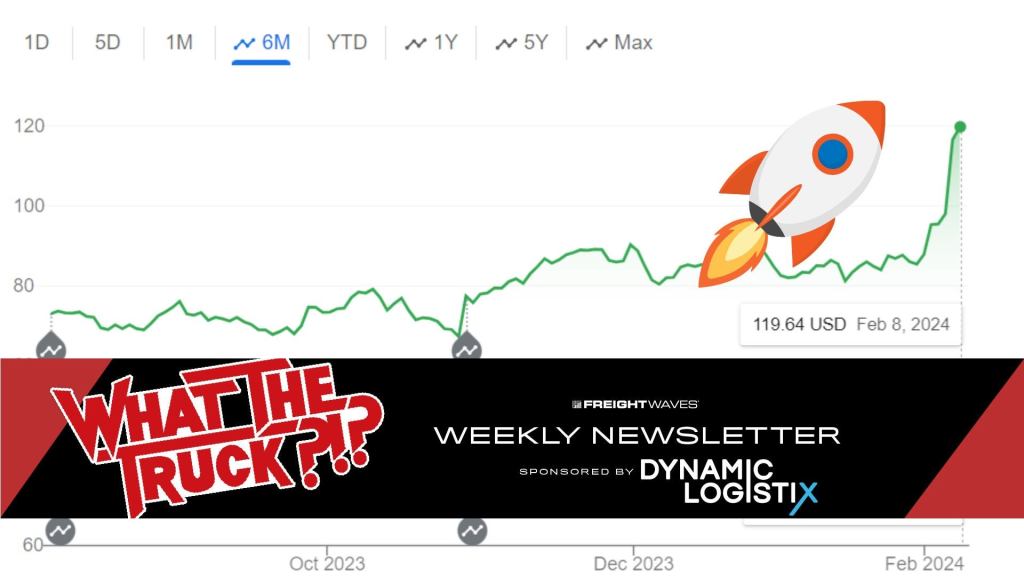
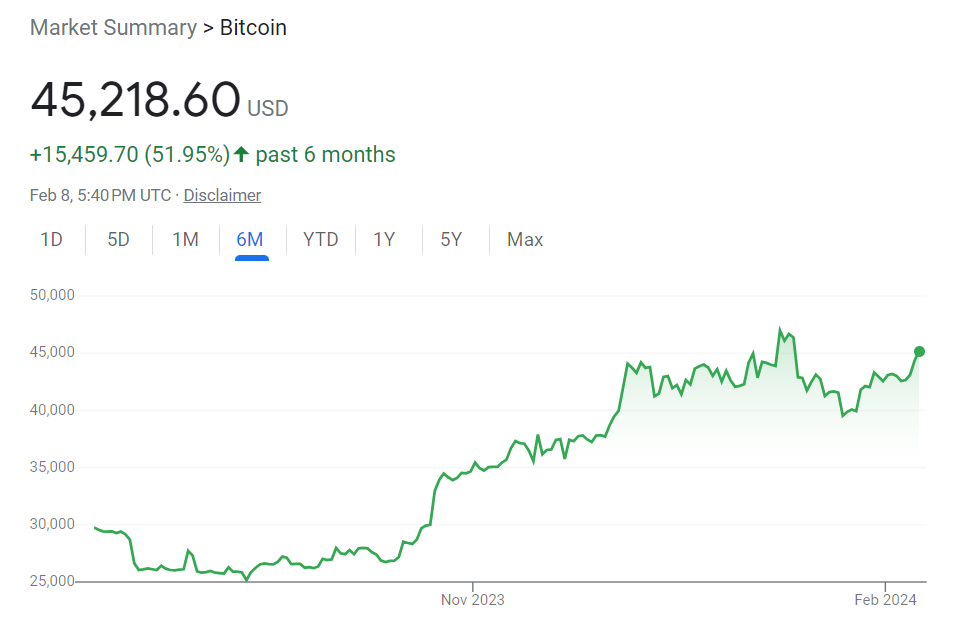
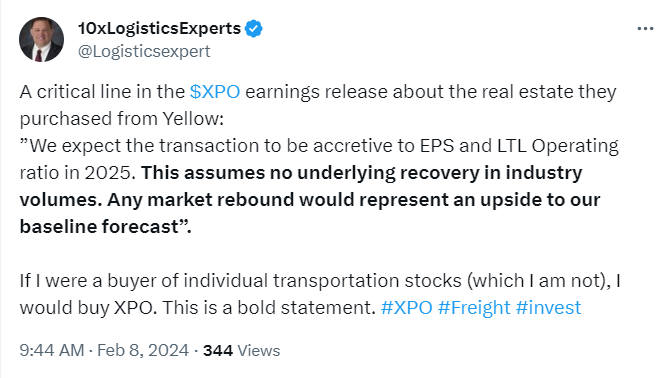
Forget bitcoin; how about XPO’s performance? — Some transportation stocks are surging and XPO is leading the charge. The LTL juggernaut’s stock price has skyrocketed 63% in the past six months. By comparison, bitcoin is up only 52% in that time frame.

Google

What’s propelling the stock to such great heights? FreightWaves’ Todd Maiden reports, “The less-than-truckload carrier reported fourth-quarter adjusted earnings per share of 77 cents, which was 15 cents better than the consensus estimate but 21 cents lower year over year (y/y).” XPO’s LTL segment also reported a 9% y/y increase in revenue to $1.19 billion.

“[We’re] even more optimistic for the back half [of 2024].” — XPO CEO Mario Harik

X

Saia soars too — XPO isn’t the only stock headed to the moon. Saia is up 27.42% over the past six months. MarketBeat reports, “Saia had its target price hoisted by stock analysts at Susquehanna from $500.00 to $625.00 in a research report issued on Thursday.” 

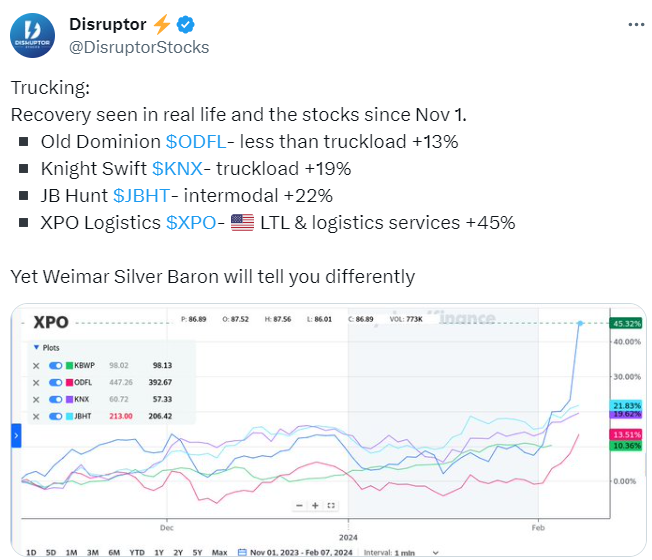
And they’re not the only ones. Since Nov. 1, Old Dominion is up 13%; Knight Swift is up 19%; and JB Hunt is up 22%.

Sound off — Are you feeling more optimistic about recovery in the freight market in 2024? Email me your answer.

Super Bowl logistics

FreightWaves

The most expensive Super Bowl ever — Taylor Swift faces the 49ers this Sunday in Super Bowl LVIII, and if you’re the average viewer it’s going to cost you 5% more than last year to celebrate. NewsNation reports, “This year, the National Retail Federation anticipates households will spend $86.04 on game day festivities, with total spending across the country hitting $17.3 billion.”

“When it comes to increased sales, avocados are the real Super Bowl champion.” — USDA in a blog post

Just how much food, drink and beer are we talking about here? FreightWaves’ Noi Mahoney reports, “Over 12 billion chicken wings, 50 million cases of beer, 28 million pounds of chips and 54 million avocados will be consumed on Super Bowl Sunday, which equals more than 30,000 truckloads, according to third-party logistics provider Compass Logistics.” That’s 20% of all U.S. avocado sales in an entire year!

Bad blood

X

Waiting game — No, this isn’t a picture of the county booking department. It’s a typical line truckers have to wait in at a receiver. Twittering trucker Cholt7727 recently posted, “Every driver knows the feeling of this picture.”

Freight X (a loose-knit group of supply chainers on the social media platform) sounded off on the pic.

New Trucker Mike — I can feel the frustration coming off this photo.

ImChrisHanchard — I thought “Hurry up and Wait” only applied to the military. I stand corrected.

Kitchen_Rebelz — I can hear my own internal debate about whether or not I’d be happier shoving bamboo shoots into my scrotum.

ResolutionaryM — Wow! What a driver friendly and driver appreciative place! I bet they have a porta potty outside too!


SONAR

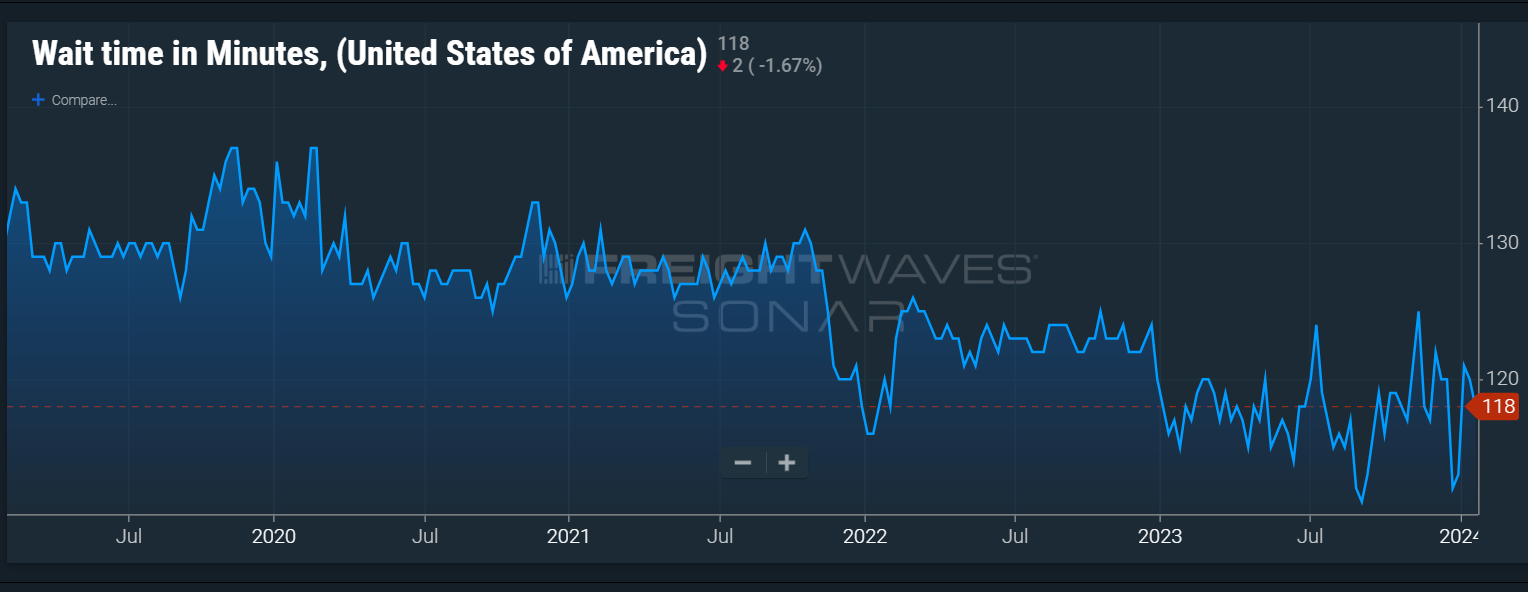
Consolation prize — Excessive wait times and frustration at receivers wear drivers down and contribute to the massive turnover problem in this industry. But, there’s some good news on a national level. According to SONAR, wait times are down to 118 minutes — significant improvement from just a couple years ago.

However, if you’re at a bad receiver that’s on the wrong side of that average … your mileage may vary.

The rest of the noise


X

WTT Friday

Logistics behind Carl’s Jr.’s Super Bowl free burger promo — This Friday on WHAT THE TRUCK?!?, I’m joined by CKE Restaurants’ John Brewer, who talks about the logistics behind their free burger day Super Bowl promotion. 

Mutha Trucker News’ Alex Mai has built his own media empire on social media. He’ll share some of his biggest trucking stories, how he built a following of over 900,000 and how trucking companies can better market themselves.

Echo Global Logistics’ Mike Mobley talks about order optimization and how it reduces shipping costs.

Northland Trucking Risk Control’s Anthony Slamar shares how insurance views advanced driver assistance systems.

Plus, latest news, weirdness and trends.

Catch new shows live at noon EST Mondays, Wednesdays and Fridays on FreightWaves LinkedIn, Facebook, X or YouTube or on demand by looking up WHAT THE TRUCK?!? on your favorite podcast player.

Now on demand

Did the spot market see its shadow?

Trucking M&A forecast; monster loads; tech to make life easier

Thanks for reading and feel free to forward this to a friend.


Tweet @ Dooner

Email me

Subscribe to the newsletter

Subscribe to the show

Apple Podcasts

Spotify

YouTube

TikTok

Twitter

Or simply look up WHAT THE TRUCK?!? on your favorite podcast player. 

Don’t be a stranger,

Dooner

Werner aims to grow dedicated after Q4 earnings miss

Werner aims to grow dedicated after Q4 earnings miss

(Source: Werner Enterprises; chart: FreightWaves)

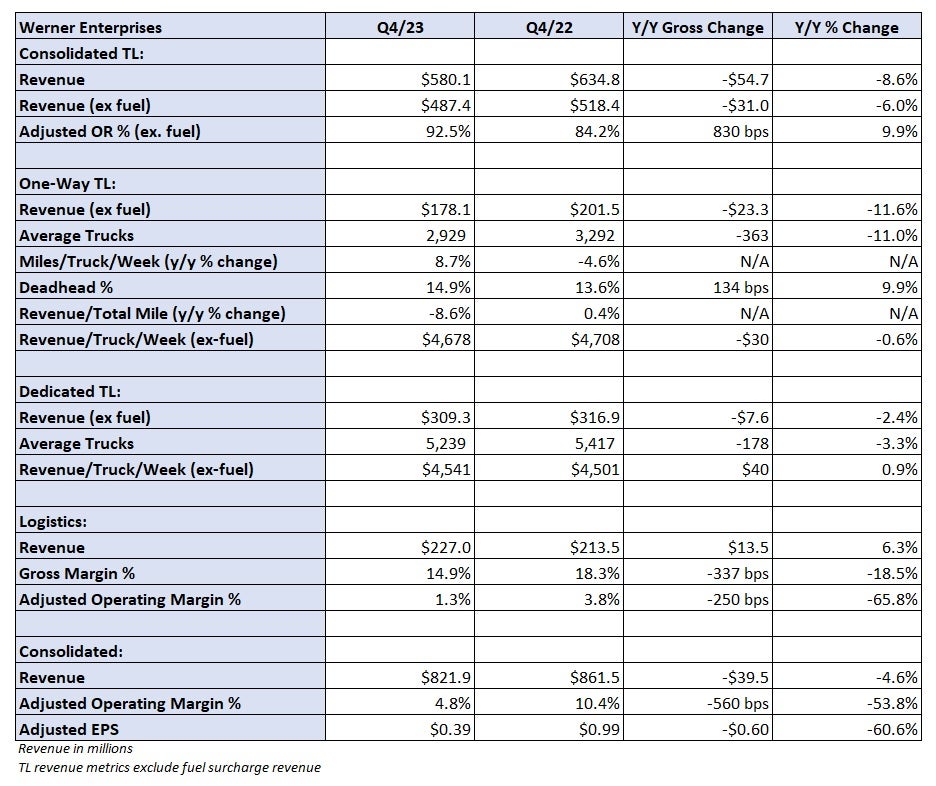
On Tuesday, truckload carrier Werner Enterprises released its Q4 earnings, which saw one-way customers (or OTR) continue one last push for savings on upcoming RFPs but nearing an inflection point due to profitability concerns.

The pricing discipline and willingness to limit the company’s semi-random OTR network while pivoting to dedicated is a proven down-market strategy in which you adjust the mix for less volatile dedicated business and lock in better margins. Stemming losses is the name of the game. Dedicated is more complex than OTR and provides advantages to large carriers that have the assets and people to pull it off.

On Werner’s Q4 earnings call, Chairman and CEO Derek Leathers, said: “Clearly there are customers that are looking to try to take one last bite of the apple. There’s clear pressure, especially on the one-way side of the network. But our stance is we’ve got to stay disciplined. … So they’re going to be frictional. They’re going to be difficult. We’ve already indicated that we’re willing to shrink the fleet size if need be and we’ve shown that through 2023. The good news is we also have a lot of stability in the dedicated portion of the portfolio”

We should see in the coming quarters enterprise fleets maintain or reduce their over-the-road exposure until rates improve. If an inflection begins in H2 2024, we may see early signs of fleets attempting to increase head count and take advantage of higher rates but at a measured pace due to higher equipment- and driver-related costs. 

LMI’s January index sees expansion in every metric

(Source: The Logistics Managers’ Index)

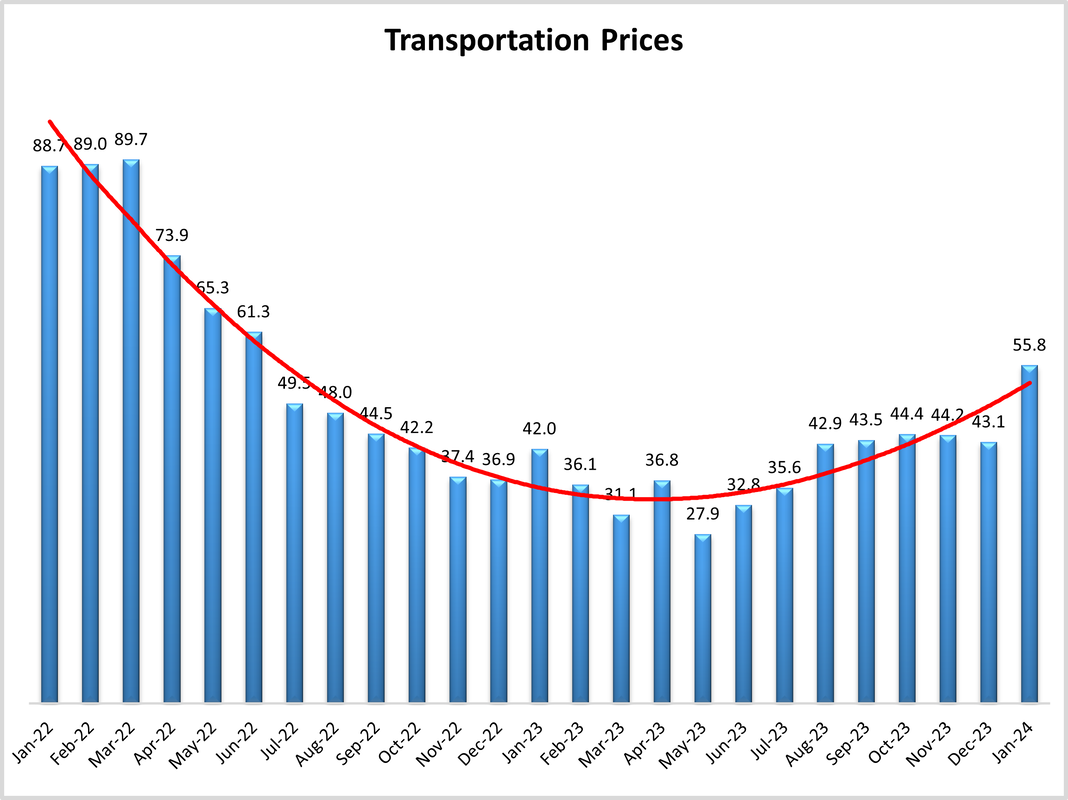
The Logistics Managers’ Index recently released its January index data, which saw all metrics read in expansion territory, the first time since September 2019. An index reading below 50 indicates a contraction while a reading above 50 is an expansion. The overall LMI rose 5 points to 55.6 in January compared to a December reading of 50.6. 

One positive sign for truckload carriers is the expansion of transportation prices by 12.7 points month over month to 55.8. This is the first time in more than two years that the report saw prices in expansion territory. The report adds, “It is worth noting that Transportation Prices and Transportation Capacity inverted this month, with the former now growing slightly faster than the latter. Every time there has been an inversion between these two metrics over the 7.5 years of this index it has signaled a shift in the market.”

Potential interest rate cuts are also worth watching. FreightWaves’ Todd Maiden writes, “Another positive catalyst for the transportation industry could come in the form of interest rate cuts as some analysts are predicting. Lower rates would likely result in more activity at upstream firms, like manufacturers and wholesalers, resulting in more ‘larger, bulkier shipments,’ the report said.”

Market update: U.S. Bank Q4 Index see continued declines

(Source: U.S. Bank)

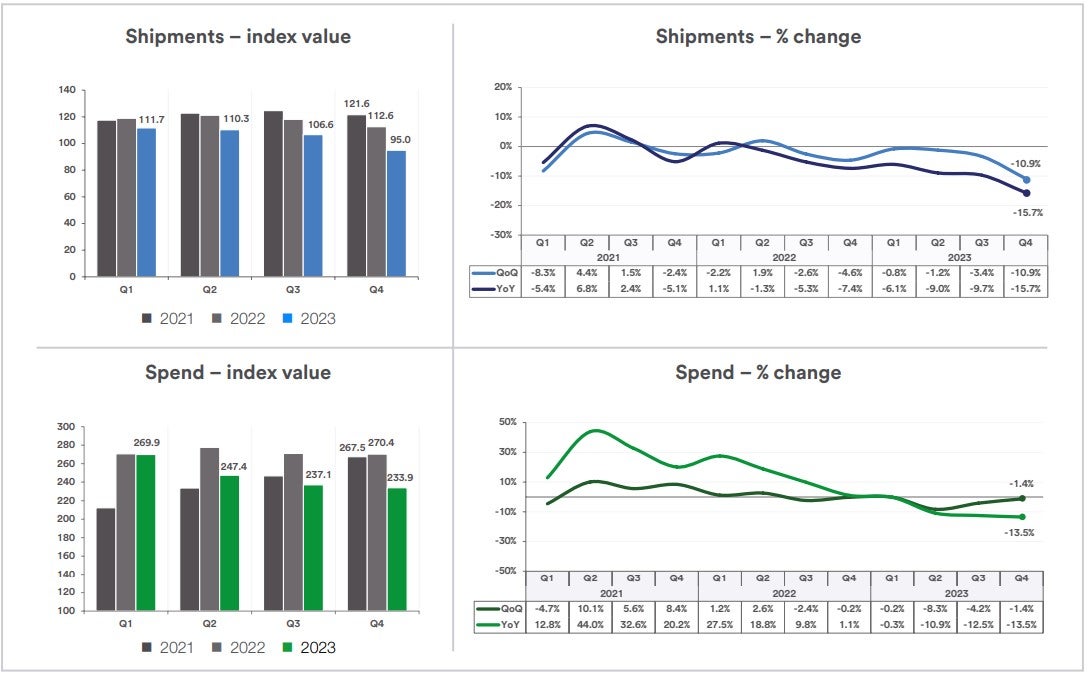
Freight audit and payment provider U.S. Bank recently released its Q4 2023 Freight Payment Index, which saw both national shipments and spend index decline for the fourth consecutive quarter. While year-over-year declines remained high, quarter-to-quarter declines moderated. The Shipments index fell from 106.6 points in Q3 2023 to 95 points in Q4 while the Spend index declined from 237.1 points in Q3 to 233.9 points in Q4. 

FreightWaves’ John Kingston wrote: “In what might be considered the most accurate summation of the current market, the U.S. Bank commentary said: ‘As shipments volumes contract, it results in too many trucks chasing too little freight.’ But the bank also noted that given that the Shipments index was down 10.9% and the Spend index dropped just 1.4% relative to the third quarter, that variance is ‘suggesting that the market may be moving closer to balance between supply and demand.’”

Inventory levels and customer restocking remained an important theme. The report notes, “One of the reasons why freight volumes were so soft during the final quarter was that retailer inventory reduction was significant during the final three months of 2023. As businesses worked to reduce inventories, they required fewer truck shipments. Furthermore, shelf destocking reduces total economic activity; the reduction in inventory, once completed, will no longer be a headwind on the freight supply chain.”

FreightWaves SONAR spotlight: Spot linehaul rates lose steam

(Source: FreightWaves SONAR)

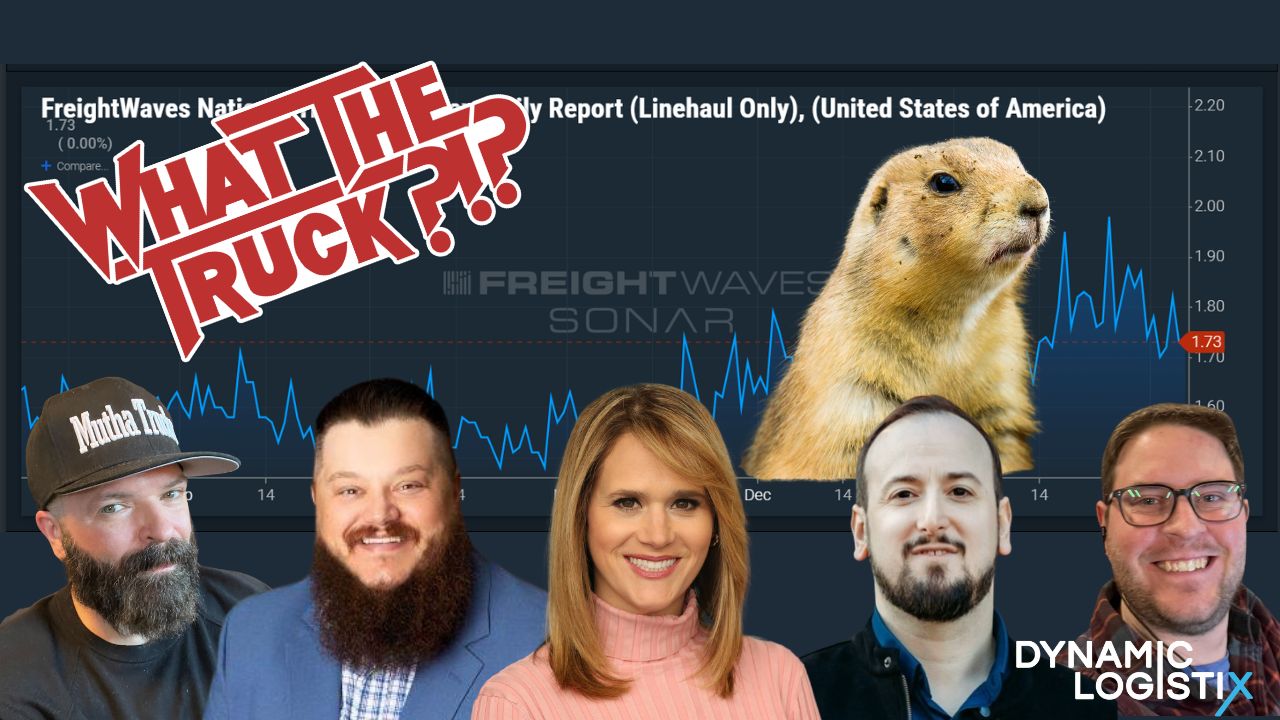
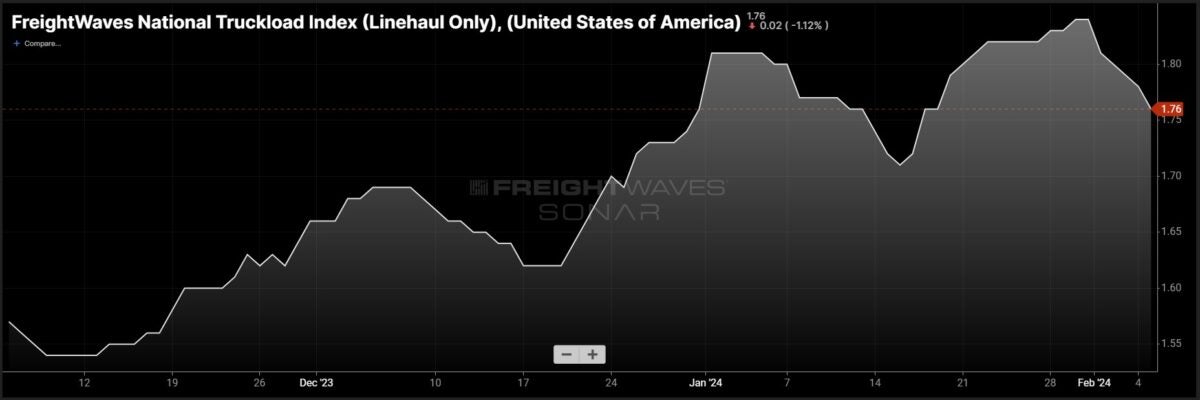
Summary: The prognostications of Punxsutawney Phil, resident groundhog and weather expert who on Friday predicted an early spring, have not swayed spot market linehaul rates in the past week. The FreightWaves National Truckload Index (Linehaul Only) fell 7 cents per mile week over week from $1.83 on Jan. 29 to $1.76. It remains premature to predict an end to the gradual improvement in spot market rates based on one week’s worth of change. However, for groundhogs as a substitute for a real freight analyst, early spot market activity for February suggests that rodents may not make informed market decisions.

Dry van all-in spot market rates also saw declines in the past week, with the NTI falling only 3 cents per mile w/w from $2.40 on Jan. 29 to $2.37. Reefer spot rates (RTI) continue to outperform dry van rates, rising 4 cents per mile w/w from $2.75 on Jan. 29 to $2.79. The flatbed segment also saw improvements, increasing 6 cents per mile all-in from $2.77 on Jan. 29 to $2.83.

Looking ahead over the next 28 days, spot market rates suggest signs of stabilization but at elevated levels compared to the past three months. The NTI 28-Day outlook forecasts all-in spot market rates declining 6 cents per mile then stabilizing at $2.35 per mile by March 3 from its current level of $2.41. For adherents of groundhog-based freight analysis, this outlook provides some signs of optimism, as the freight cycle slowly transitions from a down cycle to a cautious upswing and truckload capacity moves closer to truckload demand equilibrium.

FMCSA calls out sham towing fees charged to truckers (FreightWaves)

Imports of avocados, beer from Mexico score big on Super Bowl Sunday (FreightWaves)

Extreme weather in January obscures carriers’ Q1 outlooks (Trucking Dive)

Bankrupt Yellow repays principal, interest on COVID loan (FreightWaves)

FreightWaves opens 2024 Shipper of Choice award nominations (FreightWaves)
‘Take Our Border Back’ convoy ends with rallies in 3 states (FreightWaves)

329 layoffs hit freight-related firms in Texas

Shearer’s Foods

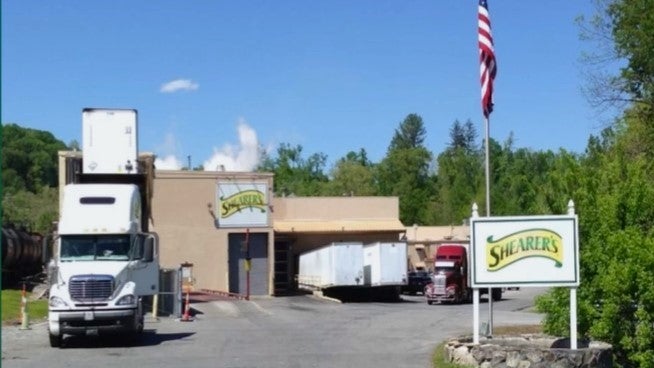
Shearer’s Foods is permanently closing a production facility in Lubbock, Texas, and laying off all 176 workers, according to a filing with the Texas Workforce Commission (TWC).

The Massillon, Ohio-based company is a contract manufacturer and private label supplier of salty snacks, cookies and crackers.

“After an extensive period of consideration, the difficult decision has been made to shutter production at our facility in Lubbock, effective March 31,” the company said in an email to FreightWaves. “This decision came after closely analyzing our supply chain and determining how to best manufacture our products to service our customers. The decision was made largely due to a decrease in demand from the largest customer of the facility.” 

Shearer’s opened the 180,000-square-foot facility in Lubbock in 2007. The company and its subsidiaries currently operate 16 manufacturing facilities and a distribution center in North America. Company officials did not say if they plan to close other facilities.

In December, Shearer’s Foods was acquired by New York-based private equity firm Clayton, Dubilier & Rice. Terms of the acquisition were not disclosed.

Hollingsworth

Transportation and logistics provider Hollingsworth is shutting down a distribution center in Fort Worth and laying off 153 workers. 

Company officials said the facility’s closure was related to losing a contract with security and aerospace firm Lockheed Martin. All employees will be terminated by March 31.

The employees, represented by the International Association of Machinists and Aerospace Workers District Lodge 776, have begun applying for positions at Lockheed, officials said.

“The reason for our ceasing operations relates to Lockheed Martin opting not to renew our commercial agreement and taking the work … in house,” Hollingsworth officials said in a notice filed with the TWC. “The majority of our employees at this location have interviewed with Lockheed Martin in hopes of retaining their position with that company.” 

Hollingsworth is based in Dearborn, Michigan. The company has 27 facilities across the country and employs about 4,000 workers.

More articles by Noi Mahoney

Goodyear Tire ordered to pay $4M in back pay to Mexican workers

FBI alleges Mexican cartel, Canadian truckers part of drug ring

4 things to know about the ‘Take Our Border Back’ convoy

Water level projections threaten future Panama Canal transits

Dry season in Panama is in full swing, and the impacts to trade through the Panama Canal will remain challenged in the months to come. The situation in the canal, after a wetter-than-expected November, wasn’t as dire as many believed, allowing the number of daily transits to increase in January.

The Panama Canal forecast 24 daily transits in January, up from 20 previously expected for January and 18 previously expected for February. Throughout fiscal year 2023, 12,638 vessels traversed the canal, a daily average of 34 oceangoing vessels moving through the canal. 

In the first four months of the canal’s fiscal year 2024, there were 3,233 transits across all vessel types, with the vast majority being Panamax vessels. The run rate for fiscal year 2024 of vessels through the canal is 9,700, 23% lower than the 2023 fiscal year throughput.

While container traffic receives a lot of attention, the tanker and dry bulk market will be heavily impacted as well. Through the first four months of fiscal 2024, chemical tankers have made up 25.6% of Panamax-class vessels that have traversed the canal. Liquefied petroleum gas carriers made up 25.5% of the Neopanamax traffic through the canal.

The water levels within the Panama Canal are largely to blame, but any hope for a significant rebound in water levels to boost throughput will likely be met with a harsh reality over the next few months.

The water levels are going to remain a challenge that has the potential to continue to derail vessel throughput. Gatun Lake, the manmade lake that vessels must traverse, had water levels at 81.2 feet as of Tuesday. Water levels in this critical portion of the canal have started 2024 at the lowest level on record, dating back to 1965.

Projections are for even lower levels over the next two months, falling below 80 feet in early April.

Three of the largest five ports in the U.S. rely on shipments that navigate through the Panama Canal: the Port of New York and New Jersey, the Port of Savannah, Georgia, and Port Houston. Over the past month, these three ports combined to handle 30% of total twenty-foot equivalent unit throughput. For reference, the two largest ports in the country: the Port of Los Angeles and the Port of Long Beach, accounted for 32% of the total U.S. throughput.

Import demand has picked up steam ahead of the Lunar New Year, which will provide a boost to overall imports that are trending above last year’s levels. This boost is being felt by the East Coast ports, like Savannah, where the Ocean TEU Volume Index is up over 40% in the past month.

The water crisis is creating increased delays as backlogs around the canal remain.

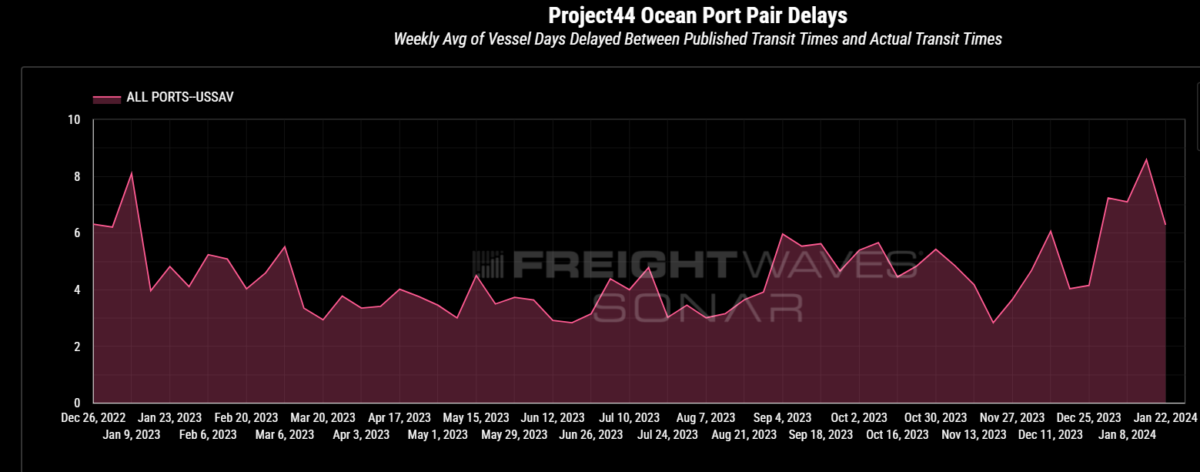
FreightWaves SONAR Container Atlas, Project 44 Ocean Port Pair Delays, all global ports to the Port of Savannah.

The limiting effects of the low water levels have created an additional six-day delay on average to the Port of Savannah from all ports around the globe. These delays are adding an extra day and a half to the scheduled transit times, which have also increased — nearly four days longer than they were this time last year.

These delays are even more impactful the further up the Eastern Seaboard you go. The Port of New York and New Jersey is having similar delays, around the six-day mark, but are over three days longer than they were last year.

Comparing these East Coast ports to their West Coast counterparts, the port pair delays for the Port of Los Angeles are under three days and nearly a day less than they were this time last year.

Mother Nature is outside human control, and if the water level projection holds true, the next couple of months could add to the ongoing crisis.

Recruiting and retention leadership – Taking the Hire Road

Sadie Church, president of Recruit Hire Retain, joined Jeremy Reymer on a recent episode of Taking the Hire Road. The duo dove into Church’s trucking industry background and her passion for helping carriers improve their recruiting and retention processes.

Church’s affinity for trucking started at a young age. Church’s father was a driver and owner-operator throughout her childhood, leaving her with fond memories of summer vacations in the truck, as well as a deep-rooted respect for the industry as a whole.

“I always joked that we spent more time at truck stops than we did amusement parks,” Church said of her childhood. 

When Church entered the workforce, the trucking industry was the most natural place for her to land. Earlier in her career, Church spent time at CDLLife, where she interacted with drivers on a daily basis. She grew even more passionate about making the industry better after hearing about the difficult and often unethical situations many drivers face – from bait-and-switch schemes to dishonest recruiting practices.

“[My dad] was an owner-operator contracted with the same company my entire life,” Church said. “I had never seen that side of trucking, and it was really disheartening to me.”

Church left CDLLife and started working to create change on the carrier side, leading multiple departments – including marketing, recruiting and driver relations – for individual trucking companies. From there, she decided to broaden her net through the creation of Recruit Hire Retain.

Recruit Hire Retain is a consulting firm designed to better the lives of drivers by helping carriers create the best policies and work environments possible. Church consults on everything from new driver orientation and onboarding to retention procedures and measuring key performance indicators. 

No matter what company Church is working with, she prides herself on paying attention to the little things. 

“We think big things are the problem, but sometimes the problems are in the details.” 

Seemingly insignificant issues – from cold application follow-ups to time-consuming onboarding strategies – can sabotage a carrier’s chances at getting a driver behind the wheel in the first place.

Church’s attention to detail helps her clients spot and correct small issues and inefficiencies before they evolve into larger problems, leading to optimized recruiting and retention techniques. 

When carriers are prepared to take good care of their drivers, the industry becomes a safer and more ethical place for everyone. 

Other highlights from this episode of Taking the Hire Road

Book recommendations: The Happiness Advantage: The Seven Principles of Positive Psychology That Fuel Success and Performance at Work by Shawn Achor

Sponsors: Career Now Brands, The National Transportation Institute, Infinit-I, Asurint, Transportation Marketing Group, Driver iQ, Seiza, Trucksafe and DriverReach

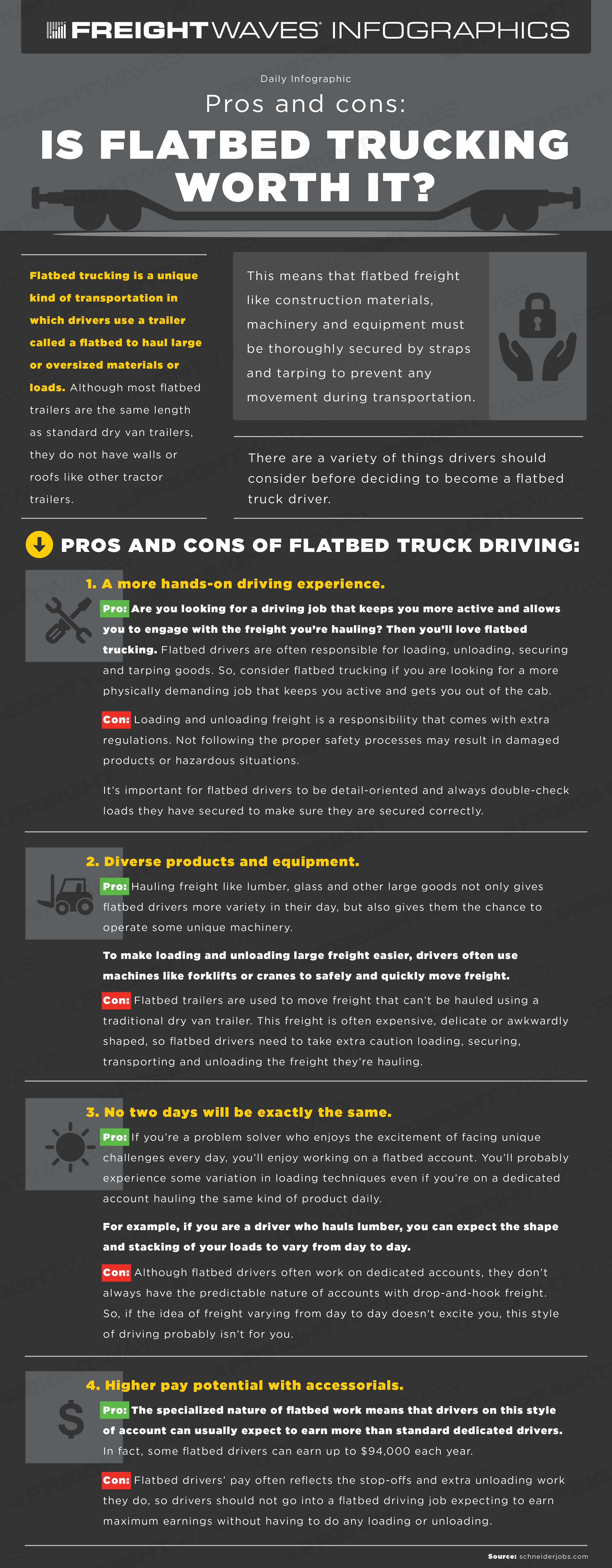
Daily Infographic: Pros and cons: Is flatbed trucking worth it?


To view more FreightWaves infographics, click here