Thomas Schmitt out as CEO at beleaguered Forward Air

Forward Air CEO Thomas Schmitt, who engineered the acquisition with Omni Logistics that has sliced a massive amount of shareholder value, then tried to get out of it and then ultimately closed the deal, is out at the LTL carrier.

The move, announced early Wednesday, came a day after two major ratings agencies weighed in on the Forward Air acquisition of Omni Logistics with reports that were decidedly negative.

S&P Global Ratings said Tuesday that it was lowering its rating on Forward to B+ from BB-, citing renewed review of its acquisition of Omni. Both ratings are under the cutoff mark for investment-grade ratings.

Meanwhile, Fitch Ratings Services did not reduce its rating on LTL carrier Forward (NASDAQ: FWRD), which is at BB-, but it did revise the outlook on Forward to negative from stable, which is often a step taken as a prelude to a downgrade. By contrast, S&P has a stable rating on Forward Air, a sign that it believes the metrics at the LTL carrier have nowhere to go but up.

Michael Hance, Forward’s chief legal officer and secretary, has been named interim CEO. He has been with the company since 2006 and has served as general counsel since 2008 and chief legal officer since 2014. He also headed the team’s human resources department between 2010 and 2014.

Schmitt’s departure, which has been predicted in some quarters given the collapse in Forward Air’s stock price, means that the two key architects of the Forward Air purchase of Omni Logistics — Schmitt and Omni CEO J.J. Schickel — will both be gone from the much larger company. 

Schickel’s departure was announced a week after the two companies reached an out-of-court settlement over a lawsuit brought by Forward Air that sought to invalidate the merger deal announced in August. 

The erosion of Forward Air’s stock price has been stunning. Since hitting a 52-week high on July 27, the stock is down almost 63%. The investor community sees the structure of the Omni acquisition as dilutive to existing Forward shareholders. 

Schmitt also had been president and chairman at Forward Air. Chris Ruble, COO since 2018 and an employee going back to 1996, will add the president title. In the prepared statement announcing Schmitt’s departure, Ruble was said to have “played a critical role in the successful integration of all of Forward’s acquisitions.”

The independent chairman of the company will be George Mayes. Mayes has been on the board since 2021. He is the founder and CEO of LeanVue, “which provides strategic analysis for global supply chain design and strategy development for managing complex global supply webs,” the company’s website said.

The original agreement called for Omni shareholders to receive $150 million in cash and a 37.7% equity stake in Forward. The enterprise value of Omni at the time of the acquisition was $3.2 billion. Under the revised deal that came out of the lawsuit settlement, the cash going to Omni shareholders was cut to $20 million and the equity distribution was cut to 35% from 37.7% The enterprise value was estimated to have fallen to $2.1 billion.

But the announcement of the deal did not stop the stock from sliding, with Forward Air regularly notching 52-week lows in the two weeks since the revised agreement was announced Jan. 22.

Ratings agencies were originally positive on the deal

The move on ratings by S&P and Fitch mark a significant reversal from what the ratings agencies said in September when the deal was announced. At that time, both agencies made no changes in their ratings but issued comments that, in the case of S&P, could be interpreted as supportive of the deal while Fitch was more cautious.

Debt taken on by Forward Air to complete the acquisition of Omni was its first foray into the public debt markets. The initial BB- rating was placed on $925 million in senior secured notes.

With S&P Global Ratings making a cut in its rating and Fitch going to the less drastic step of a cut in the outlook, it is the former whose actions are more negative.

For the ratings agencies, their decisions always come down to numbers and a company’s ability to service its debt. The numbers laid out by S&P in its rating were stark in describing the changes it now sees in Forward Air’s ability to service its debt.

S&P said it expects Forward Air’s adjusted debt-to-EBITDA ratio to have come in at 8.6X in 2023 (the company has not yet issued its earnings) and 6.2X in 2024. The earlier forecasts were 7.2X and 5.1X, respectively. Funds from Operations (FFO) are projected to have been 4.5% in 2023 and 8.2% in 2024, deteriorating from 5.4% and 9.9%, respectively. (S&P defines FFO as a “company’s ability to generate recurring cash flows from operations independent of changes in working capital. We derive our FFO metric from adjusted EBITDA and subtract cash interest and cash taxes.”)

S&P was not optimistic about the state of the freight market that Forward/Omni faces. It said the combined revenue at Forward was likely to have declined 24% to 26%, compared to S&P’s earlier estimates that it was facing a 20% drop. It also sees revenue growth of just 3% to 5% next year, down from an earlier estimate of 9%.

The numbers on Omni are particularly negative. S&P estimates that Omni as a stand-alone company had a drop in revenue of 30% to 32% last year, compared to an earlier estimate of 22% to 24%. Freight forwarding was particularly troubled, with a decline of 35% last year versus an earlier estimate of 25%.

Revenue growth at Omni this year is expected to be 1% to 3%, according to S&P, versus an earlier estimate of 7% to 9%.

Those revenue declines, combined with what S&P said were “elevated labor and transaction expenses” and slower growth, led S&P to cut its estimate on EBITDA at stand-alone Omni, which now is under the Forward banner.

The S&P estimate for Omni had been EBITDA of about $220 million last year and $470 million this year. But assumptions now have been cut to $175 million and $300 million, respectively.

Decisions made by management are part of the problem, S&P said. “The rapid deterioration of ocean and air freight rates going into 2023 left Omni with a bloated cost structure in a softer demand environment,” the ratings agency said. “This reflects labor-related expenses in its selling, general, and administrative costs that we now expect to be above $500 million compared with about $400 million in our previous forecast.”

“Rightsizing” those costs was supposed to have commenced as part of the deal with Forward Air, S&P said. “Instead, Omni’s management chose to invest in its International air sales resources — delaying targeted cost reduction.”

And S&P said it saw damage from the battle over whether the merger would go through. “Recent litigation between Forward Air and Omni has delayed the start of integration between the companies amid a rapidly evolving freight environment, likely delaying deleveraging,” it said. “We believe management’s execution of its previously stated strategy also continues to shift with changes to growth prospects at Omni.”

The S&P report was published late Tuesday. But by Wednesday morning, this sentence was moot: “The executive team, after the close of the merger and following a period of litigation between the companies, is uncertain as of the current writing,” S&P said. 

A spokesman for Forward Air declined comment on the ratings agencies’ report.

More articles by John Kingston

New Jersey hikes truck insurance minimum to $1.5M, higher than most states

14-year-old case that brought ABC test to New Jersey was just settled

C.H. Robinson’s Q4 sees little improvement; shift at top of brokerage unit
Bestpass, Geotab collaborate on toll-telematic integration

Toll management solutions provider Bestpass is working with telematics creator Geotab to help commercial fleets better manage and monitor tolls to reduce expenses.

Bestpass allows for commercial vehicles to automatically pay tolls, and manage tolls for drivers. It covers all major toll roads in the U.S. Geotab provides vehicle data and GPS location information that integrates with Bestpass’ toll information. Their partnership will work to identify discrepancies between vehicle locations and reported tolls received. This can help smooth over disputes regarding toll charges for drivers and customers.

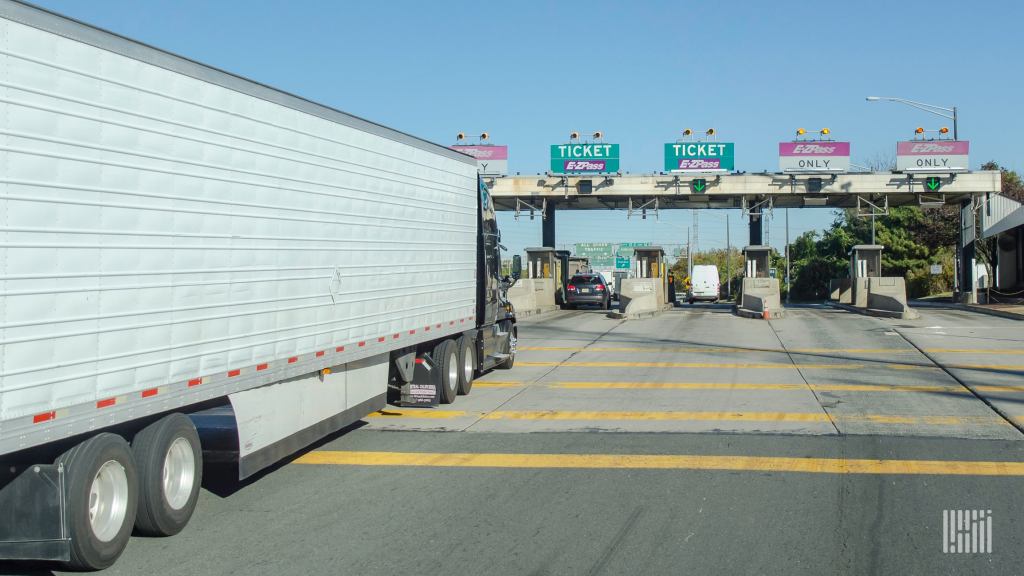
Customers will also have access to a high-level heat map, highlighting areas with high toll costs. All the data will be combined in one account, on Geotab’s platform. Users must be customers of both Bestpass and Geotab, and vehicles must be equipped with a compatible Geotab GO device.

The collaboration brings Bestpass’ Toll Genius feature to Geotab’s marketplace.

The Geotab platform shows Bestpass heat map information. (Photo: Bestpass/Geotab)

“This information can help fleets leverage the toll data to optimize routes and avoid costly tolls,” said Bestpass Head of Product David Long. “Fleets and owner-operators using Bestpass can also monitor all toll transactions and expenses in real-time, easily ensure necessary transponder coverage across your fleet, identify fraudulent activity, and more through their account.”

In November, Bestpass announced that it had acquired risk management platform Fleetworthy Solutions, in another move to expand its customer base.

Bestpass was also recently named to the 2024 FreightTech 100 by FreightWaves, which recognizes the most innovative companies in the commercial transportation industry.

XPO beats Q4 estimates

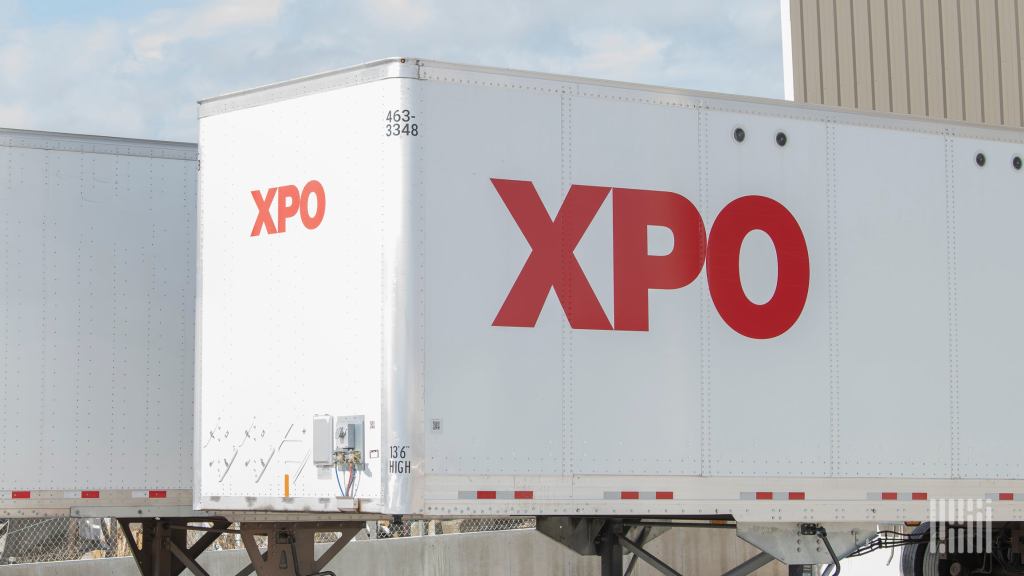
An XPO trailer at a terminal

Less-than-truckload carrier XPO reported an earnings beat ahead of the market open on Wednesday.

XPO (NYSE: XPO) reported fourth-quarter adjusted earnings per share of 77 cents, 15 cents better than the consensus estimate but 21 cents lower year over year (y/y). The adjusted number excludes transaction, litigation and restructuring costs.

Revenue in the LTL segment increased 9% y/y to $1.19 billion as tonnage per day was up 2% and revenue per hundredweight, or yield, increased 6% (10% higher excluding fuel surcharges). The tonnage increase was the combination of a 6% increase in shipments, partially offset by a 3% decline in weight per shipment. The lower shipment weights positively impacted yields.

Click for full report – “XPO’s shares jump 18% on big Q4”

A 270-basis-point reduction in purchased transportation expense as a percentage of revenue pushed the unit’s adjusted operating ratio to 86.5%, 380 bps better y/y. The OR was just 30 bps worse than the third-quarter result and better than management’s guidance, which called for roughly 210 bps of deterioration.

“We delivered fourth quarter results that were solidly above expectations, reflecting substantial momentum in service quality, pricing and productivity,” said XPO CEO Mario Harik in a news release.

XPO’s European transportation segment recorded a 2% y/y revenue increase to $753 million and an adjusted earnings before interest, taxes, depreciation and amortization margin of 4.7%, which was 50 bps lower y/y.

The company will host a call to discuss fourth-quarter results with analysts on Wednesday at 8:30 a.m. EST.

Click for full report – “XPO’s shares jump 18% on big Q4”

Table: XPO’s key performance indicators

Daily Infographic: Helpful apps for truckers


To view more FreightWaves infographics, click here

Despite economic worries, more containers flow from China to US

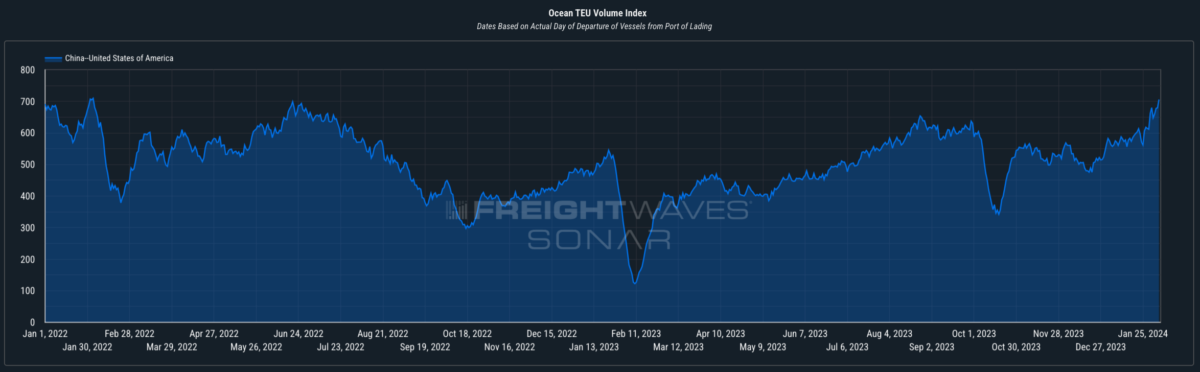
There’s a seeming contradiction in the macroeconomic and trade data coming out of China these days: Despite contracting industrial activity, low consumer confidence and a worsening stock market rout, China is currently sending the highest volume of ocean container freight to the United States since May 2022.

(Indexed ocean container volumes from all Chinese ports to all U.S. ports by day of vessel departure. Chart: FreightWaves SONAR)

Part of the surge in shipments is due to the traditional pre-Chinese New Year surge, when factories on China’s coast move a flurry of goods to the port before their workers depart for a long holiday in their hometowns. But this year’s peak is well above 2023’s anemic Chinese New Year season, and volumes have been mounting all year.

Container volumes from China to the United States are steadily growing at a time when the macroeconomic picture in China couldn’t be more uncertain. China’s manufacturing Purchasing Managers’ Index contracted in January for the fourth consecutive month. China’s second-largest property developer, Evergrande, is being liquidated, with approximately $300 billion in debts against $245 billion in assets. Chinese stocks have been in a deepening rout: The CSI 300, an index of the 300 largest stocks on the Shanghai stock exchange, is down more than 19% over the past year. The Chinese government has taken steps to limit short selling by domestic institutional investors and is considering asset purchases exceeding $1 trillion in order to put a floor under the market.

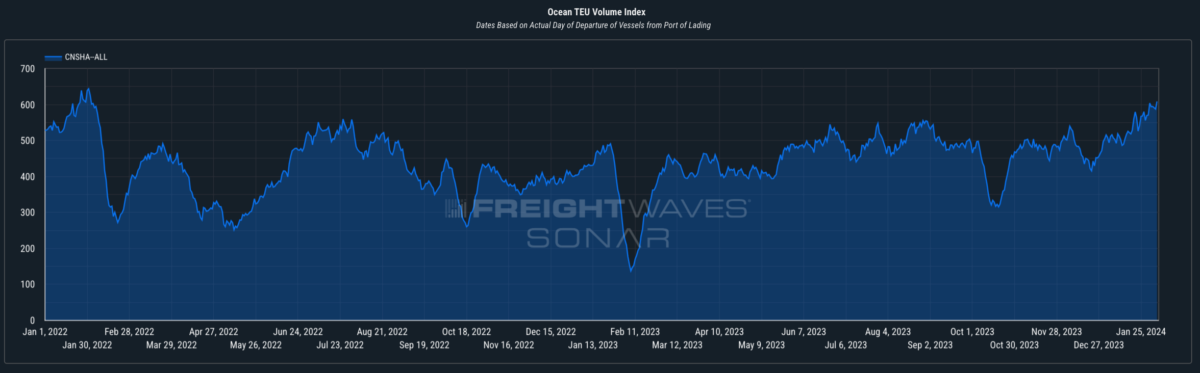
Why, if China’s GDP growth fell to 5.3% in 2023, its slowest growth of the 21st century, is the port of Shanghai (for example) shipping more volume than at any time in the past two years?

(Indexed ocean container volumes from Shanghai to all global ports by day of vessel departure. Chart: FreightWaves SONAR)

It appears that volume isn’t so much being pushed out of China by a burgeoning manufacturing sector so much as it’s being pulled out of China by U.S. importers who have burned off inventory and are preparing to face higher-than-expected retail sales. In November 2023, the most recent date for which data is available, U.S. inventory-to-sales ratios fell to 1.37 months, well below pre-pandemic baselines. Meanwhile, in December 2023, U.S. retail sales grew 4.8% year over year to $709 billion, outpacing overall y/y GDP growth of 3.3% in the fourth quarter of 2023.

February and March should be relatively strong months for U.S. ports, particularly on the West Coast. In general, when inventories are low yet economic growth is strong, transportation providers find themselves in a more favorable business environment. Retailers and manufacturers need to move higher volumes of goods and accelerate the velocity of freight through their networks, which tightens transportation capacity and raises rates. 

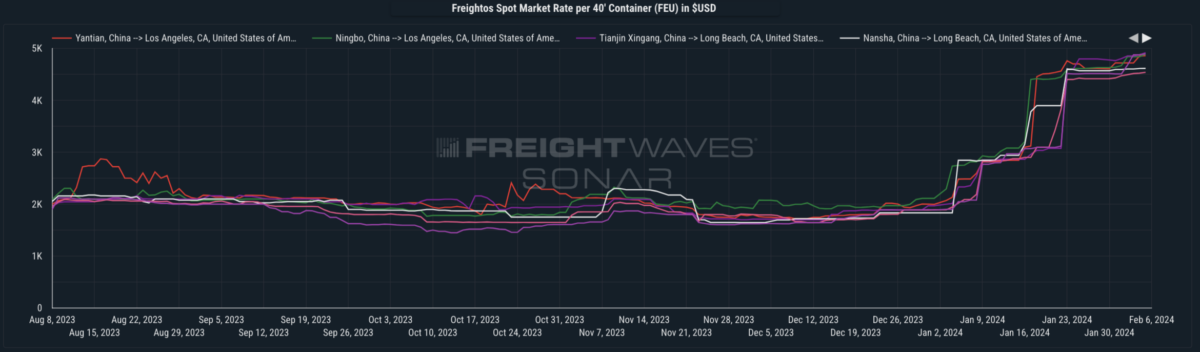
On the other side of the planet, Houthi terrorist attacks against international shipping in the Red Sea have necessitated diverting shipping from the Suez Canal around the Cape of Good Hope, extending transit times and effectively removing containership capacity from the market. Because those strains on steamship line networks are coinciding with higher volumes out of China, eastbound spot rates on the trans-Pacific have ripped upward to more than $4,500 per forty-foot equivalent unit on most lanes out of China to the West Coast. 

(A basket of Freightos spot rates from China ports to U.S. West Coast ports. Chart: FreightWaves SONAR)

In C.H. Robinson’s fourth-quarter earnings call on Jan. 31, CEO Dave Bozeman commented on the crisis’ impact on global supply chains and container rates.

“In the wake of the ongoing conflict in the Red Sea and low water levels in the Panama Canal, global supply chains are facing transit interruptions and vessel rerouting, which is causing extended transit times and putting a strain on global ocean capacity,” Bozeman said. “While the Asia-to-Europe trade lane has been most affected, the impact is extending to other lanes as carriers adjust routes based on shipping demand. As a result, ocean rates have increased sharply in Q1 on several trade lanes, including Asia to Europe and Asia to North America. While the Red Sea disruption continues without any clear timeline of when it will be resolved, the strain on capacity and the elevated spot rates are expected to continue through at least the Chinese New Year.”

According to the Port of Los Angeles’ PortOptimizer, Week 6 TEU volumes were up 38.6% compared to the same week in 2023 (105,076 TEUs vs. 75,801 TEUs). In other words, volumes are already elevated compared to last year, and there’s reason to believe that even more is on the way.

Werner reports Q4 miss

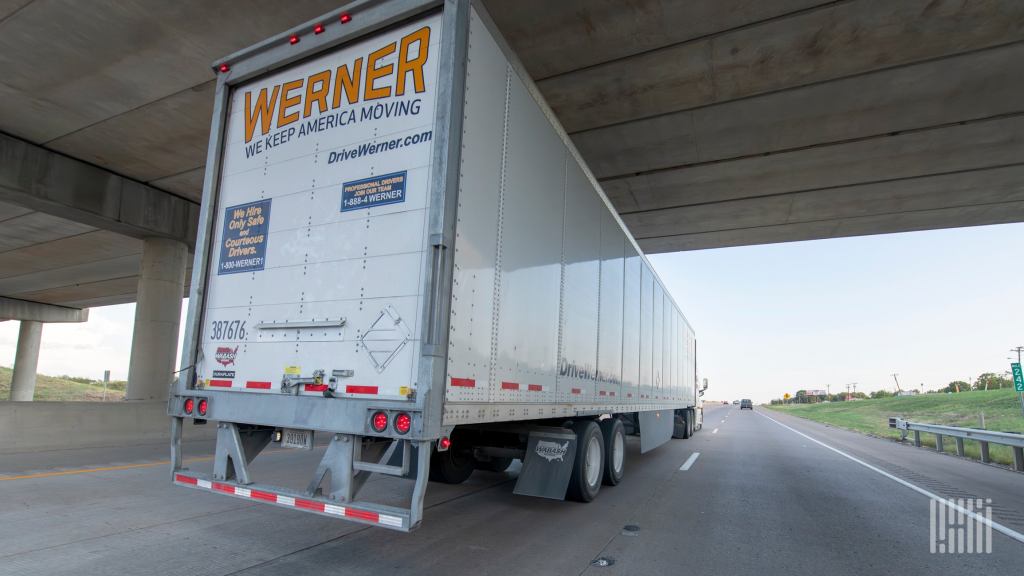
A Werner tractor-trailer moving under an underpass

Werner Enterprises saw another tough quarter to close 2023 and said it will continue to favor investment in its dedicated fleet over one-way operations.

The company’s 2024 guidance calls for the total truck count to be down 3% to flat, noting that the one-way truckload market is “not reinvestable” at the current moment as rates continue to be pressured by excess capacity and tepid demand.

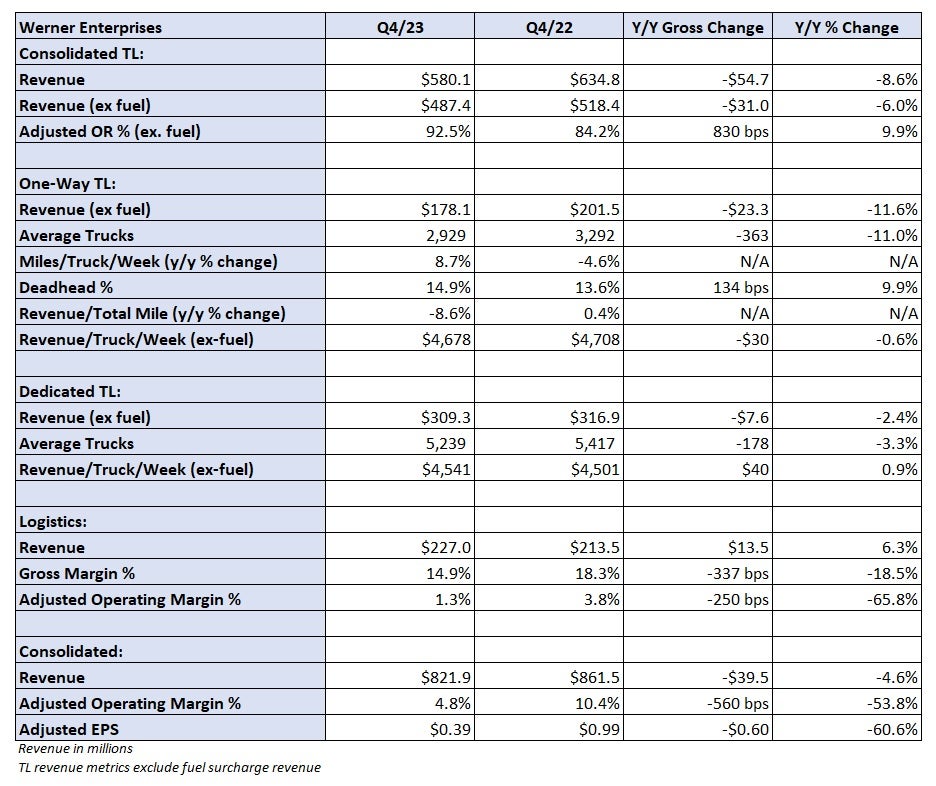
The one-way segment saw an 11% year over year (y/y) decline in average trucks in service to 2,929 units during the fourth quarter. Average trucks in use on the dedicated side were off just 3% y/y to 5,239 as some customers have reduced the number of trucks needed on a daily basis.

“We’re not going to continue to run a network in one-way at the return levels that we are seeing today … we owe it to our shareholders and others to make sure that isn’t the case,” said Chairman and CEO Derek Leathers on a Tuesday evening call with analysts.

The company achieved a $43 million cost savings run rate by the end of 2023 and has identified $40 million in new savings opportunities for 2024, of which, only 15% overlap with the prior year.

Werner (NASDAQ: WERN) reported fourth-quarter adjusted earnings per share of 39 cents, 4 cents light of the consensus estimate and 60 cents lower y/y. The result excluded acquisition-related expenses, costs from an insurance claim that has been appealed and changes to earnouts.

Compared to the 2023 fourth quarter, lower gains on sale were a 26-cent headwind, net interest expense (debt down $45 million y/y but variable interest expense up) was a 3-cent headwind, a lower tax rate was a 1-cent tailwind and a lower loss on equity investments was a 2-cent tailwind.

The company saw an 11% decline in the number of trucks sold but a more than 60% increase in trailers sold. Much lower per-unit gains were the culprit.  

Werner’s dedicated business saw revenue decline 2% y/y to $309 million. Revenue per truck per week was up 1%. The full-year 2024 outlook calls for the utilization metric to be flat to 3% higher.

Werner’s one-way segment reported a 12% y/y revenue decline to $178 million. Revenue per truck per week was down just 1% with the drop in tractor count accounting for the rest of the decline. Revenue per total mile was off 9% in the quarter and is expected to decline 6% to 3% y/y in the first half of 2024.

Total truckload operations produced a 92.5% adjusted operating ratio (the inverse of operating margin), 830 basis points worse y/y.

The logistics segment reported a 6% y/y increase in revenue to $227 million. The number was partially boosted by a brokerage acquisition last November. The segment was profitable, recording a 1.3% operating margin, which was 250 bps worse y/y.

Table: Werner’s key performance indicators

More FreightWaves articles by Todd Maiden

14-year-old case that brought ABC test to New Jersey was just settled

The case that first brought the ABC test for determining independent contractor status into New Jersey involved truck drivers hauling bedding. Fourteen years later, the case has been settled out of court.

That’s just one development in recent weeks regarding the always contentious question of how a court or regulator determines whether a worker is an employee or a truly independent contractor.

In recent weeks, there has also been the Department of Labor’s independent contractor rule, which sets the parameters for DOL’s Wage and Hour division to use on questions of IC status. There are at least two lawsuits arising out of that proposal.

For trucking, these latest developments come as stakeholders wait to see whether a federal court will hand down a new injunction any day now blocking California’s AB5 law — which is built around that ABC test.

In New Jersey, the $4.5 million settlement came last month in the case of several drivers against Sleepy’s, a mattress retailer. Richard Reibstein, an attorney with the law firm Locke Lord who specializes in independent contractor status and writes a blog on the subject, reviewed the history of the Sleepy’s case that dates back to 2010.

Sleepy’s won summary judgment at the federal district court level in New Jersey in 2012. The court ruled that the drivers who filed the case were in fact independent contractors. But in 2015 — coincidentally the same year Sleepy’s was acquired by Mattress Firm (NASDAQ: MFRM) — a federal appellate court overturned that decision and cited the ABC test as the guiding principle for determining whether a worker is an employee or a contractor.

According to Reibstein, that brought the ABC test into New Jersey case law, though the appellate court had received the recommendation to use the ABC test from the New Jersey Supreme Court.

“New Jersey borrowed the state’s strict ABC test under its unemployment law and adopted it as the new test for independent contractor status under its wage laws,” Reibstein wrote. “That change in the law was not an act by the state legislature; instead, it was created entirely by the judiciary. These judicial decisions have created havoc for businesses and legitimate independent contractors that had developed business relationships based on then-existing law.”

A long, tortuous history

The Sleepy’s case was kicked back to district court, where its history online shows a long list of motions, notices, a series of decisions at both the district and appellate court levels regarding seeking class certification of the case (which was ultimately granted to about 120 class members), failed mediation in 2021, and finally a settlement.

Under the settlement, Sleepy’s denies any wrongdoing. Its total payout will be $4.5 million, according to court documents. 

The three named plaintiffs in the case, who had set up companies to drive for Sleepy’s but were ultimately found to be employees rather than independent contractors under the ABC test, each will receive $26,666 under the settlement. The court documents also say approximately $2.425 million will be available to the 120 class members.

Though the ultimate numbers might not be large, especially given the roughly 14 years of litigation,  Reibstein said in his blog that the legacy of the Sleepy’s case and the introduction of the ABC test into case law because of it, means that “today, New Jersey is one of a few states in the U.S. where businesses and freelancers are in peril if they seek to create or maintain IC relationships including those that would otherwise be compliant with the test for IC status under the federal wage and hour law and most state wage laws.”

Though IC cases in New Jersey are not as frequent as in California (which has a codified the ABC test through AB5) and Massachusetts (which, like New Jersey, has established through case law the factors that determine IC status), Reibstein said they are “quite prevalent” in the Garden State.

What’s in the ABC test?

The three-pronged ABC test helps guide a determination of whether a worker is an employee or a contractor. Broadly, it deals with questions of control and the independence of the occupation. For trucking, the B prong is particularly problematic: “The work takes place outside the usual course of the business of the company and off the site of the business.” That calls into question whether a trucking company can fairly hire an independent owner-operator to move freight when trucking is that company’s “usual course of business.”

California’s trucking industry awaits word from Judge Roger Benitez of the U.S. District Court for the Southern District of California on the latest request from the California Trucking Association and the Owner-Operator Independent Drivers Association to block implementation of AB5 in the state’s trucking industry.

The case is the same one that resulted in an injunction handed down New Year’s Eve 2019, a day before AB5 went into effect. That injunction agreed with the CTA’s argument that AB5 conflicted with the transportation provisions of the Federal Aviation Administration Authorization Act (F4A) and should be blocked. But an appellate court overturned that decision, the Supreme Court chose not to hear the CTA appeal, and the case was kicked back to district court while AB5 went into effect.

Oral arguments in the case were heard in early November. The scope of the arguments has widened beyond F4A. An earlier projection in some California trucking quarters that Benitez would rule before the end of 2023 proved false, and the waiting game goes on.

2 lawsuits challenge DOL rule

Meanwhile, the Department of Labor’s proposed independent contractor rule faces two lawsuits, one that was already in place and had an impact in 2021 and another filed by a group of freelance writers.

One of those cases, Coalition for Workforce Innovation, et al. v. Walsh, et al., resulted in a ruling early in the Biden administration by the U.S. District Court for the Eastern District of Texas that the Biden-aligned officials running the DOL erred in yanking the Trump administration rule that went into effect just before the end of Trump’s term.

That case was never fully adjudicated despite the impact it had, and in fact an appellate court in the 5th U.S. Circuit handed down a stay. Despite that, the Trump rule — seen as more favorable to declaring a worker an independent contractor rather than an employee — stayed in place while the Biden administration appealed the lower court ruling and drew up its substitute independent contractor rule.

In a recent blog posting, the law firm of Baker Hostettler said the plaintiffs — the Coalition for Workforce Innovation — are seeking to use the case to challenge the DOL rule. “The coalition has opted to try lifting the stay and reviving its 2021 challenge — rather than filing a fresh challenge to the DOL’s new rule — likely in the hopes of retaining a friendly trial court venue that sided with them once before,” the firm wrote.

The other lawsuit was filed last month by a group of four freelancers who have been prominent in discussions on X under the hashtag #FightForFreelancers. That case is Warren, et al. v. U.S. Dep’t of Labor, et al.; Warren is Karon Warren, one of the plaintiffs. (Another plaintiff is Kim Kavin, who writes frequently for other publications owned by Firecrown Media, which as of last week owns FreightWaves Media.)

The case was filed in the U.S. District Court for the Northern District of Georgia.

The four plaintiffs are being assisted by the Pacific Legal Foundation. In a blog posting on the lawsuit, the foundation said that “the government should protect the flexibility of freelancers and their clients to build mutually beneficial working relationships. Instead, the DOL’s new rule deliberately prevents workers and businesses from knowing whether anyone is an independent contractor and exposes those who work with freelancers to huge fines and criminal penalties for not knowing.”

But the Baker Hostettler blog posting was skeptical of the lawsuit. Referring to the argument that most freelancers want to stay in that situation, the law firm wrote, “while this argument may be persuasive in the court of public opinion, litigants should be aware that a worker’s classification preference is of minimal value. It has long been established that the economic reality of the working relationship controls workers’ classification under the FLSA [Fair Labor Standards Act] — not their subjective beliefs.”

More articles by John Kingston

New Jersey hikes truck insurance minimum to $1.5M, higher than most states

Love’s: Restraint in new travel centers/truck parking in ’24 but larger growth plans

C.H. Robinson’s Q4 sees little improvement; shift at top of brokerage unit
Port of Savannah building overpass to divert trucks out of neighborhoods

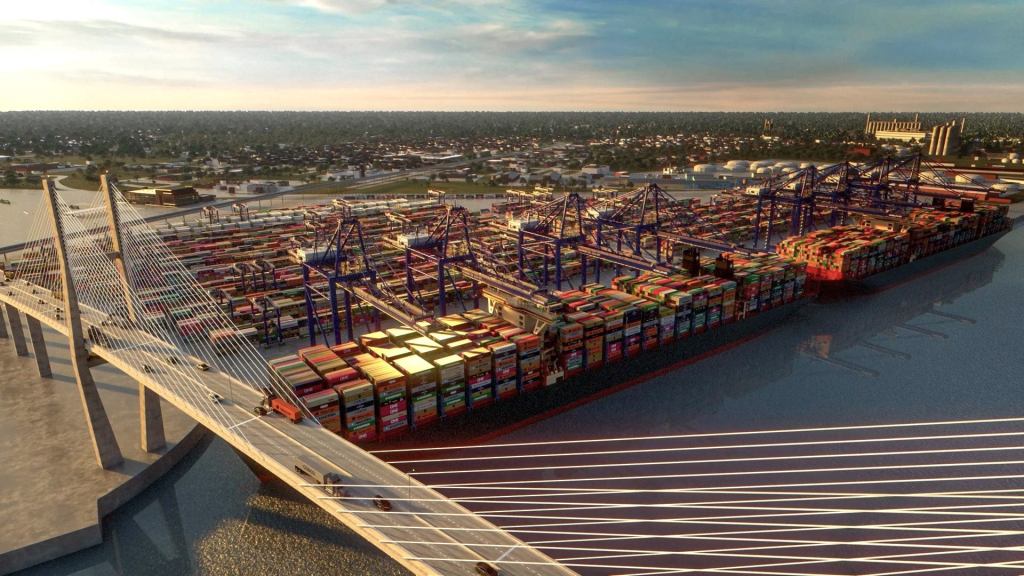
Georgia Ports Authority (GPA) announced plans to construct a $29 million highway overpass linking the Port of Savannah’s Ocean Terminal with U.S. Route 17.

Officials said the aim of the overpass is to keep tractor-trailer traffic away from local communities. The project is scheduled to be completed in 2026.

“This is a port project in the best interest of the community,” President and CEO Griff Lynch said in a news release. “We want to keep trucks off local neighborhood roads for safety and sustainability reasons.”

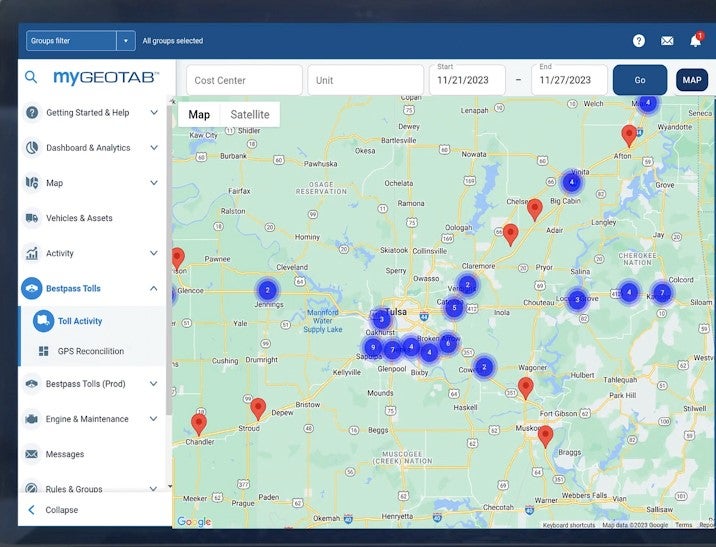
The overpass will enable trucks to directly access Route 17, rather than use Louisville Road and local streets in Savannah to enter Interstate 16. GPA will construct the overpass and roadway entrance to Route 17.

In addition to the overpass and entrance ramp construction to Route 17, GPA will also build a dedicated exit ramp from Route 17 and a tractor-trailer-only entrance roadway into Ocean Terminal.

Once completed, the overpass will be turned over to the Georgia Department of Transportation for the roadway’s maintenance and repair.

The project is the outcome of collaboration among GPA, GDOT and the city of Savannah. GPA officials said the initiative started by talking to communities near Ocean Terminal and hearing the concerns of residents on the impact of increased truck traffic on neighborhood streets.

The Port of Savannah’s 200-acre Ocean Terminal is one of the busiest container ports on the East Coast. Ocean Terminal and the port’s Garden City Terminal handle about 2 million twenty-foot equivalent units annually.

In December, GPA announced details of a $4.5 billion expansion plan that includes the Garden City Terminal West, Blue Ridge Connector and improvements to Berth 1 at the Garden City Terminal.

With these expansions and renovations, GPA expects container capacity at the Port of Savannah to grow by approximately 3.5 million TEUs per year, with annual capacity reaching 10 million TEUs by 2026.

More articles by Noi Mahoney

Goodyear Tire ordered to pay $4M in back pay to Mexican workers

FBI alleges Mexican cartel, Canadian truckers part of drug ring

4 things to know about the ‘Take Our Border Back’ convoy

Bankrupt Yellow repays principal, interest on COVID loan

Yellow tractors parked along a fence at a terminal

Bankrupt Yellow Corp. said it repaid the $700 million COVID-relief loan it received from the U.S. Treasury in 2020. In addition to the principal amount, it repaid more than $151 million in interest, a late Monday statement read.

The controversial loan was viewed as an unwarranted bailout by some and outside the scope of the CARES Act, which established a lending program to help companies fund near-term liquidity needs associated with lost business from COVID-related lockdowns.

The defunct less-than-truckload carrier qualified for the loan on a carveout provision, allowing companies “critical to maintaining national security” to participate. Shortly after the loan was made, lawmakers and the Treasury and Defense departments squabbled over which party was ultimately responsible for blessing the transaction.

A congressional oversight commission would conclude in 2023 that the loan to Yellow (YRC Worldwide at the time) should not have been made and that it brought undue credit risk to taxpayers.

It was the $400 million second tranche of the loan package that drew the ire of some officials. The first $300 million was set aside for the company to catch up on delinquent pension and health care payments to its Teamsters workforce. However, the second portion of the loan allowed the company to make capital investments by replacing older tractors and trailers.

Treasury did receive a 29.6% equity stake in Yellow, which is currently worth more than $60 million, as part of the collateral agreement.

“This repayment demonstrates Yellow’s absolute commitment to fulfilling its promise to the American taxpayers that its CARES Act loan would be repaid in full with interest,” said Matthew Doheny, Yellow’s chief restructuring officer, who is tasked with unwinding the company’s assets through a Chapter 11 proceeding.

The estate recently auctioned off 153 owned and leased terminals, roughly half of the company’s real estate portfolio, for $2 billion. Most of the buyers were former Yellow competitors.

A Delaware bankruptcy court is overseeing the liquidation, which also includes the sale of 12,000 tractors and 35,000 trailers. That process remains ongoing.

Roughly $900 million in other secured debt and debtor-in-possession financing remains outstanding.

The estate will also have to address numerous unsecured claims, including potential withdrawal liabilities from multiemployer pension funds, penalties for potential WARN Act violations and more than 200 personal injury claims, among other items.

The company said it is still pursuing a $137 million breach of contract lawsuit against Teamsters for blocking proposed changes to modernize how the carrier operates. 

More FreightWaves articles by Todd Maiden

AIT closes on Lubbers acquisition

Supply chain management provider AIT Worldwide Logistics said Tuesday that it has completed its acquisition of European logistics company Lubbers Logistics Group. Terms of the transaction were not disclosed.

The deal, disclosed in mid-November, adds 18 offices to AIT’s 130-location global network. It expands Itasca, Ill.-based AIT’s network to Denmark, Romania and Turkey. Lubbers also has facilities in Germany, Italy, Norway and the United Kingdom. 

In business for decades, Lubbers, headquartered in Schoonebeek, Netherlands, has nine road transport hubs and nine freight locations. It has more than 350 employees.

“We see significant potential for their broad network by growing freight forwarding operations and energy sector expertise” to enhance AIT’s operations,said Greg Wiegel, AIT’s chief customer officer, in a statement.

AIT will add middle-mile service in Europe to complement its recently launched U.S. middle-mile network, Wiegel said.