With the next freight-related legal battle in California centered on a request for a new injunction to block independent contractor law AB5 from being implemented against trucking, California is arguing that AB5 is not having an impact in that sector.
California’s attorney general’s office, in a recent filing in response to the amended preliminary injunction request by the California Trucking Association (CTA) and the Owner-Operator Independent Drivers Association (OOIDA), said that “the disruptions and burdens predicted by [CTA and OOIDA] have not materialized. Drivers are still driving. Ports are functioning. And packages and freight are being delivered across the state.”
If these arguments sound familiar, it’s because it’s the second time the state of California has made them.
The AB5 law passed in 2019 has at its core the ABC test for determining whether a worker should be classified as an employee or a legitimate independent contractor. For trucking, it is the B prong of the ABC test that is problematic, as it says an independent contract is a worker who “performs work that is outside the usual course of the hiring entity’s business.” That can be a tough case to make for a trucking company hiring an independent truck driver.
CTA and OOIDA first asked for a new preliminary injunction in January against implementation of AB5 in trucking. AB5 was implemented in trucking after a 9th Circuit appellate court in 2021 overturned a 2020 injunction handed down by Judge Roger Benitez in federal district court in the Southern District of California that had blocked AB5 in trucking and a subsequent June 2022 decision by the U.S. Supreme Court not to review that appellate court decision.
CTA was the plaintiff in the original case. OOIDA was added as an intervenor in the case in September 2022.
The need for a new filing comes after CTA’s and OOIDA’s amended request for an injunction brought in, among other things, comments by AB5 sponsor Lorena Gonzalez, a former state assemblywoman who is now a California labor leader. Those comments were cited by CTA and OOIDA as suggesting that trucking was singled out for AB5 enforcement when so many other industries were exempted from the law.
The state’s attorney general’s office opposed the motion for a new injunction with some of the same arguments it made earlier: California trucking has not descended into chaos since AB5 became law of the land, or in this case, law of the roads.
The court hearing the case is the same federal district court for the Southern District of California that handed down the original 2019 injunction blocking AB5 from implementation of AB5 in trucking. Judge Benitez continues to oversee the case, which was never fully litigated. The only thing that has come out of it so far has been the injunction that was in effect for about 30 months but was killed by the 9th Circuit appellate court and the Supreme Court inaction.
California has had several months since its last filing to add to its argument that AB5 has not disrupted trucking in the state. The weak freight market that the entire country has been experiencing helped support that argument. “In the time since the preliminary injunction was lifted, thereby allowing AB5 to take effect, California saw rate declines,” the state said.
California also rejects any suggestion that AB5 would cut into the supply of trucks coming from smaller carriers — “nor have smaller trucking businesses been forced out of business,” the state wrote in its brief. “Since AB5 has gone into effect, small business trucking is growing faster (state’s emphasis) than before.”
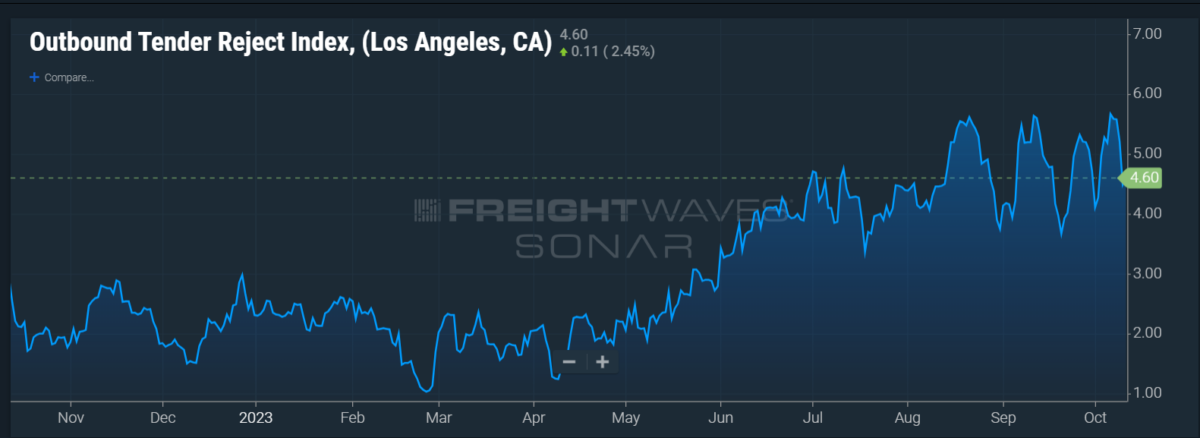
The Outbound Tender Rejection Index is a measure of trucking capacity. This chart from FreightWaves SONAR shows that while capacity has tightened in recent months, it remains at levels that reflect an excess capacity situation.
Citing documents contained in the 700-plus-page Request for Judicial Notice filed in the case, the state said that “previously misclassified truck drivers who are now classified as employees attested in sworn declarations that they saw no change to their type of work or how that work is performed.”
But it is the arguments about equal protection and potential “animus” from Gonzalez that were needed by the state to respond to the amended complaint.
California said the exemptions from AB5, which at first glance appear to not follow any pattern — hairdressers got a break, so did surgeons — “was to avoid creating unnecessary uncertainty for workers long and lawfully classified as independent contractors” under the Borello test, a less stringent yet still demanding legal precedent that governed independent contractor law in California (and several other states) before the ABC test became the governing rule in the state.
CTA and OOIDA do not make “any serious attempt to show that workers in the exempted professions are similarly situated to motor carrier drivers, as would be necessary to show irrational treatment for purposes of the Equal Protection Clause,” the state argued. The Equal Protection Clause of the 14th amendment of the Constitution was cited by CTA and OOIDA in the revised filing, arguing that the exemptions that passed over trucking amounted to a violation.
In arguing against the “animus” charge, the state cited a Gonzalez statement that AB5 needed to be applied to trucking because drivers “act a lot like employees.”
“Rather than demonstrate animus, this statement underscores the Legislature’s purpose in including motor carrier services in the long list of other industries that AB5 covers: to address worker misclassification,” the state wrote. “The Legislature was concerned that misclassification is rampant across the economy, and especially in particular growth industries, including — but far from limited to — the motor carrier industry.”
It also quoted wording from a separate legal precedent that said “accommodating one interest group is not equivalent to intentionally harming another.”
“AB5 and its exemptions serve the rational, legitimate purpose of protecting workers against misclassification, while exempting industries and occupations in which workers have traditionally and properly been classified as independent contractors,” the state said in summing up its arguments.
A hearing on the arguments is set for Nov. 13 before Judge Benitez, who sits in San Diego.
In other key arguments in the filing:
- The original injunction blocking AB5 from trucking was handed down at the end of 2019 just as the law was going into effect in the state. CTA argued that provisions of the Federal Aviation Administration Authorization Act regarding trucking preempted AB5’s implementation, to which the lower court agreed. With that injunction dead, CTA and OOIDA raise the issue again in their request for a new injunction. CTA and OOIDA “have raised no new material arguments in support of the F4A preemption claim that were not already considered and rejected by the Ninth Circuit,” the state wrote, asserting that the finding by the 9th Circuit was “binding” because precedent precludes a court from “reconsidering an issue decided previously by a higher court in the same case.”
- California conceded that a company wishing to hire independent owner-operators as drivers by citing the business-to-business exemption has a tough bar to meet. But the state said it is ongoing. “Major California motor carriers seeking to hire independently contracted drivers under the B2B exemption are contracting with drivers who have formed their own corporations.”
More articles by John Kingston
California Supreme Court to review rulings on constitutionality of Prop 22
15 states jump into California’s ongoing AB5 legal battle
AB5 3-ring legal circus: Full federal appeals court may hear Olson case
Brokerage Compliance Symposium
The day before F3. Every compliance issue you face - fraud exposure, carrier liability, FMCSA rules, cargo theft, insurance gaps - navigated by attorneys and operators defining best practices in a changing industry.
F3 Awards Dinner
The night before F3. FreightTech100 companies honored. FreightTech 25 and Shipper of Choice winners revealed live. Cocktail reception into dinner and live music - 300 industry leaders in one purpose-built room.
F3: Future of Freight Festival
Industry-defining keynotes, rapid-fire technology demos, and industry leaders networking in experiences across Chattanooga - plus the inaugural F3 Awards Dinner featuring the FreightTech and Shipper of Choice reveals.
The day before F3. Every compliance issue you face - fraud exposure, carrier liability, FMCSA rules, cargo theft, insurance gaps - navigated by attorneys and operators defining best practices in a changing industry.
The Signal at Chattanooga Choo Choo • Chattanooga, TN Register NowThe night before F3. FreightTech100 companies honored. FreightTech 25 and Shipper of Choice winners revealed live. Cocktail reception into dinner and live music - 300 industry leaders in one purpose-built room.
The Signal at Chattanooga Choo Choo • Chattanooga, TN Register NowIndustry-defining keynotes, rapid-fire technology demos, and industry leaders networking in experiences across Chattanooga - plus the inaugural F3 Awards Dinner featuring the FreightTech and Shipper of Choice reveals.
The Signal at Chattanooga Choo Choo • Chattanooga, TN Register Now