Plan to replace I-81 in Syracuse with urban boulevard gets court win
A major legal hurdle to tearing down the interstate 81 viaduct through Syracuse, New York, and replacing it with an urban boulevard was cleared Friday when a New York court overturned a ruling blocking the project.
The only legal route now for Renew 81, a group opposing the “new urbanism” project, would be to seek relief from the New York Court of Appeals, the highest in the state.
In a unanimous decision, a five-judge panel overturned a lower court decision that a new environmental impact statement was needed for the project, due to the planned construction of a semiconductor manufacturing plant in Syracuse.
Friday’s decision was handed down by the Appellate Division, Fourth Judicial Department of the New York Supreme Court. The Supreme Court in New York is not the highest in the state; the Court of Appeals is.
State agencies in charge of the project, the Supreme Court decision said, “complied with the substantive obligations under the State Environmental Quality Review Act inasmuch as they took the requisite ‘hard look’ at the relative environmental factors.”
The court also said an environmental impact statement for the I-81 project based on the construction of the semiconductor plant was not necessary.
An Onondaga County legislator, Charles Garland, who is a member of Renew 81, was quoted by Syracuse.com as saying the group would likely appeal. “We feel that the facts are very clear, and that the Court of Appeals will certainly agree” with the lower court decision requiring an environmental review.
In that same article, Syracuse Mayor Ben Walsh said of a possible appeal: “What’s the point? Their strategy from day one has been delay, delay, delay.”
New York Gov. Kathy Hochul, a backer of the project, praised the decision on X.
NEW: Following a court ruling today, we can definitively say that the I-81 Viaduct — which has literally divided the City of Syracuse for decades — is finally coming down!
This decision is a landmark step in the right direction as we work to reconnect communities in Syracuse.
The project would demolish a viaduct that sends I-81 traffic through the heart of Syracuse. Instead, I-81 northbound and southbound traffic would be routed onto what is now Interstate 481, which loops around the city’s east side.
The viaduct is 1.4 miles long and needed significant repairs regardless of what policy the city pursued. The state, on a web page about the project, said the entire corridor is 12 miles.
Renew 81 has estimated that diversion around the city could add 8 to 22 miles to any trip.
In place of Interstate 81 in the city will be a grade-level highway and boulevard. There will be red lights along its way, but those are mostly toward the middle of the road, with the more free-flowing boulevard north and south of that center, which is a traffic circle.
Syracuse.com also reported that work has been done near the two ends of the right-of-way where Interstates 81 and 481 come together north and south of the city. Contracts for that work were awarded last August, according to Construction Dive.
The Congress for New Urbanism (CNU) has been a backer of similar highway-to-boulevard projects, but the one in Syracuse would be among the largest. The “Big Dig” in Boston, replacing the city’s Central Artery of Interstate 93 with a tunnel, was one of the most prominent New Urbanism projects.
On its web page, it said of the Syracuse plans: “The construction of Interstate 81 in Syracuse came with the forced displacement of nearly 1,300 residents from the city’s 15th Ward. It devastated a historic black community, severing the social fabric of the community and razing swaths of buildings, and with them, affordable housing options. Neighborhood deterioration, a glut of surface parking lots, and citywide population loss followed.”
Efforts on what the CNU called the “I-81 Challenge” go back as far as 2012.
NTSB investigating after Norfolk Southern worker killed
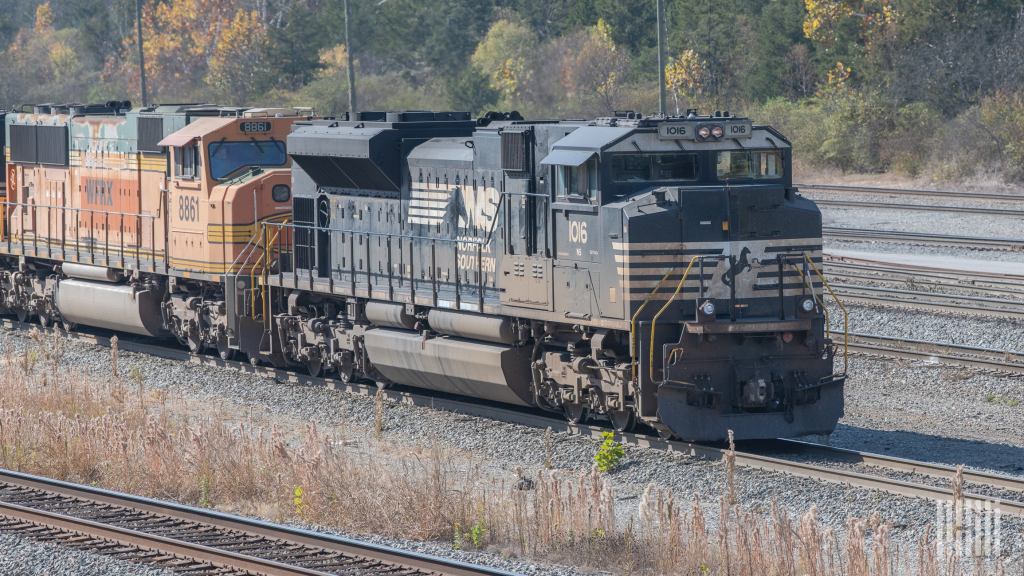
An investigation is underway after a Norfolk Southern train engineer died this week after being hit by a train in Decatur, Alabama.
The National Transportation Safety Board said the incident happened just after 5 p.m. Wednesday.
The victim has been identified as Chris Wilson, 55, of Muscle Shoals, Alabama. He was a 30-year employee of Norfolk Southern, according to the Brotherhood of Locomotive Engineers and Trainmen.
The cause of the incident is under investigation; the NTSB has sent investigators to the scene.
“This tragic loss underscores the safety risks present in railroading, even in the controlled environment of a railyard,” Eddie Hall, BLET’s national president, said in a statement. “This week marks one year since Norfolk Southern’s derailment and chemical spill in East Palestine, Ohio. I hope as we reflect on that disaster and on the need to continually improve rail safety that we also pause to remember Brother Wilson and the family he leaves behind.”
Running on Ice: How cold can you go?
All thawed out
Schott Pharma’s Everic freeze vials are suitable for drugs that require deep-cold storage. (Image: Schott Pharma/Oana Szekely)
How cold can you go? That’s a question Schott Pharma is asking. It just revealed its Everic freeze vials, which are designed for ultracold storage of messenger RNA and gene therapy drugs. How cold are these vials built for? Minus 80 C. Apparently the problem with some of the other vials is casual cracking and breakage on thawing, which ruins the contents of the vial.
A Glass International article notes, “In 2023, there were, for example, 11 mRNA drugs and 10 gene therapy drugs commercially available, which required deep-cold storage, and over 100 mRNA and 45 gene therapy drugs in clinical trials.”
Having a dedicated solution for these trials to increase efficiency and speed along research on countless diseases and conditions could be a game-changer — not to mention that the amount of wasted product will dramatically decrease.
Temperature checks
(Photo: Jim Allen/FreightWaves)
Heading over to the food acquisition space, Seviroli Foods, a frozen pasta manufacturer and importer of specialty goods, has acquired a portfolio of Italian food productions from Ajinomoto Foods North America. This acquisition will enhance Seviroli’s frozen pasta product offering. Seviroli is a portfolio company of Mill Point Capital.
Ajinomoto is calling it a win. Hiroshi Kaho, CEO and president of Ajinomoto, said in a news release, “The sale of our Italian frozen pasta business will allow us to shift our priority on growing our core products, such as gyozas and potstickers, for continued long-term success.”
Any deal that results in more pasta readily available is a good deal to me — not to mention more gyozas and potstickers. There truly could not be a better way to start 2024.
Food and drugs
(Photo: Jim Allen/FreightWaves)
Predictions for 2024 have come from every corner of the internet. One worth noting for the cold chain side of things are emerging trends regarding frozen food. That’s according to Conagra Brands, which published its inaugural “comprehensive, data-driven report” taking a deep dive into the $78 billion industry. The report sought to find out how and why people want to enjoy frozen food.
Some of the findings, published in a news release, were:
Global cuisine: Moving away from the Americanized “meat and potatoes” and toward more bold flavors — anything from Asian-inspired foods to Indian and Korean BBQ.
Frozen food and breakfast: The “most important meal of the day” is increasingly becoming a hot time of the day for frozen food consumption. Frozen croissant sandwiches, breakfast burritos and biscuit sandwiches are among the most popular items driving growth.
The return of the hors d’oeuvres: Consumers are looking for small bites but big flavor, aka the rise of the frozen snack. Consumers’ growing desire for smaller portions and healthier options has brought finger foods back to the forefront.
Kids’ meals: Frozen foods that kids enjoy and are easy for parents to prepare have seen significant growth. Kid-friendly frozen food now generates more than $248 million in annual sales.
The rise of the air fryer: The number of frozen foods with air-frying instructions has jumped 90% in the past four years. Air-fryer preparation often saves time, can be a healthier food prep option and emits less heat for year-round cooking.
The full report can be found here on Conagra’s website.
Cold chain lanes
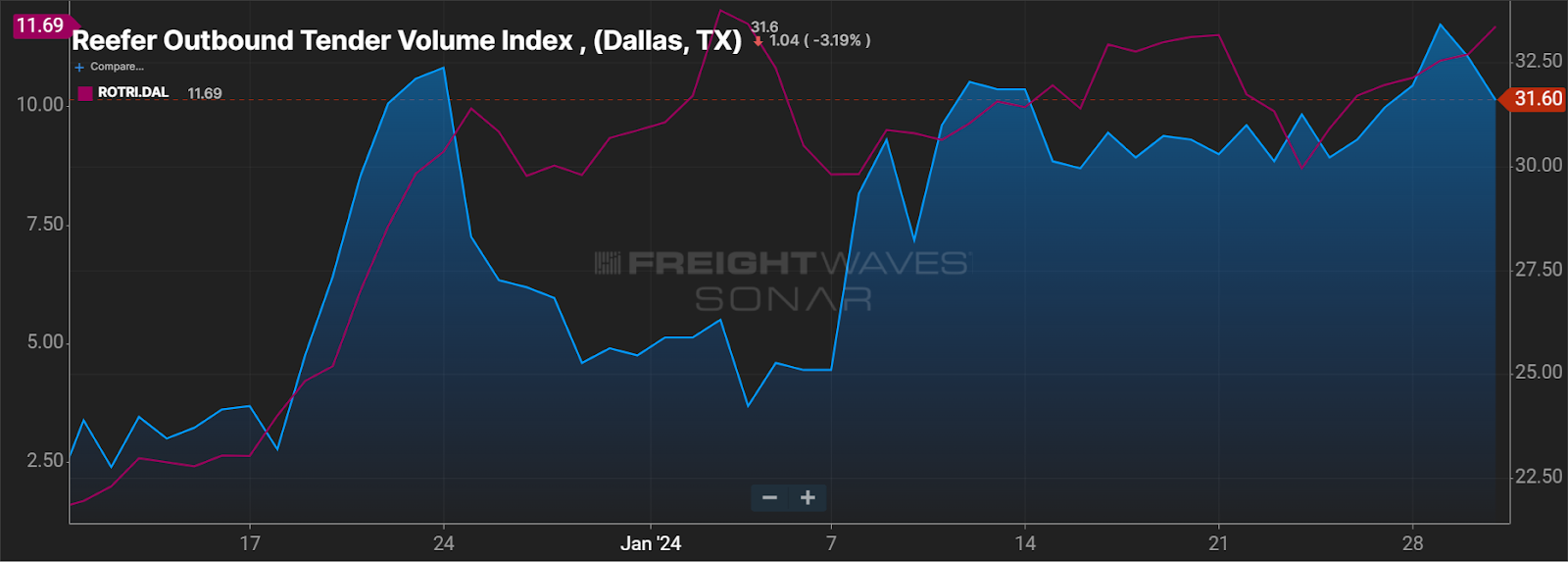
SONAR Tickers: ROTVI.DAL, ROTRI.DAL
There seems to be no end in sight for the Dallas market as it continues to buck the slow January trend. Reefer outbound tender volumes have started falling, down 5.72% week over week, but levels are still up from where the year started. One thing that hasn’t taken a dive is reefer outbound tender rejections; they have risen to 11.7%, a 38-basis-point increase w/w.
Rejections that are above 10% are a sign that there are inflated spot rates in that market. Shippers can rest easy, for now, that outbound tender lead times don’t need to increase. It’s actually trending the opposite way, where lead times are coming under three days out. It’s important to watch closely as spot rates continue to rise and Dallas has anything but a calm January.
Wanna chat in the cooler? Shoot me an email with comments, questions or story ideas at moconnell@www.freightwaves.com.
See you on the internet.
Mary
Tracking your supply chain with satellites; insurtech woes; freight apparel – WTT
On episode 677 of WHAT THE TRUCK?!? Dooner is joined by Skylo CEO and co-founder Parthsarathi Trivedi. Skylo is the leading direct-to-device satellite connectivity service provider, and we’ll find out how their service is bringing visibility and tracking to freight and fleets.
Does insurtech have a big liability problem? Adam Barnett, chief underwriting officer at HDVI, talks about the past year being the worst on record for liability losses in the industry. We’ll find out what this means for the future of truck insurance and your fleet.
Freightees is a brand new trucking apparel company. We’ll meet their founder, Jared Gilmer, to learn about why he started the business, what designs the people are buying and if the Coyote curve applies to fashion.
Plus, how WHAT THE TRUCK?!? led to a couple getting married; gaslighting jobs report; high cost of hydrogen; trucking valets; the harsh reality of getting fired on the road and more.
Saia’s $1B growth plan to test LTL’s tight capacity structure
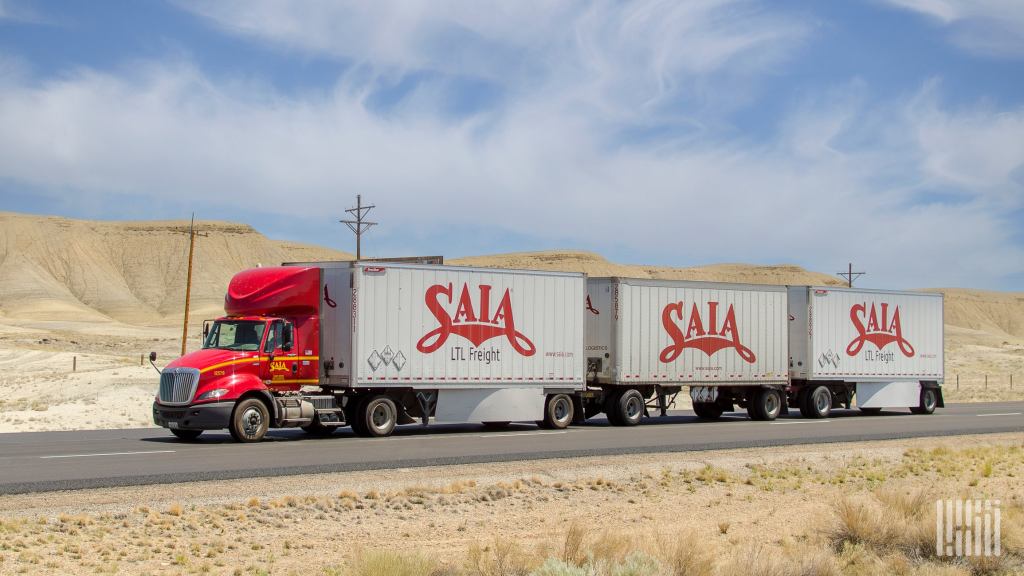
Less-than-truckload carrier Saia Inc. has big growth plans in 2024 after picking up 28 terminals from bankrupt Yellow Corp.’s estate. It outlined a $1 billion capital expenditures plan in its fourth-quarter report, which if executed would represent nearly one-third of its annual revenue.
The acquired terminals (17 owned and 11 leased) represent $244 million of the capex budget. Saia plans to open 15 to 20 of those facilities this year. Some of the additions are expected to be accretive to earnings near term, especially in areas where it is moving out of partner facilities used in an interline arrangement into owned service centers. The company will need to put some money in the acquired sites before they are ready to handle freight again. Saia also plans to relocate approximately 10 of its current locations into larger facilities.
In total, the outlay on real estate is expected to be $550 million.
Saia has about 20% excess capacity in the network currently and sees the incremental investments as allowing it to take on business wins without having to be reactionary with infrastructure.
It opened 25 terminals over the past three years. If the new sites come on line as planned, it would have 210 to 215 terminals in use by year-end. Including ongoing efforts to expand and relocate other facilities, the company’s door count could be 12% to 14% higher by the end of the year compared to 8,700 doors in use at the end of 2023.
“These terminals, once opened, will allow us to provide direct coverage in new markets, add density in existing markets and serve as replacement terminals for some of our existing leased and owned facilities,” said Fritz Holzgrefe, Saia’s president and CEO.
Saia will add to its fleet to accommodate higher volumes with a focus on trailer additions to improve efficiency. It will also reduce the number of equipment leases it has, which were quickly taken on following Yellow’s collapse, opting for asset ownership instead. Equipment spend is expected to be $400 million to $450 million.
Capex for IT will be approximately $50 million. Saia recorded total capex of $437 million last year (15% of revenue) in comparison.
As part of the growth plan, Saia has increased head count by 1,500 (12%) to nearly 14,000 since the end of the second quarter when it appeared Yellow was likely to close.
Saia was the second LTL carrier this week to voice big growth plans. Old Dominion Freight Line (NASDAQ: ODFL) said Wednesday it was carrying 30% excess capacity and that it had grown head count for the first time in six quarters.
Most analysts have applauded the fact Yellow’s terminals are being passed into the hands of carriers that are more price disciplined. But Morgan Stanley (NYSE: MS) analyst Ravi Shanker believes the large investment in capacity could upset the industry’s favorable supply-demand balance, which, unlike the truckload market, is driven by high barriers to entry.
“With SAIA at 20% excess capacity after absorbing the initial YELL volumes, ODFL at 30% and others arguably even higher, it is difficult to expect supernormal pricing when there is so much excess capacity to begin with and a lot more capex going in, in our view,” Shanker said in a Friday note to clients.
Q4 by the numbers
Table: Saia’s key performance indicators
Saia (NASDAQ: SAIA) reported fourth-quarter earnings per share of $3.33, which was 13 cents better than the consensus estimate and 68 cents higher year over year (y/y). A lower tax rate compared to last year was a 5-cent tailwind.
Revenue of $751 million was 15% higher y/y as tonnage increased 8% and revenue per hundredweight, or yield, was up 7%. Revenue excluding fuel surcharges was 21% higher and yield (excluding fuel) was up 12%. An 8% decline in weight per shipment drove some of the increase in the yield metric.
Shipments per day were 18% higher y/y but down 2% from the third quarter. Yields were 5% higher than in the third quarter but weight per shipment was down 3%.
Tonnage during the quarter was 7.8% higher y/y in October, 9.2% higher in November and 6.8% higher in December. December had the benefit of an easy prior-year comp (down 13%). Tonnage in January was up just 3.3% y/y but inclement weather, which idled several terminals for days, was a detractor.
Saia pulled forward several contracts in the quarter, renewing 50% more agreements in the period than it did last year. Those negotiations resulted in an average price increase of 8.7% y/y. The company expects revenue per shipment to increase in the low-single-digit range during 2024.
The carrier implemented a 7.5% general rate increase at the beginning of December, which positively impacted just one month during the quarter.
An 85% operating ratio was 90 basis points better y/y. The period contended with a 210-bp increase (as a percentage of revenue) in salaries, wages and benefits due to the higher head count and a 4.1% wage increase implemented in July.
Saia’s OR normally improves by 50 bps to 75 bps from fourth to first quarter, which management believes is still achievable even with the poor weather to start the year. It’s guiding 100 bps to 200 bps of y/y OR improvement for full-year 2024.
Shares of SAIA were up 12.3% Friday at 12:46 p.m. EST compared to the S&P 500, which was up 0.7%.
Many Black Americans helped pave the way in transportation
The most notable African American in relation to the transportation sector is no doubt Rosa Parks, who famously refused to give up her seat on a public bus in Montgomery, Alabama, in 1955. But there are so many other leaders in the transportation sector who also made massive contributions to not only the industry but to civil rights throughout history. Many made their impact in the freight and logistics world.
To celebrate the end of Black History Month, here are some of the top African American figures in transportation history:
Garrett Morgan
Born in Paris, Kentucky, in 1877, Garrett Augustus Morgan grew up to make significant contributions to public safety on the road. Morgan’s most important contribution was likely patenting the traffic signal, according to Biography.com.
Garret Morgan is the mind behind a tricolor stoplight and gas masks. Photo: African American Registry
Morgan’s father was previously enslaved but freed in 1863, and his mother was a Baptist minister’s daughter of both Indian and African descent. His mixed heritage helped influence his business dealings as he grew older.
The future inventor’s interest in machinery began to spark while working at sewing machine factories, leading him to create a patent for a new design and open a repair business. This was the start of a wide range of patents that ran the gamut across many industries.
After opening his sewing machine repair business, Morgan married his wife, Mary Anne Hassek, a German seamstress. Together, the two later opened a tailoring shop. It’s here he discovered a chemical solution for straightening hair after searching for a way to prevent friction between sewing machine needles and fabric to avoid scorch marks. The hair solution guided him to yet another venture — a hair product company.
Throughout his life, Morgan moved on to create numerous other inventions, including gas masks for World War I. He often hired a white actor to present the gas mask, posing as its inventor to circumvent discrimination. However, when he saved two people during an explosion using his gas mask invention, the publicity surrounding that incident revealed him to be the real Garrett Morgan.
Morgan was also the first Black man in Cleveland to own a vehicle. He even created a friction drive clutch for automobiles.
Finally in 1923, the accomplished inventor came up with the idea to include a warning light in traffic signals to prepare drivers for the signal switching to stop. The thought came to him after witnessing an accident between an auto and a carriage accident at a dangerous intersection.
His patent for this device became the start of the tricolored traffic signal we know today.
Bessie Coleman
Bessie Coleman, popularly known as “Brave Bessie,” was the first woman of African American and Native American descent to earn a pilot’s license in the United States. Coleman was born to a Black woman in Atlanta, Texas, on Jan. 26, 1892, and her father of both Native American and African American descent, worked as a sharecropper.
Bessie Coleman was an important figure in the flying industry and transportation. (Photo: FLYING Magazine Archive)
Coleman was known for breathtaking stunts in the air and was an advocate for equal rights. The pilot’s life goal was to inspire other African Americans to follow their dreams no matter how big, according to the National Women’s History Museum.
She became obsessed with learning to fly after her brothers brought back tales of French female pilots they witnessed during World War I, ribbing her that she was not allowed to do so as an American. Coleman’s ethnicity and gender prevented her from gaining acceptance into any flight schools in the U.S. until she decided to take the leap and move to France.
However, the future pilot needed to submit her application to those flight schools in French, a language she did not know. So, Coleman began taking night classes to learn French until she was accepted into the Caudron Brothers School of Aviation in Le Crotoy, France. On June 15, 1921, the Fédération Aéronautique Internationale awarded her an international pilot’s license. According to Smithsonian magazine, she was the first Black woman ever to do so. After training for a bit in Germany, she returned home to the U.S.
Brave Bessie made a name for herself in one-woman air shows through daring stunts, known for impressive figure eights and loop the loops,” according to the National Women’s History Museum. She survived one crash after a mechanical failure, escaping with numerous cracked ribs, a broken leg and several cuts. But she persevered and bought her own plane, a Curtiss JN-4A “Jenny,” fitted with an OXX-5 9-cylinder engine.
Throughout her career, Coleman made public speeches across the country, gave flight lessons and encouraged more African American women to learn to fly. Though she refused to speak at any segregated locations.
When she returned to her hometown in segregated Texas to perform, officials attempted to create separate entrances for Black and white attendees. She refused to perform until managers agreed to one entrance and became known as a pioneer for standing up for her beliefs. However, the stadium seating itself remained segregated.
Unfortunately, her love of flying led to her death in 1926, when mechanic William Wills piloted a test flight with Coleman as the passenger. A loose wrench became stuck in the engine and Wills lost control of the plane, which flipped upside down at 3,000 feet. With no roof and Coleman not wearing a seatbelt, she fell to her death before the plane crashed a few feet away, killing Wills as well. Her legacy continued, though, setting the stage for many women to become pilots in the years following and inspiring many African American citizens in the U.S. to follow their dreams.
Frederick McKinley Jones
Another inventor, Frederick McKinley Jones made important contributions across numerous sectors and is responsible for significant strides in refrigerated shipping. Jones is credited with 40 patents in relation to refrigeration.
Frederick McKinley Jones created refrigerated trucking in the 1930s. (Photo: African American Registry)
Jones was born May 17, 1893, in Covington, Kentucky, and lost his mother when he was 9 years old, forcing him to drop out of school, according to BlackPast.org. He served in France during World War I as an electrician, which stoked his interest in machinery.
Once he returned home, Jones created many different inventions while working at various jobs, drawing inspiration from daily problems. For instance, when working with doctors for in-home visits, he created a rudimentary “snow machine” vehicle to travel more easily through winter conditions. He also built and designed cars for racing at county fairs, according to the African American Registry.
Throughout the 1920s, the inventor also made many contributions to the movie industry, like changing previously silent movie projectors to work with talking films and a ticket-dispensing system for box offices.
In 1935, he made his biggest contribution to the trucking industry when he created a refrigeration system to prevent food from spoiling in long-haul trucks and rail cars — a cooling device attached to roofs. Jones received a patent for the idea in 1949, and it was adapted for more forms of shipping such as ocean carriers.
This was the beginning of ThermoKing Corporation, established in 1935 that remains an important part of the refrigeration industry. Jones’ invention was the start of fresh produce shipments across the country — in summer or winter. He also piggybacked off of the long-haul refrigeration to help America’s efforts during World War II. He created an air-conditioned unit to store blood and medicines for field hospitals and refrigeration for field kitchens.
BlackPast says Jones was the first African American elected into the American Society of Refrigeration Engineers and to serve as a consultant to the U.S. Department of Defense and U.S. Bureau of Standards.
Jones passed away on Feb. 21, 1961. He posthumously became the first African American inventor to receive the National Medal of Technology and Innovation.
Lois Cooper
Lois Cooper while working in 1960. (Photo: CalTrans)
Many of the biggest contributions that changed the world throughout history are made by individuals simply for taking on a certain job. Discrimination throughout the United States meant many women and African American workers had to fight for good-paying jobs.
Lois Cooper is one of those who made a difference by being the first woman in an industry.
Cooper is recognized as the first female engineer for the engineering division of the California Department of Transportation (Caltrans), known during her time as the California Division of Highways. She became a trailblazer for many women and African Americans, according to the International Bridge, Tunnel and Turnpike Association (IBTTA), after accomplishing many firsts throughout her life.
She was a talented mathematician, born in 1931 in Vicksburg, Mississippi. Cooper received a math degree from Los Angeles State College in 1954, the only Black woman in her class. In an interview in 2005 with the Society of Women Engineers, Cooper explained that she lost jobs she was interested in because she was a woman until she secured a position as an engineering aide at the California Division of Highways.
Despite being accomplished in mathematics, Cooper often experienced discrimination in the workplace, with many coworkers predefining her as incompetent based on her race.
“Because, I mean, you could be the smartest person in the world, if you were Black, you’re Black,” Cooper said. “And more times than not, a lot of times they never find out if you’re smart. They’ve already defined you because you’re Black.”
But eventually, according to IBTTA, Cooper earned a reputation for being someone who could perform complex calculations and correct others’ mistakes — years before the use of calculators. She was then the go-to resource for problem-solving and corrections in calculations. Highways in Southern California — such as the Interstate 105 Century Freeway, San Diego Freeway, Long Beach Freeway, San Gabriel River Freeway and Riverside Freeway — all feature Cooper’s mathematical influence as part of their projects.
Cooper went on to continuously seek out new educational opportunities. When she discovered the Los Angeles Council of Black Professional Engineers, she became a true advocate. She often conducted public speaking engagements, advocating for Black Americans to receive math and engineering education and also taught classes herself. She died in 2014 after paving the way for many women and African Americans to enjoy flourishing careers in engineering.
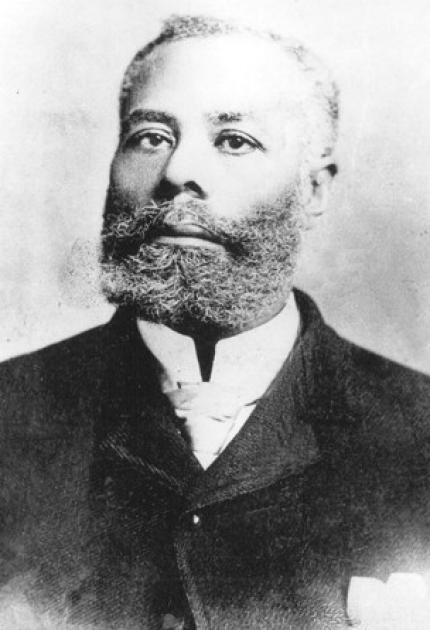
Elijah McCoy
Born on May 2, 1844, in Canada to parents who fled slavery through the Underground Railroad, Elijah McCoy was a pioneer in the railroad industry. His parents, George and Mildred Goins McCoy, escaped from slavery in Kentucky, fleeing to Canada but in 1847 returning to the United States in Michigan, according to Biography.com.
Elijah McCoy was an important inventor in the lubrication sector. (Photo: National Inventors Hall of Fame)
The future innovator possessed a love for mechanics early on, traveling to Scotland at age 15 to become an apprentice as a mechanical engineer. McCoy moved back to the U.S. once he was certified. However, racial boundaries kept him from finding work, as Black Americans were not allowed to hold skilled positions. So, he became a worker for the Michigan Central Railroad.
While the position was greatly beneath McCoy’s qualifications, it was greatly beneficial to him since it’s where he developed the idea for many major inventions like a lubrication cup that dispensed oil evenly throughout an engine’s parts, lengthening the time trains could run without having to stop for maintenance. He obtained a patent for the cup soon after.
McCoy is credited with almost 60 patents, mostly focused on lubrication systems and machinery. Unfortunately, due to a lack of capital, his name was not featured on many of the products he invented. He would often sell patent rights to investors or allow employers to own the rights.
Finally, in 1920, he created the Elijah McCoy Manufacturing Co. where lubrication products sported his name. He died nine years later at the age of 85.
Have a topic you want me to cover? Email me at bjaekel@www.freightwaves.comor follow me on Twitter.
FBX Report: February 02, 2024
To learn more about FreightWaves SONAR, click here.
Meth bust at US-Canada border one of largest in Canadian history
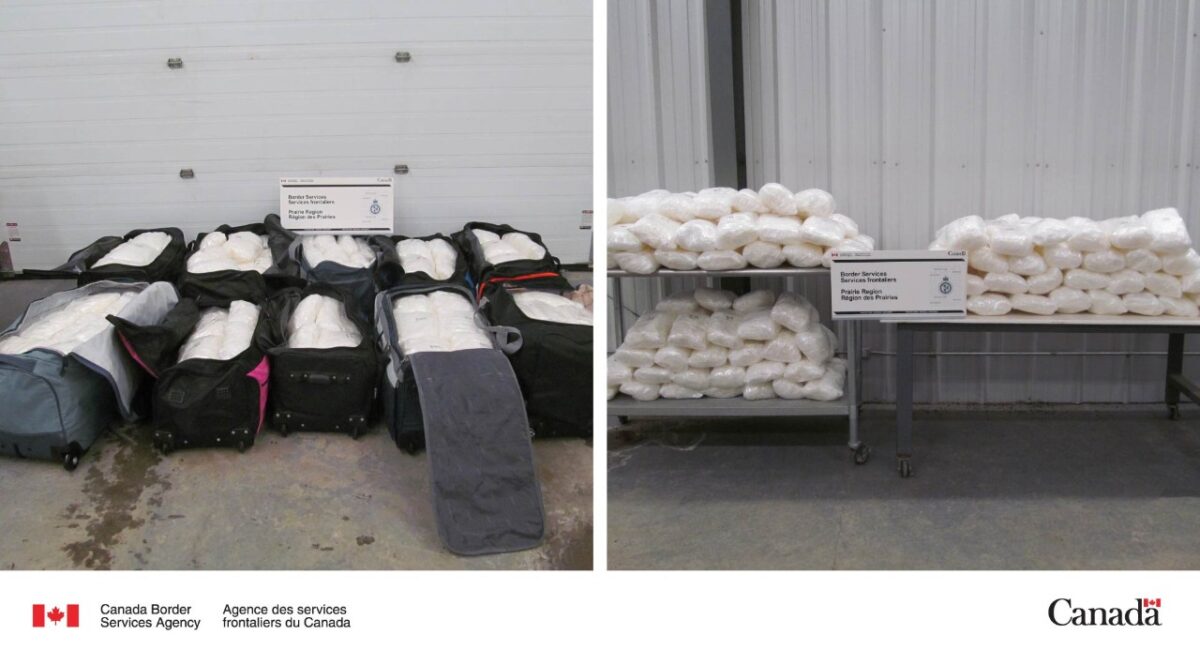
Canadian border officials made what they say is likely the largest narcotics seizure in the history of Canada’s Western provinces, finding 896 pounds of alleged methamphetamine at the Boissevain port of entry in southern Manitoba.
The suspected drugs seized add up to around 4 million doses of methamphetamine, with an estimated street value of more than $50.7 million, according to a news release.
“This is the largest seizure of narcotics our border officers have ever made in the Prairies,” Janalee Bell-Boychuk, regional director general of the Prairie region for the Canada Border Services Agency (CBSA), said in a statement. “Thanks to their quick and decisive action, more than 400 kilograms of methamphetamine were kept off our streets.”
The Canadian Prairies in western Canada consists of the provinces of Alberta, Saskatchewan and Manitoba.
The seizure occurred Jan. 14 and officials announced details of the case on Wednesday. CBSA officers discovered the suspected methamphetamine while checking a truck that was crossing from North Dakota into Canada at the Boissevain port of entry.
The shipment was heading for the city of Winnipeg. Authorities did not provide information on any other type of freight the truck was carrying.
Authorities recently discovered 896 pounds of alleged methamphetamine in a tractor-trailer crossing from North Dakota into Canada. (Photo: CBSA)
The driver has been identified as Komalpreet Sidhu, a 29-year-old man from Winnipeg. He was taken into custody by the Manitoba branch of the Royal Canadian Mounted Police.
Sidhu faces charges of importation of methamphetamine and possession of a controlled substance for the purpose of trafficking.
His arrest follows another case involving Canadian long-haul truckers charged with taking part in a drug ring that smuggled and transported cocaine and methamphetamine from Mexico to California and eventually across the Canadian border.
BLS says fewer truck transportation jobs in ’23 than first estimated
The Bureau of Labor Statistics said back in August that its annual employment model revision was likely to show a large drop in the estimated number of 2023 truck transportation jobs when it came out in February.
On Friday, the agency delivered on that forecast.
On top of that, it sharply revised downward the number of 2023 jobs in warehouses as well.
The key number in the data is that a month ago, when the BLS came out with its regular report on the number of truck transportation jobs, the agency said there were 1,586,300 jobs in that sector in December. When the latest report was released Friday, the revision showed that in December, there actually were 1,553,300 jobs in truck transportation, a drop of 33,000 jobs.
BLS data is subject to revision for two months after it is initially published and then subject to what can be a large revision — like this year — when the February report is published.
Under the first revision, the BLS publishes an estimate of jobs nationally in its hundreds of individual sectors, of which truck transportation is one. That number is then subject to revision for two months after that before it becomes “final.”
But “final” only lasts until a larger revision of the underlying model for calculating jobs totals is implemented in January. Last year, the annual revision showed more people working in truck transportation throughout 2022 than originally estimated.
The revision is sweeping, impacting the job totals for years before 2023 as well, as the agency continues to collect data. But the revisions to 2023 are of a greater magnitude than the shifts a year ago when higher levels were posted for 2022.
For example, the model in use through 2023 showed that the all-time-high level of truck transportation jobs was recorded in January 2023, at 1,611,400. That figure then was reported to have trended down throughout the year until it hit a low for the year at 1,583,000 jobs in November before an upturn in December to 1,586,300 jobs.
But with the revised model, that 2023 low of 1,583,000 jobs under the “old” model would have almost been the highest number for 2023. Under the new model, January 2023 employment in the truck transportation sector was 1,587,000 jobs. But that was 24,400 jobs fewer than originally estimated.
January 2023 no longer is the all-time high in truck transportation. August 2022 is now the new “king” of truck transportation employment, at 1,587,600 jobs, 600 more than the latest revision for January 2023.
The difference between the original 2023 estimates and the revised grew throughout the year. For example, the gap between the original figure for January and the revised figure for January of 24,400 jobs widened to 33,000 jobs by the end of the year.
On a shorter-term basis, truck transportation jobs in January 2024 rose to 1,555,700 jobs from 1,553,300 jobs, an increase of 2,400 from December. The December data and the January figure are both on the same model.
David Spencer, vice president of market intelligence at Arrive Logistics and a regular commenter on the BLS data, said in an email to FreightWaves that there are signs in the new model that a bottom has been reached. August employment in the new model was 1,543,100 jobs, 12,600 fewer than the latest figure for January of 1,555,700 jobs.
“The data appears to be telling the story that trucking employment bottomed in August 2023 and has been back on the rise since,” Spencer wrote. “However, trucking conditions remain challenging and this trend would go against expectation that employment levels should continue to moderate given the current spot rate environment.”
But with a market consensus that the weak trucking market is more a problem of excess supply than of weak demand, Spencer cautioned that the rise in employment the past few months may mean prolonging current conditions. “Carriers may be looking ahead to a potential shift in market conditions and not wanting to miss out on the opportunity when it presents itself, which could lead to a continuation of trucking jobs growth, and potentially result in an extension of the ongoing market conditions that are eroding profits.”
Continued downward move in warehouse jobs
The warehouse model also showed fewer jobs in 2023 than originally reported, after the annual revision the past two years showed a sharp increase. (The report published in February 2022, with revisions for 2021, marked the first time warehouse jobs were reported to exceed truck transportation jobs, a shift that occurred only because of the annual revision.)
For example, the top number under the warehouse model in place throughout 2023 was 1,960,300 jobs in June 2022. Since then, jobs in that sector had fallen almost every month through the end of 2023, with a final figure for last year coming in at 1,851,200 jobs.
But according to the revised model, the highest number of warehouse jobs was 1,942,200 jobs in May 2022, 18,100 jobs fewer than the earlier reported peak of June 2022.
By the end of 2023, warehouse jobs under the revised model were 1,773,500 in December. That is a whopping 77,000 jobs fewer than what was reported under the old model for December 2023 employment.
Rail job numbers higher
One additional key data point: Rail employment data, which has been a focus of some industry critics, benefited from the revisions. In December, rail employment was reported as 150,500 jobs. But the revisions put December employment at 153,000 jobs, falling to 152,600 jobs in January.
Specific trucking sectors
Breakdowns of the truck transportation data by individual types of transportation are on a one-month delay. Mazen Danaf, an economist with Uber Freight (NYSE: UBER), said those numbers show a drop in long-distance drivers and an increase in local freight employment.
“For example, local general freight employment rose 1.3K and local specialized freight employment rose 1.4K in December,” Danaf said in an email to FreightWaves. “These were about 3% to 5% above their year-earlier levels.”
But long-distance truckload was down 900 jobs in December and was down 1.4% year on year. Specialized long-distance freight was down 800 jobs in December, Danaf said.
“The data continues to show gradual capacity correction in the oversupplied long-distance freight sector, which could drive spot rates higher in the coming months, but not as severely as what happened at the onset of COVID, where trucking employment fell 5% overnight,” he added.
Georgia-based trucking company files for bankruptcy
A 25-year-old Georgia-based trucking company, which has 60 drivers and 33 power units, recently filed for bankruptcy protection.
Newsome Trucking of Jasper, Georgia, filed its petition Monday in the U.S. Bankruptcy Court for the Northern District of Georgia.
In its Chapter 11 petition, Newsome Trucking listed its assets and liabilities as between $1 million and $10 million. The company, which seeks to reorganize, states that it has up to 49 creditors and maintains that funds will be available for unsecured creditors once it pays administrative fees.
In its bare-bones petition, the company listed The McPherson Companies Inc. of Trussville, Alabama; Commercial Credit Group of Charlotte, North Carolina; and AutoZone, as creditors, although no amounts were given.
Newsome’s trucks had been inspected 11 times and one had been placed out of service in a 24-month period, resulting in a 9.1% out-of-service rate. This is significantly lower than the industry’s national average of around 22.3%, according to the Federal Motor Carrier Safety Administration’s SAFER website.
Newsome’s drivers had been inspected 29 times over the same 24-month period with no drivers being placed out of service. The national average is around 6.7%, according to FMCSA data. In the past two years, the company’s trucks had been involved in six towaways.
The bankruptcy petition lists Kevin Newsome as president of Newsome Trucking, which hauls general freight. He also owns KRN Logistics, also of Jasper, which has 15 power units and 15 truck drivers. The logistics arm is not part of the Chapter 11 bankruptcy filing.
Newsome’s attorney, Paul Marr, did not respond to FreightWaves’ request for comment as of publication.
According to FMCSA data, Newsome Trucking’s common carrier authority was granted in April 2012 and its contract carrier authority was granted in September 1999. The company’s Bodily Injury Property Damage Coverage (BIPD) insurance is slated to be canceled on Feb. 29.
A creditor’s meeting is scheduled for Feb. 23.
Do you have a news tip to share? Send me an email or message me @cage_writer on X, formerly known as Twitter. Your name will not be used without your permission.