Common traits of the best-performing fleets – Taking the Hire Road
On this week’s episode of Taking the Hire Road, host Jeremy Reymer was joined by KSM Transport Advisors Chief Operating Officer Chris Henry. The pair discussed how companies can best navigate turbulent times based on KSMTA’s “12 Traits of Highly Profitable Trucking Companies” series.
Henry is no stranger to figuring out what makes a trucking company successful. He has spent 25 years in the transportation industry, with much of that time spent focusing on operational and profitability benchmarking.
Before joining KSM, Henry created the carrier benchmarking service StakUp. During his time with StakUp, he often referred clients to KSM to look deeper into any opportunities for improvement uncovered during the benchmarking process.
“When I was doing benchmarking, we were able to go a mile wide and an inch deep. There were a number of different statistics, but they only went so far down,” Henry said. “KSM helped them go a mile deep.”
The information carriers gleaned from the combined efforts of StakUp and KSM — in addition to the willingness to make changes — was often enough to help them become some of the most successful and profitable companies in the industry.
Even the most successful carriers have struggled during the ongoing freight recession, however.
“We have some very smart operators within our client base that have been around for decades, and a number of them have said this is worse than the Great Recession because of the lack of clarity and how quickly things swung from awesome to terrible,” Henry said.
The current freight environment is not conducive to easy success, making it more important than ever for dedicated carriers to embrace the characteristics and best practices proven to increase profitability.
KSMTA laid out 12 of the most important traits of highly profitable trucking companies in a series of recent blog posts. Of those 12 traits, Henry pinpointed two as being the most important: transparency and humble leadership.
When trucking companies commit to having transparent and open conversations with their drivers and their peers, it creates an atmosphere of openness and collaboration. That atmosphere must then be nurtured by a team of humble and approachable leaders.
Carriers can read about all 12 traits on the KSMTA blog today. The organization will publish a new series of posts aimed at helping trucking companies embrace each of those traits themselves throughout 2024.
Other highlights from this episode of Taking the Hire Road
Red Sea-driven surge in container shipping rates loses momentum
Mass diversions of container ships around Africa’s Cape of Good Hope caused spot rates to surge, but the Red Sea effect has a limit, which may have already been reached.
Upward momentum has slackened. Rates in most lanes have leveled off. Several indexes for European lanes have pulled back.
The Shanghai Containerized Freight Index (SCFI) dropped 2.7% in the week ending Friday versus the prior week, the first weekly drop since late November.
Location of container ships with capacity of 10,000 twenty-foot equivalent units or more as of Friday. (Map: MarineTraffic)
“The squeeze in freight rates into Europe continues to abate from high levels, though freight rates in other regions remain firm,” said Jefferies shipping analyst Omar Nokta on Friday.
The rate dynamic now is very different than in the pandemic boom. The 2020-2022 supply chain crisis was driven by demand, as consumers bought more goods amid the pandemic. The current rate surge is driven by supply.
Liner diversions around the Cape of Good Hope extend voyage time, tying up ship and container equipment supply. But as liners adjust schedules to the longer routes, rates should theoretically stop rising, barring higher demand.
Container lines are taking delivery of a record number of new ships this year, which should give them the added vessel supply to handle longer routes. Furthermore, the Chinese New Year holiday in early February should temporarily limit vessel demand, easing the squeeze.
‘Breathing room’ ahead
Lars Jensen, CEO of consultancy Vespucci Maritime, wrote in an online post: “Once we get past Chinese New Year, not only will demand drop and give some breathing room, [but] we will also begin to see vessels and equipment flows settle into a predictable pattern on their new round-Africa routings.
“This will still mean rates are much higher than pre-crisis levels, because the longer routes will soak up large amounts of capacity and carry extra cost, but I expect the spike in spot rates to abate somewhat. Contract rates, on the other hand, are likely to increase as it appears we might be settling into a round-Africa [pattern] for the foreseeable future.”
The effect on the contract market appears in the China Containerized Freight Index (CCFI), which also includes contract rates, unlike the SCFI. While the SCFI pulled back this week, the CCFI rose 9%.
Platts indexes
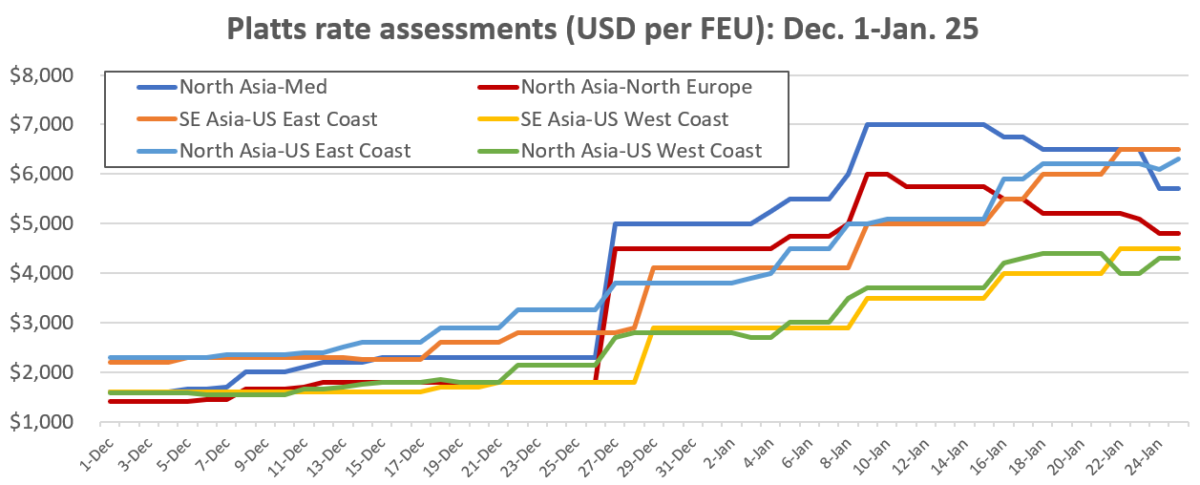
On the spot rate side, assessments from Platts, a division of S&P Global (NYSE: SPGI), imply a peak has been reached.
Platts put Thursday’s North Asia-Mediterranean spot rates at $5,700 per forty-foot equivalent unit, down 19% from the high reached on Jan. 9-15. Its North Asia-North Europe assessment, at $4,800 per FEU, was down 20% from the Jan. 9-10 high.
In contrast, rates still remain at their highest level in U.S. import lanes, although gains have slowed.
Platts put Southeast Asia-U.S. East Coast rates on Thursday at $6,500 per FEU, up 195% from Dec. 1; North Asia-U.S. East Coast rates at $6,300 per FEU, up 174%; Southeast Asia-U.S. West Coast rates at $4,500 per FEU, up 181%; and Southeast Asia-U.S. East Coast rates at $4,300, up 173%.
(Chart: FreightWaves based on data from Platts)
Drewry WCI indexes
The Drewry World Container Index (WCI) shows rates still rising, albeit at a much slower pace in European markets.
The WCI global index for the week ending Thursday increased 5% versus the prior week. The index for Shanghai to Rotterdam, Netherlands, came in at $4,984 per FEU, up only 1% week on week (w/w). Spot rates for Shanghai to Genoa, Italy, averaged $6,365 per FEU, also up 1% w/w.
In contrast, the WCI Shanghai-Los Angeles index shot up 13% w/w, to $4,344 per FEU, and the Shanghai-New York assessment rose 9% w/w, to $6,143 per FEU.
Spot rates in USD per FEU. Blue line: global composite. Purple line: Shanghai-Genoa. Orange line: Shanghai-New York. Yellow line: Shanghai-Rotterdam. Green line: Shanghai-Los Angeles. (Chart: FreightWaves SONAR)
FBX indexes
The Freightos Baltic Daily Index (FBX) global composite was at $3,409 per FEU on Thursday, flat since Monday.
The FBX China-Mediterranean rate was $6,403 per FEU, 8% below the high hit on Jan. 18. The China-North Europe rate was $5,366 per FEU, down 7% versus Jan. 18.
The FBX China-East Coast rate was still at its highest level of the Red Sea crisis period, at $6,142 per FEU, flat since Monday but up 143% since Dec. 1.
The FBX China-West Coast rate is still rising and is also at its highest level, at $4,198 per FEU on Thursday, up 169% since Dec. 1.
Spot rates in USD per FEU. Blue line: global composite. Purple line: China-Mediterranean. Orange line: China-U.S. East Coast. Yellow line: China-North Europe. Green line: China-U.S. West Coast. (Chart: FreightWaves SONAR)
Bison Transport partners with CPKC to provide international intermodal service
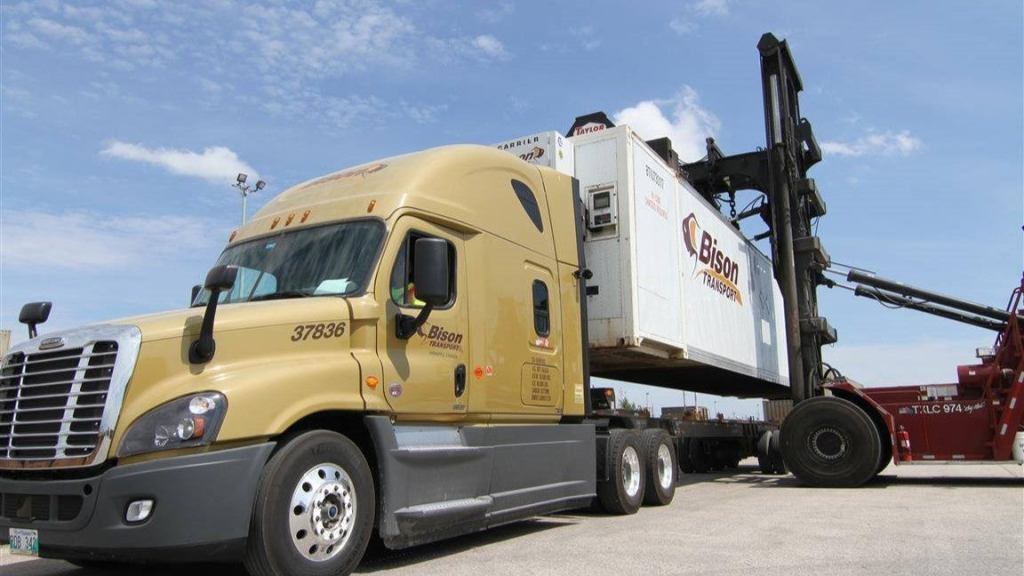
With global shippers seeking more routing options, Bison Transport recently announced an agreement with Canadian Pacific Kansas City (CPKC) to deliver intermodal transportation services across North America.
The partnership will utilize the railway’s north-south corridor connecting Canada, the U.S. and Mexico, and Winnipeg, Canada-based Bison Transport’s 3,000 tractors and 10,000 trailers.
“Bison Transport and CPKC have a long history of successfully serving and rapidly growing our customer base in Canada, and we look forward to expanding that intermodal growth in the U.S. and Mexico,” Rob Penner, Bison Transport’s president and CEO, said in a news release. “With Bison’s established operations in Mexico and our commitment to growth of cross-border freight services in that market, the timing of this agreement is ideal.”
Founded in 1969, Bison Transport is one of the largest carriers in Canada. The company has over 4,000 drivers and offers truckload, less-than-truckload, dedicated, logistics, intermodal, yard management and warehousing and distribution services.
Officials for CPKC (NYSE: CP) said the deal with Bison Transport boosts the company’s goal of connecting North American markets with single-line, expedited intermodal freight transportation service. CPKC has 17 intermodal facilities across North America.
“This agreement between CPKC and Bison Transport will generate multiple synergies for customers as they benefit from reliable capacity and industry leading service,” Jonathan Wahba, CPKC senior vice president of sales and marketing, bulk and intermodal, said in a statement.
The agreement with Bison Transport is one of the latest developments between CPKC and carriers, as the company seeks to gain more market share through more intermodal offerings.
In May, the railway began offering a daily premium intermodal service running between the U.S. Midwest and Mexico, called the Mexico Midwest Express.
In April, CPKC also secured agreements with carriers Schneider (NYSE: SNDR) and Knight-Swift (NYSE: KNX) for intermodal services between Canada, the U.S. and Mexico.
Schneider will serve as a strategic carrier on the intermodal line that connects Chicago to major ports and regions in Mexico, while Knight-Swift is providing truckload capacity for a Mexico-to-Chicago cross-border train.
Texas trucking company files for bankruptcy days before wrongful death trial
A Texas-based trucking company has filed for bankruptcy liquidation four days before a wrongful death civil trial filed by the family of one of its former drivers who drowned in 2016 was slated to start in El Paso County, Texas.
J.J. & Sons Logistics, doing business as JJ Transport, of Clint, Texas, filed its petition Monday in the U.S. Bankruptcy Court for the Western District of Texas.
In its Chapter 7 petition, JJ Transport listed its assets as up to $500,000 and liabilities as between $100 million and $500 million. The shuttered company states that it has up to 49 creditors and maintains that funds will be available for unsecured creditors once it pays administrative fees.
JJ Transport once had 19 drivers and 18 power units prior to filing for bankruptcy. In its bare-bones petition, the company listed Fleetone Factoring LLC of Antioch, Tennessee; Auxillior Capital Partners of Plymouth Meeting, Pennsylvania; and Wells Fargo Bank of Des Moines, Iowa, as creditors, although no amounts were given.
Its trucks had been inspected 27 times and two had been placed out of service in a 24-month period, resulting in a 7.4% out-of-service rate. This is lower than the industry’s national average of around 22.3%, according to the Federal Motor Carrier Safety Administration’s SAFER website.
JJ Transport’s drivers had been inspected 53 times over the same 24-month period and one driver was placed out of service, resulting in a 1.9% out-of-service rate. This is lower than the national average of around 6.7%, according to FMCSA data. In the past two years, the company’s trucks had been involved in five crashes, including two injuries and three towaways.
The bankruptcy petition lists Juan Jose Murillo as president of JJ Transport. His attorney, Carlos Miranda, did not respond to FreightWaves’ request for comment as of publication.
The petition also lists the estate of Pedro Rascon Morales as a creditor in its bankruptcy petition.
Wrongful death lawsuit
According to court documents, Morales, 61, drowned in his tractor-trailer on April 18, 2016, in Harris County, Texas, while employed by Murillo and his wife, Esmeralda Murillo, who worked as the company’s operations manager.
On April 17, 2016, Morales was dispatched to deliver a load from El Paso County to Harris County, which was experiencing record flooding. Court documents allege that hours before his death, Morales checked in with Esmeralda Murrillo, who “failed to discontinue [Morales’] trip.
Morales drove his tractor-trailer into an overpass locally known as “The Pit,” where water quickly began to submerge his vehicle. Despite attempts by good Samaritans to save Morales as water rose to depths of over 20 feet, he became trapped and drowned in his cab, according to court records.
A special setting jury trial was slated to start Friday in El Paso County, however, it was canceled after the bankruptcy petition was filed in federal court.
The wrongful death lawsuit, which sought damages of more than $1 million, was filed in December 2017 by Morales’ wife, Maria Socorro Morales; his son, Elias Morales; and his daughter, Dora Hunnicutt. A trial date in the case has been rescheduled multiple times prior to JJ Transport’s bankruptcy filing.
A creditor’s meeting is scheduled for Feb. 26.
Do you have a news tip to share? Send me an email or message me @cage_writer on X, formerly known as Twitter. Your name will not be used without your permission.
Startup electric truck infrastructure developer WattEV won’t say how much money it has raised from investors. But its stunning accumulation of grant money is a bigger story.
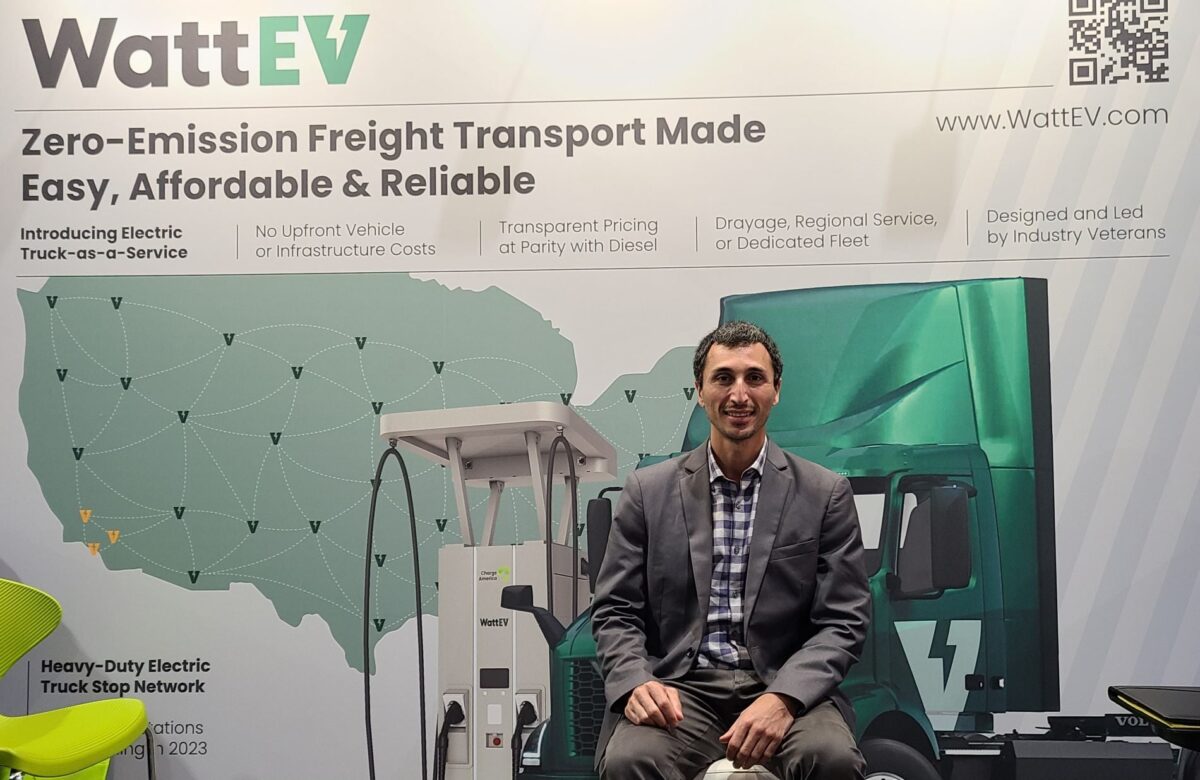
“It’s one of the things that definitely sets us apart,” co-founder and CEO Salim Youssefzadeh told me about his private company’s grant hoard.
WattEV took in the largest chunk of $623 million — nearly 15% — the Federal Highway Administration awarded to 47 electric vehicle (EV) charging and alternative-fueling infrastructure projects in 22 states and Puerto Rico. The money comes from $2.5 billion allocated under the Bipartisan Infrastructure Law.
$109M from federal programs
The $75.6 million haul by Long Beach, California-based WattEV’s brings to $109 million from federal programs,. That includes $34 million to build and operate what is expected to be the nation’s largest electric charging depot on more than 100 acres south of Sacramento International Airport on Interstate 5 that runs from San Diego to Seattle.
Tens of millions more has come in from state and local grants.
WattEV co-founder Salim Youssefzadeh says grant funding follows his startup’s progress in electrification infrastructure. (Photo: Alan Adler/FreightWaves)
“WattEV isn’t just talk. It’s execution,” Youssefzadeh said. “We’ve got sites in development coming online in the next two months. “When grant organizations are [deciding] who to give funds to, do they give funds to a company that’s just talking about building corridors or do they give funds to a company that’s actually building corridors?”
WattEV has outside investment but how much is a mystery
Practically since its public introduction at the Advanced Clean Transportation Expo in 2022, WattEV has pushed out talk of investors and when it would move to a Series A round of financing from its mostly family-and-friends-funded seed round.
“We got the Series A we closed,” Youssefzadeh said. “We announced that in November with Vitol and Apollo. These are two major infrastructure banks and infrastructure providers. They provided a good amount of capital both on the equity side as well as financing for infrastructure.”
The Nov. 9 news release stood out more for what it didn’t say than what it did. Vitol talked about owning 1.2 gigawatts (GW) operational renewable generation capacity and committing more than $2.2 billion to renewable and sustainable investments.
Apollo pointed to launching its sustainable investing platform in 2022, targeting $50 billion in clean energy and climate capital by 2027 with an eye toward doling out $100 billion by 2030.
Neither Vitol nor Apollo said how much they invested in or loaned to WattEV.
Infrastructure incentives aren’t forever
The availability of incentives for large fleets to purchase electric trucks becomes more scarce — at least in California — in 2025. That comes as the state refocuses on helping smaller fleets and owner-operators afford equipment that costs two to three times as much as a diesel tractor.
“Eventually, it will dry up, and how soon that happens will probably depend a lot on what happens in [the presidential election] November,” Sam Abuelsamid, principal analyst at Guidehouse Insights, told me. “At some point, they will stop subsidizing the installation of infrastructure and it will have to become self-sustaining.”
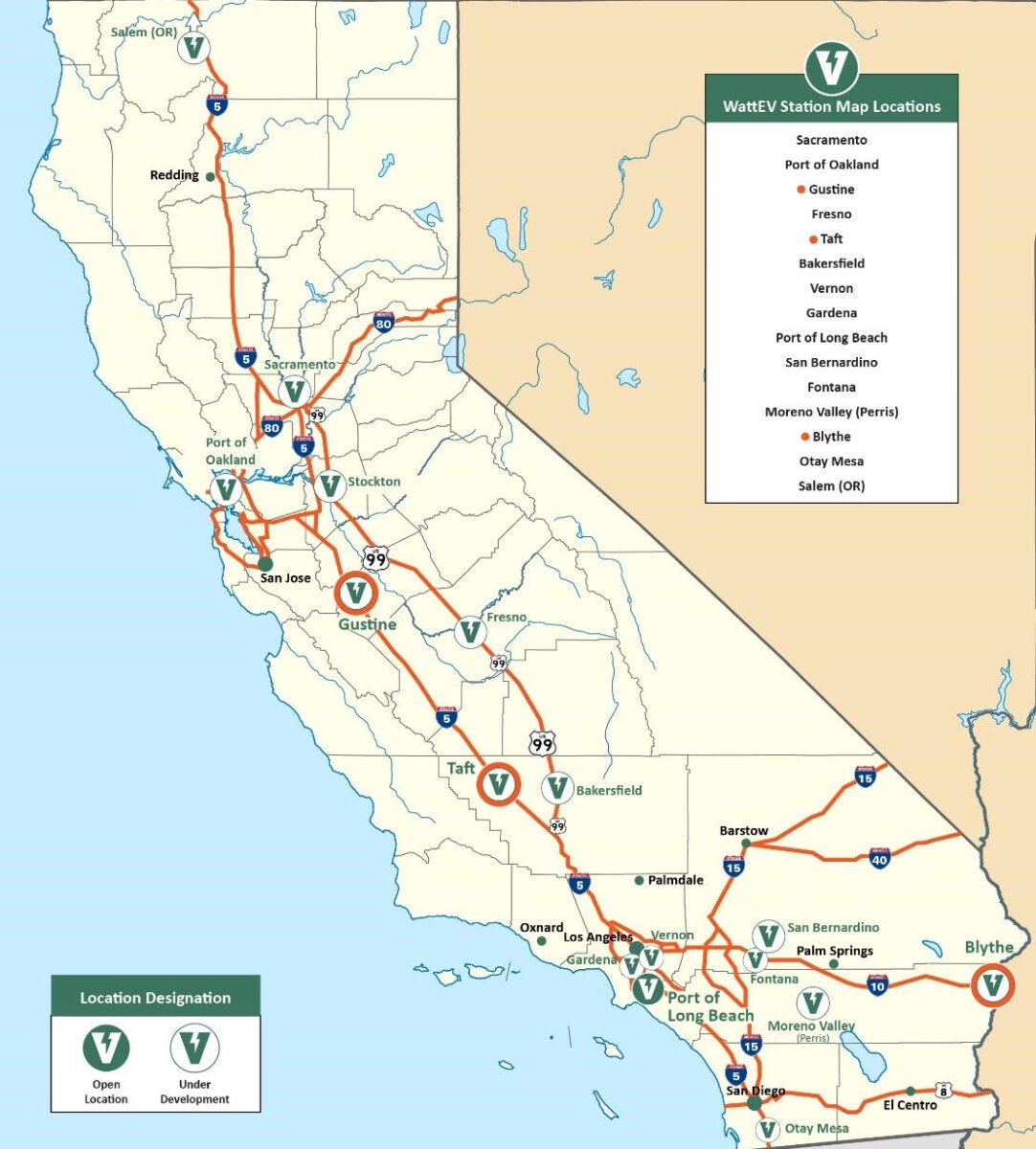
But for now, WattEV is able to attract money for its ambitious buildout plans. So far, that consists of a medium- and heavy-duty charging depot operating at the Port of Long Beach. Depots in San Bernardino in the Inland Empire, Gardenia and Bakersfield come online soon,
The FHWA money included $56 million awarded to WattEV and the San Joaquin Valley Air Pollution Control District. It was the largest of 10 awards to California. The City of Blythe in Riverside County shared a second grant of $19.6 million for a charging depot on I-10, which covers 2,640 miles and eight states from California to Florida.
WattEV has plans to build north-south and east-west electric truck charging corridors along Interstates 5 and 10. (Illustration: WattEV)
Is Megawatt charging premature?
WattEV’s site in Bakersfield will be its first to offer a megawatt charging system. That’s a power level only the purpose-built Tesla Semi comes close to being able to use.
Youssefzadeh defends the decision to go big now. The 1.2 MW power cabinets being installed can split the wattage among five trucks at one time. Charging rates range between 60 kilowatt hours (kWh) to 240 kWh at five dispensers. One dispenser is reserved for MW charging.
“We’re putting in technology that is future proof,” he said. “You can charge current technology trucks with CCS [combined charging system] and have the ability to charge with MW charging when those trucks are on the road.”
Unlike current chargers that, for example, split a 350kWh load between two vehicles, WattEV is pushing dynamic charging.
“We’ve had an opportunity to charge almost all of the [electric] truck manufacturers out there,” Youssefzadeh said. “There’s pros and cons to all of them. Some charge faster than others. Some have a little more range but at the expense of [battery] weight. It’s really about finding the use case that works best for them.”
Judge to TuSimple: Not so fast
Autonomous trucking developer TuSimple wants to get out of Dodge. That includes selling its trucks and office furniture and taking its $777 million cash pile to its China-based operations in Shanghai. A federal judge in San Diego this week told the company to hold its horses.
U.S. District Court Judge Roger Benitez granted a temporary restraining order sought by shareholders. They alleged TuSimple co-founders Xiaodi Hou and Mo Chen, along with CEO Cheng Lu and Sina Corp. Chairman Guowei “Charles” Chao, are trying to get around national security laws by taking TuSimple private.
Allegations about a lack of transparency about TuSimple providing services to Hydron kicked off a nasty boardroom battle in 2022. Results included Hou’s ouster as CEO followed by the firing of independent directors by Chen 10 days later.
TuSimple’s winddown of its U.S. business effectively began with the layoff of 350 U.S. employees in December 2022. Another 300 were furloughed in May followed by 150 more in December. TuSimple said Jan. 17 it would delist its stock from the Nasdaq.
The shareholders argued in a hearing Monday that Hydron’s announcement that its trucks were “autonomous ready” just 20 months after its March 2021 founding suggested Hydron used TuSimple’s trade secrets. TuSimple took seven years to perfect its robot driving system it piloted on an 80-mile run in December 2021.
A federal judge temporarily barred TuSimple from selling off its trucks and office furniture as it exits the U.S. to focus on autonomous truck operations in China. (Photo: Alan Adler/FreightWaves)
Briefly noted:
A report in TechCrunch says Aurora Innovation laid off dozens of workers amounting to 3% of its 1,800-person workforce at the beginning of the year.
The $9 trillion asset management company BlackRock Inc. now holds 8.1% of the stock in engine maker and power distribution provider Cummins Inc.
Prime Mover magazine reports that Bill Hall, featured here as one of Nikola’s early purchasers of its fuel cell truck, completed a 400-mile run on a single tank of hydrogen.
FedEx restores service guarantees on 2nd-day air morning service
FedEx Corp. (NYSE: FDX), following rival UPS Inc.’s lead from earlier this week, said Friday that it will restore money-back guarantees for its second-day morning air service in the domestic U.S.
UPS (NYSE: UPS) said on Wednesday that it would reinstate refunds for its second-day morning service, which calls for packages and documents to be delivered by 10:30 a.m. on the second day. FedEx’s actions follow suit.
The carriers did away with all money-back guarantees — known in the parcel-delivery trade as guaranteed service refunds — when the pandemic hit the U.S. in the spring of 2020. Both eventually restored the refund feature for their various next-day air delivery products. Refunds remain suspended for the carriers’ respective ground services.
Josh Taylor, senior director of professional services for consultancy Shipware LLC, said the moves are unlikely to signal a return of broader money-back guarantees from the carriers. Second-day air morning services are used infrequently, so there is little downside risk for the carriers to reinstate them, especially when it sends a favorable message to the slice of the shipping public that does use those services, Taylor said.
At UPS, because the scheduled delivery times for second-day air is earlier in the day, those shipments are loaded into the same package cars that deliver next-day air service, which is already guaranteed, Taylor said.
The moves by the carriers generate favorable publicity, without them making any operational changes or taking any risks, Taylor said.
The views expressed here are solely those of the author and do not necessarily represent the views of FreightWaves or its affiliates.
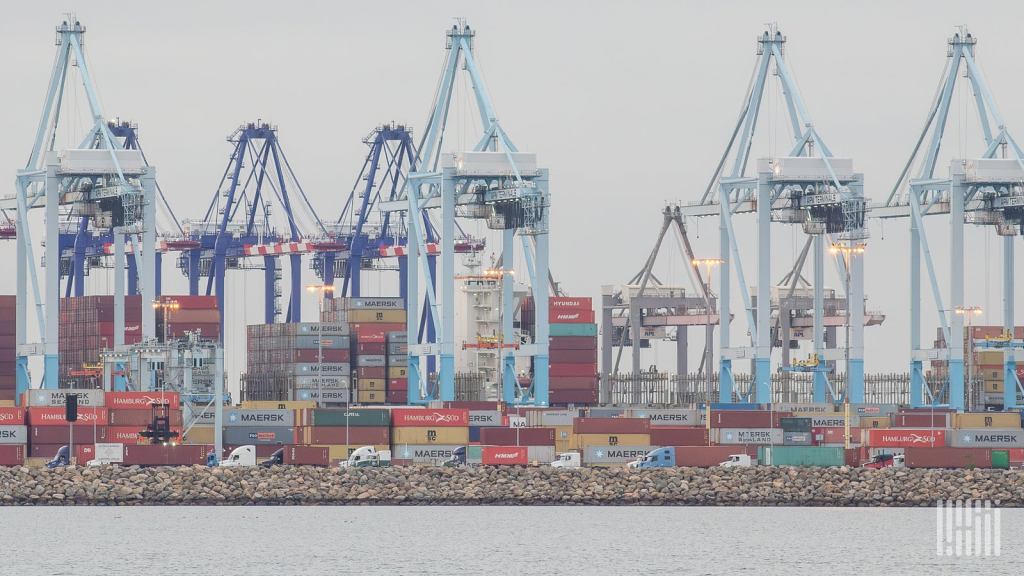
The bustling ports of Los Angeles and Long Beach, California, gateways to the American consumer market, have become notorious for chronic congestion. But in January 2024, the logjam will reach a new level, threatening to send ripples through the entire U.S. economy.
This month’s ITS Logistics U.S. Port/Rail Ramp Freight Index reveals a jump in trans-Pacific volumes amid restocking for Lunar New Year, a major holiday for many East Asian countries. This is likely to collide with expected congestion at East Coast ports in the U.S. Rerouted lanes from Asia to the U.S. East Coast will see additional cost and transit-time pressure that will continue to push volumes to trans-Pacific trade lanes.
The current Lunar New Year restock is paired with diverted volumes that are a direct result of shippers’ efforts to avoid the crisis in and around the Suez Canal. As a result, underutilized West Coast ports are expected to become stressed, especially in the Los Angeles and Long Beach terminals.
Several factors on a global scale converged to create this perfect storm of congestion, the first being Lunar New Year, Feb. 10-24. It creates a confluence of the festive season plus restocking for the year ahead in China, which leads to a massive influx of containers. During the Lunar New Year celebrations, almost all factories and manufacturers in China halt their processes, ports limit their operations, and workers are unavailable, disrupting the entire supply chain and logistical operations.
Ongoing difficulties in attracting and retaining dockworkers further hampers the pace of unloading and container handling. Limited yard space and outdated technology slow the movement of goods, and disruptions in other global ports due to events like the ongoing war in Ukraine are adding to the pressure on West Coast infrastructure.
The consequences of this congestion are impacting businesses and consumers alike. Delayed shipments can lead to empty shelves and shortages of various goods, from electronics to furniture to household essentials. This can hurt businesses’ sales and frustrate consumers facing limited choices. Increased shipping costs and delays trickle down to consumers in the form of higher prices on store shelves.
Additional costs incurred by businesses due to disruptions can also impact long-term profitability. The overall slowdown in the movement of goods can have a negative impact on the U.S. economy, potentially affecting gross domestic product growth and employment rates.
Businesses and consumers alike need to brace themselves for the challenges ahead. But as in many other challenges, technology can play a key role.
Investing in real-time tracking tools and building strong relationships with logistics providers can give businesses greater control over inventory and the ability to proactively manage delays. Companies should leverage their visibility and traceability data for better inventory management. They should analyze past customer behaviors and historical order patterns during the Lunar New Year season. It will help to better guide inventory planning, anticipate demand and ensure extra inventory to cater to your customers in case of shipping delays. Relying on a wider range of suppliers and exploring alternative shipping routes can mitigate the impact of disruptions at any single port or geographic region. Modeling and simulation tools based on real-time data can help improve the network, resulting in less disruption.
The current situation at the West Coast ports — and many other ports for that matter — serves as a stark reminder of the fragility of global supply chains and the interconnectedness of the global economy. By recognizing the challenges, adapting strategies and investing in long-term technology solutions, businesses and consumers can navigate the choppy waters ahead and ensure a more resilient and efficient flow of goods in the future.
Look for more articles from me every week on FreightWaves.com.
About the author
Bart De Muynck is an industry thought leader with over 30 years of supply chain and logistics experience. He has worked for major international companies, including EY, GE Capital, Penske Logistics and PepsiCo, as well as several tech companies. He also spent eight years as a vice president of research at Gartner and, most recently, served as chief industry officer at project44. He is a member of the Forbes Technology Council and CSCMP’s Executive Inner Circle.
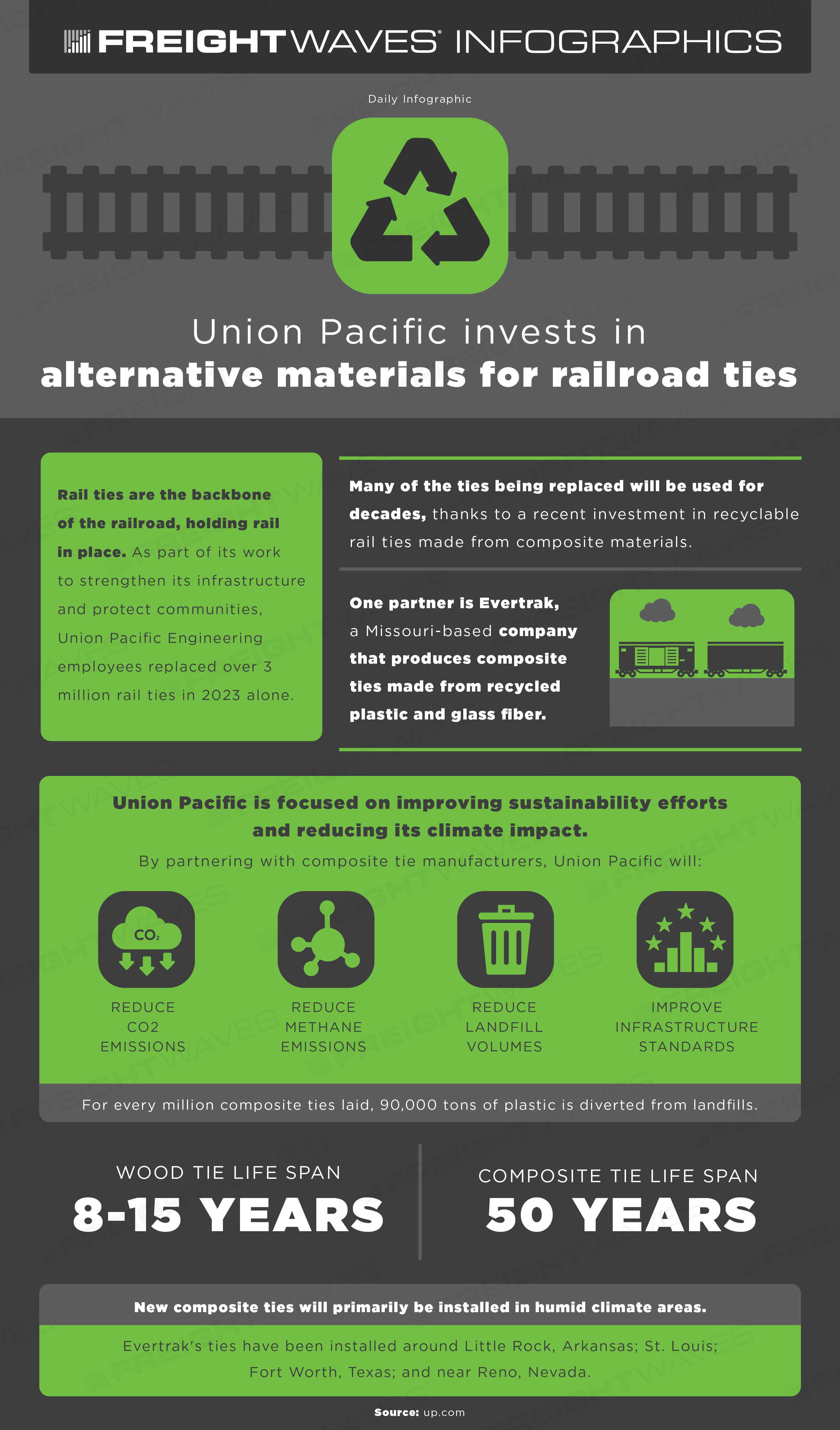
Daily Infographic: Union Pacific invests in alternative materials for railroad ties
To view more FreightWaves infographics, click here
Love’s: Restraint in new travel centers/truck parking in ’24, but larger growth plans
Coming off a year in which it made several significant acquisitions even as its growth in new travel centers slowed somewhat, Love’s has an aggressive plan for 2024 that might include new growth in its factoring business.
In a news conference earlier this week, Love’s President Shane Wharton said the company’s plans to open about 20 to 25 new locations in 2024, which will result in about 1,500 to 2,000 new truck parking spots. Wharton said that number means the company is closing in on 50,000 parking spots through its network of 640 locations in 42 states.
Wharton said the most significant acquisition the company made in 2023 was its purchase of TVC Pro-Driver. In the October prepared statement announcing the acquisition, TVC Pro-Driver was described as a CDL “protection subscription service … assisting individual drivers and fleets in reducing or dismissing fines, preventing downtime for court and protecting compliance safety and accountability (CSA) scores.”
“Obviously, if they don’t have a CDL they don’t have a job,” Wharton said. He described a situation where TVC would get involved: a driver gets a ticket in the Chicago area, But he’s based near Los Angeles. TVC has a network of attorneys ACROSS the country set up to handle that issue.
“It may be hard for the driver to physically to get to Chicago, so TVC can handle that for them, and help manage the amount of points that ends up on their CDL record,” Wharton said.
One area where Love’s did not make an acquisition in 2023 was in its factoring arm, Love’s Financial.
“We wanted to but we just didn’t see the right opportunities,” Wharton said of sitting pat with its existing factoring business.
But Wharton suggested that growth in factoring is still on the Love’s agenda. “We’re thinking we may see the right opportunities this year,” he said.
Echoing what so many others in the factoring industry have said, Wharton described the business as “fragmented.” If Love’s is going to stay and grow in the business, Wharton said, “we want to be the best in class and we want it to be large so that we can offer a good value proposition to our customers. We intend to grow that business and be one of the top players.”
While most of Love’s growth in its network of stores has been organic, it did make a niche-driven acquisition in April when it bought EZ GO from Carey Johnson Oil Co. It was a niche purchase because EZ GO has six travel stops on Oklahoma turnpikes and five on the Kansas Turnpike, as well as other convenience stores in Oklahoma and Nebraska.
Interstate highways do not have travel stops except for those sections that would also be considered state turnpikes. The restriction on commercial operations on the interstate highways that don’t fall under that exception goes back to the beginning of the interstate highway system and generally is considered sacrosanct by the truck stop industry.
“We’ve seen really good results from that,” Wharton said of the EZ GO acquisition, noting that Love’s previously had no presence on state turnpikes. “So we’re looking at other opportunities and other states specific to turnpike systems because those come up for bid every so often. We’re going to keep our eyes open for that.”
Love’s growth in parking spots in 2024 will be on the low side compared to recent years. For several years, Love’s has put out press releases at the beginning of the year, previewing its expansion plans. Every press release between 2018 and 2022 projected 3,000 new parking spots. Love’s preview for 2023 didn’t mention the number of new parking spots planned for that year, but its projection of 25 new travel centers last year was less than in earlier years — which frequently came in at close to 35. Last year’s openings resulted in about 2,000 new parking spots, a Love’s spokeswoman told FreightWaves earlier this month.
Love’s, which does not charge for its parking, wrapped up 2023 by opening four new sites in about a week’s time — Salinas, California; Michigan City, Indiana; Nicholson, Mississippi; and Watertown, New York. That added 377 parking spots.
“Whenever we’re evaluating a site, we’re obviously looking at what the traffic is in that particular lane,” Wharton said of the challenges of finding new locations for travel centers and by extension new spots for parking. “But many times, getting that perfect piece of real estate for a travel stop doesn’t exist. It’s hard to find real estate to build a travel stop on.”
The number of new parking spots “is going to correlate, as you would expect it would, to the number of new locations we opened,” he added.
He said Love’s also has gone to older existing sites where there was available land for expansion and added spots. “As you might imagine, that’s harder to do,” Wharton said. But he said in the last year, “we were able to do a little more of that. But there’s only so much we can do.”
Wharton also reviewed an ambitious plan for renovation of 35 to 40 stores and a total rebuild of four others.
In 2023, Love’s was the only one of the big three travel center companies that didn’t go through an acquisition, and the two sales that did take place didn’t come without controversy.
Pilot Travel Centers became majority-owned by Berkshire Hathaway (NYSE: BRK.B) in January 2023. The founding Haslam family was set to exercise its option to have Berkshire buy the last 20% it didn’t own this month, but a dispute over accounting practices resulted in competing lawsuits. The dispute was settled just before a trial was to begin earlier this month in Delaware Chancery Court. The sale of the 20% then proceeded.
Travel Centers of America was a publicly traded company that BP announced it was acquiring in February. Convenience store operator Arko (NASDAQ: ARKO) launched an effort to acquire TA for a price that on the surface appeared to be worth more than the BP (NYSE: BP) offer. But the TA board ultimately stuck with the BP bid and that sale was completed in May.
That Love’s had an uneventful year in its ownership was noted early in Wharton’s presentation. “We think it makes a difference in how we run our business and how we take care of our customers,” he said, ticking off various second- and now-third-generation members of the Love family still involved in the company.
But there was change even for Love’s in 2023: founder Tom Love died at age 85 in March. He died one year before Love’s is celebrating 60 years in business.
The surprising reasons why truck drivers wait hours unpaid
Mike Nichols, a truck driver based in Wisconsin, is probably one of the lucky ones. Unlike many of America’s 2.2 million truck drivers, he doesn’t waste hours of his week waiting to be loaded or unloaded.
“My customers and their customers are excited to see me,” said Nichols, who mostly hauls agricultural loads rather than trailers full of, say, Amazon orders, groceries or furniture. “It’s amazing how stark the difference is between how they treat bulk carriers versus the way most treat the outbound box trailers.”
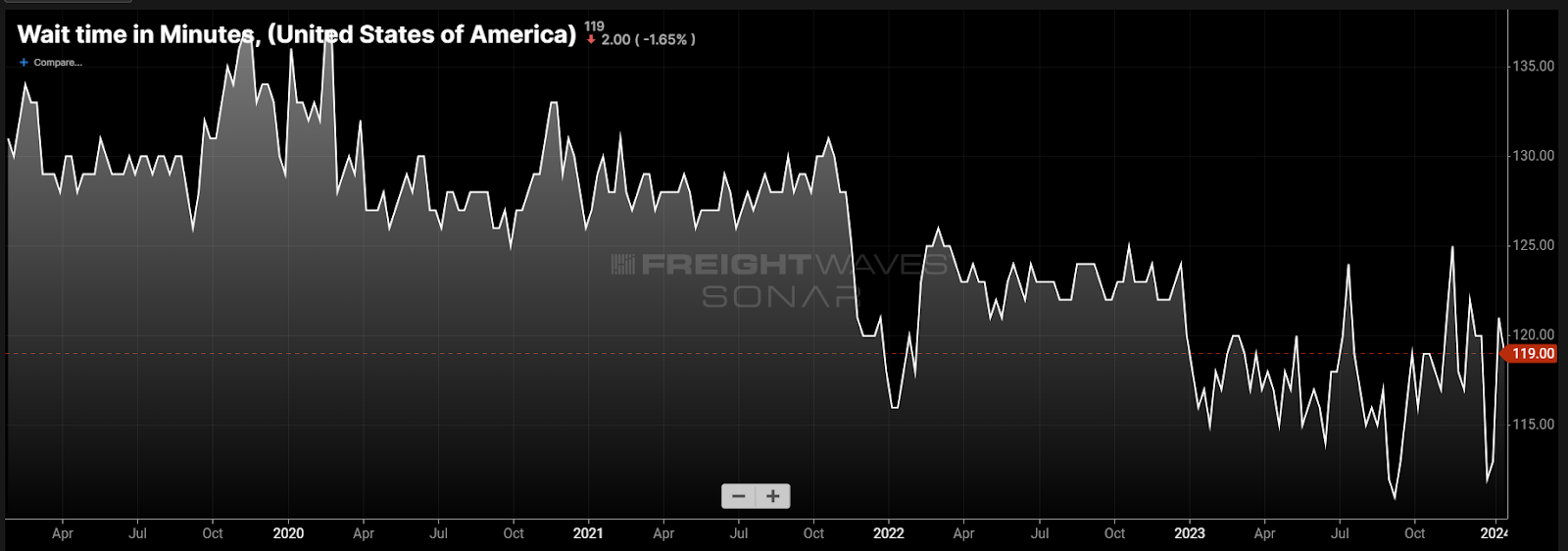
Detention time, as it’s called, is a bizarre feature of being a trucker. Few outside of trucking know about this aggravating waste of time. Per FreightWaves SONAR data, truck drivers spend an average of 119 minutes per pickup or drop-off waiting to be loaded or unloaded. Drivers are expected to wait for free during the first two hours of detention, and then receive hourly pay for any additional hour.
Truck drivers wait nearly two hours on average at loading docks, per FreightWaves SONAR data. (FreightWaves SONAR)
If that seems absurdly inefficient, it is. A 2018 study from the U.S. Department of Transportation’s Office of Inspector General found that truck drivers lose $1.1 billion to $1.3 billion in earnings because of detention time. What’s more, each 15-minute increase in detention increases the average expected crash rate by 6.2%. Detention isn’t just frustrating for drivers; it’s potentially dangerous.
“This becomes a safety issue,” said Isaias Sanchez, a truck driver based in Murfreesboro, Tennessee. “Truckers are always in a hurry to get back on the road and that can lead to accidents.”
So, I chatted with two former executives from the food and beverage world to learn more — Rob Haddock and Ben Richey. They’re the guys who used to get calls from truck drivers asking why on earth they can’t get out of their warehouses more quickly. The reasons boil down to this:
Warehouses need to hire more workers.
Warehouses are extremely out of date.
Big brands aren’t falling all over themselves to address either issue.
Warehouses need to hire more workers
Richey pointed to a pretty obvious reason for why it takes forever to get truck drivers loaded and unloaded: There just aren’t enough warehouse workers. That problem, Richey said, compounded during the early 2020s, when companies at large struggled to find workers.
Pay increases have followed. About 1.8 million people work in the warehousing sector, per federal data. In November 2023, the latest period for which data is available, warehouse workers and management earned just under $24 an hour on average. That’s a $1.50-an-hour increase from the year before, and $4 higher than five years ago. This pay is higher than most blue-collar or service work, according to Business Insider.
Still, that does not appear to keep warehouses staffed. Warehouse work is notoriously demanding, with chaotic hours, challenging quotas and higher exposure to workplace injuries.
“The general trend has been we can’t fill all our open roles,” Richey said. “We can’t keep up with the pace of work.”
Antiquated warehouses are no match for the modern shopper
There are two common ways a truck can get loaded:
Drop-and-hook, where a driver simply unhooks the trailer or hooks up to a new one. Haddock said drivers can get in and out of a warehouse in about 30 minutes in that system. Warehouse workers load or unload the trailer without needing the driver to be there.
Live load, where a driver waits while being loaded or unloaded. Haddock said that takes around three hours, in large part because you’re waiting for workers to be available to do the job.
Drop-and-hook is becoming the norm. However, it requires more space. That’s a problem for longtime brands that have their warehouses and distribution centers in areas where they can’t expand, Haddock said. He estimated that the warehouses of most established brands are 50 to 70 years old.
Obviously, the U.S. consumer base has massively expanded since then. So have the number of stock-keeping units, or SKUs, that each company sells. SKU proliferation, as insiders call it, is pretty out of control. Brands sunset a certain number of SKUs each year, but plenty more seem to join in. Some products aren’t particularly popular, but retailers might insist on keeping those products alive for a regional tranche of shoppers.
Consumer packaged goods companies also offer each product in a variety of sizes — for example, a six-pack of gum or a more jumbo portion of the same offering. “We as American consumers are probably extremely spoiled,” Haddock said.
SKU proliferation in real time. (Photo: Jim Allen/FreightWaves)
The spoils of consumerism are great for the average grocery shopper but can certainly muck up supply chains.
“Depending on how old the plants are, their facilities were designed for a very limited number of offerings,” Haddock said. “Now those facilities are just overwhelmed with the amount of complexity.”
Big brands are not falling all over themselves to address either issue
Crazy-long detention time seems to be a result of company cultures that just don’t prioritize logistics.
“When the logistics group is asking for money to improve, they’re also going up against every other department in the organization,” Haddock said. “Unless the company has endless funds to distribute, the funds go to the departments that have the most compelling story as to why it’s needed.
“Let’s say there’s a million dollars. The sales team can say, ‘Well, if you give me a million dollars in marketing, I can sell 10,000 more cases,’” Haddock added. “Manufacturing will say, ‘If you give me a million dollars, I can produce 100,000 more cases.’ If you give logistics a million dollars, they’re going to say, ‘We think it’ll improve the efficiency of the warehouse.’ It probably will, but you have to take a leap of faith.”
That attention to logistics has to come from the on-the-ground management too. Richey said supervisors need to engage in “soup-to-nuts” planning the day before, then pack up trucks or stage inventory to accommodate whatever is happening the next day. “It all falls into place when you have leadership that really cares,” Richey said.
Perhaps the most cynical reason for why shippers gobble up truckers’ time is that it’s free — at least the first two hours. It’s unsurprising that retailers would consume every minute of that.
But Haddock said there is a consequence of that so-called free good. Trucking companies are going to be more hesitant to work with a facility that’s known to take up truck drivers’ time. He said, ultimately, notorious facilities have to pay above market rate to lure drivers to haul for them. They’re also likely to get slapped with detention time pay — to the tune of $25 to $100 an hour or more.
Ho hum. (Photo: Jim Allen/FreightWaves)
At a certain point, many retailers are paying whether or not there’s detention time; either they’re updating their facilities to get drivers out the door faster or paying carriers in extra charges. Haddock and Richey (and likely most truck drivers) believe it would make the most sense to simply update the warehouses.
Ultimately, it’s likely the consumer who ends up paying for detention time.
“That cost gets embedded probably in the finished good cost of goods at the end of the day, and it shows up on the consumer shelf,” Haddock said.
“It’s unhealthy, and it drives inflation.”
David Summitt is the president of a midsize trucking company based in Clarksville, Indiana, employing around 130 drivers. He said that come bid season on new contracts, he tries to avoid facilities that involve live loads or unloads.
Still, with hundreds of thousands of small trucking companies, especially ones that might feel emboldened to turn down even a crappy job, it’s unlikely that detention time will ever fully be fixed.
“I have watched our industry for many years, and this seems to be one of those issues that just never goes away,” Summitt said. “I think until there is a government-mandated set of rules for shippers and carriers to follow, this situation is not going to get much better.”