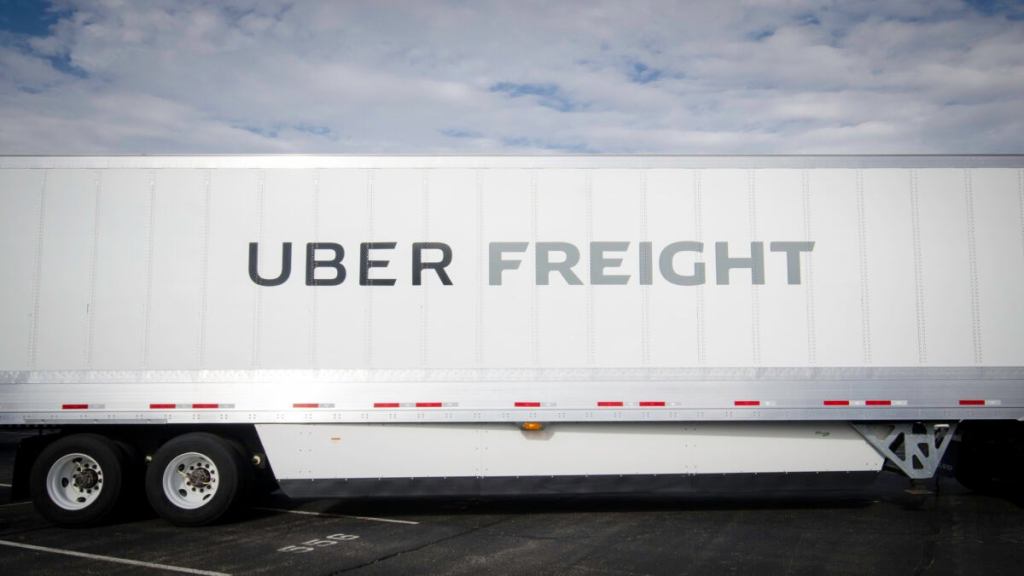
Logistics leader Uber Freight confirmed Tuesday that it was forced to cut a number of jobs in order to align with its “continued commitment to drive sustainable growth.”
A source familiar with the layoffs said between 40 and 50 jobs were cut Monday. However, Chicago-based Uber Freight (NYSE: UBER) declined to disclose the exact number of employees affected or the percentage of the company’s workforce that was part of the layoffs.
“We made a strategic workforce adjustment aligned with our continued commitment to drive sustainable growth. Regrettably, this means a small reduction in force,” an Uber spokesperson said in a statement to FreightWaves. “This decision, not made lightly, optimizes the team to enhance operational efficiency and long-term success.”
One former employee told FreightWaves that he and others received their separation agreements from human resources via email around noon CST on Monday, hours before they were laid off via one-on-one Zoom calls.
“HR screwed up and sent out separation agreements and everyone was in panic mode, but the company kept telling us it was just an error in the system,” the source, who didn’t want to be identified for fear of retaliation, told FreightWaves. “Hours later, we received calendar invites to join a Zoom call about 10 minutes before we were let go.”
In October, news that Uber Freight’s largest competitor, Seattle-based Convoy, was ceasing operations because of the “massive freight recession” rattled the digital freight brokerage industry.
One Ex-Uber Freight employee said this is the first round of layoffs that have impacted employees from legacy Transplace, which Uber Freight acquired in 2021.
“While I was more in tune with Uber Freight people, I do know some Transplace employees’ positions were impacted by the layoffs as well,” the source, who didn’t want to be identified, told FreightWaves.
The Uber Freight spokesperson declined to comment further about the layoffs Monday or confirm details about the former employees’ severance packages.
“We deeply appreciate the contributions of all team members and are providing support for those affected,” according to the company’s statement. “Our focus remains on delivering excellence to our customers and creating sustained value for our stakeholders.”
Do you have a news tip to share? Send me an email or message me @cage_writer on Twitter. Your name will not be used without your permission.
Check Call: Broker liability still remains questionable
Welcome to Check Call, our corner of the internet for all things 3PL, freight broker and supply chain. Check Call the podcast comes out every Tuesday at 12:30 p.m. EDT. Catch up on previous episodes here. If this was forwarded to you, sign up for Check Call the newsletter here.
In this edition: The Supreme Court rejected hearing another case on broker liability; spot rates on the decline in Phoenix; and the settlement heard round the world.
(Gif: Yarn)
The Supreme Court continues to remain tight-lipped about the question of broker liability. Tight-lipped in the way of not hearing the case as it has once again chosen to pass on hearing the case. This rejection of a case that involves the death or injury of a person struck by a truck that was booked by a 3PL has actually brought a win for the brokerage industry.
As for why the Supreme Court refused to hear the case, great question. As FreightWaves’ John Kingston reported: “Presumably, the court either determined that the circuit split was still too shallow or that the issue did not yet rise to the level of an issue of great public importance,” Marc Blubaugh, head of the transportation practice at the Benesch law firm, said in an email to FreightWaves.
Where does it stand now? There are two major cases being called up as conflicting arguments for whether or not brokers should be held liable for its hired carriers actions on the road. The first ruling is in Miller v. Robinson in which the 9th Circuit ultimately held that C.H. Robinson was liable for hiring the trucking company involved in the crash. The ruling that now leaves the decision split is Ye v. GlobalTranz in which the 7th U.S. Circuit Court of Appeals ruled that GlobalTranz was not held liable for the death of Shawn Lin.
The one commonality between the two is that the Supreme Court declined to hear both cases, echoing Blubaugh’s sentiment that the issue isn’t of enough public importance. There is a light in the form of the guy named “James” case where the 11th U.S. Circuit Court of Appeals has affirmed that Landstar wasn’t negligent in the August 2020 theft of a truckload of expensive freight, saying that broker liability exception applied to cargo theft as well.
Regardless, the issue still remains up in the air and will until more courts provide varying opinions.
SONAR TRAC Market Dashboard
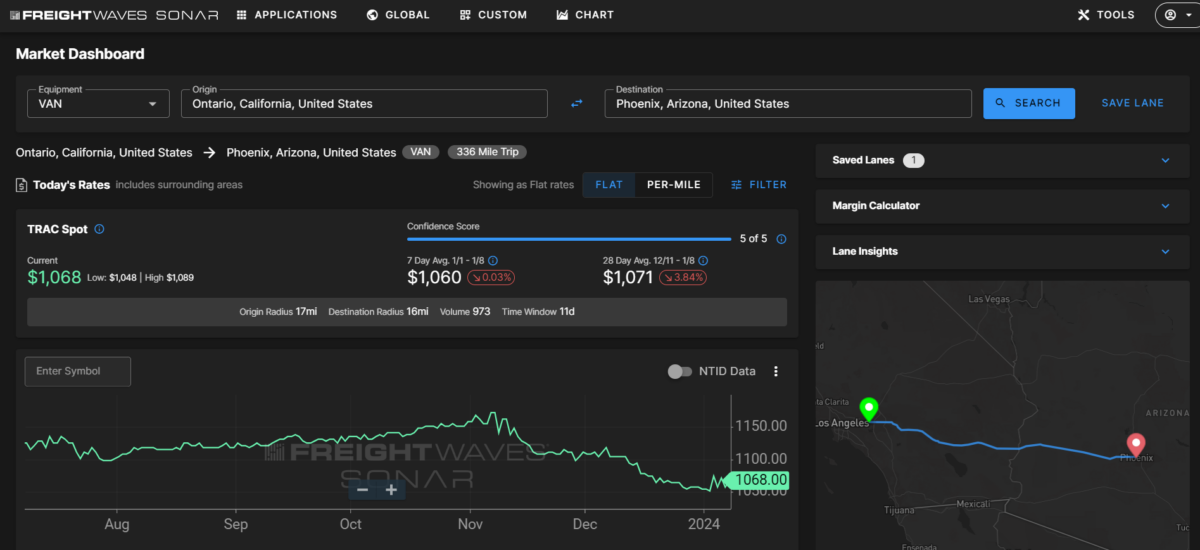
TRAC Tuesday. This week’s TRAC lane is from the heart of Southern California, Ontario, California to Phoenix, Arizona. Capacity is tightening in Ontario as outbound tender rejection rates increase to 4.35%. Spot rates remain relatively unaffected by the slightly tightened capacity in California due to the loosening of capacity in Phoenix as outbound tender rejections drop to 2.12%. The low rejection rate in Phoenix, coupled with the slow January, means rates should remain stable and lower than average for this lane for the foreseeable future.
(GIF: Yarn)
Who’s with whom? The battle for the ages, in a surprising turn, has actually reached a settlement. Berkshire Hathaway and Pilot Travel Centers have reached an agreement. The lawsuit started when Berkshire Hathaway bought Pilot Travel Centers and then remaining 20% of the stock for Pilot was still in the hands of the founding family of Pilot, the Haslams. The family accused Berkshire Hathaway of adopting new accounting practices that impacted the value of that final one-fifth ownership.
After many months the two sides have come to a settlement, which the intricate details of still remain a mystery. FreightWaves’ John Kingston’s article states: “Pilot Corporation … and the Haslam family, is pleased to announce that it has reached an agreement to fully settle the Delaware litigation between the Company and Berkshire Hathaway Inc., Pilot Travel Centers, LLC, and National Indemnity Company, including the dismissal of all claims and counterclaims against each other,” the statement said. Pilot Corp. is the Haslams’, and Pilot Travel Centers, the largest chain of truck stops and travel centers in the country, is the operating entity now owned by Berkshire Hathaway.”
It’s seemingly good news that the worst of it is behind everyone and Berkshire Hathaway can get on with its plans for Pilot Travel Centers
PS Logistics acquires flatbed, dedicated hauler Buddy Moore Trucking
PS Logistics announced it has acquired flatbed and dedicated truckload carrier Buddy Moore Trucking (BMT). The combination of the two Birmingham, Alabama-based transportation providers will expand PS Logistics’ presence in the Southeastern U.S.
Founded in 1999, Buddy Moore Trucking touts a flatbed fleet of 130 tractors and a dry van operation with 120 trucks. It has a total of 517 power units registered, according to Federal Motor Carrier Safety Administration data. The company also has a brokerage division.
Financial terms of the transaction were not disclosed.
“BMT will complement PSL’s best-in-class ‘asset-right’ operating model with expanded flatbed and dedicated dry van capacity, diversified geography, and new end markets,” said Scott Smith, PS Logistics’ CEO and co-founder.
BMT will continue to operate under its current banner as a stand-alone division of PS Logistics.
PS Logistics provides asset-based transportation as well as non-asset offerings like brokerage, third-party logistics and managed transportation. The company has been focused on acquiring family-owned flatbed trucking and logistics businesses since 2016. The addition of BMT marks PS Logistics’ 30th acquisition over that time. It has executed more than 35 transactions since its 2004 inception.
“Over the years, I’ve witnessed how well they execute acquisitions and deliver value to their customers, drivers, and employees, and I look forward to what we will achieve together now that Buddy Moore Trucking has access to a larger freight network, additional capital, and wider array of customer solutions,” said Buck Moore, president and CEO of BMT.
Gatik, Goodyear roll on with autonomous trucking tire technology
LAS VEGAS — Tires are the only part of an autonomous truck that touch the road. So it helps when those tires are smart enough to send road information to the driverless vehicle.
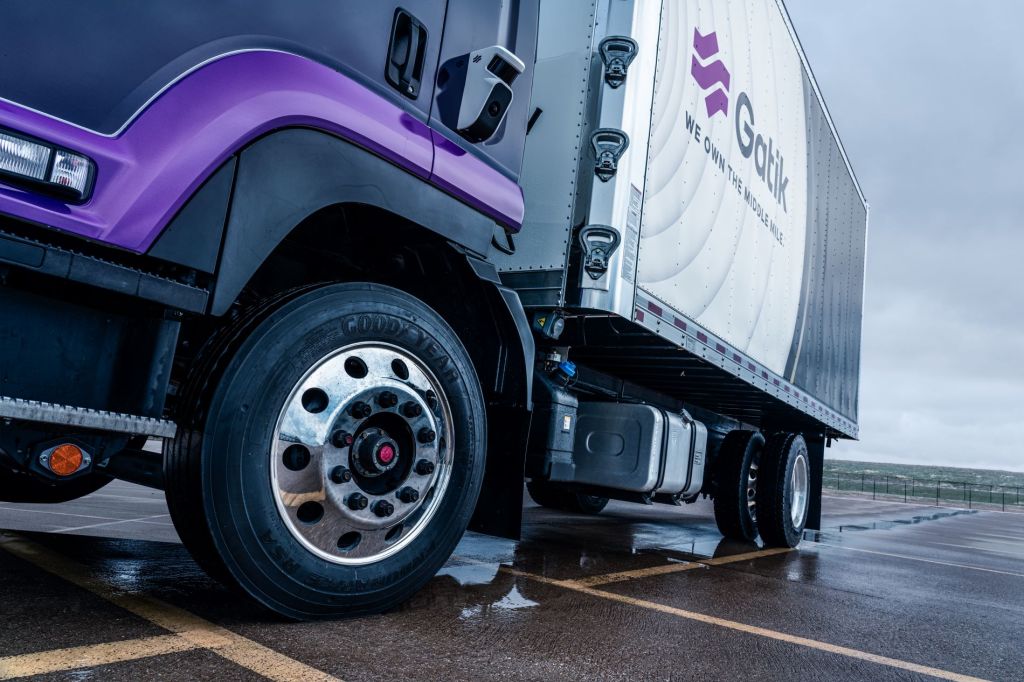
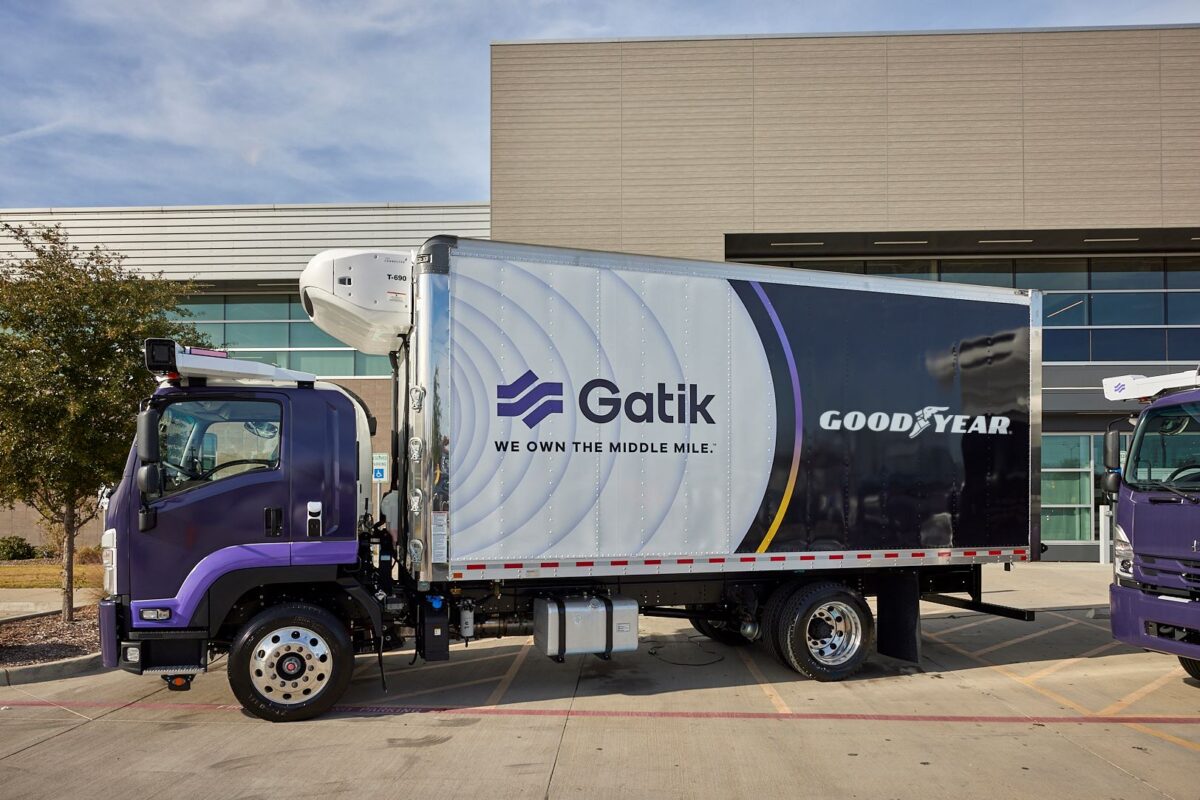
Middle-mile autonomous trucking leader Gatik has been working with Goodyear Tire & Rubber Co. on tire technology for several years. Now the two are equipping Gatik’s fleet’s with Goodyear Endurance RSA tires with Goodyear SightLine technology.
“Being the vehicle’s only contact point to the road, the tire can play a pivotal role in enabling the vehicle to react like a driver would,” Chris Helsel, Goodyear senior vice president, global operations and chief technology officer, said in a news release.
“Gatik is revolutionizing the autonomous technology space. By providing real-time insights through intelligent tire data, we can support Gatik’s autonomous driving system to become even more safe, reliable and efficient.”
Gatik and Goodyear are advancing intelligent tire technology for autonomous trucks. (Photo: Gatik)
Sightline technology rolling out on significant portion on Gatik vehicles
Mountain View, California-based Gatik plans to implement SightLine on a significant portion of its autonomous fleet of Class 3-7 box trucks across the U.S. and Canada this year.
Extensive on-road testing in a variety of real-world driving scenarios at Goodyear’s San Angelo, Texas, Proving Grounds have helped Gatik advance its autonomous vehicle controllers. Insights include accurate cornering and braking stiffness, rolling resistance and tire load.
A real-time feedback loop enables Gatik to adapt to a variety of road conditions. That includes when the mass or payload of the truck varies by delivery.
“The data derived from intelligent tire technology not only enhances the safety and predictability of our autonomous vehicles. [It] also enables us to maintain high levels of efficiency, reliability and delivery uptime throughout our operations,” said Gautam Narang, Gatik CEO and co-founder.
Goodyear and Gatik plan to integrate Goodyear’s advanced predictive road condition monitoring solution into Gatik’s autonomous driving system. That will enable strategic planning of its operations for customers that include Tyson Foods, Kroger and Canada’s Loblaws supermarket chain.
Separately, Goodyear said Tuesday it has achieved successful integration of tire intelligence technologies with vehicle motion control software in collaboration with vehicle systems and industrial technology supplier ZF.
Warehousing and fulfillment startup Flexe lays off 99 workers
Seattle-based startup Flexe has laid off 99 workers, about 38% of its workforce, according to a filing in Washington state.
Officials for the on-demand logistics and warehousing firm said the layoffs were due to “ongoing market volatility in the logistics industry driven by continued macroeconomic uncertainty. While we have a very strong cash position, it is important that we preserve our ability to continue investing in the business,” according to the Puget Sound Business Journal.
Flexe officials did not immediately return a request for comment from FreightWaves.
Founded in 2013, Flexe provides technology, logistics, warehousing, transportation and fulfillment services for both online and brick-and-mortar retailers. Flexe’s customers include Ace Hardware, BJ’s Wholesale Club, Ralph Lauren, Staples and Walmart.
The latest round of layoffs is the company’s third in the last two years. In September, Flexe laid off 33% of its workforce.
In July 2022, Flexe also laid off an unspecified number of employees in its recruiting department, according to Seattle Inno. That same month, Flexe reached a $1 billion valuation after securing a $119 million Series D funding round.
Craig Fuller joins the board of trailer-sharing platform Repowr
Craig Fuller, CEO and founder of FreightWaves, has joined the board of directors of Repowr, a Chattanooga-based FreightTech company pioneering the largest commercial trailer marketplace in North America.
With Repowr, asset-based fleets, brokers, shippers and owner-operators can tap into the Universal Trailer Network (UTN) to seamlessly exchange trailer capacity. The Repowr platform supplements existing fleet management tools and empowers logistics companies to fully leverage the benefits of a trailers-as-a-service model. Fleets supplying trailers to the network are able to optimize trailer utilization, maximize revenue per trailer and reduce empty mileage. Fleets also accrue a variety of other efficiency gains by leveraging Repowr’s streamlined interchange experience — certificate of insurance verification, dynamic trailer pricing and digital chains of custody. Simultaneously, logistics companies seeking trailers can scale with ease and efficiency as the UTN offers on-demand access to trailers under a flexible pay-per-use model. Sharing trailers creates a win-win experience, helping both parties mitigate risks associated with market volatility.
“We are thrilled to have Craig join Repowr’s board of directors,” said Spencer Ware, co-founder and CEO of Repowr. “He brings a very deep knowledge of the trucking industry to the company and is one of the most respected and influential visionaries in our space. His expertise aligns perfectly with Repowr’s strategic objectives. ”
Fuller has been around trucking his entire life, having grown up as the son of the founder of U.S. Xpress. During his tenure with the company, he started Xpress Direct, which became one of the largest providers of on-demand trucking services in North America, and eventually served as president of Xpress Global Systems, a less-than-truckload and logistics provider for the building materials industry.
Fuller left the family trucking business in 2005 and helped to develop Transcard, a fleet payment provider that was sold to U.S. Bank seven years later. In 2016, Fuller started FreightWaves, the largest provider of news and high-frequency data to the global logistics industry.
“Trailers are the most underutilized asset in the trucking industry and Repowr has developed a solution for this. By matching fleets that have too much trailer capacity, with fleets that need trailers for popup fleets or short-term project needs, Repowr is helping to optimize the national trailer fleet,” Fuller stated.
Repowr’s co-founders Patrick Visintainer and Ware launched the company in 2021, during the pandemic, when trailers were a scarcity. The two saw a massive opportunity to unlock stagnant trailer pool capacity, an efficiency gain for the entire supply chain.
“The pandemic really magnified the importance of trailer optimization. Since then, we’ve seen fleets, brokers and shippers invest heavily into becoming more trailer-centric. The UTN complements those investments and enables a more dynamic use of trailers, removing limitations that exist with individual, isolated trailer pools. As the network scales, it becomes easier for participants to rapidly adapt to market changes without being limited by the capacity of their own fleets,” said Ware.
In joining the Repowr board, Fuller stated, “I tell friends that Repowr is the Airbnb of the trucking industry, helping fleets with underutilized trailers generate incremental revenue when those assets are not being optimally utilized. Repowr is building a market-defining platform.”
Shuttered California trucking company files for Chapter 7
A California-based third-party logistics company, which had 34 power units and 33 drivers, filed for bankruptcy liquidation on Thursday.
Wise Choice Trans. Corp., headquartered in Hayward, California, filed its petition in the U.S. Bankruptcy Court for the Northern District of California.
The 3PL, which was founded in 2009, offered final mile, less-than-truckload and full truckload services in the San Francisco Bay area. Wise Choice also provided warehouse and fulfillment services before shuttering operations.
Wise Choice listed its assets and liabilities as between $1 million and $10 million, according to the petition. It stated that it has up to 49 creditors and maintains that no funds will be available for unsecured creditors once it pays administrative fees. Erick Crespo is listed as the CEO of the trucking firm. He has also filed for personal bankruptcy protection, according to the petition.
As of publication, Crespo’s attorney, Stephen D. Finestone, did not respond to FreightWaves’ request for comment.
The trucking company’s top secured creditor is Fremont Bank of Livermore, California, which is owed more than $1.3 million for more than 20 Freightliner tractors and other equipment. The petition states that Propella Capital LLC of Brooklyn, New York, is the largest unsecured creditor and is owed $100,000.
In its petition, Wise Choice posted gross revenues of around $3.6 million in 2023, a drop of around $600,000 compared to its revenues of $4.2 million in 2022.
Over the past 24 months, Wise Choice’s trucks had been inspected 94 times, and five had been placed out of service for a 5.3% out-of-service rate. That is significantly lower than the industry’s national average of around 22%, according to the Federal Motor Carrier Safety Administration’s SAFER site.
The company’s drivers had been inspected 106 times, and two were placed out of service over a two-year period, resulting in a 2% out-of-service rate. The national average for drivers is about 6.7%, according to FMCSA data. The company’s insurance was canceled on Jan. 5.
In the petition, Wise Choice lists its involvement in four legal actions that are ongoing or have been concluded in San Francisco Superior Court and in Santa Clara Superior Court, although no amounts were listed.
A creditor’s meeting has been set for Jan. 31.
Do you have a news tip to share? Send me an email or message me @cage_writer on Twitter. Your name will not be used without your permission.
Kodiak reveals production-ready autonomous truck at CES
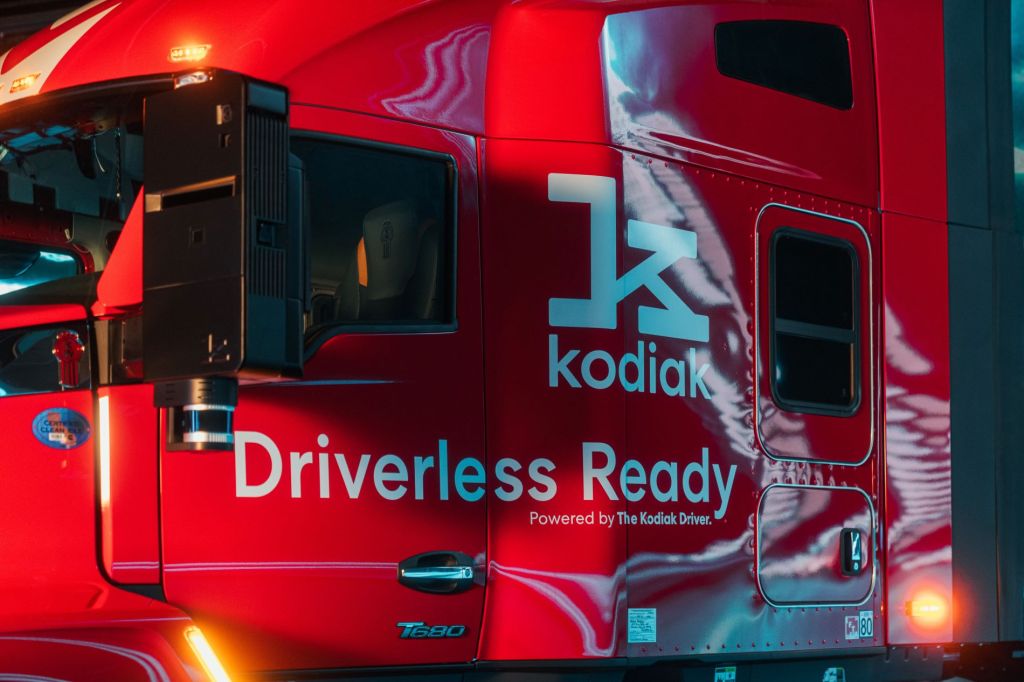
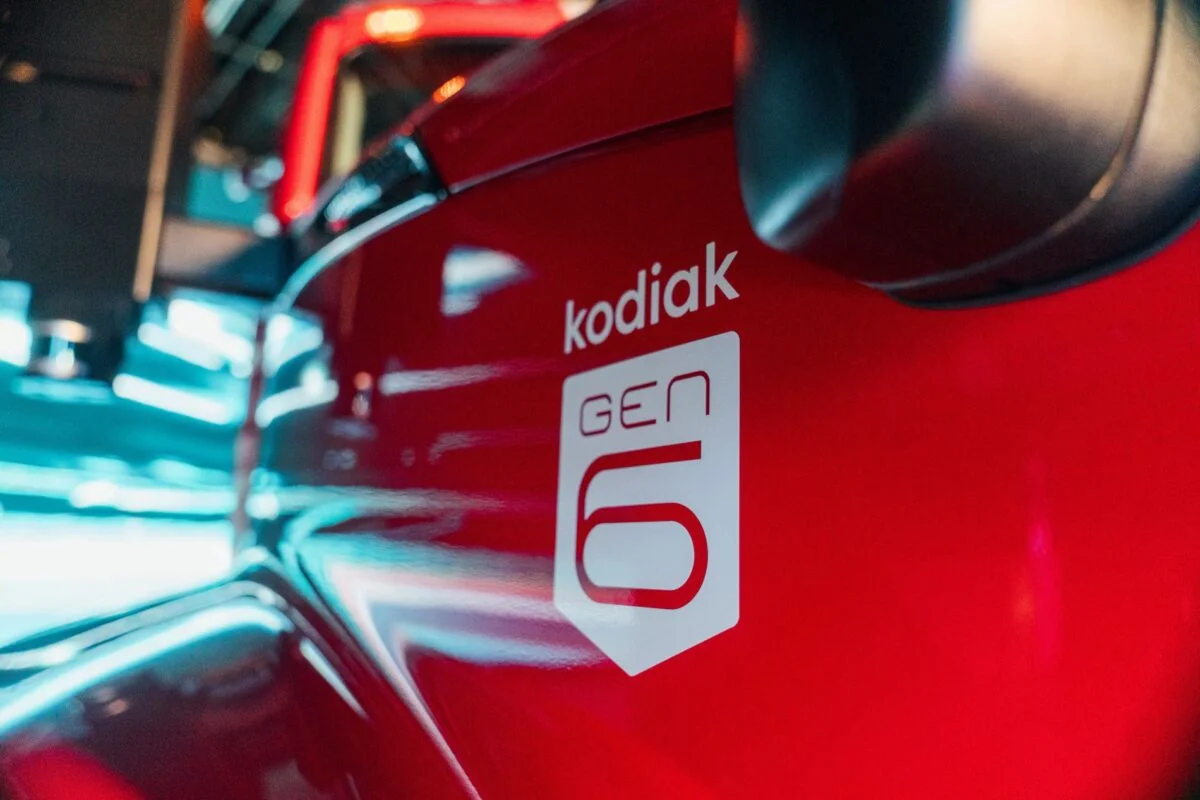
LAS VEGAS — Kodiak Robotics on Tuesday revealed its sixth-generation Class 8 autonomous truck, a production-ready model it plans to launch without a human driver later this year in Texas.
After five years of testing and 5,000 driver-monitored autonomous loads covering more than 2.5 million miles, Kodiak reached the finish line with a system capable of being retrofitted on any major Class 8 truck. Kodiak will upfit Kenworth T680s with its redundant braking, steering, power and sensors that provide backup in case of a primary system outage.
Kodiak Robotics revealed its sixth-generation driverless truck at the Consumer Electronics Show (CES). (Photo: Kodiak Robotics)
Kodiak and Aurora take different approaches to driverless rollout
Mountain View, California-based Kodiak and Pittsburgh-based rival Aurora Innovation both plan commercial driverless operations from Houston to Dallas this year.
“While we are working closely with OEM partners to develop our technology, we have intentionally developed the Kodiak Driver so that we are not dependent on OEMs to commercialize,” Kodiak founder Don Burnette told FreightWaves. “While OEMs are making great strides, progress is slow, and some are still years away from offering a driverless-ready truck platform.
“By building our own driverless-ready truck, we can maintain control over how and when we bring our technology to market. We believe this approach is unique in the industry. In the long run, we expect that our technology will be direct from the OEMs. But we think our approach will give us an advantage for the next few years.”
“Over the course of 2.5 million miles, we’ve successfully demonstrated that our self-driving trucks can withstand the harsh environment of long-haul trucking from both a platform integrity and a software perspective,” Burnette said. “This truck fundamentally demonstrates that we’ve done the work necessary to safely handle driverless operations.”
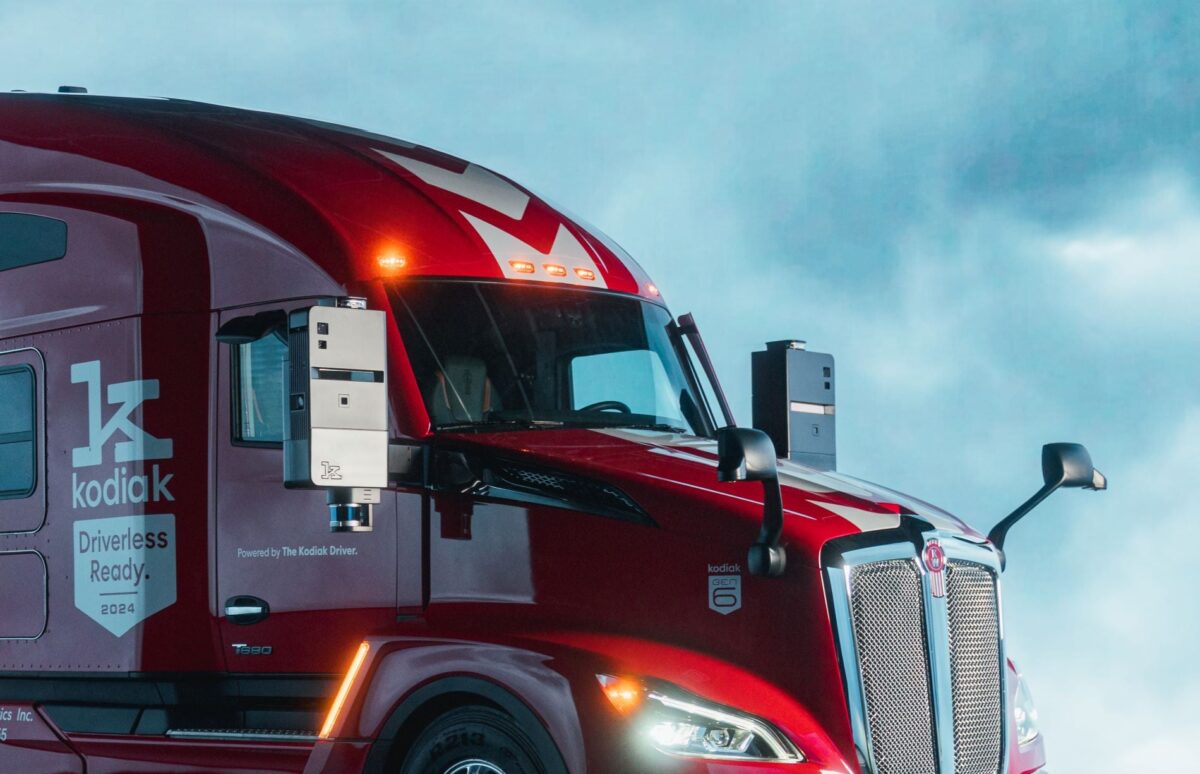
New features are a part of the production-ready sixth-generation autonomous truck from Kodiak Robotics. (Photo: Kodiak Robotics)
Safety redundancy
Kodiak’s pneumatic braking system consists of three individual brake actuators simultaneously controlled by Kodiak’s proprietary software. Should any of the braking actuators fail, the backup systems can prevent loss of control and bring the truck to a safe stop.
The dual-redundant steering system includes two redundantZF actuators controlled by Kodiak’s safety system. If the primary steering actuator experiences any type of failure, the steering system seamlessly switches to the secondary actuator to maintain full control.
Kodiak’s custom-designed, high-integrity safety computer ensures the Kodiak Driver can guide the truck to a safe “fallback” out of the flow of traffic in the event of a critical system failure.
Kodiak’s sixth-generation truck features twice the graphics processing unit cores, 1.6-times greater processing speed, 3 times more memory, and 2.75 times greater bandwidth to run software processes compared to Kodiak’s first-generation truck.
The redundant power system for computers, sensors, actuators and other electrical systems is split into two fully isolated subsystems. That ensures all safety systems can execute a safe fallback should either fail.
Upgraded features
Kodiak’s proprietary SensorPods — pre-calibrated and pre-built for fast and easy repairs– now have two automotive grade higher-resolution light detecting and ranging (lidar) sensors. Two additional side radar sensors improve long-range object detection.
In total, the Kodiak driverless-ready truck features 12 cameras, four lidar sensors, and six radar sensors. Nvidia GPUs handle the high-performance compute functions.
Later in 2024. Kodiak will integrate a next-generation Ambarella CV3-AD AI domain control system-on-chip to continuously improve the truck’s sensor and machine-learning capabilities.
The SensorPods also have top-mounted, extra-bright hazard lights. Kodiak hopes these will replace road flares when a Kodiak truck is parked on the side of the road. Their use is pending Federal Motor Carrier Safety Administration approval.
Going to market
Kodiak has designed its self-driving system to work on any truck.
“Over the next two years, Kodiak will work with our customers to determine the make and model of the trucks that will best fit into their fleets,” Burnette said. “Customers will order the trucks from a dealership. Kodiak and our upfit partners will equip them with our self-driving system, including hardware and software.”
An upfit will take about four weeks.
Kodiak plans to offer a driver-as-a-service model, charging customers a per-mile fee to use the Kodiak Driver on the customers’ trucks.
“We believe the Kodiak Driver will eventually be available on every make and model truck,” Burnette said.