Supreme Court rejects review in broker liability case, leaving the issue unresolved

(The story has been edited to reflect that court action in Miller vs. C.H. Robinson did not find the 3PL liable but did find that it was not protected  by the FAAAA.)

The Supreme Court has again rejected a review of the question of broker liability in a case involving the death or injury of a person struck by a truck that was booked by a 3PL.

However, unlike the case of Miller v. C.H. Robinson, this rejection is considered a victory for the brokerage industry.

In a long list of denials of certiorari posted Monday, the court without comment said it would not review the appeal brought by Ying Ye, the widow of a man killed in 2017 in an accident in Texas. Ye’s action against Global Sunrise was brought in Illinois, where the carrier is based. Ye won her lawsuit against Global Sunrise, being awarded $10 million in April 2022 in summary judgment handed down by the federal court. 

Ye also attempted to bring freight broker GlobalTranz into the lawsuit, as it was GlobalTranz that hired Global Sunrise. But both the federal District court and an appeals court of the 7th Circuit rejected the claim, primarily by citing the Federal Aviation Administration Authorization Act (FAAAA). The FAAAA holds that a state may not take action that could impact a transportation “price, route or service.” 

Ye then appealed to the Supreme Court, which rejected her attempt Monday. 

There had been some rooting among the legal bar for the Supreme Court to take up the Ying Ye case, so as to settle the question over broker liability that remains unresolved given the Miller decision in the 9th Circuit. Not surprisingly, GlobalTranz, with a victory in hand, was not one of them. 

“Presumably, the court either determined that the circuit split was still too shallow or that the issue did not yet rise to the level of an issue of great public importance,” Marc Blubaugh, head of the transportation practice at the Benesch law firm, said in an email to FreightWaves.

The result means that there is no final settlement for now of whether a broker can be liable under federal tort law for an action taken by a truck it hired. The issue is not restricted just to bodily injury; Landstar (NASDAQ: LSTR) last year won a case on appeal to the 11th circuit regarding its liability over the theft of a truck and its cargo that it had brokered, with the court finding the 3PL not liable. 

But in the Miller v. Robinson case, coming out of a 2016 accident that left Alan Miller a quadriplegic, the 9th Circuit ultimately held that C.H. Robinson (NASDAQ: CHRW) was not protected by the FAAAA for hiring the trucking company involved in the crash. The 3PL giant took the case to the Supreme Court on appeal, but like in the Ying Ye case, certiorari was denied in June 2022. (It later settled the case).

The FAAAA has a safety exemption that does allow state action for negligence “with respect to motor vehicles” even if that action has the potential to violate a “price, route or service.” 

However, that issue is tangled up with the fact that the safety exemption is tied to “motor vehicles.” Whether a brokerage can be considered a motor vehicle was a key question in the Ying Ye case; the court ultimately concluded GlobalTranz wasn’t a motor vehicle so was protected by the rest of the FAAAA.

But in the case of Miller vs. Robinson, according to a spokeswoman for C.H. Robinson, the 9th Circuit found that the affirmative defense was not available to the broker because the safety exception did not allow for preemption of state action. “The panel concluded that negligence claims against brokers, to the extent that they arise out of motor vehicle accidents, have the requisite ‘connection with’ motor vehicles,” the court wrote. “Therefore, the safety exception applied to plaintiff’s claim against C.H. Robinson.”

But the court’s certiorari denial means that federal courts not in a jurisdiction where the question of broker liability has largely been settled — like the 7th Circuit, where the Ying Ye case was tried, or the 11th, which ruled in the Landstar case — can turn to the Miller precedent from the 9th Circuit, a prospect the 3PL industry finds worrisome.

“As a result, the application of the so-called ‘safety exception’ under the FAAAA will continue to play out in lower courts — both state courts and federal courts,” Blubaugh said. “Fortunately, from the freight brokerage industry perspective, the vast majority of lower courts are now adopting the well-reasoned approach of the 7th and 11th Circuits.”

Blubaugh cited a recent state court decision that went in favor of C.H. Robinson in an action brought by parents of a man killed in an accident in Florida. The truck had been hired by C.H. Robinson. 

“The FAAAA expressly preempts plaintiffs’ claim against freight broker C.H. Robinson in this case, and the claim does not fall within the FAAAA’s safety exception,” the court in Palm Beach County wrote, citing the 7th and 11th Circuit decisions.

In that case, Landstar is also a defendant, but it was acting as a motor carrier, not as a broker, so it was not involved in the question over the FAAAA.

More articles by John Kingston

Logistics M&A slower, but opportunities still there

Convoy autopsy continues; Panel sees capacity issues, lack of disclosure

The inside story of how GlobalTranz and Worldwide Express came together
As Red Sea risk spooks container shipping, tankers remain unfazed

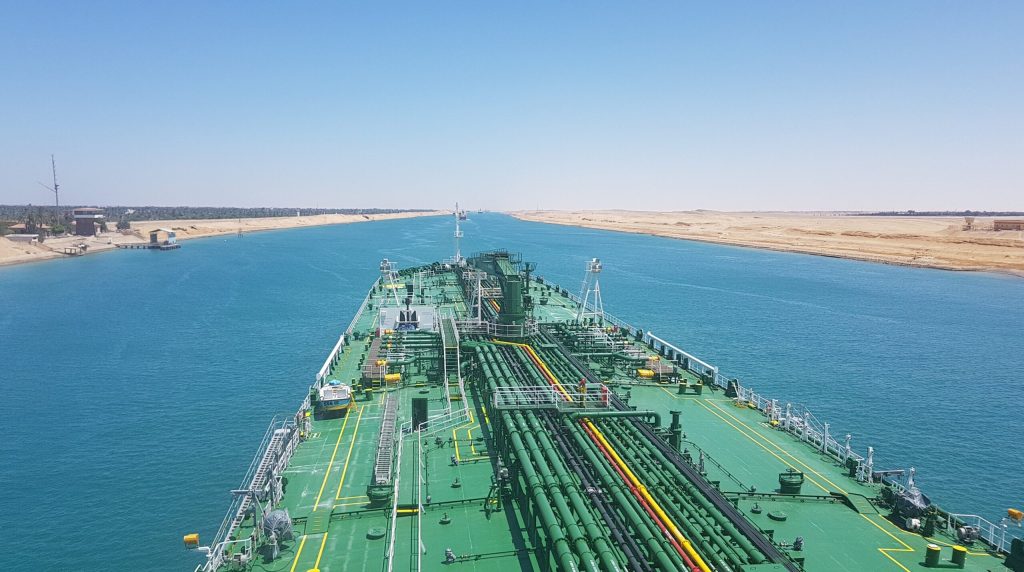
a photo of tankers in Suez Canal

Shipping investors love trade disruptions, which generally boost freight rates. The mass diversions of container ships around the Cape of Good Hope are cheered by container shipping stock investors even as pundits and politicians warn of supply chain fallout for consumers and businesses.

Tanker shipping investors look on in envy at container shipping chaos. Tankers, as well as dry bulk vessels, continue to transit the Red Sea and the Bab-el-Mandeb Strait, unbowed by the threat of Yemen’s Houthi rebels.

Today’s tanker rates are high, and profitable, but have yet to be truly juiced by the Red Sea effect. As for tankers’ cargo, the price of Brent crude has actually fallen 5% since the Red Sea attacks began on Nov. 19.

“Despite reports to the contrary, tankers are continuing to transit through both the Red Sea and the Suez Canal,” said tanker brokerage BRS on Monday.

“Although container lines are continuing to reroute via the Cape of Good Hope, the latest data from AXSMarine suggests that in December, tanker traffic through the Suez Canal was relatively flat year on year.

“Broker information suggests that the vast majority of tankers that are rerouting via the Cape are those … directly linked to Israel,” said BRS. “The impact on tankers appears minimal, on par with that of dry bulkers.”

Vortexa Senior Freight Analyst Ioannis Papadimitriou published a similar opinion Friday.

“Tanker diversions have picked up in the span of the last two weeks, but these are not occurring en masse, as tankers and volumes continue to flow via the Red Sea. Instead, these diversions are [largely] constrained to U.S.-, EU- and Israel-linked entities and the companies that announced the decision to divert via the Cape of Good Hope.

“Although freight rates for the impacted routes [through the Red Sea] have picked up, this has not been reflected in the overall tanker market, implying that there is not en-masse rerouting taking place at the moment,” said Papadimitriou.

Escalation good for rates — but not too much escalation

A dramatically positive effect on tanker rates — on par with what’s being seen in container shipping — appears to require further escalation.

The market risk is that hostilities could escalate too much, creating disruptions at the Strait of Hormuz off Iran that would be detrimental to tanker rates. The sweet spot for tanker rates is mass diversions from the Red Sea, but no issues at the Strait of Hormuz that shut in Middle East crude and refined product supplies.

Red Sea tanker diversions could theoretically increase if the U.S.-led coalition begins military strikes in Yemen and subsequent Houthi attacks on passing ships become more indiscriminate.

The Western coalition gave a final warning last Wednesday, stating that the Houthis “will bear the responsibility of the consequences” should they continue to attack. That said, the Houthis have continued to attack and as of late Monday, there had been no retaliatory strikes on Houthi positions in Yemen.

The rate-negative escalation scenario

BRS believes that “the largest geopolitical risk to tankers in 2024” involves an escalation of the Israel-Hamas war into a regional conflict that involves Iran and halts traffic through the Strait of Hormuz.  

“Any closure of this chokepoint would threaten the nearly 17 million barrels per day of crude and refined products exports from the Middle East Gulf,” said BRS, which warned that this would be “a significant net negative to global tanker markets due to higher bunker [fuel] prices and less oil on the water.”

BRS said that such a disruption would create both winners and big losers. “The impact of a closure on Middle Eastern tanker markets would be catastrophic,” while at the same time, “the cost of lifting crude and products from other regions would surge.”

The brokerage believes a loss of Middle Eastern supply would lead to more Atlantic Basin crude heading to Asia and more Asian refined products heading to the Atlantic Basin.

This added voyage distance would increase tanker demand measured in ton-miles (volume multiplied by distance), but that gain would be more than offset by lost ton-miles due to the shut-in of Middle East supply, said BRS.

Click for more articles by Greg Miller 

Benchmark diesel down again as Saudi moves suggest there’s more declines to come

On the day when the benchmark diesel price used for most fuel surcharges fell for the 13th time in 16 weeks, the futures market suggested this decline may have more room to run.

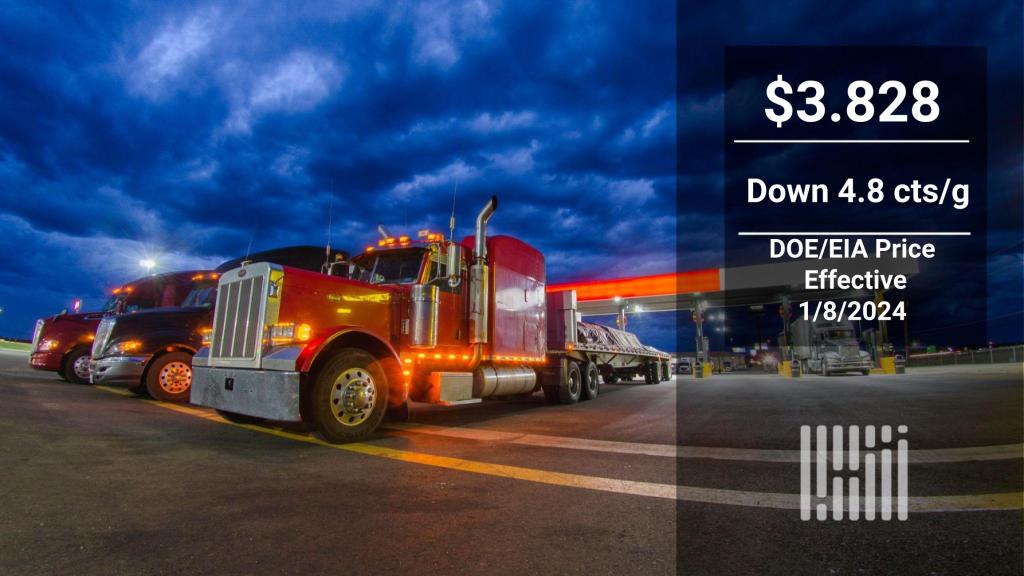
The weekly Department of Energy/Energy Information Administration weekly average retail diesel price declined 4.8 cents a gallon to $3.828. It was the 10th decline in the last 11 weeks. 

Since Sept. 18, the last date before the run of mostly declines began, the DOE/EIA diesel price has dropped 80.5 cents a gallon.

The decrease in the retail benchmark price comes after several days in which the futures price of ultra low sulfur diesel (ULSD) on the CME commodity exchange trended higher, primarily on the back of concerns that shipping through the Red Sea and Suez Canal would push oil into further voyages. The practical effect of such a disruption is that oil ends up in inventory longer than it would be otherwise, which is bullish for prices.

But the upward trend in reaction to the Red Sea strife wasn’t that strong. It did come after prices already had been elevated by a significant amount of buying that was believed to be tied to traders with short positions, betting the price would drop. That resulted in many traders deciding to close those short positions with a round of buying. That trend took the ULSD price up to a settlement of $2.7168/g on Dec. 19.

But that trend couldn’t hold and ULSD opened 2024 trading with a Jan. 2 settlement of $2.5258 a gallon. Suez Canal concerns did lift the price back over $2.60 a gallon for a few days last week. 

That mildly upward trend ended Monday. The decline in ULSD was relatively mild, just 3.16 cents a gallon to $2.5769 a gallon, a drop of 1.21%.

But over in crude markets, the declines were much steeper Monday. A drop of $3.04 per barrel in the West Texas Intermediate crude market took prices down to $70.77 per barrel, a drop of 4.11% from Friday. Global crude benchmark Brent declined slightly more, about 4.2%. RBOB gasoline, the unfinished proxy product for finished gasoline, dropped 3.69%.

Consensus in the market was that it was the Saudi announcement of its price formulas for February that created the selloff. Saudi Arabia prices its crude as a differential to benchmarks in various regions. For example, in North America, the Saudis set a differential to a price index set by Argus Media called the ASCI price. There are different benchmarks in different parts of the world.

The formulas for February, which came out late Sunday U.S. time, showed widening of the discounts to the benchmarks. For example, the differential in the Saudi formula for sales of its Arab Light crude into Asia widened by $2 per barrel, an enormous one-month move.

It was seen by the market as a sign that Saudi Arabia is either going to get aggressive in clawing back market share it may have given up in the second half of 2023 as it implemented several production cuts aimed at stabilizing the price of oil, or that its order book is showing weak demand and it responded in kind. 

.More articles by John Kingston

Truck transportation jobs trend higher while warehouses shed workers

After 2023 price declines, diesel focus turns to its relationship to crude oil

Berkshire, Haslams settle suits, avoiding trial over valuation of Pilot Travel Center

Berkshire, Haslams settle suits, avoiding trial over valuation of Pilot Travel Centers

On the day the legal battle between the founding family of Pilot Travel Centers and its current owner Berkshire Hathaway was to go to trial in Delaware, the two sides reached a settlement.

In a brief statement released early Monday, a spokeswoman for the Haslam family said the two sides had reached a deal and are ending all litigation over the issue.

The Haslams had originally sued Berkshire, which then filed a countersuit. Patriarch James A. Haslam II founded Pilot Travel Centers (PTC) and has been selling it off in pieces to Berkshire Hathaway since a first purchase by Berkshire of 38.6% of Pilot in 2017. 

“Pilot Corporation … and the Haslam family, is pleased to announce that it has reached an agreement to fully settle the Delaware litigation between the Company and Berkshire Hathaway Inc., Pilot Travel Centers, LLC, and National Indemnity Company, including the dismissal of all claims and counterclaims against each other,” the statement said. Pilot Corp. is the Haslams’, and Pilot Travel Centers, the largest chain of truck stops and travel centers in the country, is the operating entity now owned by Berkshire Hathaway. 

The trial between the two sides was to begin Monday in Delaware Chancery Court.

There were no other details provided. It is unclear if the settlement involves the elimination of “pushdown accounting” that was adopted by Berkshire in early 2023 to value PTC, which Berkshire took control of early last year after the acquisition of 41.4% of the travel center chain. The Haslams’ spokeswoman offered no further comment.

It was that financial step that led to the dispute and litigation between the two sides. The Haslams said the accounting would reduce the value of PTC, which would reduce the price Berkshire Hathaway would pay for the remaining 20% of PTC. However, the lawsuit also said that the elder Haslam had been told by Berkshire Hathaway CEO Warren Buffett that the valuation of the 20% stake would be done under accounting rules agreed upon in the earlier sale of the company, which would not be on the basis of pushdown accounting. But that assurance apparently was not enough for the Haslams, leading to the lawsuit.

Berkshire’s counterclaim was mostly that Jimmy Haslam III was making ostensible bonus payments to PTC executives loyal to him without the knowledge of current PTC management, which had come out of Berkshire Hathaway. Haslam III is the son of James Haslam and was CEO and president of Pilot.

The Berkshire charge was that Haslam’s goal was to have family loyalists still at the company take steps that might give a short-term boost to profits at PTC but that could possibly have negative longer-term implications for PTC.

With the litigation out of the way, the biggest remaining question is whether the Haslams, as Pilot Corp., will exercise what amounts to a put option that will trigger a sale to Berkshire Hathaway of the 20% it doesn’t own already. The formula for determining the value of PTC is 10 times its earnings before interest and taxes, though there are some other adjustments. 

Court filings in the case said the “put right” must be exercised within 60 days following the close of the PTC fiscal year, which is Dec. 31. If it isn’t exercised this year, the right rolls over to 2025. 

Various references in the court documents suggested that both sides expect the put right to be exercised this year.

More articles by John Kingston

Debt ratings review: Pilot remains strong operator

1st peek at Pilot’s finances after Berkshire Hathaway ownership grows

Court rules CRST team drivers must be paid for some hours in sleeper berth

Private firm strikes $262M deal for 25-building logistics portfolio in South Florida

Longpoint has acquired a cluster of industrial-logistics properties totaling 1.4 million square feet across 12 locations in the Miami and Fort Lauderdale, Florida, areas. 

The Boston-based real estate private equity firm acquired the 25-building industrial portfolio for $262 million from Pennsylvania-based Seagis Property Group. Longpoint officials said the acquisition expands the company’s presence throughout several infill submarkets in Florida.

The transaction closed in December and was officially announced on Friday.

“The properties are complementary to our portfolio and represent our strategy of acquiring high-quality industrial properties in critical logistics hubs,” Dwight Angelini, co-founder and managing partner of Longpoint, said in a news release. “This portfolio offers significant upside opportunity through capital improvements and operational upgrades.”

The transaction was the largest industrial sale in Florida in 2023, according to real estate firm CBRE.

“The buyer was attracted to this portfolio because it offered rare critical mass in South Florida, one of the strongest industrial markets in the country,” CBRE Vice Chairman Jose Lobon said in a statement.

The portfolio consists of properties situated along or near major transportation roads, allowing tenants to service South Florida’s population centers, which total about 6.5 million individuals, Longpoint officials said. 

In 2023, Florida led the nation in net income migration at nearly $40 billion, the bulk of which flowed directly into Miami-Dade and Broward counties. The increase in purchase power has led to record levels of demand for distribution facilities in South Florida, according to Longpoint.

Longpoint did not specify the exact location of the properties, but nine of the buildings are located in the communities of Davie, Deerfield Beach, Fort Lauderdale and Lauderhill, Florida, according to The Real Deal. 

Longpoint Partners, founded in 2015, is a private equity owner and operator of real estate focused on serving the needs of consumers. The company has eight offices and more than 50 employees across the U.S.

More articles by Noi Mahoney

CBP reopens 4 Southwest ports of entry after weekslong closures

US, Mexican partnership to expand international rail-car ferry service

Canadian trucking company suspended after multiple overpass crashes

Cummins commits $580M to North Carolina plant makeover

Cummins Inc. is spending $580 million to revamp a plant in Rocky Mount, North Carolina, to make fuel-agnostic small engines as part of its path to zero-emissions products by 2050.

The engine versions come from a base engine with many common parts. Above the head gasket, the powertrains will have different components for different fuel types. Each B6.7, X15 and new X10 will operate using a different, single fuel. 

“Cummins is focused on Destination Zero and getting there as quickly as possible,” Steve Pinkston, Cummins Rocky Mount engine plant manager, said in a news release. “This investment is not just about engines. It’s a testament to our unwavering commitment to the community and our vision for a sustainable and impactful future.”

In December, Columbus, Indiana-based Cummins agreed to pay a $1.675 billion civil fine related to emissions defeat devices on engines for Ram pickup trucks made from 2013-2019. It was the second-largest penalty for a Clean Air Act violation in history behind only the $2.6 billion criminal fine that Volkswagen paid in 2015.

The company invested $452 million on its Jamestown Engine Plant in April to upgrade the 998,000-square-foot facility in western New York. It is producing the first fuel-agnostic internal combustion engine platform capable of running on natural gas, hydrogen and other fuels.

Part of $1B+ investment announced in April 2023

That announcement totaled more than $1 billion and included a placeholder for Rocky Mount. Incentives from Nash County sealed the deal for the 40-year-old plant. Nash County agreed to a 50% tax abatement from 2025-2032.

“We need engagement from federal, state, and local governments like Nash County to achieve our goals and we are grateful for their support,” Pinkson said. “When we receive engagement from local partners like this, it helps us move faster toward a more sustainable future.”

The Rocky Mount investment expects to add 80 new jobs at the plant that employs 2,000 workers. The plant produced its 5 millionth engine in May. The 1.3 million-square-foot manufacturing plant has operated since 1983. It started as a joint venture with Case named Consolidated Diesel Co. Cummins bought out Case in 2008.

Cummins will pay $1.675B fine for engine emissions violations

Cummins plans $1B+ investment in engine plants, hydrogen equipment

New Power division rebranded as tech future-focused Accelera by Cummins

Click for more FreightWaves articles by Alan Adler.

Morgan Stanley sees inventory restock producing freight upcycle soon

A red Knight Transportation tractor on a highway

An end to a prolonged freight recession could be approaching sooner than some investors may think, one equities analyst said Monday. The bullish call was largely centered on the need for inventories to be replenished after companies have spent the last few quarters drawing down overstocked levels.

“Shippers continue to remain on reorder ‘strike’ while they wait for stronger signals or more favorable conditions on macro but while destocking at the same time, which could lead to everyone wanting to restock at the same time, when the coast clears (or they run out of inventory),” Morgan Stanley (NYSE: MS) analyst Ravi Shanker told clients Monday.

He said that could kick off an inventory replenishment period, pushing freight volumes higher for the trucking and intermodal companies he follows. He believes an upcycle could occur as soon as the end of the first quarter. He acknowledged the call is “out-of-consensus” but said that most shippers had already purged excess merchandise from their shelves this summer.

The recent supply overhang was the result of miscalculations from supply chain managers looking to avoid the prolonged stockouts seen during the pandemic. Vowing to not endure a repeat of the 2021 holiday season, the country’s biggest brands executed a “just-in-case” ordering strategy heading into the back half of 2022, which ended up producing bloated warehouses and notable discounting.

Many large shippers have said their inventories have been right-sized in recent months, which has Shanker thinking an uptick in ordering could occur if consumer spending remains healthy as it did during the recent holiday season.

“The longer the limbo period lasts, the more pressure builds for the upcycle to come,” Shanker said.

Shanker pointed to a 20-year-old, proprietary survey of shippers, which has been successful in predicting prior cycle inflections. The fourth-quarter iteration released Monday showed inventory destocking continued “at a historic pace, even as inventory levels rapidly normalize.”

Of those polled, only 5% said they needed to increase inventory levels. Thirty-nine percent of respondents said they would reduce stock levels, which was a notable decline from the cycle-high of 48% that was registered during the second quarter.

“We believe record-high levels of destocking when inventory is already normalized are not sustainable as are record-high levels of shippers looking to ‘maintain inventory’ from here together with record-low ‘increase inventory,’” Shanker said. “We believe shippers will need to start increasing inventory soon if the rate of destocking (driven by consumer spending) keeps up at its current rate.”

After several quarters of year-over-year (y/y) declines, the truckload and intermodal sectors will benefit from easier volume and pricing comparisons in 2024. The survey showed y/y volume expectations for shippers moved back into positive territory, however, the group’s current expectation for TL and intermodal rates was still negative as they expect these modes to be the loosest from a capacity standpoint.

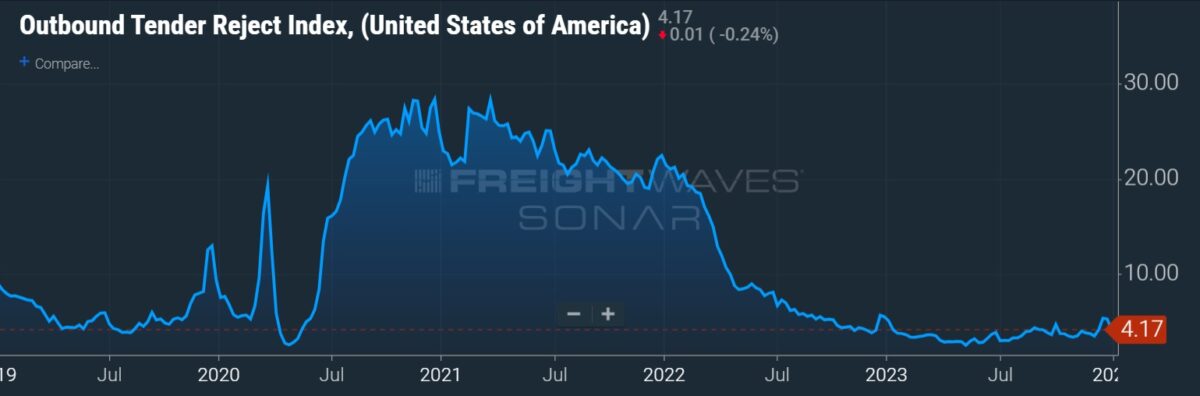
Chart: (SONAR: OTRI.USA). A proxy for truck capacity, the Outbound Tender Reject Index, shows the number of loads being rejected by carriers. Carriers are currently rejecting 4% of all loads tendered under contract compared to cycle highs of more than 25%. To learn more about FreightWaves SONAR, click here.

For the full year, 20% of shippers expect TL rates to be flat. However, the response category of “down more than 4% y/y” received the second-largest number of votes at 15%.

That might be wishful thinking from shippers as Shanker’s base case for TL rates — excluding fuel surcharges — is flat to up mid-single-digits for the full year. Again, the comps from the prior year are negative.

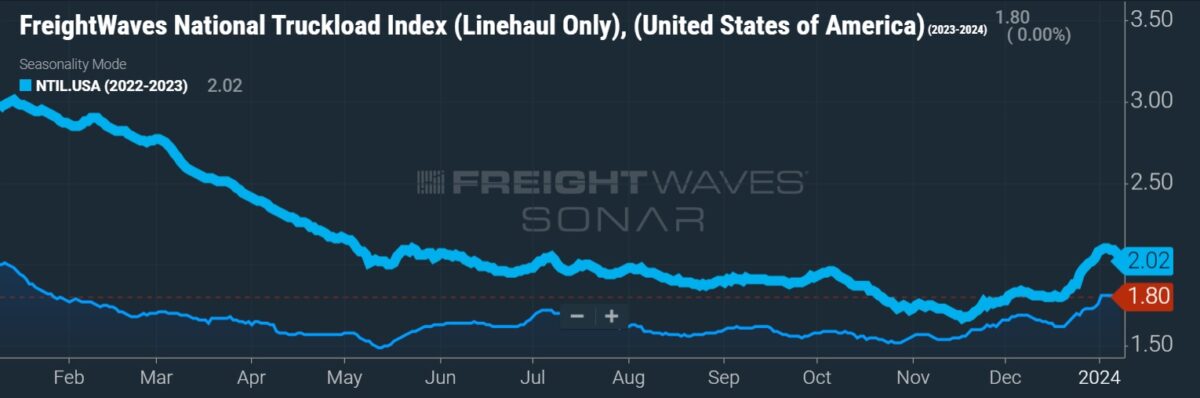
Chart: (SONAR: NTIL.USA). The National Truckload Index (linehaul only – NTIL) is based on an average of booked spot dry van loads from 250,000 lanes. The NTIL is a seven-day moving average of linehaul spot rates excluding fuel. Spot rates are currently 11% lower y/y.

Shanker doesn’t expect management teams to express his exuberance when they report fourth-quarter results and provide full-year earnings guidance in the coming weeks. He’s expecting their outlooks to be a “tale of two halves,” with the first half clouded by broader macro uncertainties coupled with more constructive commentary around the back half.

He said the TLs and less-than-truckload carriers will likely be the winners in an upcycle, favoring the risk-reward setup for TLs more given the outperformance in shares of LTL carriers last year. His top pick is Knight-Swift Transportation (NYSE: KNX) followed by TFI International (NYSE: TFII) and Schneider National (NYSE: SNDR).

Shanker also noted a disconnect brewing in LTL as investors bullish on the space believe shippers will pay “super-premium rates” even though some carriers are now “sitting on 30-40% excess [terminal] capacity” following Yellow’s terminal auctions. While those terminals aren’t expected to be reopened all at once, Shanker said that rate scenario is likely “untenable … unless we have a record upcycle.”

This year will be a big year for two of those three carriers as they integrate billion-dollar acquisitions. Knight-Swift acquired U.S. Xpress for more than $800 million in July and TFI plans to close on its $1.1 billion bid for flatbed carrier Daseke (NASDAQ: DSKE) in the second quarter.

“We are more bullish as we believe the pressure to restock is likely to be more intense than carriers or shippers believe,” Shanker concluded. “We believe only a black swan event or severe recalibration of macro expectations will push the upcycle into 2025.”

More FreightWaves articles by Todd Maiden

Cali puts drayage in the crosshairs; why brokers Zyn; Manifest takes Vegas – WTT

On today’s episode of WHAT THE TRUCK?!? Dooner is talking to Harbor Trucking Association’s Matt Schrap about drayage entering California’s crosshairs. We’ll learn how new CARB and AB5 regulations will impact West Coast ports in ’24. 

Manifest kicks off the winter conference season with their blockbuster event in Las Vegas. We’ll hear from Pam Simon about what’s on the agenda this year and who’s going to take the stage at their big event.

CDL 1000’s Niraj Mahapatra is helping carriers get ahead of green regulations with new tools aimed at tracking and reducing emissions. 

Is there a Zyn epidemic at America’s freight brokerages? TMX Logitran’s Stephen Ruhe talks about why Zyn culture is sweeping the nation. 

Plus, 95% of container ships that would’ve transited the Red Sea are now going around the southern tip of Africa; how to call in sick; a guide to catching ducks; missing cat goes over the road and more.

Watch on YouTube

Subscribe to the WTT newsletter

Apple Podcasts

Spotify

More FreightWaves Podcasts

Texas cargo bridge projects could be expedited under new law

Several Texas-Mexico border infrastructure developments recently received a boost after a new law took effect that speeds up the federal approval process for international cargo bridge projects.

U.S. Rep. Henry Cuellar, D-Laredo, and U.S. Sen. Ted Cruz, R-Texas, led the policy change effort to reform the presidential permitting process for new and expanded border bridges, with the focus on international crossings in Laredo, Eagle Pass and Brownsville, Texas.

The bill, which sets a maximum 120-day timeline for the president to decide whether to approve a permit for international border crossings, was signed into law by President Joe Biden on Dec. 22. The previous process used by the Biden administration required an environmental review, which could have taken several years, according to Cuellar.

“We now have changed the law that will move the bridge permitting faster, that means we can move the construction of the bridges at [Laredo’s] World Trade Bridge, construction of the Laredo-Colombia Solidarity International Bridge much, much faster,” Cuellar said at a news conference Thursday in Laredo. “Last year, we had more than $863 billion worth of trade between the U.S. and Mexico, 40% of that trade came through this port in Laredo.”

A project to expand the World Trade Bridge from eight to 18 lanes and the Colombia-Solidarity Bridge from eight to 16 lanes has been in the works for years. 

Laredo currently has three bridges, including two commercial cargo bridges — the World Trade Bridge and the Colombia-Solidarity Bridge. The World Trade Bridge connects to Nuevo Laredo, Mexico. The Colombia-Solidarity Bridge is further north and connects Laredo to the community of Colombia in Nuevo Leon, Mexico. 

Port Laredo — which includes the World Trade and Colombia-Solidarity bridges, as well as an international rail bridge and Laredo International Airport — is currently the No. 1-ranked U.S. international trade gateway. In October, two-way trade in Laredo totaled $28.7 billion.

The bridge expansion projects are aimed at decreasing growing wait times for cargo trucks crossing the bridges, Cuellar said.

“Bridges serve as economic lifelines for our border communities, facilitating international trade and commerce,” Cuellar said. “However, drivers and truckers often report lines stretching for thousands to cross, delaying the transportation of goods and costing our economy millions.”

Another commercial development that could be expedited includes the Puerto Verde Global Trade Bridge project, which would construct a cross-border rail and truck freight bridge between Eagle Pass and Piedras Negras, Mexico. 

A fourth project in Brownsville aims to expand an international passenger vehicle bridge.

Under the new law, the State Department has 60 days to recommend to the president whether to approve a permit for an international bridge project in South Texas. The president then has 60 days to approve the permit request. If the president does not act, the permit is automatically granted.

More articles by Noi Mahoney

CBP reopens 4 Southwest ports of entry after weekslong closures

US, Mexican partnership to expand international rail-car ferry service

Canadian trucking company suspended after multiple overpass crashes

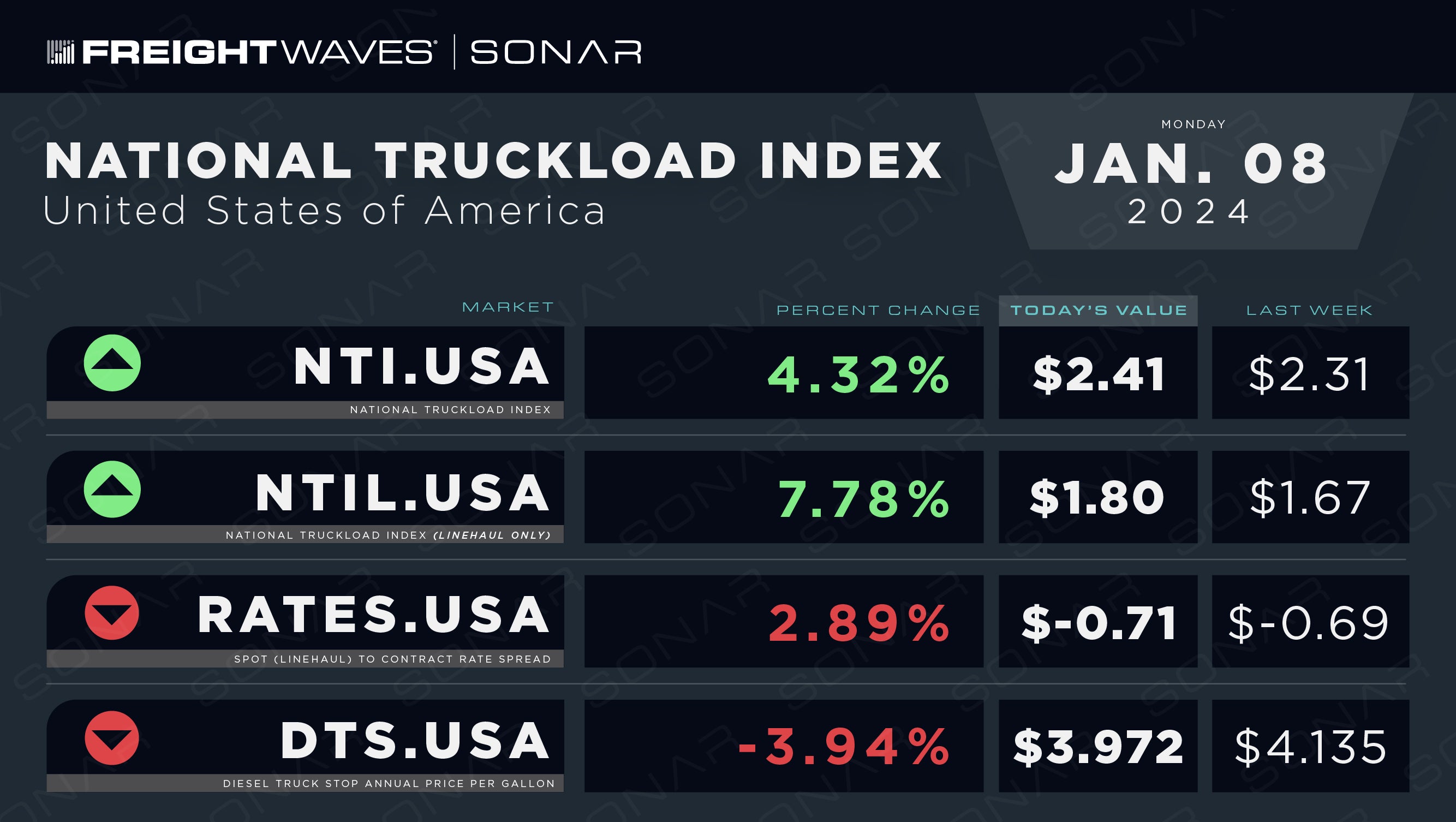
Weekly NTI Update: January 08, 2024


Learn more at SONAR.FreightWaves.com