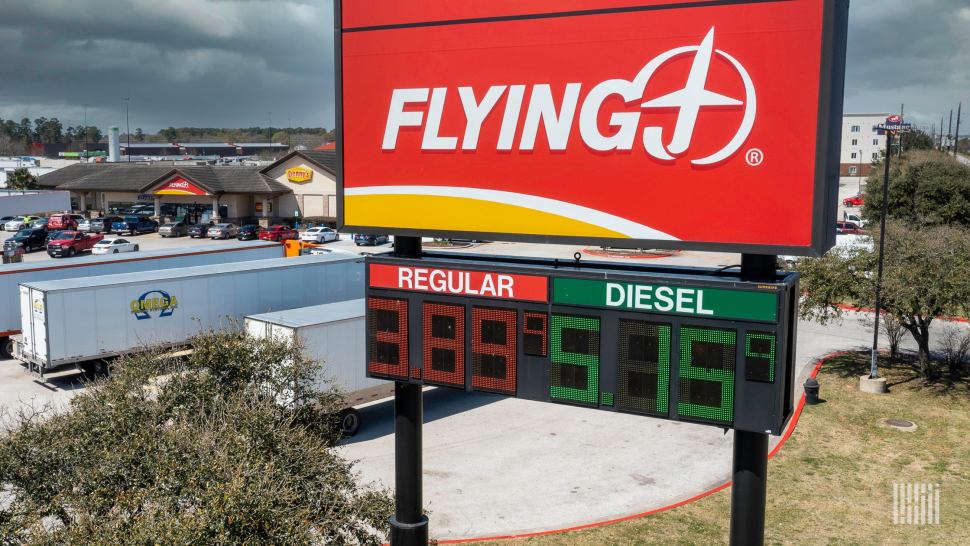
With travel stop operator Pilot Travel Centers now 80% owned by Berkshire Hathaway, the conglomerate’s first earnings report since Berkshire took its ownership up to that level is providing a more complete look at Pilot’s finances.
Pilot had been privately owned but with a 38.6% interest held by Berkshire Hathaway, acquired in 2017. The sale of the additional shares bringing Berkshire up to 80% was finalized earlier this year, though it had been agreed upon previously. The founding Haslam family owns the remaining 20% of Pilot.
The new ownership benchmark results in more detailed financial data being reported as part of Berkshire Hathaway’s quarterly earnings report.
Among the key points in the report, which did not discuss Pilot’s business in detail:
- Revenues for the second quarter at Pilot were $14.8 billion, down from $21.5 billion in the corresponding period of 2022. For the first six months of the year, revenues at Pilot were $29.3 billion, compared to $36 billion a year earlier.
- Pretax earnings were $186 million in the second quarter, compared to $241 million last year. For the first six months, pretax earnings were $411 million compared to $542 million a year ago. Earnings before income taxes at Pilot were $186 million in the second quarter and $322 million for the first six months. Corresponding figures for 2022 were not provided.
- Net earnings attributable to Berkshire Hathaway shareholders were $114 million in the second quarter. The company did not provide a prior-year comparison, and the data for the first half of the year is only for five months, dating back to when Pilot increased its share to 80%. That figure shows net earnings of $197 million.
- Pilot’s sales for the first six months of 2023 were approximately 9.25 billion gallons of all fuels, which include diesel, gasoline and “other fuel-related products.” No corresponding figure for 2022 was disclosed.
More articles by John Kingston
PIlot launches partnership with RTS Financial for factoring services
Oil giant BP buying major truck stop chain TravelCenters
After declines and revisions, US truck jobs now below October 2022 level
Brokerage Compliance Symposium
The day before F3. Every compliance issue you face - fraud exposure, carrier liability, FMCSA rules, cargo theft, insurance gaps - navigated by attorneys and operators defining best practices in a changing industry.
F3 Awards Dinner
The night before F3. FreightTech100 companies honored. FreightTech 25 and Shipper of Choice winners revealed live. Cocktail reception into dinner and live music - 300 industry leaders in one purpose-built room.
F3: Future of Freight Festival
Industry-defining keynotes, rapid-fire technology demos, and industry leaders networking in experiences across Chattanooga - plus the inaugural F3 Awards Dinner featuring the FreightTech and Shipper of Choice reveals.
The day before F3. Every compliance issue you face - fraud exposure, carrier liability, FMCSA rules, cargo theft, insurance gaps - navigated by attorneys and operators defining best practices in a changing industry.
The Signal at Chattanooga Choo Choo • Chattanooga, TN Register NowThe night before F3. FreightTech100 companies honored. FreightTech 25 and Shipper of Choice winners revealed live. Cocktail reception into dinner and live music - 300 industry leaders in one purpose-built room.
The Signal at Chattanooga Choo Choo • Chattanooga, TN Register NowIndustry-defining keynotes, rapid-fire technology demos, and industry leaders networking in experiences across Chattanooga - plus the inaugural F3 Awards Dinner featuring the FreightTech and Shipper of Choice reveals.
The Signal at Chattanooga Choo Choo • Chattanooga, TN Register Now