
Intersection of tech and fraud: Brokers, carriers must work together to secure supply chain

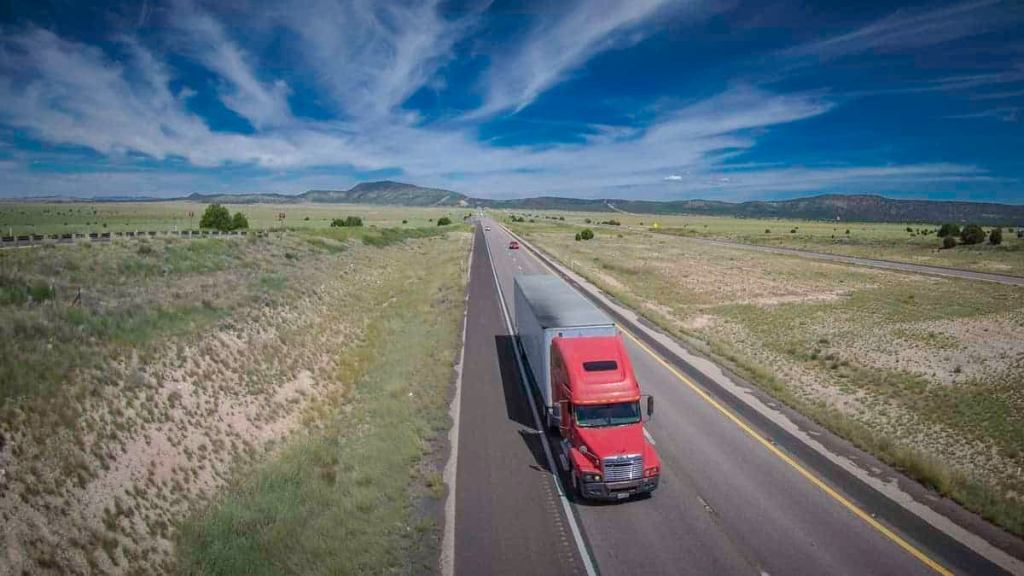
A truck rolls down the highway. (Photo: Jim Allen/FreightWaves)

The introduction of tech-enabled solutions has made the transportation industry more efficient and effective at moving and tracking freight. However, the widespread adoption of digital solutions has also created opportunities for scammers across the supply chain. 

Challenging economic conditions have only escalated fraudulent activities as criminals continue to find ways to exploit vulnerabilities. In fact, CargoNet’s third quarter 2023 report shows an increase across all types of cargo theft, including outsized growth in strategic cargo theft events like double-brokering shipment misdirection attacks. 

“We caution the industry that throughout this year, strategic cargo theft rings have picked up activity around holiday periods,” CargoNet reported in a recent press release. “We also caution that strategic cargo theft groups continue to pioneer new methods of strategic cargo theft that seek to evade common compliance practices used by logistics brokers.”

Technology Creates More Sophisticated Theft Tactics

When discussing cargo fraud, straight theft – when cargo is stolen physically from a carrier – often dominates the conversation. While this type of fraud is still a problem, more modern strategies, including strategic theft and cyber attacks, also pose a serious threat to transportation companies.

“Across the board, fraud is exceptionally high across all channels,” Truckstop CEO Kendra Tucker said. “There are literally thousands of fraudulent actors that we have helped to take out. The types of fraud continue to evolve, disrupting the security of the industry.”

These newer types of fraud flourish in an increasingly digital and connected freight world. Technology is now woven into the fabric of the industry – helping brokers, carriers, shippers, and the supply chain increase automation and improve transparency to get more done faster.

However, the rapid acceleration of supply chain technologies has created multiple touchpoints scammers can access. And the lack of standardized security regulations only makes it easier and more tempting for criminals.

The First Line of Defense

Combatting fraud isn’t easy, but trusted collaboration is the key to protecting the supply chain from the growing number of bad actors. When brokers and carriers commit to building relationships based on trust and transparency, it becomes more difficult for fraudsters to exploit either party, creating a trusted and reliable network that is continuously alert.

There are several ways that players across the industry can promote collaboration, both among their peers and with outside sources like law enforcement.

For brokers, prioritizing communication and transparency is one of the best ways to reduce fraud risks. That commitment must extend to its shipper customers, carrier partners, broker peers, and law enforcement agencies like the FBI.

Implementing non-negotiable security practices can also prevent fraud and keep cargo safe. Utilizing the Truckstop RMIS Carrier Onboarding and Monitoring helps spot and stop suspicious activity by automating carrier onboarding and monitoring. With RMIS, brokers can vet carriers thoroughly and track performance, mitigating the ongoing risk of carrier fraud that continues to plague the industry. Through Truckstop’s exclusive partnership with Carrier Assure, users can even assess a carrier’s daily performance, alerting them to potential issues early.

Load boards can take the initiative to protect the industry by putting tools in place to verify the identity of brokers and carriers. Using advanced identity verification and validation with the help of multi-factor authentication confirms people are who they say they are before doing business. Load boards must also employ regulations that will help continuously monitor behaviors and adjust based on evolving fraud schemes.

Carriers play an important role in keeping the industry safe. They must also do their due diligence in vetting brokers. Confirming the legitimacy of a haul, especially when the rates seem too good to be true, can help uncover more nefarious activities. Reporting suspicious behavior or cargo theft crime is critical to help organizations like the FBI uncover major theft organizations and advocate for more government action to secure the freight industry.

Building a Trusted Network is Key

Ongoing freight market fraud has eroded trust between all parties, creating an environment of suspicion that, ironically, leaves companies even more vulnerable to bad actors. But when each player moves to create a safer supply chain, it builds trust for every load being hauled.

“Trust between carriers and brokers increases efficiency and confidence in the transportation industry,” Tucker said. “Increased broker transparency creates a secure, reliable supply chain where everyone benefits.”

All members of the supply chain must commit to building communities of trust in order for the initiative to succeed at the largest scale. This requires collaborative effort at every turn and a willingness to embrace tools designed to protect against fraud in today’s digital world.

Click here to learn more about Truckstop

Your top 5 WHAT THE TRUCK?!? episodes of the year

Welcome to the WHAT THE TRUCK?!? Newsletter. In this issue, the top 5 WTTs of the year, FourKites layoffs and speed limiter clapback.

Your top episodes of WTT ’23

Not a huge surprise here: Yellow and Convoy reporting ruled the news cycle. And how couldn’t they? They represent the largest trucking bankruptcy in history and the largest venture-backed company collapse in this space. Here were your top 5 most-watched episodes of WTT in 2023.

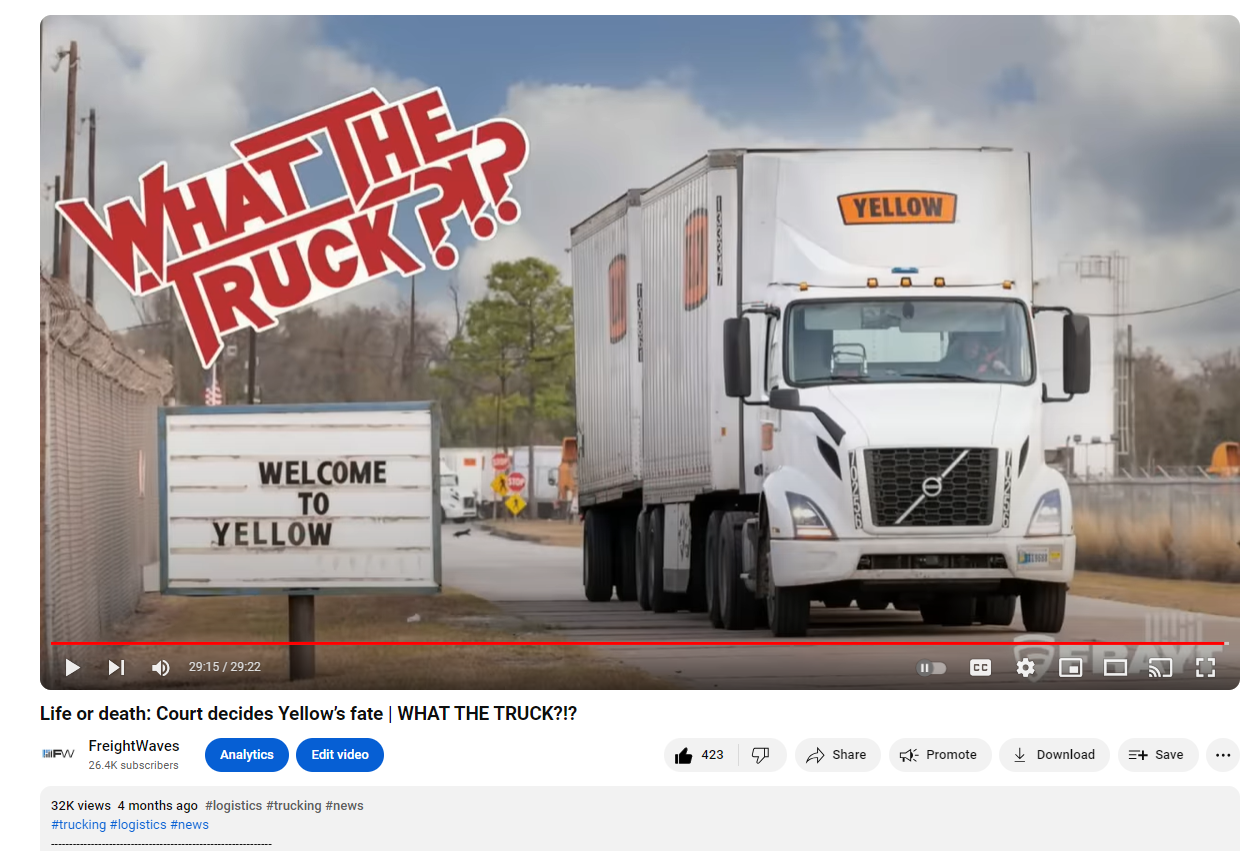
#1 Life or death: Court decides Yellow’s fate

Watch https://www.youtube.com/watch?v=BW5Ml_fc0-E

July 21 — As Yellow’s fate was being decided by a court in Kansas City, a panel of experts broke down the decision that sealed the 99-year-old LTL carrier’s coffin. 

With special guests Michael Bookout, co-founder of MyCarrierTMS; Todd Maiden, finance editor at FreightWaves; Matthew Leffler, The Armchair Attorney; and FreightWaves’ Zach Strickland.

#2 Yellow’s final Friday; port strikes; and escalating fuel costs


Watch: https://www.youtube.com/watch?v=aHpGxVlJcdE 

July 28 — With news of Yellow’s shutdown coming in just days, Dooner caught up with CNBC’s Lori Ann LaRocco, Trauxit’s Joe Stevens and Hell Bent Xpress’ Jamie Hagen.

#3 Convoy cancels all loads; why freight companies fail; and unpopular opinions


Watch: https://www.youtube.com/watch?v=IXTHFjHRC4I 

Oct. 18 — With the sudden news that Convoy may be shutting down, Dooner broke down the situation with FreightWaves’ Craig Fuller, Thomas Wasson and Justin Martin, Shatranj Capital Partners’ Brittain Ladd and Steam’s Lee Britain.

#4 Yellow drivers speak out; UPS backup plans; beating cancer and a down market


Watch: https://www.youtube.com/watch?v=Jbnnlp3xuks 

July 24 With time running out for Yellow, Dooner caught up with a pair of its drivers to see what the boots on the ground workers thought of the situation. With special guests Yellow drivers Jay and Dwayne; Luke Denny, co-founder and CEO at Frayt; John Seidl, vice president of risk services at Reliance Partners; and High Performance Logistics Sales’ Dan Deigan.

#5 The largest trucking bankruptcy in history


Watch: https://www.youtube.com/watch?v=jYqYvMFFRek 

July 31 — With word becoming official that Yellow would shut down, Dooner caught up with special guests Covenant’s Matt McLelland; Anderson Trucking Service’s Robert Powell; trucker Michael Lombard; and Marine Traffic’s Adil Ashiq.

Thank you It’s been a challenging year in this space, but I’d like to thank all of our listeners and guests who helped bring clarity, guidance and memes to a very messy market. You can catch all of our back episodes on YouTube right here or if you prefer audio only, just look up WHAT THE TRUCK?!? on any podcast player.

FourKites cuts 15%


X

Supply chain visibility platform FourKites has cut 15% of its staff in a move it says is aimed at getting the “burn rate to zero.” 

FreightWaves’ Grace Sharkey reports, “The move included the departure of another key executive, Glenn Koepke, vice president of strategy. Koepke played a crucial role in leading industry strategy and go-to-market execution, particularly in sectors like food and beverage, consumer packaged goods, and logistics solutions.”

FourKites, like many FreightTech firms, has had a rough go in 2023. Prior to these layoffs, it went through what it labeled “routine internal organizational changes.” Those included the departure of then-President Rocky Subramanian.


X

Industry insiders have recently raised concerns about FourKites as it tries to stop its cash burn and negative growth. Others have wondered if FourKites’ role as a global player has diminished as it loses sales presence in Europe, China and Japan. 

As cash reserves dwindle for venture-backed companies, 2024 could be do or die time in this space.

Clapping back on speed limiters

“But I hope you equally consider the 15,000 comments from America’s truckers who have provided input on this rulemaking. They’re not going to be able to host a big fundraiser for you.” U.S. Rep. Troy Nehls, R-Texas

Are the speed limiters coming? FreightWaves’ John Gallagher reports, “One of the biggest concerns surfacing in the three-and-a-half-hour House Transportation and Infrastructure highway subcommittee hearing on Wednesday related to the ethics of the speed limiter rulemaking process.”

The issue is over the FMCSA rescinding a 68 mph limit on electronic speed governors in trucks. The agency now wants speed limiters set at 60 mph. Republicans are questioning Federal Motor Carrier Safety Administration chief Robin Hutcheson about a fundraiser she attended that was sponsored by “labor unions, trial attorneys, large trucking companies.”

One fleet owner said, “We have speed limiters out there now. They’re called speed limit signs.”

We’ll know which speed limiter number sticks by the end of the month when the FMCSA is expected to issue a notice. Follow Gallagher for the latest and read the full report here.

WTT Friday

A Very WHAT THE TRUCK?!? Christmas Join us on Friday’s episode of WHAT THE TRUCK?!? for our final episode of the year as we celebrate this year in freight.

We’re joined by very special guest: Wreaths Across America’s Courtney George; Brown Dog Carrier’s Graig Morin; Qued’s Tom Curee; FreightCaviar’s Paul-Bernard Jaroslawski; Lost Fr8’s Reed Loustalot; and The Armchair Attorney Matthew Leffler.

Catch new shows live at noon EST Mondays, Wednesdays and Fridays on FreightWaves LinkedIn, Facebook, X or YouTube or on demand by looking up WHAT THE TRUCK?!? on your favorite podcast player.

Now on demand

Haulin’ for the Holidays; carriers say Convoy owes them cash; golf logistics

Does trucking need a Barbie; Supply Chain Bingo; freight theft trends

Thanks for reading and have a very happy holiday season! See you in 2024.


Tweet @ Dooner

Subscribe to the newsletter

Subscribe to the show

Apple Podcasts

Spotify

YouTube

TikTok

Twitter

Or simply look up WHAT THE TRUCK?!? on your favorite podcast player. 

All FreightWaves podcasts can also be found on one feed by looking up FreightCasts wherever you get your podcasts. 

Don’t be a stranger,

Dooner

Freight cycle bottom continues to form in November

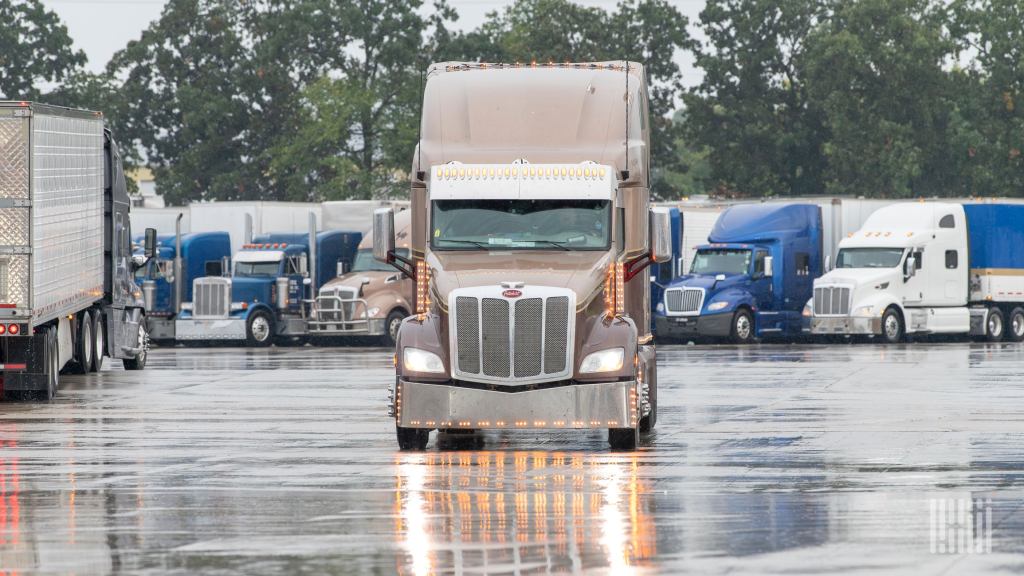
Several trucks in the rain at a truckstop

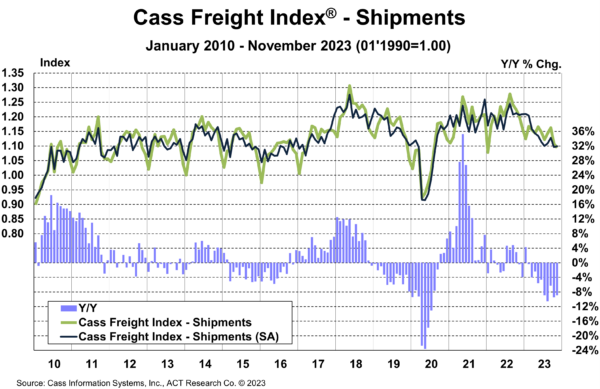
Freight shipments and expenditures dipped further in November, according to data compiled in the Cass Freight Index.

Shipments were down 8.9% year over year (y/y) in the month and off 1.3% from October (up 0.3% on a seasonally adjusted basis). The latest reading puts Cass’ shipments index at its lowest level since January 2022. However, the report said the declines are flattening, with December also likely to produce a 9% y/y decline.

“The acceleration in real disposable incomes, supported by a surprisingly sharp disinflation, and the ongoing strong labor market suggest demand fundamentals will improve in 2024,” said ACT Research’s Tim Denoyer in a Thursday report.

November 2023
y/y

2-year

m/m

m/m (SA)
Shipments-8.9%-9.3%-1.3%0.3%
Expenditures-25.6%-22.1%-1.3%0.9%
TL Linehaul Index-7.5%-5.9%-0.3%NM
Table: Cass Information Systems. SA (seasonally adjusted)

Expenditures were off 25.6% y/y and down 1.3% from October (up 0.9% seasonally adjusted). The November reading was the lowest since February 2021. However, backing out the change in shipments, actual rates were roughly flat with October (up 0.6% seasonally adjusted).

The expenditures index measures the total amount spent on freight and accounts for changes in fuel surcharges, accessorials and modal mix. After rising 38% in 2021 and 23% in 2022, the index is likely to be off 18% this year. Denoyer said if traditional seasonal patterns hold, the data set will likely be off again by 14% in the first half of 2024.

“We continue to expect modest y/y growth in consumer spending this holiday season, driven by the acceleration in real disposable incomes and the ongoing strong labor market,” Denoyer said. “The recent easing in fuel prices improves our confidence that peak season will end on a higher note.”

Cass’ truckload linehaul index, which excludes fuel and accessorials, fell to a cycle low, down 0.3% sequentially and 7.5% y/y. The index was at its lowest level since February 2021 during the month, but the y/y declines continued to narrow. Compared to two years ago, the index was down 5.9%.  

“With spot rates stabilizing over the past several months, downward pressure on the larger contract market is lessening, with a few instances of contract rate increases bucking the downtrend of late,” Denoyer said.

The TL linehaul index includes both spot and contract freight.

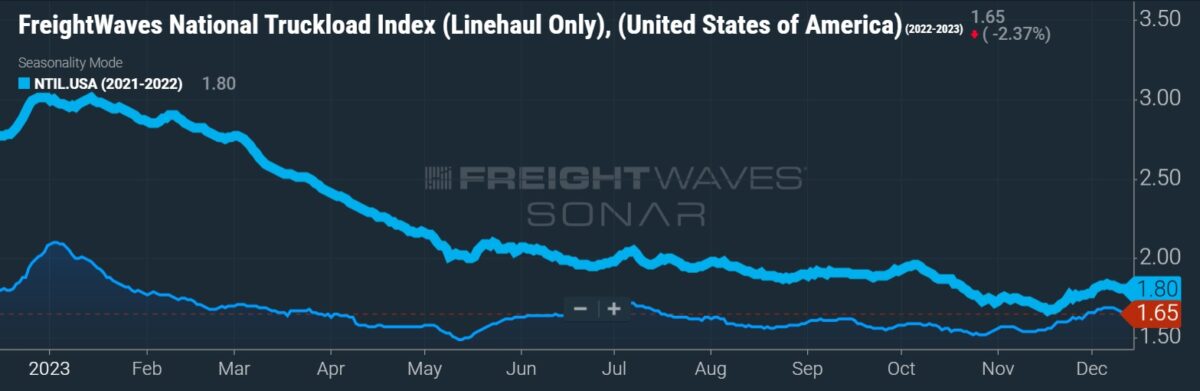
Chart: (SONAR: NTIL.USA). The National Truckload Index (linehaul only – NTIL) is based on an average of booked spot dry van loads from 250,000 lanes. The NTIL is a seven-day moving average of linehaul spot rates excluding fuel. Spot rates are still 8% lower y/y. To learn more about FreightWaves SONAR, click here.

Denoyer noted that recent private fleet expansions have pulled some freight out of the for-hire trucking market, but that overall, softer rates are pushing “net revocations of operating authorities to a record net pace.”

“The surprising strength in the economy in 2023 may provide less support for freight in 2024, but supply contraction should propel the cycle forward in 2024, causing the trajectory of rate trends to change, even if the broad economy slows,” Denoyer concluded.

Data used in the Cass indexes is derived from freight bills paid by Cass (NASDAQ: CASS), a provider of payment management solutions. Cass processes $44 billion in freight payables annually on behalf of customers.

More FreightWaves articles by Todd Maiden

Loaded and Rolling: RXO: Too much trucking capacity heading into 2024

RXO: Too much trucking capacity heading into 2024

(Video source: FreightWaves)

On Wednesday, FreightWaves hosted the Domestic Supply Chain Summit, a virtual event with RXO Chief Strategy Officer Jared Weisfeld as the keynote speaker. The interview, conducted by enterprise trucking carrier expert Thomas Wasson, included an outlook for 2024 and highlighted the biggest supply chain challenges and opportunities. RXO is the freight brokerage that was spun off from LTL carrier XPO last year.

Excess truckload capacity and carrier exits were a central theme. Weisfeld noted that since October 2022, each month has seen more net revocations in operating authorities than carriers entering the market. He added, “That’s encouraging but not yet at the pace that’s required to bring that load-to-truck ratio above where it is right now, which is about 3-to-1. The long-term average is about 4-to-1. You’ll start seeing the spot market reemerge when we start seeing that punch up above that. There’s still too much capacity in the market.”

Another topic highlighted was the growth in 3PL/brokerage market penetration that began during the consumer COVID- and stimulus-inspired spending boom. Weisfeld told Wasson, “If you look at 3PL/brokerage penetration as a percentage of the for-hire truckload market, we estimate about a year ago it was around a low 20%, up from close to 10% a decade ago.” Asked if this trend will continue, Weisfeld was bullish, adding, “If you’re a shipper and can get better access to technology, incredible service, more flexibility — we think that penetration can increase to 40-50% over the long term, as a percentage of the $400 billion for-hire truckload market. We think RXO is going to be a winner in that trend.”

Experts caution structural risks to supply chain remain

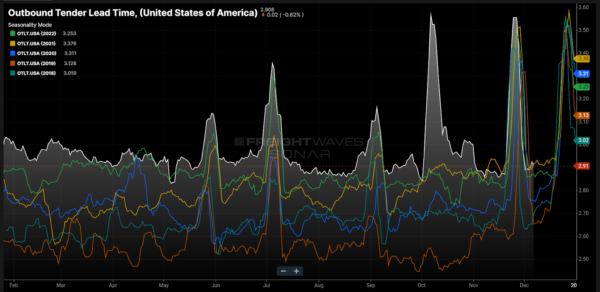
(Source: FreightWaves SONAR)

On Thursday, FreightWaves’ Rachel Premack wrote an article arguing that the impacts of the pandemic on supply chains may not have caused any lasting structural changes. Premack writes, “Ultimately, the reason we’re no longer in a supply chain crisis isn’t that companies did anything particularly amazing to overhaul their manufacturing and distribution systems. Rather, we just started buying less stuff than we did in the peak of 2020 to 2021 — and corporations were able to catch up at last.” 

This comes as Outbound Tender Lead Times (OTLT) in 2023 remain elevated and are 10%-15% higher than pre-pandemic levels. Dustin Jalbert, senior economist of wood products at FastMarkets RISI, adds, “I don’t think a lot has changed. I think a lot of people assume that there was a paradigm shift during the pandemic … . Structurally, nothing has really changed in the market from a supply standpoint.” Given lower transportation costs and abundance of truckload capacity, there appears to be little incentive to keep higher inventory levels in the face of uncertain consumer demand.

“We are not seeing retailers/manufacturers embrace higher inventory,” notes Sandy Gosling, a partner in consultancy McKinsey’s Miami office. “In fact, most of what we see being reported is inventory being right sized after many months of being too high. Of course, this varies by industry and will continue to remain an important trade-off for companies as they consider lead time due to source locations, cost to carry, and service levels to their customers.”

Market update: Cass November data suggests painful peak season

(Source: Cass Information Systems / ACT Research)

On Thursday, freight audit and payment provider Cass Information Systems released its November Transportation Index report, “Painful Peak Season Proceeds.” The Cass shipments index fell 1.3% month over month (m/m) and is down 8.9% year over year. The report notes the larger y/y declines “remain exaggerated by unusual excess inventory repositioning in 2H’22.”

The total amount spent on freight also saw declines, with the Cass Freight Expenditures Index falling 1.3% m/m in November and down 26% y/y. The report infers that rates were flat in the past month as both shipments and expenditures fell 1.3% m/m. It adds that private fleet expansion continues to pull freight from the for-hire truckload market, but the report notes changing supply patterns may disrupt this trend. Net revocations of operating authorities remain at record levels driven by falling pent-up capex and lower freight rates.

Regarding freight expectations, the report notes some optimism, adding, “We continue to expect modest y/y growth in consumer spending this holiday season, driven by the acceleration in real disposable incomes and the ongoing strong labor market. The recent easing in fuel prices improves our confidence that peak season will end on a higher note.”

FreightWaves SONAR spotlight: DOE/EIA fuel price falls below $4 per gallon

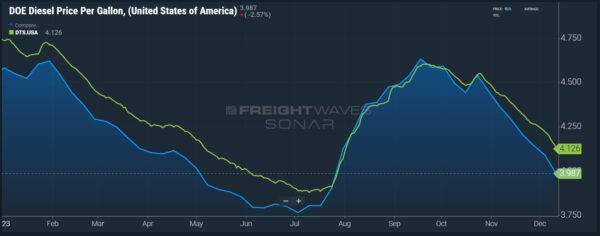
(Source: FreightWaves SONAR)

Summary: On Monday, the Department of Energy/Energy Information Administration reported that the nationwide weekly retail diesel price at the pump fell 10.5 cents per gallon to $3.987. The last time the DOE/EIA fuel price was below $4 per gallon was July 24. Diesel prices paid at the pump are 76 cents per gallon lower than this time last year.

FreightWaves’ John Kingston wrote that the current early downward movement for diesel markets partly stems from winter weather not arriving, with forecasts for the next two weeks predicting considerably higher-than-normal temperatures for December. Another factor to watch is futures market movement. Kingston wrote, “Monday’s decline in the DOE/EIA price came as the futures market for ultra low sulfur diesel on the CME commodity exchange has reversed itself significantly over the past two trading days after seven days of declines.”

According to the EIA’s short-term energy outlook, crude oil prices, which make up around 46% of the retail price of diesel, are expected to rise into 2024. The report cites the recently announced OPEC+ production cuts totaling around 2.2 million barrels per day as a catalyst for higher Brent crude spot prices into 2024. The current December spot average of $78 per barrel is expected to rise to $84 per barrel in the first half of 2024. For domestic production, the report is more upbeat, stating, “We expect net exports of U.S. crude oil and petroleum products to reach a record high of almost 2.0 million barrels per day (b/d) in 2024, up from around 1.8 million b/d this year and 1.2 million b/d in 2022. This growth is primarily driven by an increase in U.S. crude oil and hydrocarbon gas liquids production.”

Some Convoy carriers say collapsed startup owes them thousands of dollars (FreightWaves)

Trailer side-guard rule likely delayed until at least October 2024 (FreightWaves)

Terminal raises $3.1M, wants to be the ‘Plaid of trucking’ (FreightWaves)

Motive Monthly Economic Report — December 2023 (Motive)

Republicans pan truck speed limiter proposal at House hearing (FreightWaves)


California asks EPA for waiver to implement Advanced Clean Fleets rule (FreightWaves)

Like the content? Subscribe to the newsletter here.

Wabtec joins rail telematics market

Devices such as multiple sensors laid out on a table.

Pittsburgh-headquartered Wabtec has signed an agreement with Dutch company Intermodal Telematics to produce telematics technology for rail cars.

Wabtec, a rail technology provider, says the product could be ready in the first quarter of 2024. Wabtec (NYSE: WAB) will use Intermodal Telematics’ technology to create the rail car telematics offering.

The telematics technology enables rail car owners and operators to access real-time data to see the location and status of individual rail cars and monitor rail car components such as hand brakes, hatches and doors, according to Wabtec. Tank car owners and operators will be able to track a tank car’s cargo temperature and pressure as well.

Having this information will also allow rail car owners and operators to develop insights on how to optimize rail cars’ performance and predict maintenance needs, Wabtec said.

The technology will consist of sensors, gateways, wireless communications and analytics, and it will be made available for retrofit on existing fleets as well as integrated onto new rail cars, Wabtec said in a Thursday release. It will be available in North America as well as other areas globally, per the agreement. 

Wabtec’s partnership and new offering come as others in the industry have been seeking not only to provide more real-time data on rail cars, but to use that data to help make supply chain flows more efficient.

For example, RailPulse, a coalition of eight rail car owners consisting of rail equipment manufacturers, rail lessors and some Class I railroads, has been seeking to develop what it describes as “a neutral, open-architecture, industry-wide railcar telematics platform” that uses rail car-mounted sensors to cull data on rail car movements. And Quincy, Massachusetts-based RailState has been deploying sensors along the Canadian and U.S. rail network to provide insights on regional network flows.

“The rail industry is on the verge of a new era where the use of real-time data about the status and condition of cargo will be transformative to the customer experience and supply chain efficiency,” Nalin Jain, Wabtec group president of digital intelligence, said in the release. “Telematics builds on Wabtec’s rich history serving the freight car markets with next-generation solutions. Our innovative solutions will improve shipment visibility, increase on-time performance, and expand asset utilization to make shipping freight by rail more competitive.”

Subscribe to FreightWaves’ e-newsletters and get the latest insights on freight right in your inbox.

Click here for more FreightWaves articles by Joanna Marsh.

Ramaswamy to roll out trucking policy at Iowa 80

Vivek Ramaswamy

Vivek Ramaswamy, a Republican presidential candidate, will host an event at Iowa 80 on Dec. 21 that’s all about the American trucking industry and its workers. 

According to a Thursday press release, Ramaswamy will roll out his “official trucking policy” at the event. Members of CDL Drivers Unlimited, a new membership alliance for truck drivers, will share “concerns about trucking-related issues” at the event too. 

It’s unusual for presidential candidates to specifically target the truck driver community, even though federal data says there are more than 2 million tractor-trailer truck drivers in the United States. 

In the release, Ramaswamy emphasized last year’s Freedom Convoy, in which hundreds of truck drivers blocked Ottawa and other parts of Canada to protest vaccine mandates for cross-border truck drivers, and Canada’s response to that protest, which includes charges like mischief and obstructing police, for more than 140 people.

“Truckers are a crucial link in the American supply chain that power America’s economy. They’re not just haulers of goods — they’re the guardians of freedom on our highways,” Ramaswamy said in the release. “Last year, we watched as the ‘Freedom Convoy’ in Canada unmasked the perils of government overreach — speech was censored, peaceful protesters were arrested, and big banks froze personal funds. Those Canadian truckers taught the world a valuable lesson about the power of civil protest against an out-of-control totalitarian government. On Thursday, Dec. 21, join me at Iowa 80, the World’s Largest Truckstop, where I will lay out my detailed plan for how we support our truckers and ensure freedom for all.”

Recent polls suggest that former President Donald Trump is by far the leading Republican candidate among the GOP electorate. Morning Consult, one leading pollster, found that 67% of likely voters who are Republican would vote for Trump, followed by Florida Gov. Ron DeSantis (13%), former South Carolina Gov. Nikki Haley (10%) and Ramaswamy (6%).

How Freight Ninja is changing the game in truck parking

Imagine you’re behind the wheel of a tractor-trailer. You’re nearing the end of an 11-hour shift and you’re exhausted. Now you face a daunting task: finding a place to park.

It’s a routine that unfolds night after night, each time a reminder of the reality that for every available parking spot, there are 11 trucks vying for it. This isn’t just a daily inconvenience, it’s a significant hurdle in the life of a trucker.

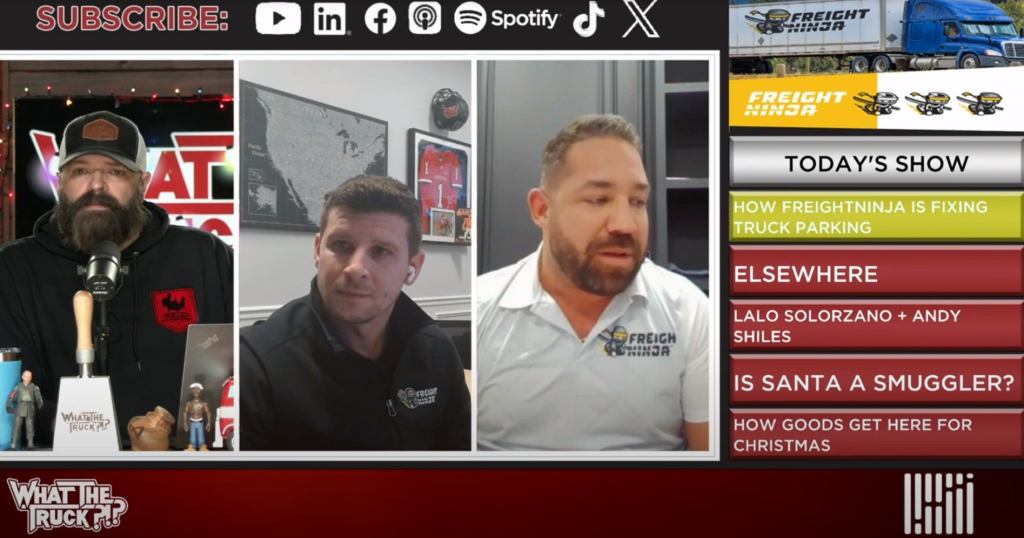
Against this backdrop, Freight Ninja is one potential solution. Its services were the topic of discussion during an interview on Friday’s episode of What the Truck?!? between FreightWaves’ Dooner and Freight Ninja CEO John Borsellino and COO Chris Lantz. During the conversation, the pair delved into how their company is tackling this persistent issue. 

Community and security at the forefront

Freight Ninja isn’t just about providing parking spaces. Part of its mission is to create a community for truckers. 

Lantz emphasized a commitment to monthly parking over daily options, which cultivates a sense of belonging and responsibility among drivers. It transforms parking lots into spaces where truckers not only park their vehicles but also engage in mutual respect. By doing so, Freight Ninja is hoping to address the transient nature of truck parking and its associated issues, particularly security risks and lack of accountability.

“We’ve been approached by a couple companies to get involved in [single-night parking],” Lantz said. “But we’re just not ready for that, because we feel what we’re building here is a little bit more intimate.”

Security is paramount in the trucking industry, where the theft of loads can lead to significant losses. Freight Ninja is addressing this concern by offering secure properties for parking, ensuring truckers can rest easy knowing their vehicles and loads are safe.

Freight Ninja’s hands-on approach sets it apart. Clients interact directly with a team experienced in the trucking industry, ensuring services are tailored to the truckers’ needs. Borsellino highlighted that their team speaks the trucker’s language, offering solutions based on real understanding and experience. In this sense, Freight Ninja sees itself as not just a service provider but a partner to the trucking community.

“This is their asset,” Borsellino said. “We want to keep it safe and secure for them.”

Expansion and vision for the future

Freight Ninja is gearing up for an ambitious expansion. By 2024, the company aims to double its locations, spreading its truck parking solutions across the United States. According to its website, it currently operates some 40 locations in Illinois, Wisconsin, Indiana, Ohio, Tennessee, Florida and Texas.

This expansion is particularly significant for smaller trucking companies (i.e., those with 20 trucks or less), which represent the vast majority of the industry but often struggle with inadequate parking options. 

Borsellino highlighted the limited availability for these companies. Freight Ninja’s focus on these smaller fleets helps to support a crucial segment of the trucking industry that frequently goes underserved.

“You’re talking about less than an acre of land [for their fleets],” he said. “We want these guys to treat these sites like this is their home.”

We’re still at risk for another ‘everything shortage’

supply chain shortages

Earlier this week, my colleague Zach Strickland put out an intriguing article. There’s been “one transportation management trend that has stuck and not regressed” since the coronavirus and subsequent shipping boom ravaged supply chains. Just the one!

The change is hardly jaw-dropping. Tender lead times, which represent the amount of time from when a company requests truckload capacity to when that shipment is picked up, are up 10%-15% from pre-pandemic norms. This represents a whopping addition of 9.6 hours.

For all of the hullabaloo we saw over the past four years about the supply chain crisis, you’d think there would be a more seismic change. I decided to check in with some more supply chain experts in areas like lumber, automotive and medical.

Ultimately, the reason we’re no longer in a supply chain crisis isn’t that companies did anything particularly amazing to overhaul their manufacturing and distribution systems. Rather, we just started to slow down our buying from the peak of 2020 to 2021 — and corporations were able to catch up at last. 

“I don’t think a lot has changed,” said Dustin Jalbert, senior economist of wood products at FastMarkets RISI. “I think a lot of people assume that there was a paradigm shift during the pandemic … . Structurally, nothing has really changed in the market from a supply standpoint.”

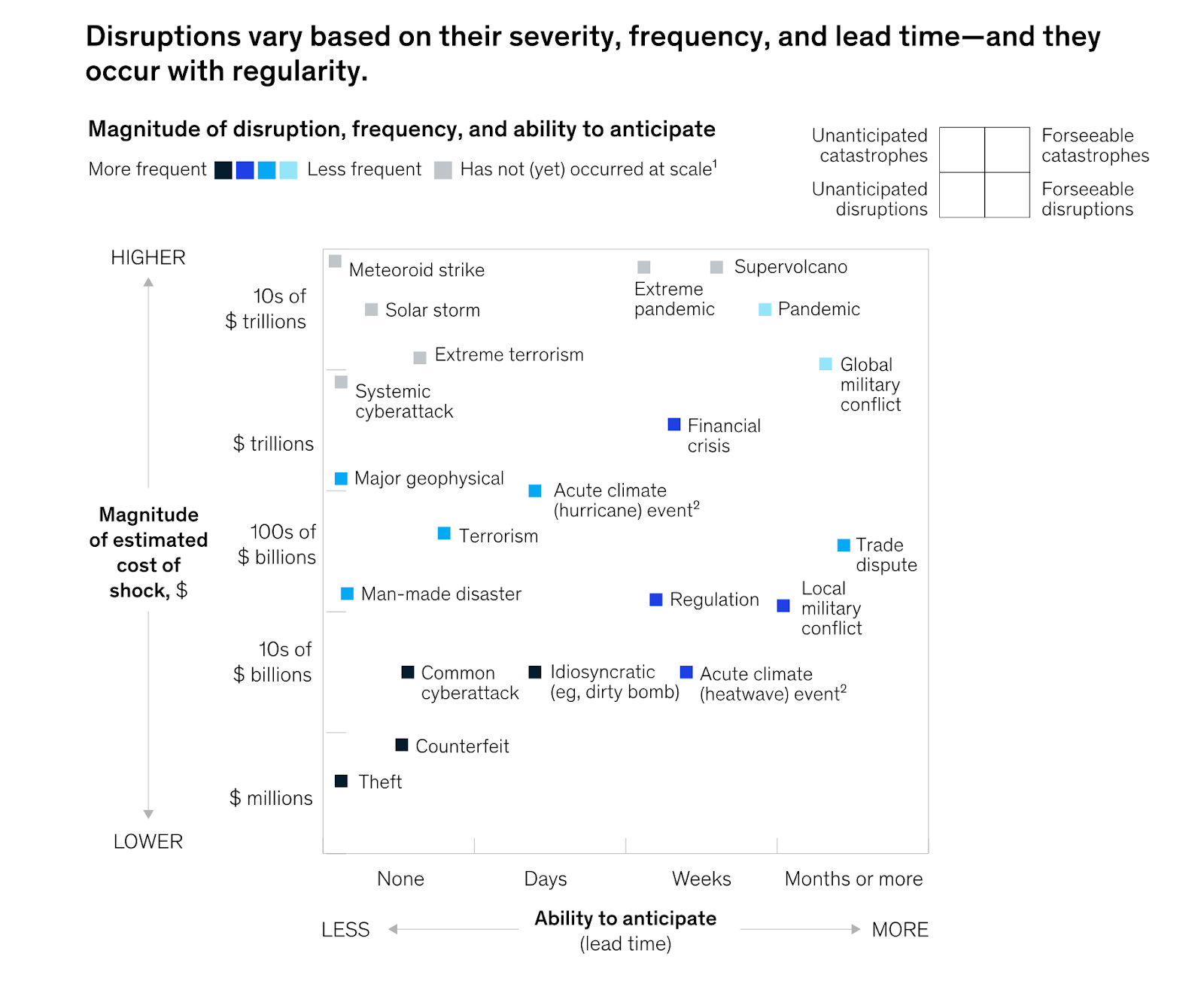
As a result, experts like Sandy Gosling, a partner in McKinsey’s Miami office, say we need to keep on our toes to prevent another “everything shortage.” The consultancy says a global military conflict, financial crisis, systemic cyberattack, extreme terrorism, supervolcano or (ugh) meteor strike could all disrupt supply chains … especially if companies refuse to keep them resilient. (On the other hand, in the case of a meteor strike, I will not be furious about delayed Amazon orders.)

McKinsey says we need to consider the impact of a meteor strike on our supply chain. I do not believe we are ready. (Photo: Shutterstock)

“This means that companies will need to continue to be resilient, adapting as their supply chains evolve,” wrote Gosling in a response to emailed interview questions. “We believe that by applying a combination of resilience, agility, and sustainability, companies can future-proof their supply chains.”

It turns out there have been some changes in how we produce and move critical goods around the world. It’s just not the fundamental sweep you might expect. Here’s a quick summary of how our supply chains differ today from those halcyon, pre-pandemic days. 

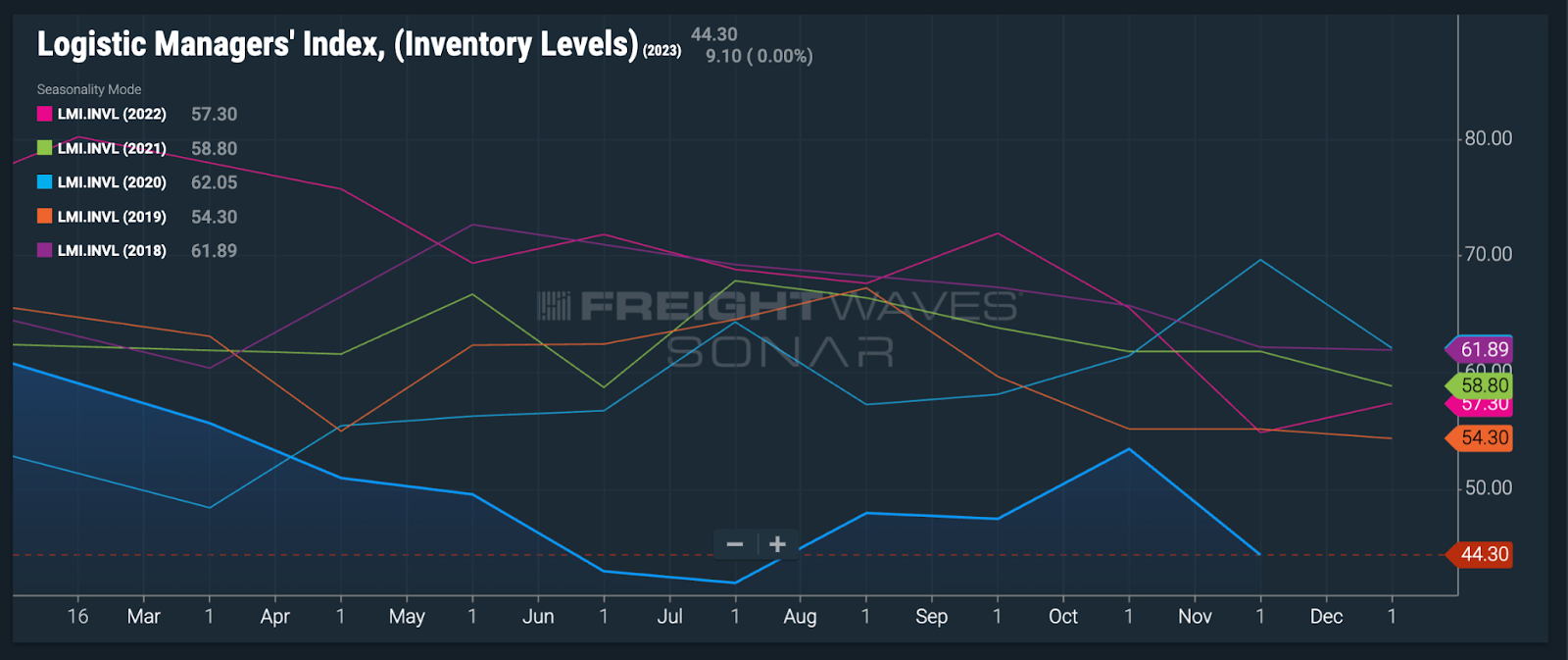
We went from minimal inventories to stockpiling to back to just-in-time

If you thought the coronavirus would kill off lean inventories, you’d be sorely mistaken. 

“We are not seeing retailers/manufacturers embrace higher inventory,” Gosling wrote. “In fact, most of what we see being reported is inventory being right sized after many months of being too high. Of course, this varies by industry and will continue to remain an important trade-off for companies as they consider lead time due to source locations, cost to carry, and service levels to their customers.”

Survey data from the Logistics Managers’ Index suggests that firms are keeping leaner inventory levels than they did in previous years. (FreightWaves SONAR) 

One key reason our delightful supply chains were so chaotic from 2020 to 2022 was the decades-long, corporate shift to embrace meager inventories and just-in-time production. One study found that American companies slashed their inventories by 2% each year from 1981 to 2000; that trend flourished through the 21st century as well. Leaner inventories have helped companies position themselves better to investors. They can appear to be producing the same amount of profit from fewer assets.

Of course, this is at the risk of having a stable foundation of goods should there be, say, a pandemic that shutters much of the world’s factories. In response, many companies started to stockpile inventories. 

Hospitals did, too, according to Anne Snowdon, a professor at the University of Windsor in Canada who studies the health care supply chain. There’s just one issue: Whatever you’re stockpiling might be useless in a year.

“Stockpiles are good as long as the product stays fresh, meaning it doesn’t expire,” Snowdon told FreightWaves. “We know like any product they all expire over time.”

Or people might just not be very interested in buying whatever is in your stockpile. Retailers like Target, Best Buy and Lowe’s learned that lesson the hard way last year, when they amassed way too much inventory to avoid being caught without beloved items. Then, suddenly, customers stopped beloving those items.

McKinsey has highlighted a few key supply chain catastrophes. Are you more fearful of the meteor strike, solar storm, or supervolcano? (Source: McKinsey)

Automotive might be the most classic example of just-in-time manufacturing — and the industry was one of the hardest-hit in the coronavirus crisis. According to Colorado State University professor Susan Golicic, it’s not likely that the industry will fully shake off just-in-time. But, it might look a little different.

“I think they’ll be looking at, What is the right amount of inventory to hold?” Golicic told FreightWaves. “They may still call it just in time, but the amount of safety stock that they’re holding might increase.”

We’re diversifying our supply chains, but there’s no mass exodus from manufacturing in China 


Another commonly cited reason for global shortages and general supply chain chaos earlier this decade was our disaggregated supply chains. Where businesses may have manufactured every component of a finished product in one factory complex in the good ol’ days, it’s more likely that finished goods hold hundreds or thousands of components that are made all over the world. To add to the fun, many of these components are only made in one country or one region. That means any disruption to global shipping — or geopolitical conflict with those nations — would cut off American access to those key supplies.

As tensions heat up with China, more manufacturers are looking to relocate some plants to other countries. But it’s not as easy as it might seem. “Very few people are picking up factories and moving them,” one retail expert told Modern Retail in August. “It simply doesn’t work that way. It’s certainly not cost effective.”

Consider the meteor-induced supply chain crisis. (Photo: Shutterstock) 

What’s more, completely closing down shop in China or East Asia more generally doesn’t make sense given the massive population of consumers there, said Amy Broglin, supply chain strategy consultant and adjunct professor at Michigan State University. 

“I don’t think most companies are looking to exit China completely,” Broglin said. “But I do think that being that heavily sourced in any place where you have an abundance of supply localized is not a solid strategy for continuity and introduces a ton of risk.”

The name of the game appears to be supply chain diversification. Some goods might come from China, others from Vietnam, and still others from Mexico or the United States.

“As a result, companies have been reevaluating their supply chains — not only by near-shoring, but also through regionalization as well, ensuring they have multiple sources of supply or multiple routes to take advantage of in case of disruption,” Gosling wrote.

In the world of medical, Snowdon said health systems have tried to reduce the cost of care by prioritizing ultra-low-cost supplies. That meant supplies typically came from low-wage countries. Now, procurement departments are thinking about buying supplies from a slew of regions.

Battery plants for electric vehicles may be one inroad for more U.S.-based manufacturing. Golicic said few plants currently exist to build these complex batteries and, as a result, automotive manufacturers are taking matters into their own hands. Ford is building plants in Michigan and Kentucky, while Toyota is investing $8 billion in an existing plant in North Carolina.

Perhaps we will see a return to the River Rouge plant yet. Such systems were probably less efficient, but they would likely weather the inevitable meteor strike with some aplomb. 

What do you think of our meager changes in supply chain? Do you fear a meteor strike? Email rpremack@www.freightwaves.com with your thoughts. And be sure to subscribe to MODES for more.

The Light Load: Fresh clucking about pilfered poultry roils trucking

What is it with freight theft and poultry these days?

Is inflation getting bad enough to spur some plucky truckers to steal chicken and chicken-ish foodstuffs to hawk on the black market?

The sky may not be falling, but something is a-fry in the transport of edible fowl, at least if authorities on two continents are to be believed.

The latest incident involves a bit of chickeny goodness that sheriff’s deputies in Sumter County, South Carolina, accuse delivery driver Christopher Thomas, 55, of nearby Florence, of selling instead of, well, delivering.

Authorities are tight-lipped on whether the purportedly purloined protein was from the superior sector of the chicken — the thigh — or drier, less meaty regions. (I’m looking at you, wings.) But the total came to 33,000 pounds of bird, they allege.

The turkey-eyed among you have deduced that shakes and bakes out to 16.5 tons. That would make barrels of Green Chicken Enchilada Soup, with enough left over to feed Salsa Verde Chicken Nachos to a battalion of small, flightless birds come game day parties on Jan. 8 (when I must reluctantly hope Alabama is beating the dressing out of Texas after shish kebabing Michigan).

Anyhow, authorities say Thomas was transporting the soon-to-be-hot (and not in the Nashville sense) chicken when somebody tipped them off about a rendezvous between the driver and a would-be buyer. They say by the time they got there, the truck held only about 8,000 pounds of its original 41,000-pound load, hence the mystery of the missing tonnage.

The tab for the full load: a reefer-cool $80,000.

Was Thomas feathering his bank account? No clue. We can only hope the well-gravied gears of justice peck their way to a fair conclusion. (Sorry, sometimes you have to suspend logic and physics to keep the extended metaphor going.)

But I’m not holding my Popeyes-perfumed breath. I quail to think how justice was spurned after a similar incident across the Atlantic.

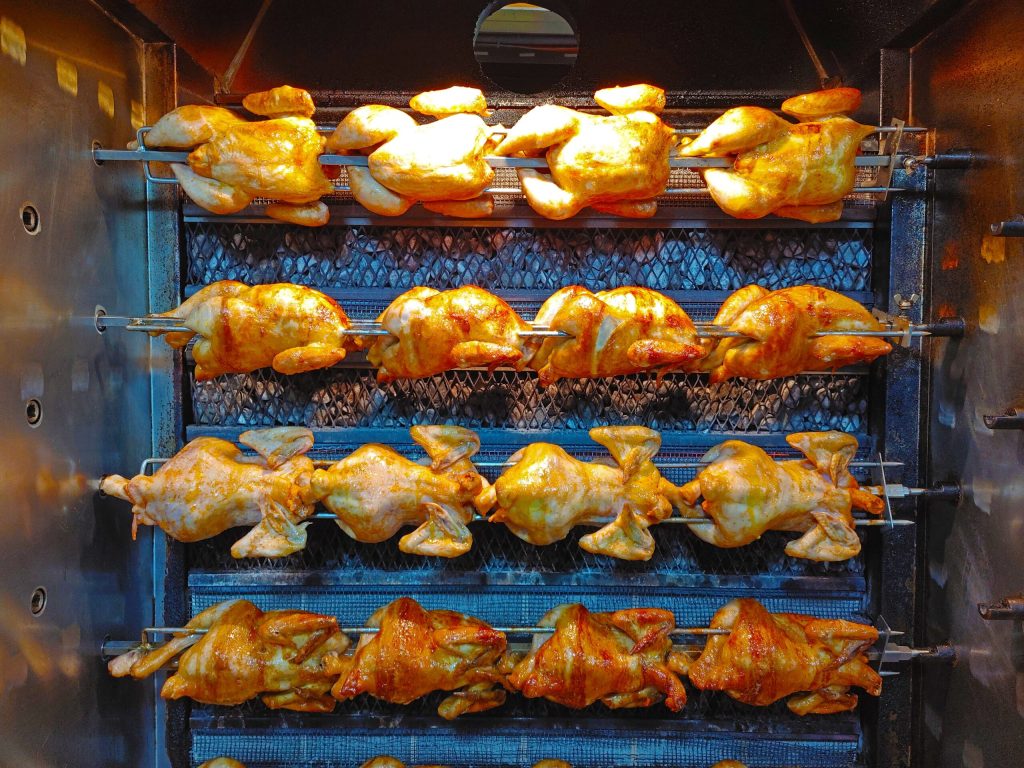
In a rotisserie-hot update we’ve all been waiting for regarding another (vaguely) chicken-related transgression, the fate of Joby “Easter Bunny” Pool has been sealed in yon Telford, England.

Lorry driver Pool was set upon earlier this year by (if you ask me) misguidedly zealous prosecutors over the celebrated spiriting away of 200,000 Cadbury Creme Eggs.

As I’ve detailed previously so there is no need to repeat it, Cadbury Creme Eggs are:

But what is driver Pool getting for trying to spare hundreds of thousands of Britons from this chocolate-and-fake-yolk-and-egg-white concoction? A year and a half — not at a Caribbean resort, no, but in prison!

Actually, Pool (#JusticeForJoby) is serving nine months, including six months of hard time already served by the time he was sentenced.

But it’s still harsh for one so civic-minded.

No justice, no Peeps! No justice, no Peeps! No …

Wait. That’s the wrong incentive.

No justice, more Peeps!

The Light Load is an occasional look at the world of transportation and logistics through the eyes of an industry greenhorn.

Related articles:

The Light Load: Supply chain gets personal — gravy shortage edition

The Light Load: Raven-on-drone violence nothing to crow about

The Light Load: Marla meets the watermelon truck

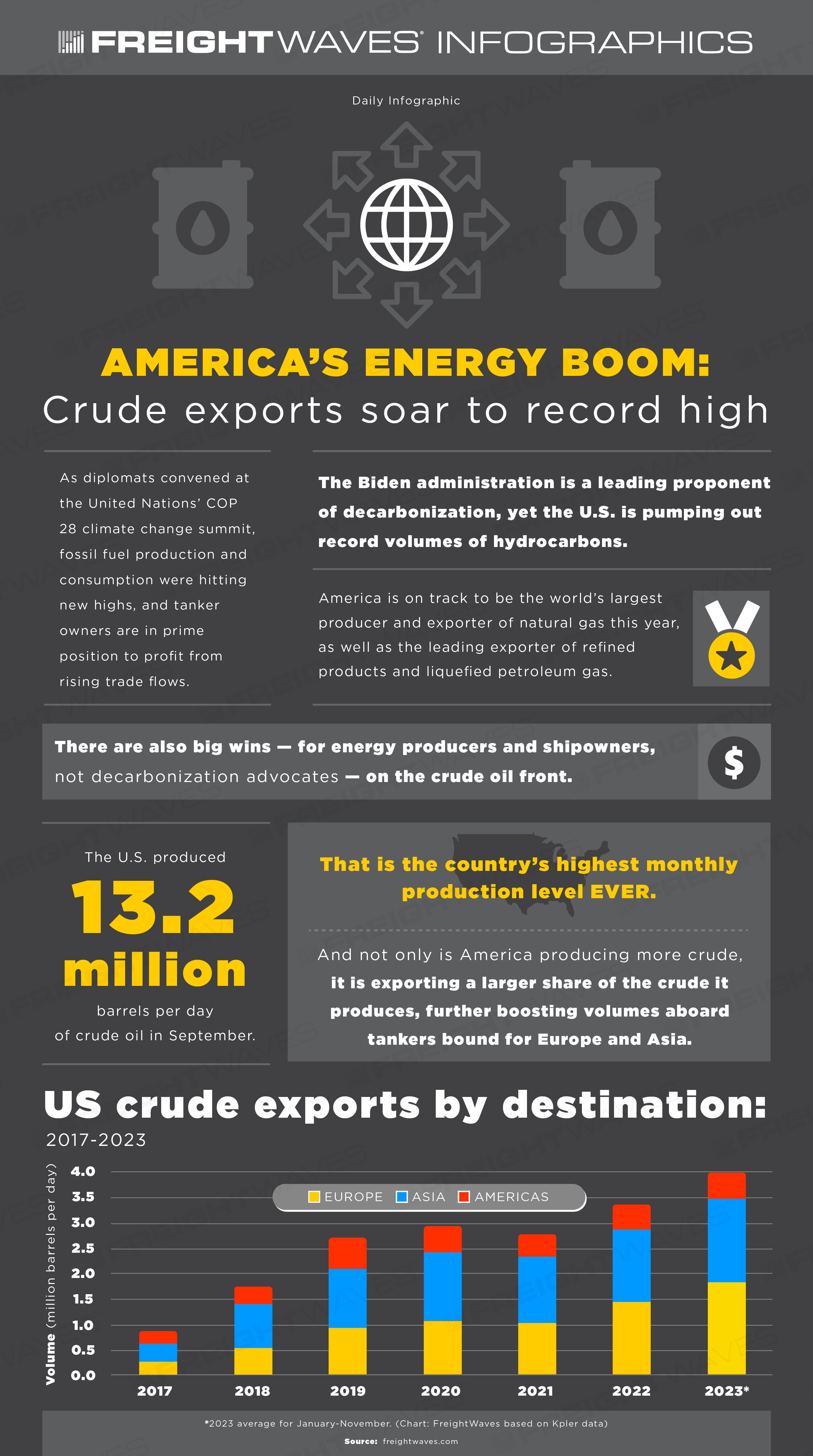
Daily Infographic: America’s energy boom: Crude exports soar to record high


To view more FreightWaves infographics, click here