FreightWaves’ Greg Miller named best shipping news journalist of 2023
Greg Miller, a senior editor with FreightWaves, was named “Best News Journalist of the Year” by the Seahorse Freight Association at an awards ceremony in London on Monday night.
The Seahorse Awards are held annually to honor outstanding achievements in transportation and logistics journalism. A panel of 21 experts judged a record number of entries this year: more than 350 articles and podcasts by over 60 competing journalists.
Winners were named in 13 categories. For the news journalism category, judges assessed writers’ ability to put breaking news in context.
The Seahorse Awards, considered the premier prizes in shipping journalism, have been held since 2004, excluding the years 2019-2021, when the awards were suspended due to the pandemic.
In his previous role at the shipping magazine Fairplay, Miller won the Seahorse Social Media Journalist of the Year award in 2016, and was runner-up for News Journalist of the Year four times: in 2004, 2010, 2011 and 2012.
Terminal raises $3.1M, wants to be the ‘Plaid of trucking’
API integrations are crucial for trucking telematics companies. They enable seamless communication among various systems, improve operational efficiency and accurate monitoring of fleet activities, and provide the ability to integrate with other industry-specific tools, enhancing overall fleet management capabilities.
For example, fintech solution Plaid significantly enhanced the banking community by providing seamless access to financial data and enabling secure transactions through its API services, making it simple for banking information to be verified and protected and promoting the development of innovative financial instruments.
Startup telematics integration solutions provider Terminal, looking to become the “Plaid of trucking,” announced Tuesday it has closed its seed round to continue building upon its Unified API, giving companies that build insurance products, fleet software and other financial services the vehicle and locations data they need.
The investment round was led in September by Golden Ventures with participation from Y Combinator, Wayfinder Ventures, Northside Ventures, McVestCo (Trimac Transportation), Boon Fund and angel investors Matt McKinney (Loop), Liz Wessel, JJ Fliegelman and Eli Brown.
Founders with fintech, trucking histories
Terminal was founded by CEO Raghav Midha and Chief Technology Officer Connor Giles, who bonded through their passion for fintech solutions and Giles’ family background in trucking. They worked together at a neobank on fintech solutions like Plaid when they began to consider how API middleware could improve the transportation industry.
“For those two and a half years, we worked a lot with various middleware solutions and we realized how core some of that infrastructure we built would be in unlocking all the efficient tools that we had,” Giles told FreightWaves. “We felt that logistics had so many opportunities to experience this same unlocking.”
“At that point, we were open to solving all sorts of different problems, but what really connected for us was so many different people were running into the challenge of integrations,” said Midha. “Anybody trying to build any system, automation or platform within logistics and trucking was spending up to 50% or more of their time just on different integration types.”
Y Combinator, Wayfinder Ventures, Northside Ventures, McVestCo (Trimac Transportation venture arm), Boon Fund, Matt McKinney (Loop), Liz Wessel, JJ Fliegelman, Eli Brown
Business goals for the round
Grow its team to continue building current solution
Total funding
$3.1 million
The duo quickly learned that this was a specific pain point for the industry’s fintech ecosystem as well, and with their backgrounds, they set off to overcome that challenge.
“We narrowed in on telematics for a couple of reasons,” said Midha. “One was the increase of adoption of telematics due to the ELD mandate a few years back and the increase of adoption around dash cameras and other safety tools.”
The second reason was carriers became more comfortable with sharing this information with all types of supply chain solutions providers, including visibility tools, transportation management systems, financial services and insurance providers.
Today, Terminal’s product does just that, making it simple for solutions providers like Samsara, Motive, Fleetmatics, TitanGPS, Isaac Instruments and others listed on its website to obtain this carrier information, giving true carrier data transparency.
Terminal rolled out its product this summer and has more than 150,000 trucks’ data committed to being integrated into its system. The company plans to utilize this data while building its universal API for vehicle statistics.
Image of Terminal dashboard. (Photo: Terminal)
“Our customer base is about half insurance companies, and the other half is primarily software companies that sell to the carrier,” Midha said. “We started here because we want to focus on the use cases that give the most benefit to the carrier and give the most incentive to them to share their data and actually get something in return.”
In these cases, that could be lower insurance premiums and better visibility to carriers’ logistics partners.
With its new capital, Terminal is sticking to that plan, leveraging its relationship with its new investment partners while building out more of the product and focusing on customer satisfaction and true return to carriers.
“The whole focus for us right now is to build our foundational engineering team so we can deliver on our promises to these customers, find areas of improvement, and establish success with our initial network of partners and add operational velocity to the company,” explained Midha.
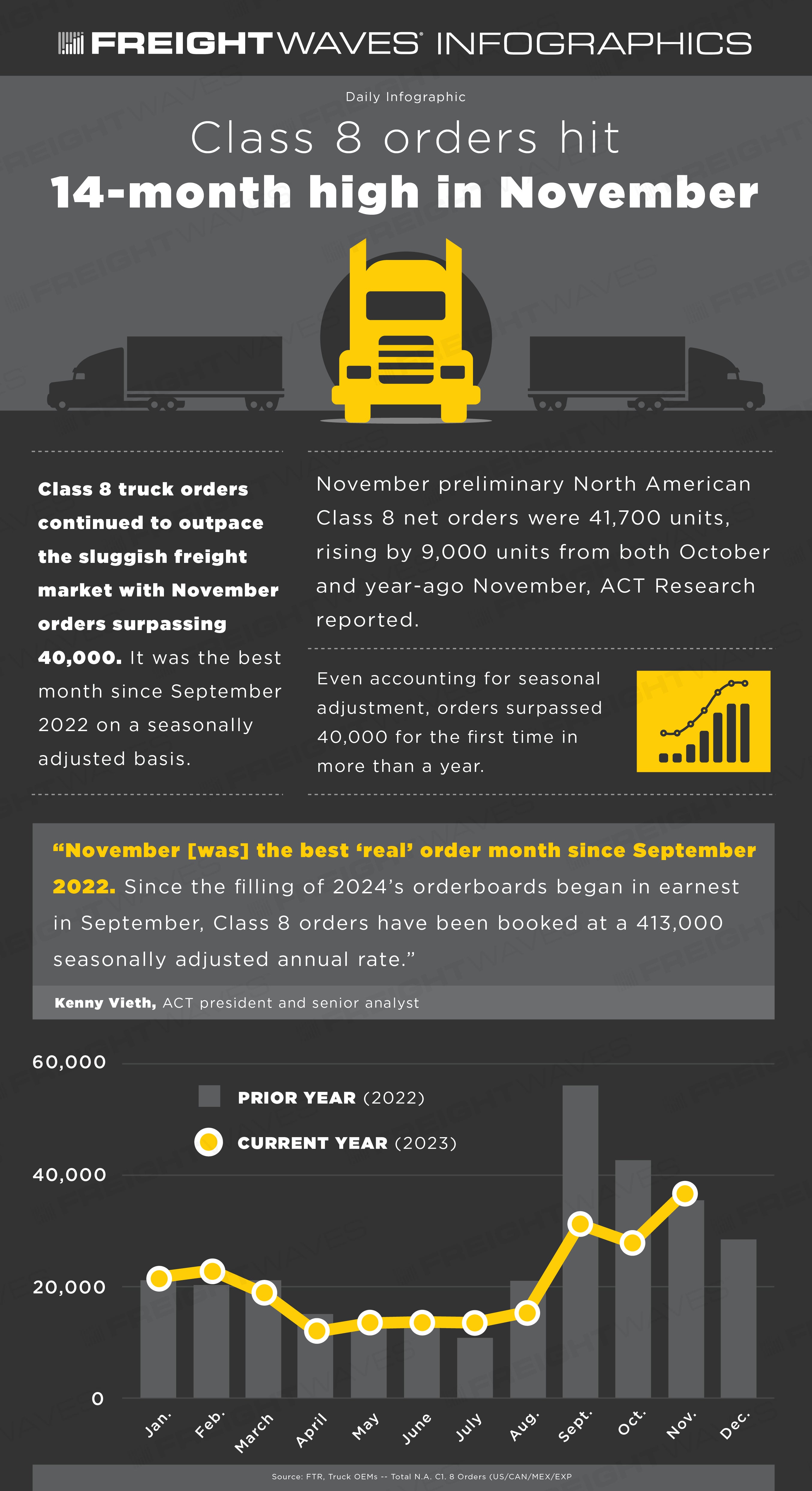
Daily Infographic: Class 8 orders hit 14-month high in November
To view more FreightWaves infographics, click here
Western Global Airlines exits bankruptcy with better balance sheet
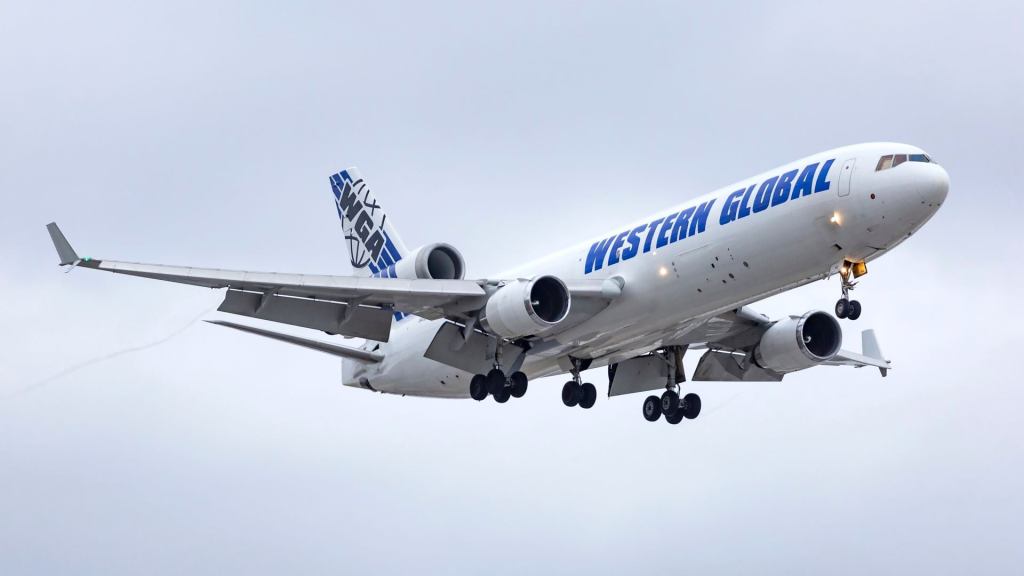
Western Global Airlines has restructured and emerged from bankruptcy protection with its fleet of 19 large freighter aircraft intact. But cargo business appears continues to be constrained, with several aircraft inactive during the busiest shipping season of the year and flying heavily concentrated for the U.S. Defense Department.
The Estero, Florida-based cargo airline reduced its debt by more than $460 million and received an injection of new capital to support ongoing business activity under a reorganization approved by a judge in the U.S. Bankruptcy Court for the District of Delaware. Western Global Airlines finalized conditions of its bankruptcy release on Dec. 4. It now has less than $100 million in debt on its books.
The company’s exit was completed in less than four months, an exceptionally fast process for a comprehensive restructuring of business operations, because there was near-universal support for the plan from creditors.
Western Global Airlines has continued to operate since petitioning for bankruptcy protection in early August with the help of $77.5 million in debtor-in-possession financing, which helped cover expenses and a cash award retention program for nearly the entire workforce. The initial reinvestment was a mix of money from owners Jim and Sunny Neff, as well as some third-party bondholders. The Neffs eventually became the sole provider of financing and waived nearly $100 million of secured and unsecured prepetition debt held by them in order to provide recovery to all creditors, according to court documents.
The restructuring gives Western Global a clean slate, wiping away obligations to vendors, customers and other creditors. The road ahead is uncertain considering the airfreight market is at an 18-month low.
“My top priority has always been to preserve the long-term viability of our company and protect our people. I am pleased our restructuring process has achieved that,” said founder and CEO Jim Neff in a news release announcing the successful restructuring.
Western Global’s fleet consists of four Boeing 747-400 and 15 MD-11 cargo jets. It also has two MD-11s that the Federal Aviation Administration must still inspect to determine whether they conform to airworthiness standards and the airline’s operating certification. Other assets include 11 aircraft harvested for parts to maintain other aircraft and maintenance equipment. During the Chapter 11 process, Western Global completed the overhaul of seven spare GE turbofan engines.
At least eight of the MD-11s are currently parked, including seven that have not flown in more than three months, aircraft databases show. One 747 is also not in service.
A large portion of Western Global’s current business is for U.S. Transportation Command, carrying supplies to U.S. and allied bases in Europe and the Middle East, including military aid for Israel and Ukraine.
In recent weeks, according to tracking site Flightradar24, five of the MD-11 freighters have regularly operated from McGuire Air Force Base in New Jersey, Travis Air Force Base in California, Norfolk Naval Air Station in Virginia, Bangor International Airport in Maine (a civil-military facility) and other U.S. locations to Ramstein Air Base in Germany; naval air stations in Rota, Spain, and Sigonella, Italy; Italy’s Aviano Air Base and then onward to Nevatim Air Base in Israel; U.S. bases in Bahrain, Qatar and Djibouti; as well as Rzeszow airport, the closest Polish airfield to the Ukraine border.
Western Global 747s have also operated from Dover AFB in Delaware to Nevatim via Frankfurt, Germany, as well as to Rzeszow airport. The jumbo jets frequently fly from Travis Air Force Base to Tokyo and bases in South Korea.
Western Global is providing extra capacity for UPS but is not flying for FedEx this peak season, pilots said in direct communications with FreightWaves and online chat boards.
Financial troubles
Western Global was forced into bankruptcy restructuring when revenues sharply contracted this year amid an overall collapse in freight demand from pandemic peaks and more competition from the rebound in lower-deck space on passenger aircraft, which exacerbated a heavy debt load and high maintenance and fuel costs associated with operating aging aircraft. The company was also harmed by pilots and mechanics leaving for better pay at passenger airlines that were on the mend, and three key customers, including Amazon, canceling contracts. Credit rating agencies earlier this year pulled coverage over the company’s lack of financial transparency and liquidity concerns.
Last summer, Neff purchased the company’s $115 million of outstanding senior secured debt for $45 million in a competitive process, a move that reduced repayment pressure from lenders but also angered creditors that were moved to the back of the line for any claims on the company’s assets.
The money Neff put into the high-interest debt is secured by the remaining assets so he gets any proceeds if the company eventually goes under.
The bankruptcy decision doesn’t limit Neff’s liability in a lawsuit by several former Western Global employees related to the establishment of the company’s Employee Stock Ownership Plan. The ESOP was dissolved under the bankruptcy reorganization.
The lawsuit alleges the Neffs profited from a bond sale made to finance an employee loan for a 37.5% stake in the company. According to the filing, the sale price for the ESOP was based on 20 times the company’s fair market value and that when Western Global issued a bond offering that shot up to 10.375% because there were no takers, Neff bought the bonds himself and stuck the employees with heavily devalued shares.
Western Global says ESOP participants didn’t purchase their shares but rather were granted them at no out-of-pocket cost and that participation is voluntary.
Western Global received restructuring advice from Alix Partners and FTI Consulting.
GlobalTranz wants Supreme Court to punt on broker liability issue
(Editor’s note: the original story has been changed to reflect that C.H. Robinson was not held liable for the accident that is at the center of Miller vs. Robinson).
GlobalTranz wants the Supreme Court to let more time pass and possibly more legal decisions to come down before the nine justices weigh in on the question of broker liability.
That GlobalTranz would argue against the high court granting certiorari review to the appeal of Ying Ye is not surprising. Ye’s case against GlobalTranz for its actions in hiring Global Sunrise, the carrier involved in a 2017 accident that killed her husband, failed in both the U.S. District Court for the Northern District of Illinois and on appeal to the 7th Circuit.
Ye last month asked the Supreme Court to review the decision, arguing that the exclusion of the 3PL from liability was based on a legal finding that puts it in conflict mostly with a decision from the 9th Circuit, Miller v. C.H. Robinson. In that case, a suit against the brokerage giant (NASDAQ: CHRW) over an accident that left a passenger car driver a quadriplegic did ultimately set a precedent that a 3PL was not legally protected against damages if it hired the carrier involved in an accident. The lawsuit ultimately was settled. But the precedent it set is considered extremely troubling by the trucking legal community.
A C.H. Robinson attempt to appeal that decision and have certiorari granted by the Supreme Court failed in June 2022. But the Ye case created the type of conflict among circuit court decisions that can help beat the small odds the nine justices will hear a case.
While the GlobalTranz brief filed last week against certiorari is multifaceted, its closing argument boils down to give it time, there will be others.
The GlobalTranz stance is understandable but is not necessarily going to be shared among members of the trucking and 3PL bar. They have been waiting for an opportunity to see the precedent in Miller v. Robinson overturned, and the conflict between the Ye case and the Miller case raised that possibility.
The brief filed by GlobalTranz last week in response to the Ye certiorari petition does not deny that there are significant issues raised in her litigation and the decision of the courts, both lower and appellate, to exclude the 3PL from liability. Having Miller v. Robinson come to a different conclusion elevates the issue, according to Global Tranz. “The current uncertainty profoundly affects the core business functions of freight brokers, which serve a central role in the efficient operation of supply chains throughout the United States,” GlobalTranz says in its brief.
But there is no urgent need to straighten it all out, according to the GlobalTranz argument. “Despite the importance of the question presented, however, there are reasons why the Court may wish to allow the question to percolate further in the lower courts.”
At the heart of the difference between the Miller and Ye cases is not the question of whether the Federal Aviation Administration Authorization Act (F4A or FAAAA) protects a brokerage from liability. F4A prohibits a state from acting in such a way that might affect transportation “prices, routes or service.”
But it also has a safety exception and that’s the issue in the dispute.
As GlobalTranz says in its opening paragraphs of its certiorari challenge, the question of the exemption is “whether a common-law negligent-hiring claim against a freight broker, seeking redress for personal injuries caused by a motor carrier’s driver, is preempted because it does not constitute an exercise of the ‘safety regulatory authority’ of a State with respect to motor vehicles’ within the meaning of the FAAAA’s safety exception.”
In Ye’s case, the lower court and the U.S. Court of Appeals for the 7th Circuit said GlobalTranz was protected by the safety exemption. The 9th Circuit concluded otherwise in Miller v. Robinson. As GlobalTranz noted in its filings, the facts of the two cases are remarkably identical: A driver hired by a brokerage is involved in an accident. There is a death in one instance and a paralyzing injury in the other. That’s about the only difference.
One of the arguments made by GlobalTranz is that the 7th Circuit “correctly held that petitioner’s claim is preempted by the FAAAA, so there is no need to correct the outcome in this case.”
What is at stake, however, is a dispute that is “shallow,” according to GlobalTranz. There are only two circuits — the 7th and 9th — that have come to different conclusions on the question of whether the safety exemption can drag in a freight broker on the question of liability even if the F4A provisions of routes, prices and services would otherwise protect it.
“Further percolation may therefore be helpful to the Court,” Global Tranz attorneys write in the second instance of the word “percolate.”
And given that the 7th Circuit’s decision is “well-reasoned,” according to GlobalTranz — not a surprising conclusion given that it was victorious in the case — “the Ninth Circuit may choose to reconsider its holding in Miller.” It cites several other cases, not connected to the F4A, in which the 9th Circuit’s conclusions could be viewed as having a view on preemption in state versus federal issues that a different lineup of appellate court judges might hold differently in any other cases involving freight broker liability.
And in a projection not likely to bring happiness to the 3PL community, GlobalTranz argues that there will be other cases. “Given the proliferation of cases against freight brokers, other courts of appeals will surely have the opportunity to address the question presented in the near future,” it says.
The other legal issues discussed by GlobalTranz in its brief are familiar. The 3PL discusses the history of the F4A and why it restricted state action that might impact prices, routes and services. Finding liability for brokers would impact their operations, something F4A is specifically written to prevent. And while the state exemption exists, it is aimed at operators of motor vehicles, and there is nothing in the language to suggest that a freight broker could be considered the operator of a motor vehicle.
Elsewhere in the response, GlobalTranz notes the roads to separate conclusions taken by the two courts. “The Ninth Circuit began by addressing a question that the Seventh Circuit did not reach in this case: namely, whether the state ‘safety regulatory authority’ pre-served by the safety exception includes a common-law claim for negligent hiring against a freight broker,” the GlobalTranz attorneys write. “Construing the safety exception ‘broadly,’ in part based on the presumption against preemption, the Ninth Circuit determined that the answer was yes.”
DOE/EIA diesel price falls again; physical markets sagging also
The benchmark diesel price used for most fuel surcharges fell again Monday, the eighth decline in the past 10 weeks, while physical markets suggest more declines might be ahead.
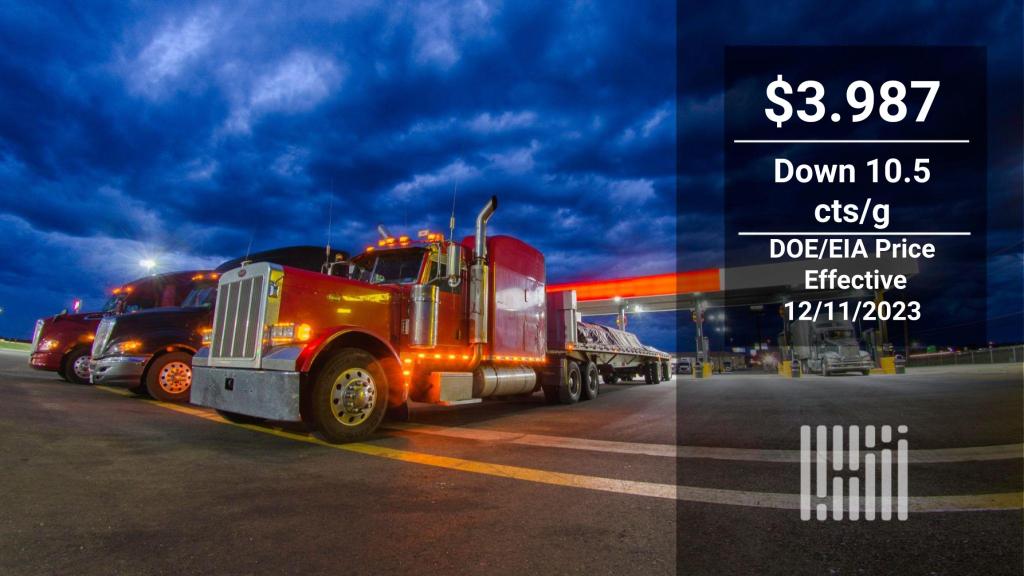
The Department of Energy/Energy Information Administration posted a price of $3.987 a gallon for Monday. That was down 10.5 cents from the prior week, the biggest one-week decline in the run of eight weeks of lower prices out of the past 10. The biggest one-week drop had been 9.5 cents a gallon on Oct. 10.
Monday’s decline in the DOE/EIA price came as the futures market for ultra low sulfur diesel on the CME commodity exchange has reversed itself significantly over the past two trading days after seven days of declines.
ULSD settled at $2.5492 a gallon Thursday, dropping almost 35.78 cents from its settlement just over $2.90 on Nov. 28. But ULSD on CME settled Monday at $2.6087 a gallon, rising almost 6 cents in the last two trading days.
Oil in general has been stronger over the past few trading days, but that comes after weeks of declines. It’s difficult to find anybody who thinks the recent increases mark a significant break in sentiment.
More importantly for diesel consumers, physical spreads in the U.S. market are falling rapidly. The spreads are the differential in transactions between buyers and sellers, delivered via pipeline or barge, and represent a discount or premium to the CME price.
The U.S. Gulf Coast market spread for ULSD fell to minus 40 cents a gallon Monday, according to data from DTN. That marked a 6-cent decline just from Friday.
That spread trended lower for all of November and into December. It started November at minus 8 cents a gallon, was down to minus 25 cents by the end of the month and has drifted lower for the first trading days of December before the big falloff Monday.
Similar price movements could be seen in other physical markets. The ULSD spread in Los Angeles was plus 40 cents a gallon as recently as Nov. 16. In five of the past six trading days, DTN estimated the spread was flat between CME ULSD and physical ULSD in Los Angeles.
In New York Harbor, ULSD was 14 cents more than CME on Nov. 30. According to DTN, it was 4 cents a gallon Monday.
Where those weaker differentials show up is in wholesale prices. Broadly speaking, wholesale prices are set on physical prices for the market that supplies the city where the fuel is sold to retail outlets. An Atlanta wholesale price would be set mostly on the basis of what is happening in the Gulf Coast market, because it is the Gulf Coast, shipping diesel primarily along the Colonial or Plantation pipelines, that supplies the Atlanta market.
Even if the price on CME rises significantly, if the physical spread is weakening, that will mute the impact of that CME price in establishing the wholesale price.
When the weaker physical spreads are combined with the fact that time spreads on the ULSD forward curve of prices have narrowed, it leads to the conclusion that diesel inventories and other distillates are starting to build after months of low levels.
The relationship between prices out on the forward curve tightly correlates to inventories. The ULSD market on CME is in backwardation, which means prices for diesel delivery in the future are less than the more current price. In a perfectly balanced market, prices will rise as the market goes out on the calendar. When stocks are tight, they flip into backwardation.
But the backwardation has been narrowing. The spread between spot month and 12-month ULSD hovered near 77 cents a gallon in late October. More recently it has fallen back to about 53 to 54 cents.
Additionally, the weekly EIA inventory report for ULSD has shown inventory builds, rising to 103.7 million barrels for the week ended Dec. 1 from 96.3 million barrels just two weeks earlier.
Diesel markets are getting an early downard push from winter not arriving yet. For example, this forecast of temperatures over the next two weeks shows considerably higher temperatures than normal for December. That was a factor in the Henry Hub natural gas price falling Monday to $2.431 per thousand cubic feet, its lowest level since June.
How Venezuelan invasion of Guyana could impact tanker shipping
Shipping already faces fallout from two wars: trade shifts due to Russia’s invasion of Ukraine and vessel attacks off Yemen in the wake of the Israel-Hamas conflict.
Could there be a third simultaneous war — and even more trade complications for shipping?
Venezuela is threatening to invade Guyana and annex Guyana’s oil-rich Essequibo region, claiming the jungle territory and its offshore areas were stolen from Venezuela in 1899. Essequibo comprises around two-thirds of Guyana.
Guyana has been a bright spot for crude tankers. Since offshore production began in 2019, crude exports have risen to 400,000 barrels per day (b/d), with projections for volumes to double by the end of 2025 and top 1 million b/d by 2027.
“In the unlikely event that Venezuela decides to go further than rhetoric and actually moves into Guyana, the oil production and exports from both countries will likely suffer,” said Erik Broekhuizen, manager of marine research and consulting at Poten & Partners, in a report on Saturday.
“Sanctions [on Venezuela] will be reimposed — and probably tightened — and international oil companies will move their assets out of Guyana, crippling the country’s production.”
Invasion would reduce Atlantic Basin exports
The positive spin for tankers on production cuts by OPEC is that these cuts reduce Middle East-to-Asia volume, which is replaced by Atlantic Basin-to-Asia volume. This increases tanker demand measured in ton-miles (volume multiplied by distance).
“I’m tempted to say it’s flat out positive,” said Lars Barstad, CEO of tanker owner Frontline (NYSE: FRO), on his company’s Nov. 30 conference call, referring to the latest round of OPEC cuts and the positive ton-mile effect.
“We’re seeing refinery capacity built up and continuing to be built up east of Suez. New oil production is coming from west of Suez. We’ve seen Brazil increasing production and new production coming out of Guyana. We’ve seen Venezuelan exports increasing,” he said, adding that OPEC cuts are also “great news for U.S. fracking and great news for U.S. production.”
In the Americas region, U.S. exports are averaging 4 million b/d this year, according to Kpler. The International Energy Agency put Brazilian exports at 1.8 million b/d. Colombia is at 400,000 b/d, according to Colombian oil company Ecopetrol. Venezuela is exporting 300,000-400,000 b/d, according to Frontline.
To the extent Atlantic Basin exports are being touted as a tanker-demand positive in light of OPEC cuts, a Venezuela-Guyana conflict would be a negative, potentially impacting around 11% of regional exports.
As Venezuela flounders, Guyana rises
“The oil industries of Venezuela and Guyana are a study in contrasts,” said Broekhuizen. “Venezuela boasts one of the largest oil reserves in the world, but its industry … is in bad shape after decades of mismanagement and corruption and — in recent years — ever-tightening sanctions.” Current Venezuelan production is less than a third of 2009 levels.
“In contrast to developments in Venezuela, Guyana’s oil industry has been a success story,” said Broekhuizen, adding that “the future for Guyana appears bright.”
Current output is via two floating production, storage and offloading (FPSO) vessels, the Liza Destiny and Liza Unity, with a third FPSO, the Prosperity, now ramping up.
Production is being handled by a consortium led by Exxon Mobil (NYSE: XOM), with a 45% stake, together with partners Hess (NYSE: HES), with 30%, and China’s CNOOC, with 25%. Hess is in the process of being acquired by Chevron (NYSE: CVX). Guyana awarded exploration rights to eight additional offshore blocs in October.
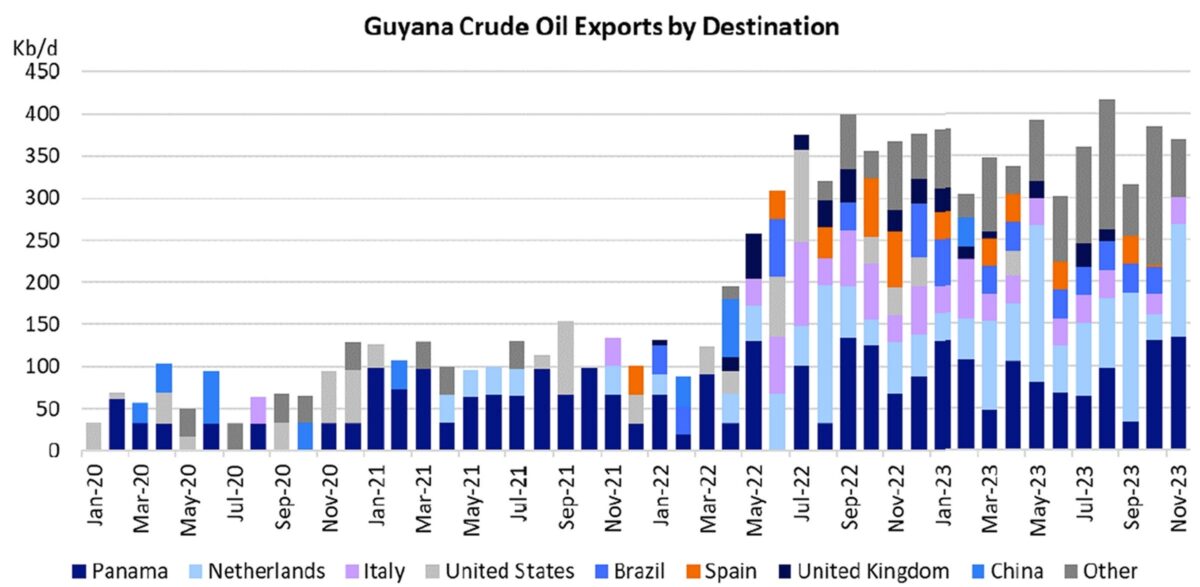
Data from Vortexa cited by Poten & Partners shows that almost all of Guyana’s current exports are staying within the Atlantic Basin, with very little headed long-haul to Asia, at least so far.
Top buyers are Panama, the Netherlands and the U.S.
(Chart: Poten & Partners. Data source: Vortexa)
The destination of Venezuelan exports has changed significantly as a result of the temporary relaxation of U.S. sanctions.
Previously, most Venezuelan crude was shipped to China using tankers in the so-called “shadow fleet” — vessels outside the Western financial and insurance systems.
In more recent months, with U.S. sanctions temporarily suspended, the U.S. has replaced China as the largest buyer of Venezuelan crude.
(Chart: Poten & Partners. Data source: Vortexa)
Double negative for tanker demand
Frontline’s Barstad predicted that Venezuelan exports would increase to 600,000-700,000 b/d if sanctions are not reinstated. “One would assume that most of this Venezuelan oil will move short-haul on Aframaxes and potentially Suezmaxes to the U.S.” (Aframaxes carry 750,000 barrels, Aframaxes 1 million barrels).
But there is also an effect on demand for very large crude carriers (VLCCs, tankers with capacity of 2 million barrels).
“What we’ve seen recently is VLCC cargoes being built up, and some of them are pointing toward India,” said Barstad. He reported four to six VLCC loadings scheduled in Venezuela in late November through December.
“These are vessels that are then not available for U.S. exports, so we believe this will actually tighten up the Atlantic market.”
An invasion of Guyana by Venezuela would be a double negative for mainstream tanker demand. It would derail burgeoning exports from Guyana and inevitably lead to renewed U.S. sanctions, pushing Venezuelan cargoes back to the shadow fleet.
The caveat is that Venezuelan and Guyanese exports are much less important to crude tanker demand than U.S. and Brazilian exports, so downside would be limited. The potential shipping impact of a third simultaneous war would be much less significant than the consequences of the first two.
DDC tackles industry’s unstructured data issue with new solution
Supply chain leaders have become increasingly aware of the importance of innovation surrounding data collection and utilization in recent years. Despite impressive technological advances, however, the majority of data produced by the logistics industry remains unstructured.
At the highest level, unstructured data is any information that must be rekeyed when passed between organizations, meaning that it cannot be utilized immediately upon receipt. Every time data has to be copied or rekeyed, the process slows down the supply chain and increases the risk of introducing errors.
“When you look at our industry, 80-90% of the data is still unstructured. If you break that up [across departments], operations is pretty much all unstructured,” DDC FPO CIO Richard Greening said.
Bills of lading are one of the most prevalent examples of unstructured data in the transportation industry.
DDC has introduced a number of solutions that improve the way the industry handles bills of lading. Most recently, the company utilized machine learning to create an innovative Auto-Extraction and Structuring solution. The tool is designed to structure the raw data from submitted bills of lading, then transmit the structured data directly to the user’s system of choice — all within a matter of seconds.
“What Auto-Extraction does is remove the keying work for our agents or your billing teams,” Greening said. “We can embed [the solution] into the carrier’s processes really quickly and get results fast.”
This new tool can be integrated with DDC’s existing suite of solutions, including DDC Sync, to create a seamless experience for users. This means a driver can submit a photo of a bill of lading via DDC Sync and — through the combined effort of DDC’s offerings — users can receive structured data regarding that shipment immediately after it is completed.
The addition of Auto-Extraction and Structuring capabilities has propelled DDC one step closer to its goal of becoming an end-to-end digital provider to its clients.
Optimized performance is the most direct advantage of utilizing DDC’s suite of solutions thanks to the significant impact quick access to clean data has on a company’s decision-making process. The benefits do not stop at making faster (and better) business decisions, though.
By simplifying the way bills of lading are processed, DDC has created a pathway for users to increase their profitability by reducing overhead costs and gain a tangible competitive advantage in the market by strengthening their digital footprints.
Does trucking need a Barbie; Supply Chain Bingo; freight theft trends – WTT
On today’s episode of WHAT THE TRUCK?!? Dooner is talking to TransForce’s Kelly McGurk about its mission to get Mattel to make a trucking Barbie. One crucial profession Barbie has yet to explore is truck driving. Recognizing women’s significant role in the trucking industry, where they currently make up 14% of the workforce, TransForce aims to highlight women’s contributions to the industry and inspire young girls to consider careers in transportation.
Father and son team Max and Zach Schuchart show off their latest freight game, Supply Chain Bingo. Max is 12 years old and Zach works for Optimal Dynamics. They’ve teamed up to teach your kids trucking while killing time on road trips.
Travelers’ Scott Cornell breaks down the latest trends in cargo theft.
Reliance Partners’ Thom Albrecht looks ahead to 2024 and shares when he thinks capacity and volumes hit equilibrium. Also, what do inventory levels and the housing market say about the health of supply chains?
J. J. Keller’s Kathy Close has the latest report on DOT drug testing trends.
Plus, a missing trucker’s family needs your help; dangerous bridges; side impact testing; and the Grinch gets strap worked.
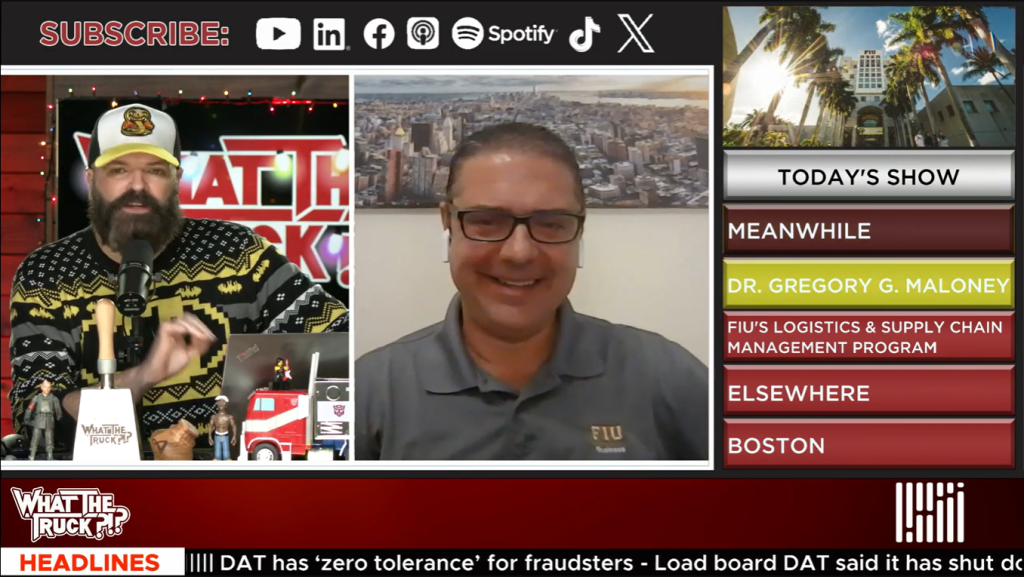
Shaping the future of supply chain management at FIU Business
When it comes to learning the ins and outs of this industry, there is no substitute for hands-on experience.
Such is the conviction of Dr. Gregory Maloney, director of Florida International University College of Business master’s program in logistics and supply chain management. To be sure, Maloney and his colleagues at FIU Business provide students with a far-reaching, theoretical understanding of supply chains. But this big-picture approach is supplemented with students’ development of real-world business acumen and industry connections.
“We’re trying to generate this next level of managers and executives that are going out into the world with skills to be able to not just do the things needed to run a business,” Maloney said of FIU’s programs, “but also the understanding to oversee the entire scope of their business.”
For many small and independent owner-operators, this comprehensive approach to the business side of trucking might not be instinctively appreciated. Education is thus key for these drivers, which is why FIU Business offers its programs in both online and hybrid formats to provide the requisite flexibility for those spending life on the road.
As for the road ahead, Maloney is eager to stress the importance of embracing changes in the industry’s use of technology and data. Contrary to the popular view of replacing people wholesale with artificial intelligence, Maloney argues that the roles and responsibilities of workers will shift toward implementing and managing evolving technologies.
He contends that data is similarly vital for success. “Companies that know how to take data and use it to make better, fact-based decisions to drive their business forward and make more money for them and for their partners are the companies that will be at the top of their class.”