Old Dominion reports muted November

An Old Dominion tractor pulling two LTL trailers on a highway

A weak freight environment was to blame for a dip in tonnage during November, less-than-truckload carrier Old Dominion Freight Line said Tuesday after the market closed.

The company reported a 2.3% year-over-year (y/y) drop in tons per day during the recent month, which followed a 1.9% decline in October. The carrier was up against weak comps from a year ago, which included y/y declines of 6.5% and 8.6% in October and November 2022, respectively.

Many carriers benefited from an early October cyberattack at Estes, which forced some shippers to seek capacity elsewhere. However, most of the repositioning was short term, with freight finding its way back to Estes’ network by the end of the month.

Old Dominion’s (NASDAQ: ODFL) latest y/y tonnage declines were smaller than the 6.9% drop it recorded in the third quarter. Shipment counts were modestly positive in the recent two months, but shipment weights continued to erode.

Table: Company reports

Industrial-related freight can account for roughly two-thirds of total revenue for many carriers. The Purchasing Managers’ Index for manufacturing has been in contraction territory for more than a year now. A 46.7 reading in November (50 is neutral) was unchanged from October. Further, the new orders subindex, an indicator of future production, improved but continued to contract at 48.3.

Old Dominion did benefit from the freight reshuffle following Yellow’s exit, but management recently said it hasn’t altered its freight selection process in efforts to keep yields high.

Revenue per hundredweight, or yield, was 3.1% higher y/y in the first two months of the fourth quarter, up 7.6% excluding fuel surcharges. However, the metric was again aided by a decline in shipment weights. When comparing Old Dominion’s yields to two years ago, the growth rates are roughly 20%, which is likely the highest in the industry.

“The decrease in our November revenue reflects continued softness in the domestic economy,” said Marty Freeman, Old Dominion president and CEO. “We were pleased, however, to see both the continued improvement in our yield metrics and a slight increase in our LTL shipments per day.”

Old Dominion was not mentioned in a Delaware court filing naming the winning bidders of Yellow’s terminals on Monday. It briefly held the top stalking horse bid at $1.5 billion but was later outbid by Estes. Old Dominion could still pursue some of the properties at a later date, or it may continue on its current course of adding more than a handful each year to its network of more than 250.

The company has made roughly $2 billion in real estate investments over the past decade, which it credits for its industry-leading operating results.

More FreightWaves articles by Todd Maiden

Truck parking expansion money still elusive on Capitol Hill

Trucks parked at night

WASHINGTON — Despite receiving more attention than ever from the trucking industry and the Biden administration, getting Congress to pass legislation aimed at alleviating the truck parking shortage remains elusive, according to industry lobbying groups.

Speaking on Tuesday during a meeting of the National Coalition on Truck Parking, a group organized under the Federal Highway Administration, Bryce Mongeon, director of legislative affairs for the Owner-Operator Independent Drivers Association, said he was encouraged with progress being made on Capitol Hill toward approving $755 million over four years for truck parking expansion.

However, “while we’ve put in a lot of work, there’s still a lot of hard work to do,” Mongeon said.

“It’s interesting because truck parking and this bill is not an issue where there’s any opposition on Capitol Hill, and that’s unique among trucking issues. The biggest challenge is getting this issue to the top of lawmakers’ priority list and getting them to dedicate the time and political capital to moving it forward.”

While the Biden administration has encouraged state and local agencies to apply for truck parking funds through various federal grant programs, truck parking projects have to compete for those grant dollars with other infrastructure projects.

But the Truck Parking Safety Improvement Act, which has been introduced in the House and Senate several times over the past four years, would set up a competitive grant program dedicated solely for truck parking. Any public entity with jurisdiction over truck parking would be eligible for the funds, as would public-private partnerships.

Tiffany Wlazlowksi Neuman, who represents truck stop and travel plazas as vice president of public affairs for the trade association NATSO, said during the meeting that the biggest challenge she sees is pushback on the local level.

“When a local community does not want truck parking, they will fight it tooth and nail,” Wlazlowski said, recounting how a small town in Montana saw truckers as “bullies” who could steal their children. “I use that to illustrate how strong citizen opposition can be.”

Despite the hurdles, however, Mongeon said there’s reason to be optimistic.

“We’ve seen a lot of activity and support on this bill in both the House and Senate,” he said, pointing to the House version of the legislation moving to the floor in May after passing the House Transportation and Infrastructure Committee by an overwhelming vote of 60-4.

Mongeon also noted that the truck parking shortage and the truck parking legislation was the most discussed topic at a recent Senate subcommittee hearing on highway safety.

“We’re hopeful this hearing helps us keep attention on this issue in the Senate. As we continue to meet with [Senate] offices to get more co-sponsors, our ultimate goal is that the [Senate Environment and Public Works] committee will mark up this bill and follow the House’s lead.

“Overall we’re at a point with the legislation where we, along with our [truck parking] coalition members, have laid a lot of the groundwork that needs to be done to be successful and actually get this signed into law.”

Click for more FreightWaves articles by John Gallagher.

Descartes reports record results in Q3 of FY 2024

A Maersk container ship near Gavelston, Texas

Supply chain software provider Descartes reported record financial results for its 2024 fiscal third quarter, ended Oct. 31.

The Canada-based company reported revenue of $145 million, which was an all-time high and up 19% year over year (y/y). The result included the acquisitions of final-mile solutions providers GroundCloud and Localz. Excluding the acquisitions, revenue growth was 9%.

CEO Ed Ryan told analysts on a Tuesday evening call that while volumes were lower the declines weren’t as bad as expected and that its recent acquisitions are producing ahead of plan. He also said demand for its real-time visibility platform, which has the capability to track more loads than its competitors, is proving to be a positive catalyst.

Descartes (NASDAQ: DSGX) reported adjusted earnings before interest, taxes, depreciation and amortization of $64 million, which was 17% higher y/y and above management’s long-term guidance growth range of 10% to 15%.

Earnings per share of 31 cents was 3 cents light of the consensus estimate but flat y/y.

Table: Descartes’ key performance indicators

The company guided to fiscal fourth-quarter revenue of $127 million with adjusted EBITDA of $48 million.

Descartes generated operating cash flow of $56 million in the quarter, which was 10% higher y/y. It ended the period with $280 million in cash, which was $52 million higher sequentially. It said it will use its cash and a $350 million credit facility to pursue acquisitions.

“We like the environment we’re in right now,” Ryan said. “More companies are coming up for sale … with a more reasonable expectation on valuation, and that’s creating an environment where we think we’re in very good position to get more deals done in the future.”

More FreightWaves articles by Todd Maiden

Looking back to when digital processes started taking hold in shipping

FreightWaves Classics is sponsored by Old Dominion Freight Line — Helping the World Keep Promises. Learn more here.

FreightWaves explores the archives of American Shipper’s nearly 70-year-old collection of shipping and maritime publications to showcase interesting freight stories of long ago.

In this week’s edition from the August 1982 issue, we step back in time to when shipping first began to handle paperwork electronically.

Electronic paperwork

Computerized tariff systems hold the promise of long-term cost savings to users, which can be achieved only if the minimum requirements of the shipper/user are met by a system that:

  1. Does not require skilled computer personnel;
  2. Allows clerical staff rather than highly trained freight clerks to select the correct bill of lading classification;
  3. Presents timely and accurate historical, current, and forthcoming rates;
  4. Eliminates reliance upon carriers and freight forwarders to calculate freight charges or freight bill auditors to determine freight overcharges; and
  5. Feeds internal corporate systems to accelerate invoicing, auditing, accounts payable, and other accounting functions.

Manalytics recently performed a study for six major shippers to determine the technological, operational, and economical feasibility of developing and operating a shipper-oriented, shared-user, ocean rate information service.

The study located and evaluated 13 companies purporting to offer or having the capability to develop a computerized rate retrieval service. The computerized tariff services operate on a variety of computer systems from as small as the IBM System/34 and Univac 90/30 for stand-alone systems to as large as dual IBM System/370-168 computers for time-share systems. There were still batch systems operating on elderly IBM System/360 computers.

Basic approaches

There are several basic approaches to developing computerized tariff systems. These vary in terms of carrier or shipper orientation, the basic software/hardware configuration, the level of automation, and the scope of service.

  • All of the rate retrieval systems are carrier-oriented in that they provide complete tariff information about all the commodities within a given tariff. Carriers are interested in knowing the rates their competitors are charging for every commodity in their tariffs. Shippers are interested only in rate data for the specific commodities they export, but  they want the data from all the tariffs they use. The voluminous carrier-oriented files combined with the sophisticated retrieval and rating routines required by shippers could lead to expensive systems without significant cost advantages to either shippers or carriers.
  • Generally, the rate retrieval systems are configured about one or more large mainframe computers. Access may be in either interactive (real-time) or batch mode.
  • Levels of automation and thus scope of service vary between systems. All existing systems, however, require skilled tariff analysts to identify the correct tariff, access the correct bill of lading classification, retrieve the associated rate and information, and calculate the shipment charge.

Interactive systems

The interactive systems have four basic software characteristics, with increasing automation and service:

  1. Word processing systems;
  2. Word processing systems with keyword access capability;
  3. Condensed databases with custom software; and
  4. Condensed databases with new database techniques.

The most widespread and least automated approach stores and retrieves tariff data in a word processing system environment. The total tariff page is usually stored, complete with punctuation, without regard to specific data fields. The word processing environment requires large storage capacity, and the systems in place operate on large IBM mainframes with extensive disk storage.

Since it does not fully automate the retrieval function, it still requires interaction by a rate clerk to select the desired tariff and the correct bill of lading classification for each shipment. It does, however, provide electronic access by computer terminal to a tariff page, which eliminates a great deal of the library function and of the associated paper handling on the part of the subscriber. Not only do automated tariff users have faster access to rates, but they realize cost savings through the elimination of tariff subscriptions and the subsequent manual filing and retrieval costs.

Key words

More sophisticated word processing software can recognize keywords, which permits commodity access by generic terminology as well as by tariff item number. Generic access allows users to retrieve all tariff items that comply with specific naming conventions.

For example, the software can recognize the word “resin” and return all tariff items in a specific tariff using that word in the bill of lading classification. One approach to developing a tariff retrieval system in a word processing environment is being considered by a large publishing company that is evaluating the development of a tariff system utilizing sophisticated typesetting and retrieval software already in-house. This system could also operate on a large IBM mainframe.

Access by tariff item

A further enhancement of the word processing environment could build a database of only rates, surcharges, and pertinent rules that can be accessed by tariff item number. This enhancement reduces the storage requirements and speeds retrieval but has the same limitations of the word processing environment, vis-a-vis automation. There is little advantage — only in the reduction of time (and cost) — in substituting an electronic library for a paper library.

FMC’s manual system

While these word processor systems fall short of the shipper requirements, they offer opportunities to carriers who wish to have electronic access to their own and their competitors’ complete tariff data and who are not so concerned with automation.

One benefit of the word processing approach to carriers and conferences is the electronic tariff page mailing service provided by Computerized Shipping Services Inc. utilizing Microcom microcomputers and a sophisticated printer at the offices of the Federal Maritime Commission. However, even this excellent approach to a segment of tariff automation is stifled short of its natural and beneficial goal by the manual filing system of the Federal Maritime Commission. The benefits of electronic mail are not matched by electronic filing at FMC.

Inadequacy of custom software

Manalytics evaluated small proprietary tariff systems managed by custom software. There was little potential for expanding these systems since the custom programs severely limited growth. Implementing a new tariff database system of the magnitude required by a full range of tariff users was economically unfeasible using custom software.

Database systems

The only economical approach was to base the system upon modern sophisticated database management software available from any one of a number of vendors. 

Recently, the TRG, Washington Group, has converted their manual tariff-watching service to a computer using this approach. Today, TRG offers an electronic tariff surveillance service, which can be accessed by computer terminals anywhere in the world.

Major transpacific import and export tariffs are currently electronically available, and additional tariffs are being added on a trade-by-trade basis. Manalytics observed the system in operation at the offices of a major transpacific carrier and found it a valuable tool for the carrier to conduct rate analysis of his and competing carriers’ base rates and surcharges. The TRG system is operating at a time-sharing facility using dual IBM System 370/168 computers. The database management software is called ADABAS.

Need for automated rating

Shippers require a database of rates, surcharges, and pertinent rules. However, they require more sophisticated access to allow retrieval by computer terminal operators unskilled in either tariff analysis or computer operation. They need automated rating, not just rate retrieval. Further, some shippers require access by their in-house computers.

Operators 

The approach was to develop a procedure by which the tariff rate and pertinent charges could be retrieved by the shipper’s product codes. In other words, the computer terminal operator or the retrieving computer itself would have to know only his own familiar internal product code to access the correct bill of lading classification in any tariff between a given origin and a given destination.

Managers

Skilled rate people would still be required in the operation, but only at managerial levels to control the linkage between product code and tariff classification. The shippers require secure control of this linkage and the exclusive right to change the linkage between a specific product code and a specific classification within a given tariff should a rate change or addition favor another appropriate classification.

Through software and hardware security, this exclusive control can be placed in the hands of the key manager within the shipper organization.

In order to determine whether or not an advantageous rate differential exists for a specific classification within a tariff, the shippers require two more attributes from an automated rate retrieval system:

  1. The ability to electronically browse through public tariff data; and
  2. Electronic notification of any changes or additions to a tariff.

Access via keyword or tariff item number to the public tariffs, as opposed to the subscribers’ private files containing product code tariff item linkage, must be provided to the user. Updates to the tariff file must be transmitted electronically on a daily basis to each subscriber according to the tariffs and commodities (not just commodity codes) they want watched.

Selection of carrier

Shippers require the system to provide them with enough information to decide between alternative carriers (or conference and independent carriers). This requirement will be met if the system provides the base rate and surcharge data for each tariff filed (and linked to the subscriber’s product code) between two geographic regions. If so, only the product code and the origin/destination ports are required to be input to the system to return the necessary rate information required for carrier selection.

Once the carrier is selected, the shippers require the system to calculate the freight charge, including port charges to the account of the cargo. The computer terminal operator or the inquiring computer should be able to input only the key shipment parameters (product code, weight and measure, value, packaging information, ports, date of shipment) for the system to calculate the total charges for the shipment. This pre-audit function provides accurate cost data for document preparation, invoicing, and freight payment.

Telephone hot line

No computer system can be expected to understand all of the complicated tariff nuances, especially when one considers some of the more complicated tariff terms and conditions. Therefore, any computerized rate retrieval system should be supported by a staff of competent and knowledgeable tariff analysts. Through the use of a telephone hotline, users must be able to contact an analyst who will have access to the printed pages of the electronically filed tariffs to discuss any aspect regarding the application of a specific classification or the calculation of any charge or surcharge.

The elements of an automated rate retrieval system are necessarily complex since sophisticated shippers require a system compatible with their own sophisticated internal systems. Simply replacing paper with terminals does little to assist potential shippers who are already competent users of today’s computer technology. It is important that vendors understand these requirements and that shippers make sure they are met by any system under evaluation.

Clearinghouse at FMC?

The Shipping Act of 1916 requires that tariffs be filed at the FMC. Whether or not this provision will be withdrawn as part of the forthcoming Maritime Regulatory Reform Bill, the needs of the shippers to have access to accurate and timely rate data will not change. The data will still be required.

The data probably will continue to be filed at the FMC as before and available to anyone who wishes to collect copies of the 1,500 changes filed daily at the FMC. The shippers still require a system to provide them prompt knowledge of those changes, unskilled access to the rates, and a fully automated rating system.

If the data will no longer be filed at the FMC, the carriers will still be required to publish their rates, but the central clearinghouse function performed by the FMC will no longer be available. Then, not only will there be a need for an automated system to provide rate data, but there will be a need for a central clearinghouse as well. Manalytics believes that tariff users should take this opportunity that any alternative to the manual filing system at the FMC be electronic. There should be an electronic clearinghouse in place even at the FMC.

The first vendor to offer shippers a truly automated, shared-user, shipper-oriented rating service will be warmly met.

Click here for more articles from the archives of American Shipper.

FreightWaves Classics articles look at various aspects of the transportation industry’s history. Subscribe to our newsletter!

Have a topic you want us to cover? Email bjaekel@www.freightwaves.com.

The next frontier in supply chains: Yard vision and automation

By Bart De Muynck

The views expressed here are solely those of the author and do not necessarily represent the views of FreightWaves or its affiliates.

In the ever-evolving landscape of logistics and supply chain management, the often-overlooked yard operations are experiencing a technological transformation that promises to revolutionize efficiency. 

Although the yard has received more attention from shippers and 3PLs in the past few years, the yard often is still a black hole in the supply chain with a lack of efficiency and very little automation. In a recent study by McKinsey, digital yard management is one of the top three technology solutions that are gathering momentum in the logistics space. (Digital logistics: Technology race gathers momentum)

The future of yard vision and the advent of yard automation are poised to bring about significant improvements in how companies manage their transportation hubs, leading to streamlined operations, reduced costs and enhanced visibility.

Yard operations are the bridge between transportation and the facility, serving as the hub where goods are transferred between trailers and docks. It’s also the first and last point of contact for shipments. 

Yard vision, powered by cutting-edge technology, aims to provide real-time visibility into these operations.

One of the core technologies underpinning yard vision is the Internet of Things (IoT). Cameras and sensors help track the movements and statuses of trailers and containers within the yard. This data feeds into a central system that can be accessed by yard managers, enabling them to make informed decisions about resource allocation, traffic management and dock scheduling.

Yard automation systems can efficiently allocate resources, such as yard jockeys and forklifts, to reduce idle time and congestion. This maximizes the throughput of goods in the yard and streamlines operations. Yard vision provides real-time information about the location and status of assets in the yard. This allows for more precise tracking and planning, reducing wait times and increasing the predictability of yard operations. Smart yard automation can optimize the flow of vehicles within the yard, reducing congestion and the associated time and fuel costs. This results in faster turnaround times for trucks and fewer delays.

Automation can replace or augment manual tasks, such as yard checks and manual data entry. This reduces the risk of human error, improves accuracy and frees up labor for more strategic tasks. Yard automation can improve security by monitoring and recording all movements and activities within the yard. This not only deters theft and vandalism but also provides valuable data in case of incidents.

But yard automation is part of the larger ecosystem of supply chain applications. Integration with warehouse management systems and transportation management systems ensures a seamless flow of data and operations from the warehouse to the yard and onward to transportation. Furthermore, yard visibility solutions present another great opportunity to provide additional data insights into the yard and improve yard automation further. This integrated ecosystem approach enhances overall supply chain visibility and efficiency.

The future of yard vision and automation holds even greater promise. Artificial intelligence and machine learning based on vision technology are being integrated to predict and proactively address issues within the yard. For example, these technologies can forecast when a dock is likely to become available and direct an incoming truck to the right spot, minimizing wait times.

Yard vision and automation represent the future of efficient yard management. With cameras, IoT, AI and automation, companies can unlock unprecedented visibility into their yard operations, optimize resource allocation, enhance security and reduce operational costs. The yard is no longer the overlooked part of the supply chain but a crucial component where technology is making a significant difference. As these advancements continue to evolve, they will play an increasingly pivotal role in the broader landscape of logistics and supply chain management.

About the author

Bart

Bart De Muynck is an industry thought leader with more than 30 years of supply chain and logistics experience. He has worked for major international companies, including EY, GE Capital, Penske Logistics and PepsiCo, as well as several tech companies. He also spent eight years as a vice president of research at Gartner and, most recently, served as chief industry officer at project44. He is a member of the Forbes Technology Council and CSCMP’s Executive Inner Circle.

Texas border wait times spike as CBP agents moved to immigration duty

Cargo truck wait times at the port of entry in Eagle Pass, Texas, have soared since federal officials announced the temporary partial closure of the border crossing on Nov. 27.

U.S. Customs and Border Protection closed the port’s International Bridge I to northbound traffic after diverting customs agents to immigration duty amid a new migrant surge in the area. 

Along with the disruption from migrants, the Texas Department of Public Safety (DPS) began safety inspections for all cargo trucks arriving from Mexico in Eagle Pass and Del Rio, Texas.

Homero Balderas, general manager for the city of Eagle Pass International Bridge System, said daily freight volumes are down as much as 50% due to the reassignment of CBP agents and Texas DPS inspections.

Bridge I in Eagle Pass services passenger vehicles, while the city’s Bridge II, also known as the Camino Real Bridge, remains open for cargo trucks. All northbound passenger vehicles arriving from Mexico has been diverted to the Camino Real Bridge, which normally only processes cargo trucks.

“Shutting down Bridge I for northbound traffic to Mexico affects commercial traffic [on the Camino Real Bridge],” Balderas told FreightWaves. “Vehicle traffic backs up so much that it impedes commercial traffic from accessing their lane, causing major delays. On top of that, Texas DPS decided to implement inspections. Commercial crossings are down 50%.”

On an average day, the port of entry in Eagle Pass processes about 850 cargo trucks arriving from Mexico, Balderas said.

As of 2 p.m. Tuesday, cargo truck wait times in Eagle Pass were over two hours, compared to an average time for a truck to cross the bridge of 34 minutes. 

The Texas DPS inspections at the border crossing in Del Rio have caused wait times to jump to over 50 minutes for a trip that would normally take 20 minutes.

The DPS inspections that began on Nov. 28 are at least the fifth time since April 2022 that the Texas agency has implemented the state-run commercial checkpoints. They are in addition to cross-border truck inspections conducted by Mexico customs, CBP and the Department of Transportation.

DPS officials said the renewed inspections were aimed at disrupting cartel activity at the border.

“We hope that frequent enhanced commercial vehicle safety inspections will help deter cartel smuggling activity along our southern border while increasing the safety of our roadways,” DPS Director Steven McCraw said in a statement to the El Paso Times in September.

On Monday, CBP officials also announced the temporary suspension of operations at the port of entry in Lukeville, Arizona, to free up agents to deal with what they call “increased levels of migrant encounters” at the border.

“In response to increased levels of migrant encounters at the Southwest Border, fueled by smugglers peddling disinformation to prey on vulnerable individuals, CBP is surging all available resources to expeditiously and safely process migrants,” officials said in a news release.

Click for more FreightWaves articles by Noi Mahoney.

More articles by Noi Mahoney

Logistics boom drives $1.2B e-commerce firm’s relocation in Texas

Synop aims to reshape supply chains starting with EV drayage trucks

ArcBest’s November tonnage dips further, yields up

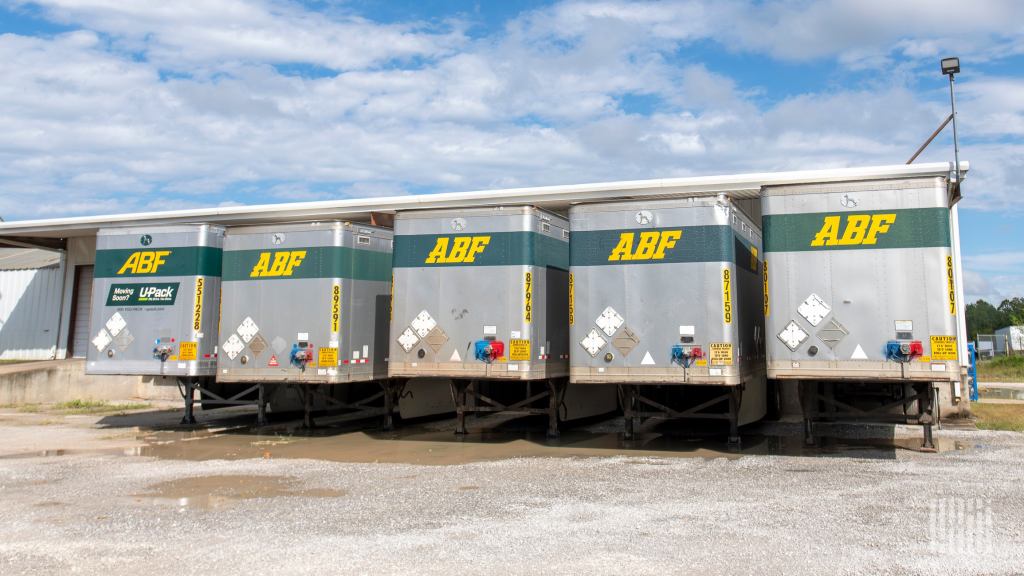
Several ABF trailers being loaded at a terminal

ArcBest saw tonnage fall again in November as it continues to use a favorable less-than-truckload capacity backdrop following Yellow’s shutdown to further unwind dynamic pricing initiatives.

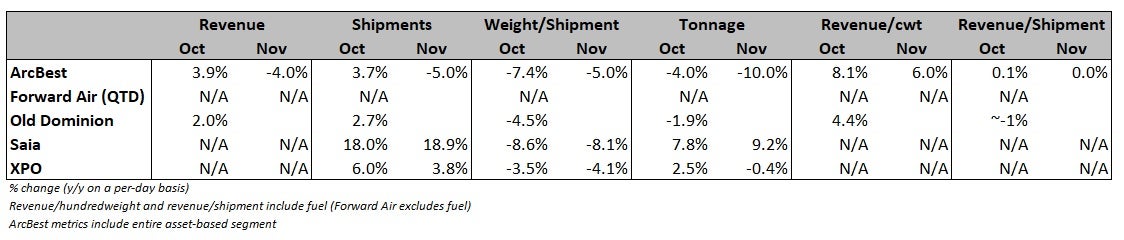
A Tuesday filing with the Securities and Exchange Commission showed tonnage in the company’s asset-based segment, which includes LTL carrier ABF Freight, was off 10% year over year (y/y) in November following a 4% decline in October. The carrier had the benefit of negative comps from a year ago (down 3.9% and 3.3% y/y in October and November 2022, respectively.)  

“The company has reduced shipments sourced from the Asset-Based tech-enabled dynamic LTL-rated, market-based pricing program in November 2023 compared to the prior year to optimize operating income and service,” the filing read.

ArcBest (NASDAQ: ARCB) began using dynamic pricing more heavily late last year after the market rolled over. The strategy utilizes technology to better match available capacity in the network with noncontractual shipment opportunities in the market. The goal of the effort is to prop up throughput at its terminals with profitable freight, albeit freight that is not as well priced as what it sees from core accounts.

The carrier’s shipments were off 5% y/y in November following a 3.7% increase in October. Mid-single-digit declines in weight per shipment bridged the gap to the tonnage declines.

On its third-quarter call at the end of October, management said shipments from core customers, which carry better margins, were up 20% sequentially from the second quarter.

Revenue per hundredweight, or yield, improved again as “pricing discipline in the industry remains strong,” the filing read. Yield was up 8.1% y/y in October and 6% in November. Stacking the current results with prior-year monthly gains shows increases of 19% and 13%, respectively.

Lower diesel prices (down 17% y/y in the first two months of the fourth quarter) have been a headwind to yields, but declines in shipment weights have been a notable tailwind for the metric.

Table: Company reports

The company also said Tuesday it “continues to see results from its cost reduction efforts while preserving the ability to serve customers as macro conditions improve.” Over the past year, management has credited dynamic pricing with allowing it to avoid significant staff reductions, which prove cumbersome when demand turns.

Industrial freight demand, which can account for roughly two-thirds of a carrier’s total volume, remains under water. The November Manufacturing Purchasing Managers’ Index was in contraction territory for a 13th straight month at 46.7.

ArcBest’s asset-based unit normally sees 100 to 300 basis points of operating ratio deterioration from the third to the fourth quarter. The Tuesday update calls for the metric to be flat to slightly better this year, which is a little worse than an indication of 100 to 200 bps of improvement provided on the October call.  

The company’s asset-light segment, which includes truckload brokerage, reported a 15% y/y decline in revenue per day during October and November. Shipments were off by mid-single digits while revenue per shipment was down by mid-teens percentages.

“The year-over-year changes in Asset-Light revenue per day results primarily reflect continued softness in the truckload brokerage market offset by continued growth in the company’s managed transportation solutions business,” the update stated.

The unit is expected to see sequential improvement from the third quarter’s adjusted operating loss of $3.9 million.

Late Monday, a Delaware bankruptcy court filing showed ArcBest’s real estate arm had a $30.2 million winning bid for three of Yellow’s terminals.

Shares of ARCB were down 9.1% at 2:41 p.m. EST on Tuesday compared to the S&P 500, which was off 0.1%.

More FreightWaves articles by Todd Maiden

Check Call: It’s all coming together

people gathered around a desk of computers. Check Call news and analysis for 3pls and brokers

Welcome to Check Call, our corner of the internet for all things 3PL, freight broker and supply chain. Check Call the podcast comes out every Tuesday at 12:30 p.m. EST. Catch up on previous episodes here. If this was forwarded to you, sign up for Check Call the newsletter here.

(Gif: Tenor) 

Better together is a phrase that didn’t die in the pandemic as BNSF Railway, Grupo México Transportes (GMXT) and J.B. Hunt Services have taken the phrase literally. These three companies are working together to form a U.S.-Mexico seamless operation for automakers and parts suppliers. They claim that goods can get from Monterrey, Mexico, to Chicago, and vice versa, in a day. 

Here’s how it’s supposed to work: GMXT will take the intermodal load from Monterrey to Eagle Pass, Texas, which is just across the U.S.-Mexico border. From there BNSF or J.B. Hunt will take the load the rest of the way to Chicago. Given the amount of nearshoring happening in Mexico, specifically in regard to auto parts, this is a game changer for automotive companies.

Gone are the days of supply chain shortages being tolerated. Carmakers are apparently also done with those excuses as they continue to build resilience into their supply chains. 

(GIf: GIPHY)

An update to the fraudulent emails coming from what appeared to be DAT but were actually hackers trying to get DAT login credentials: DAT shut it down. After learning about this scam, it said enough was enough and got the websites shut down and doubled down on its commitment to customers. 

FreightWaves’ Grace Sharkey’s article says, “DAT advises customers who suspect they have received a phishing email impersonating DAT or suspect a compromise of their DAT credentials to promptly contact the customer service department and report the incident. It also recommends sending a screenshot of the message to customer service instead of forwarding the actual phishing email to avoid further issues.” 

It cannot be said enough that if something seems off or out of place, don’t click on the links in the email and instead reach out to the customer service team. And while we’re at it, since it is December, it might be time to change those passwords and start fresh for the new year. It never hurts to be a little proactive. 

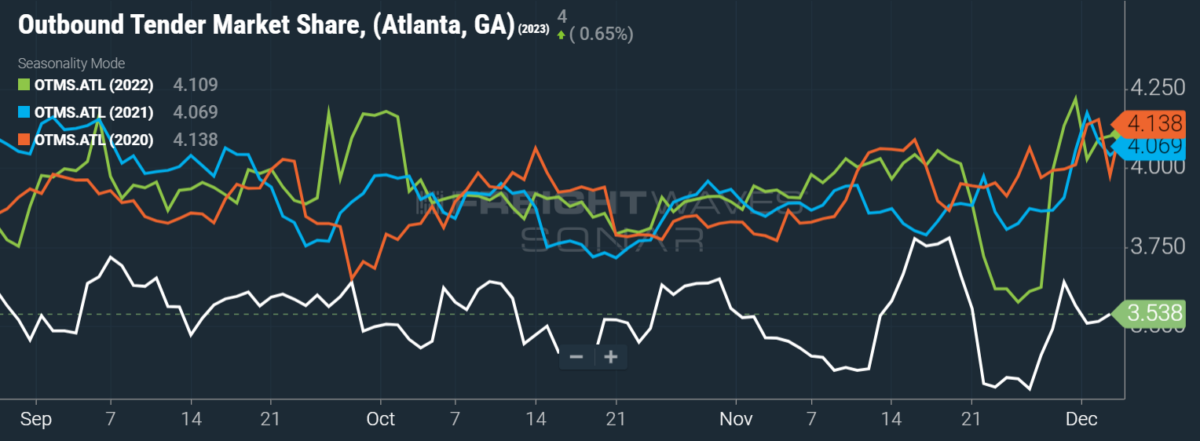
SONAR Ticker: OTMS.ATL – Seasonality

Market Check. Oh, how the mighty have fallen. Atlanta has dropped considerably in terms of total market share compared to past years. In 2020, the orange line, demand went up around the country as it was peak pandemic shopping time. Volumes were up everywhere, rates were up, a good time was had by all. However, as the middle to end of 2021 rolled around and the wait was weeks to a month to get berths at the ports of LA and Long Beach, shippers started looking elsewhere, and that elsewhere was the East Coast and that caused a massive increase in outbound tender market share. 

Fast-forward to now. The West Coast ports are relatively under control. Rail union contracts worked out. Longshoremen contracts worked out. And there’s plenty of space for ships to come in and get unloaded. With the rising issues of ships getting through the Panama Canal, it seems the tide has turned yet again and the West Coast ports have started reabsorbing the volumes lost the last few years.  

(GIF: Tenor)

Who’s with whom? Yellow’s legacy lives on, but the question remains where it lives. Yellow ceased operations at the end of July, filing for bankruptcy shortly after that. A bidding war for Yellow’s terminals then began. Estes Express Lines placed a bid on the facilities at the end of September for $1.525 billion and that offer set the floor for the auction price. The auction was held last Tuesday and the results should be posted anytime now.

It’s likely that Estes will take a majority of the facilities, but Jack Cooper Transport cannot be ruled out of contention. Jack Cooper is a carrier that specializes in automobile hauling. The details of Jack Cooper’s bid can be found in FreightWaves’ Todd Maiden’s article from late October. Jack Cooper’s plan had the support of senators and the International Brotherhood of Teamsters, which is responsible for a majority of Yellow’s former workforce. 

Yellow’s equipment like trailers and tractors have already been liquidated through auction houses around the country. It’s unlikely that the facilities will be split between the two. Since both companies are privately held, there is no easy way to tell how deep the pockets run. My money is that Estes will get the facilities, but it’s anyone’s game at this point — well, anyone that has more than $1.525 billion to spend.  

The more you know 

Feds told to start rating ‘unrated’ trucking companies for safety 

Borderlands: Logistics boom drives $1.2B e-commerce firm’s relocation in Texas

Jacobs leading takeover of software company as he readies next move 

AIT Worldwide Logistics acquires European life sciences specialist Mach II Shipping Ltd 

UPS to boost global trade with enhanced operations at new hub at Hong Kong International Airport

See you on the internet.

Mary

Join the community in freight and subscribe for more at www.freightwaves.com/subscribe.

Georgia Ports Authority plans second inland rail terminal in north Georgia

The Georgia Ports Authority Board has voted to spend $127 million to build the Blue Ridge Connector, an inland rail terminal in Gainesville, Georgia, roughly 60 miles northeast of Atlanta and over 250 miles northwest of Savannah.

GPA says the inland terminal, which will open in 2026 and benefit companies involved in manufacturing heavy equipment, food and forest products, will link northeast Georgia with the Port of Savannah and its 35 global container ship services, according to a Tuesday release. 

The port authority will fund the terminal through a mix of internal capital and a $46.8 million grant from the U.S. Department of Transportation Maritime Administration. Norfolk Southern (NYSE: NSC) will provide access between the Gainesville terminal and GPA’s Mason Mega Rail terminal in Savannah.

“Georgia is among the fastest-growing states and consistently ranked among the top to do business,” NS Chief Marketing Officer Ed Elkins said in a Thursday release. “The Georgia Ports Authority is an important partner to Norfolk Southern, a gateway for our customers, and an engine for economic growth. We look forward to building on our strong relationship and helping our mutual customers grow.”

This project has been in the works for years, with FreightWaves writing about the plan in December 2018.

“This important investment will help our customers streamline their supply chains while reducing congestion on Georgia highways” since containers between Gainesville and Savannah will make that 600-mile round trip via rail instead of truck, GPA President and CEO Griff Lynch said in the release. The facility will also feature hybrid electric rubber tire gantry cranes.

The Blue Ridge Connector will be GPA’s second inland rail terminal in north Georgia. The Appalachian Regional Port, a joint effort between GPA, Murray County, the state of Georgia and CSX, opened in August 2018. 

GPA says it has invested more than $374 million in rail capacity. That includes investments in this project as well as the Port of Savannah’s on-dock Mason Mega Rail Terminal and the Appalachian Regional Port in northwest Georgia. Approximately 18%-20% of GPA’s container cargo moves by rail, with the remainder handled by truck.

In addition to green-lighting funding for the Blue Ridge Connector, GPA’s board approved spending $44.5 million for a 300,000-square-foot facility at Garden City Terminal that will have offices and refrigeration facilities to support U.S. Customs and Border Protection. 

“Our long-term partnership with CBP is important to the safe and secure operational flow of cargo through our gateway container terminal. This investment represents the next level of making future supply chains run smoother in Savannah,” said GPA Chairman Kent Fountain. GPA says Savannah has the only on-port CBP inspection facility in the U.S. 

Subscribe to FreightWaves’ e-newsletters and get the latest insights on freight right in your inbox.

Click here for more FreightWaves articles by Joanna Marsh.

Transportation capacity grows faster in November, prices continue to slide

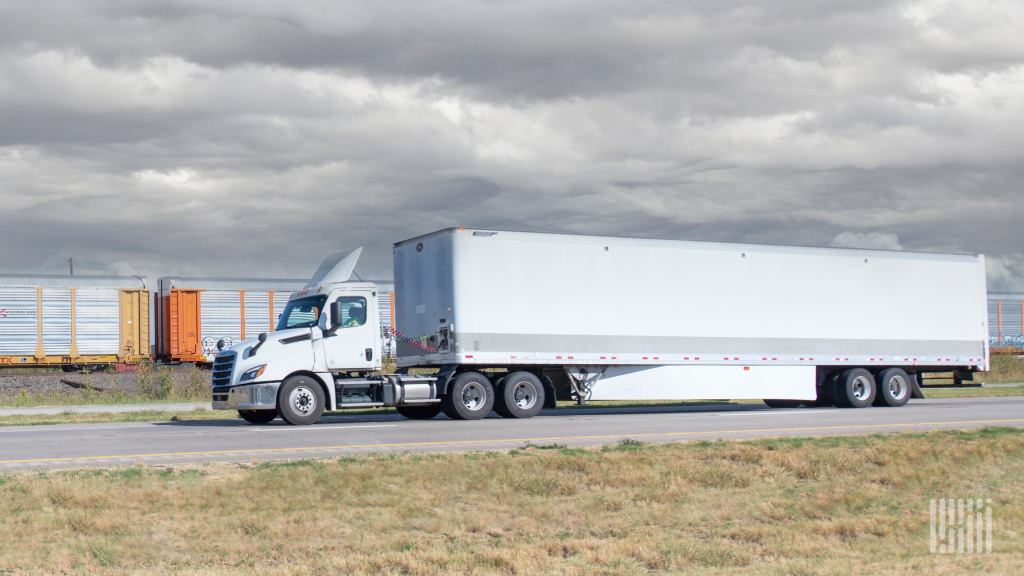
A white tractor-trailer on highway with a freight train in the background

A November survey of supply chain managers fell back into contraction territory with transportation metrics partly to blame.

The Logistics Managers’ Index (LMI) produced a reading of 49.4 during the month, which was 7.1 percentage points worse than October and followed three consecutive months of expansion. The data is compiled in a diffusion index where a reading above 50 indicates expansion while one below 50 signals contraction.

The index’s transportation metrics remained uninspiring from a carriers’ perspective during November. Capacity (61.8) increased 5.2 points, utilization (50) fell 10.7 points and pricing (44.2) remained on the decline.

Transportation capacity remained “prevalent across the supply chain” and has been on the rise since April 2022, according to the Tuesday report. When asked about transportation capacity one year from now, respondents returned a reading of 48.2, with downstream participants like retailers expecting a faster rate of contraction (43.8).

While off just slightly from October, transportation prices remained in contraction territory and the rate of decline worsened for the first time in six months. However, the responses were less-bad (47) in the last two weeks of the month “as last-mile deliveries [of] holiday goods picked up.”

“It is interesting that Transportation Prices, which have been the lowest metric all year and are often the canary in the coalmine for the overall logistics industry is the metric that had the smallest drop during November’s swoon,” the report said.

The 12-month forward expectation for transportation prices was solidly in growth mode at 63.8.

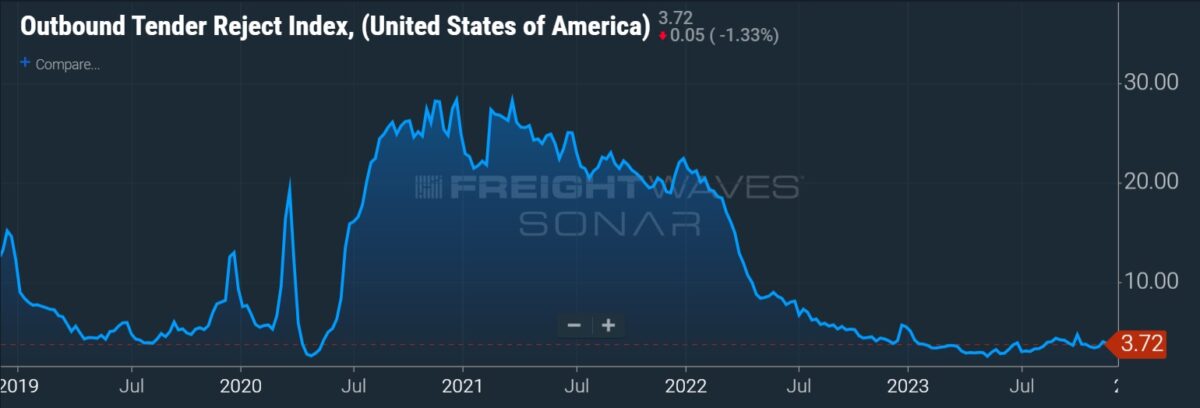
Chart: (SONAR: OTRI.USA). A proxy for truck capacity, the Outbound Tender Reject Index, shows the number of loads being rejected by carriers. Carriers are currently rejecting less than 4% of all loads tendered under contract. To learn more about FreightWaves SONAR, click here.
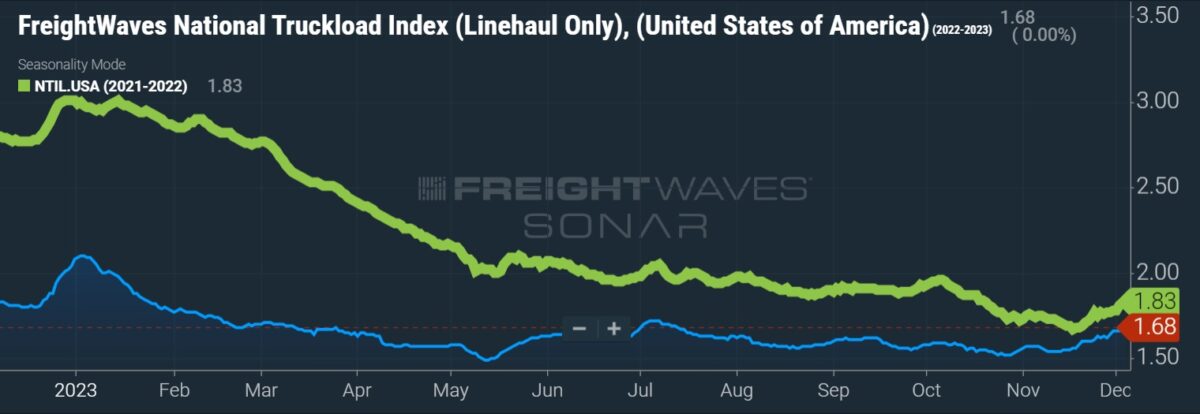
Chart: (SONAR: NTIL.USA). The National Truckload Index (linehaul only – NTIL) is based on an average of booked spot dry van loads from 250,000 lanes. The NTIL is a seven-day moving average of linehaul spot rates excluding fuel. Spot rates are currently 8% lower y/y.

Part of the backslide in the overall LMI wasn’t really bad news as inventory levels (44.3) experienced a 9.1-point sequential drop as holiday sales ramped during the month. Downstream respondents returned a future expectation of 41.5 as their merchandise has moved off the shelves but may not be immediately restocked, whereas upstream wholesalers plan to more aggressively build inventories, returning a future expectation of 54.7.

“Essentially, November’s decline seems to have come because firms are selling off inventories quickly,” the report said. “The previous large decline from April 2022 happened because firms had too much inventory and couldn’t sell any of it. Both of these scenarios led to large drops in the overall LMI, but this more recent drop is significantly less concerning.”

Warehousing capacity (60.6) continued to expand at a rate that was 3.6 points higher sequentially and nearly 14 points higher than the year-ago level. Warehousing utilization (52.9) continued to increase but at a rate that was 14 points lower than in October. Contraction was noted at the wholesale level of the supply chain while downstream respondents returned a utilization reading of 59.8.

Even with new space coming online, warehouse prices (64.2) remained on the rise, albeit 6.5 points lower than in October. The growth rates have slowed but prices continue to increase after numerous months of growth, including the exorbitant growth rates (90-plus) logged during the pandemic. Respondents returned a 12-month expectation of 65.3 for warehouse prices, indicating an expectation that rents will be growing at a similar clip one year from now.

The LMI is a collaboration among Arizona State University, Colorado State University, Florida Atlantic University, Rutgers University and the University of Nevada, Reno, conducted in conjunction with the Council of Supply Chain Management Professionals.

More FreightWaves articles by Todd Maiden