ArcBest’s November tonnage dips further, yields up

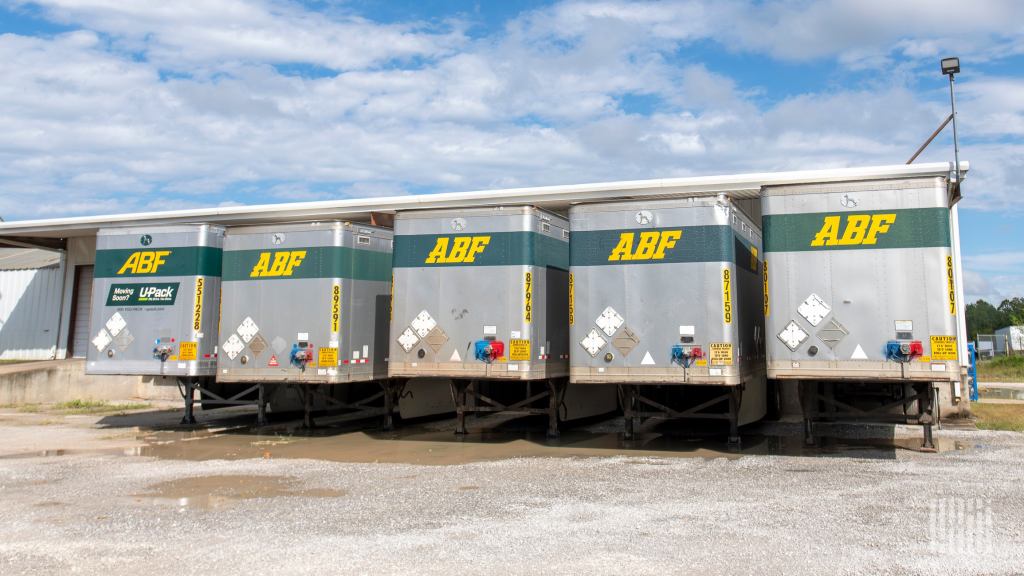
Several ABF trailers being loaded at a terminal

ArcBest saw tonnage fall again in November as it continues to use a favorable less-than-truckload capacity backdrop following Yellow’s shutdown to further unwind dynamic pricing initiatives.

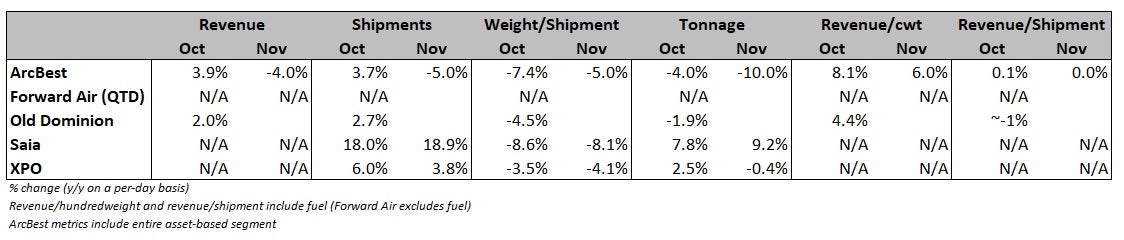
A Tuesday filing with the Securities and Exchange Commission showed tonnage in the company’s asset-based segment, which includes LTL carrier ABF Freight, was off 10% year over year (y/y) in November following a 4% decline in October. The carrier had the benefit of negative comps from a year ago (down 3.9% and 3.3% y/y in October and November 2022, respectively.)  

“The company has reduced shipments sourced from the Asset-Based tech-enabled dynamic LTL-rated, market-based pricing program in November 2023 compared to the prior year to optimize operating income and service,” the filing read.

ArcBest (NASDAQ: ARCB) began using dynamic pricing more heavily late last year after the market rolled over. The strategy utilizes technology to better match available capacity in the network with noncontractual shipment opportunities in the market. The goal of the effort is to prop up throughput at its terminals with profitable freight, albeit freight that is not as well priced as what it sees from core accounts.

The carrier’s shipments were off 5% y/y in November following a 3.7% increase in October. Mid-single-digit declines in weight per shipment bridged the gap to the tonnage declines.

On its third-quarter call at the end of October, management said shipments from core customers, which carry better margins, were up 20% sequentially from the second quarter.

Revenue per hundredweight, or yield, improved again as “pricing discipline in the industry remains strong,” the filing read. Yield was up 8.1% y/y in October and 6% in November. Stacking the current results with prior-year monthly gains shows increases of 19% and 13%, respectively.

Lower diesel prices (down 17% y/y in the first two months of the fourth quarter) have been a headwind to yields, but declines in shipment weights have been a notable tailwind for the metric.
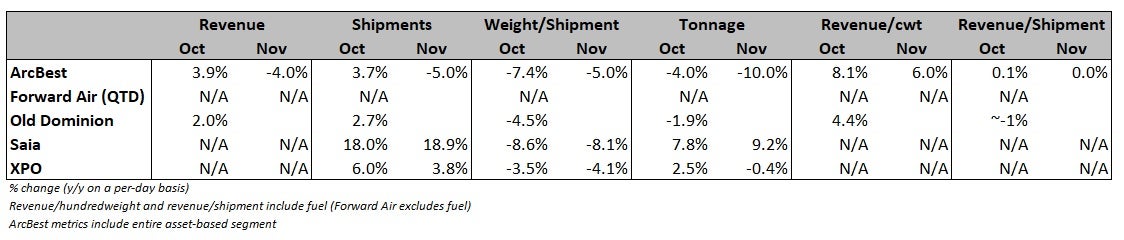
Table: Company reports

The company also said Tuesday it “continues to see results from its cost reduction efforts while preserving the ability to serve customers as macro conditions improve.” Over the past year, management has credited dynamic pricing with allowing it to avoid significant staff reductions, which prove cumbersome when demand turns.

Industrial freight demand, which can account for roughly two-thirds of a carrier’s total volume, remains under water. The November Manufacturing Purchasing Managers’ Index was in contraction territory for a 13th straight month at 46.7.

ArcBest’s asset-based unit normally sees 100 to 300 basis points of operating ratio deterioration from the third to the fourth quarter. The Tuesday update calls for the metric to be flat to slightly better this year, which is a little worse than an indication of 100 to 200 bps of improvement provided on the October call.  

The company’s asset-light segment, which includes truckload brokerage, reported a 15% y/y decline in revenue per day during October and November. Shipments were off by mid-single digits while revenue per shipment was down by mid-teens percentages.

“The year-over-year changes in Asset-Light revenue per day results primarily reflect continued softness in the truckload brokerage market offset by continued growth in the company’s managed transportation solutions business,” the update stated.

The unit is expected to see sequential improvement from the third quarter’s adjusted operating loss of $3.9 million.

Late Monday, a Delaware bankruptcy court filing showed ArcBest’s real estate arm had a $30.2 million winning bid for three of Yellow’s terminals.

Shares of ARCB were down 9.1% at 2:41 p.m. EST on Tuesday compared to the S&P 500, which was off 0.1%.

More FreightWaves articles by Todd Maiden

Check Call: It’s all coming together

people gathered around a desk of computers. Check Call news and analysis for 3pls and brokers

Welcome to Check Call, our corner of the internet for all things 3PL, freight broker and supply chain. Check Call the podcast comes out every Tuesday at 12:30 p.m. EST. Catch up on previous episodes here. If this was forwarded to you, sign up for Check Call the newsletter here.

(Gif: Tenor) 

Better together is a phrase that didn’t die in the pandemic as BNSF Railway, Grupo México Transportes (GMXT) and J.B. Hunt Services have taken the phrase literally. These three companies are working together to form a U.S.-Mexico seamless operation for automakers and parts suppliers. They claim that goods can get from Monterrey, Mexico, to Chicago, and vice versa, in a day. 

Here’s how it’s supposed to work: GMXT will take the intermodal load from Monterrey to Eagle Pass, Texas, which is just across the U.S.-Mexico border. From there BNSF or J.B. Hunt will take the load the rest of the way to Chicago. Given the amount of nearshoring happening in Mexico, specifically in regard to auto parts, this is a game changer for automotive companies.

Gone are the days of supply chain shortages being tolerated. Carmakers are apparently also done with those excuses as they continue to build resilience into their supply chains. 

(GIf: GIPHY)

An update to the fraudulent emails coming from what appeared to be DAT but were actually hackers trying to get DAT login credentials: DAT shut it down. After learning about this scam, it said enough was enough and got the websites shut down and doubled down on its commitment to customers. 

FreightWaves’ Grace Sharkey’s article says, “DAT advises customers who suspect they have received a phishing email impersonating DAT or suspect a compromise of their DAT credentials to promptly contact the customer service department and report the incident. It also recommends sending a screenshot of the message to customer service instead of forwarding the actual phishing email to avoid further issues.” 

It cannot be said enough that if something seems off or out of place, don’t click on the links in the email and instead reach out to the customer service team. And while we’re at it, since it is December, it might be time to change those passwords and start fresh for the new year. It never hurts to be a little proactive. 

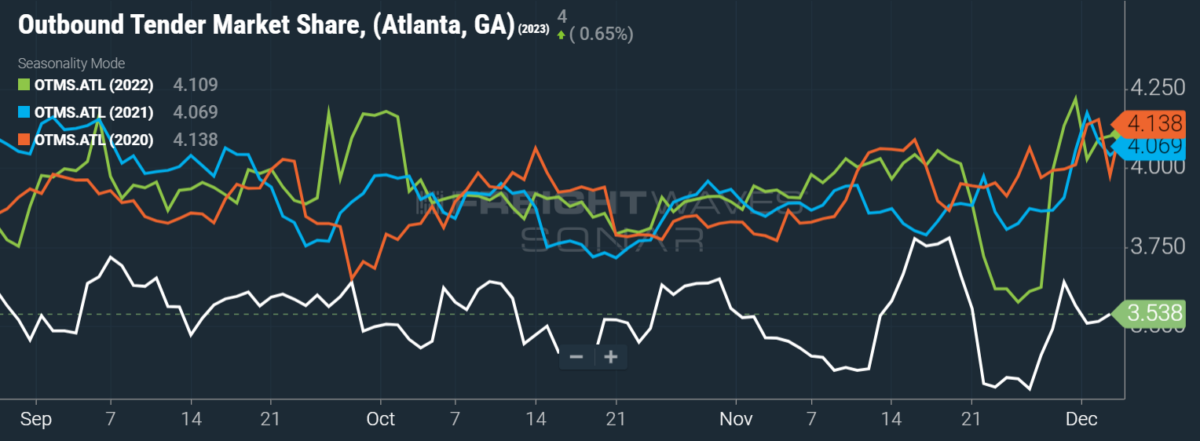
SONAR Ticker: OTMS.ATL – Seasonality

Market Check. Oh, how the mighty have fallen. Atlanta has dropped considerably in terms of total market share compared to past years. In 2020, the orange line, demand went up around the country as it was peak pandemic shopping time. Volumes were up everywhere, rates were up, a good time was had by all. However, as the middle to end of 2021 rolled around and the wait was weeks to a month to get berths at the ports of LA and Long Beach, shippers started looking elsewhere, and that elsewhere was the East Coast and that caused a massive increase in outbound tender market share. 

Fast-forward to now. The West Coast ports are relatively under control. Rail union contracts worked out. Longshoremen contracts worked out. And there’s plenty of space for ships to come in and get unloaded. With the rising issues of ships getting through the Panama Canal, it seems the tide has turned yet again and the West Coast ports have started reabsorbing the volumes lost the last few years.  

(GIF: Tenor)

Who’s with whom? Yellow’s legacy lives on, but the question remains where it lives. Yellow ceased operations at the end of July, filing for bankruptcy shortly after that. A bidding war for Yellow’s terminals then began. Estes Express Lines placed a bid on the facilities at the end of September for $1.525 billion and that offer set the floor for the auction price. The auction was held last Tuesday and the results should be posted anytime now.

It’s likely that Estes will take a majority of the facilities, but Jack Cooper Transport cannot be ruled out of contention. Jack Cooper is a carrier that specializes in automobile hauling. The details of Jack Cooper’s bid can be found in FreightWaves’ Todd Maiden’s article from late October. Jack Cooper’s plan had the support of senators and the International Brotherhood of Teamsters, which is responsible for a majority of Yellow’s former workforce. 

Yellow’s equipment like trailers and tractors have already been liquidated through auction houses around the country. It’s unlikely that the facilities will be split between the two. Since both companies are privately held, there is no easy way to tell how deep the pockets run. My money is that Estes will get the facilities, but it’s anyone’s game at this point — well, anyone that has more than $1.525 billion to spend.  

The more you know 

Feds told to start rating ‘unrated’ trucking companies for safety 

Borderlands: Logistics boom drives $1.2B e-commerce firm’s relocation in Texas

Jacobs leading takeover of software company as he readies next move 

AIT Worldwide Logistics acquires European life sciences specialist Mach II Shipping Ltd 

UPS to boost global trade with enhanced operations at new hub at Hong Kong International Airport

See you on the internet.

Mary

Join the community in freight and subscribe for more at www.freightwaves.com/subscribe.

Georgia Ports Authority plans second inland rail terminal in north Georgia

The Georgia Ports Authority Board has voted to spend $127 million to build the Blue Ridge Connector, an inland rail terminal in Gainesville, Georgia, roughly 60 miles northeast of Atlanta and over 250 miles northwest of Savannah.

GPA says the inland terminal, which will open in 2026 and benefit companies involved in manufacturing heavy equipment, food and forest products, will link northeast Georgia with the Port of Savannah and its 35 global container ship services, according to a Tuesday release. 

The port authority will fund the terminal through a mix of internal capital and a $46.8 million grant from the U.S. Department of Transportation Maritime Administration. Norfolk Southern (NYSE: NSC) will provide access between the Gainesville terminal and GPA’s Mason Mega Rail terminal in Savannah.

“Georgia is among the fastest-growing states and consistently ranked among the top to do business,” NS Chief Marketing Officer Ed Elkins said in a Thursday release. “The Georgia Ports Authority is an important partner to Norfolk Southern, a gateway for our customers, and an engine for economic growth. We look forward to building on our strong relationship and helping our mutual customers grow.”

This project has been in the works for years, with FreightWaves writing about the plan in December 2018.

“This important investment will help our customers streamline their supply chains while reducing congestion on Georgia highways” since containers between Gainesville and Savannah will make that 600-mile round trip via rail instead of truck, GPA President and CEO Griff Lynch said in the release. The facility will also feature hybrid electric rubber tire gantry cranes.

The Blue Ridge Connector will be GPA’s second inland rail terminal in north Georgia. The Appalachian Regional Port, a joint effort between GPA, Murray County, the state of Georgia and CSX, opened in August 2018. 

GPA says it has invested more than $374 million in rail capacity. That includes investments in this project as well as the Port of Savannah’s on-dock Mason Mega Rail Terminal and the Appalachian Regional Port in northwest Georgia. Approximately 18%-20% of GPA’s container cargo moves by rail, with the remainder handled by truck.

In addition to green-lighting funding for the Blue Ridge Connector, GPA’s board approved spending $44.5 million for a 300,000-square-foot facility at Garden City Terminal that will have offices and refrigeration facilities to support U.S. Customs and Border Protection. 

“Our long-term partnership with CBP is important to the safe and secure operational flow of cargo through our gateway container terminal. This investment represents the next level of making future supply chains run smoother in Savannah,” said GPA Chairman Kent Fountain. GPA says Savannah has the only on-port CBP inspection facility in the U.S. 

Subscribe to FreightWaves’ e-newsletters and get the latest insights on freight right in your inbox.

Click here for more FreightWaves articles by Joanna Marsh.

Transportation capacity grows faster in November, prices continue to slide

A white tractor-trailer on highway with a freight train in the background

A November survey of supply chain managers fell back into contraction territory with transportation metrics partly to blame.

The Logistics Managers’ Index (LMI) produced a reading of 49.4 during the month, which was 7.1 percentage points worse than October and followed three consecutive months of expansion. The data is compiled in a diffusion index where a reading above 50 indicates expansion while one below 50 signals contraction.

The index’s transportation metrics remained uninspiring from a carriers’ perspective during November. Capacity (61.8) increased 5.2 points, utilization (50) fell 10.7 points and pricing (44.2) remained on the decline.

Transportation capacity remained “prevalent across the supply chain” and has been on the rise since April 2022, according to the Tuesday report. When asked about transportation capacity one year from now, respondents returned a reading of 48.2, with downstream participants like retailers expecting a faster rate of contraction (43.8).

While off just slightly from October, transportation prices remained in contraction territory and the rate of decline worsened for the first time in six months. However, the responses were less-bad (47) in the last two weeks of the month “as last-mile deliveries [of] holiday goods picked up.”

“It is interesting that Transportation Prices, which have been the lowest metric all year and are often the canary in the coalmine for the overall logistics industry is the metric that had the smallest drop during November’s swoon,” the report said.

The 12-month forward expectation for transportation prices was solidly in growth mode at 63.8.

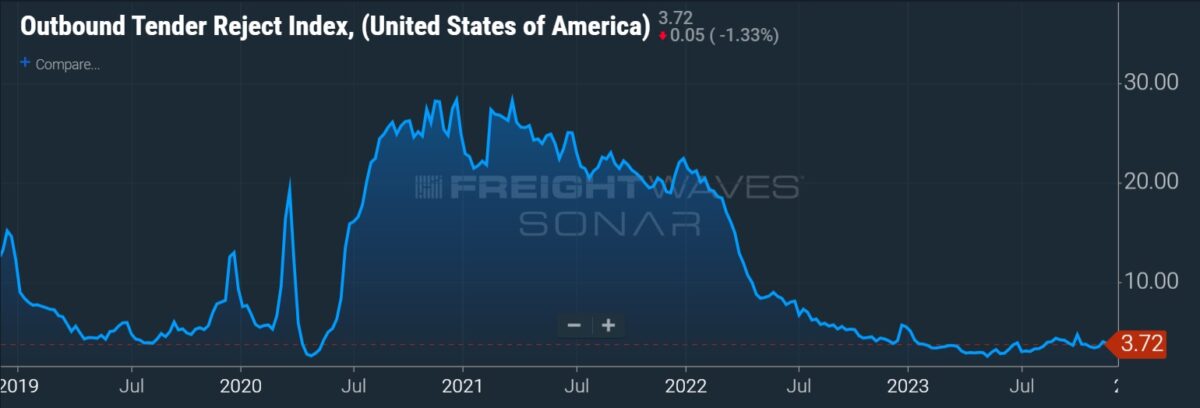
Chart: (SONAR: OTRI.USA). A proxy for truck capacity, the Outbound Tender Reject Index, shows the number of loads being rejected by carriers. Carriers are currently rejecting less than 4% of all loads tendered under contract. To learn more about FreightWaves SONAR, click here.
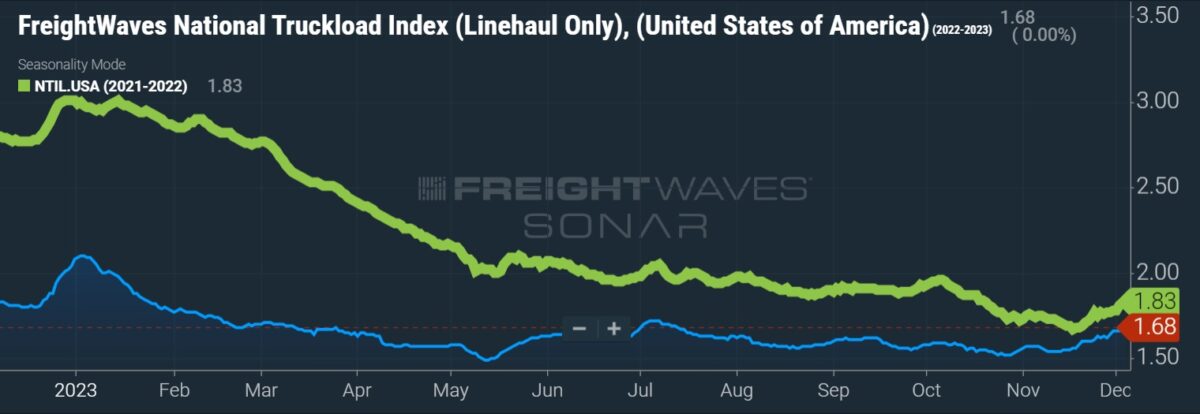
Chart: (SONAR: NTIL.USA). The National Truckload Index (linehaul only – NTIL) is based on an average of booked spot dry van loads from 250,000 lanes. The NTIL is a seven-day moving average of linehaul spot rates excluding fuel. Spot rates are currently 8% lower y/y.

Part of the backslide in the overall LMI wasn’t really bad news as inventory levels (44.3) experienced a 9.1-point sequential drop as holiday sales ramped during the month. Downstream respondents returned a future expectation of 41.5 as their merchandise has moved off the shelves but may not be immediately restocked, whereas upstream wholesalers plan to more aggressively build inventories, returning a future expectation of 54.7.

“Essentially, November’s decline seems to have come because firms are selling off inventories quickly,” the report said. “The previous large decline from April 2022 happened because firms had too much inventory and couldn’t sell any of it. Both of these scenarios led to large drops in the overall LMI, but this more recent drop is significantly less concerning.”

Warehousing capacity (60.6) continued to expand at a rate that was 3.6 points higher sequentially and nearly 14 points higher than the year-ago level. Warehousing utilization (52.9) continued to increase but at a rate that was 14 points lower than in October. Contraction was noted at the wholesale level of the supply chain while downstream respondents returned a utilization reading of 59.8.

Even with new space coming online, warehouse prices (64.2) remained on the rise, albeit 6.5 points lower than in October. The growth rates have slowed but prices continue to increase after numerous months of growth, including the exorbitant growth rates (90-plus) logged during the pandemic. Respondents returned a 12-month expectation of 65.3 for warehouse prices, indicating an expectation that rents will be growing at a similar clip one year from now.

The LMI is a collaboration among Arizona State University, Colorado State University, Florida Atlantic University, Rutgers University and the University of Nevada, Reno, conducted in conjunction with the Council of Supply Chain Management Professionals.

More FreightWaves articles by Todd Maiden

UK company develops shipping labels with built-in tracking device

A U.K.-based company said it has created the first shipping label embedded with a tracking device that’s connected to a 5G cellular network, enabling users to print tracking labels at scale from a standard thermal barcode printer.

The company, Reelables, was founded in 2018 to develop label-tracking technology for freight forwarders. It has now expanded into the parcel delivery market, a segment where tens of millions of labels are printed each day. 

The technology, which is also available to retailers, will allow for shipment tracking without the need for manual intervention to scan barcodes as shipments move through the supply chain. This eliminates the risk of human error and results in precise tracking information at the piece level, Reelables said.

The technology is a breakthrough in the field of printed electronics by fabricating an active device with coated zinc batteries that share a common paper-thin wireless circuit, according to Reelables. The technology can be used where shipping labels are already being printed by changing existing label media to Reelables, the company said.

Reelables labels automatically collect actual location data from the cellular network data and trigger events the moment a shipment arrives or departs a warehouse or waypoint or an exception is detected, the company said.

Reelables said the underlying technology is a reel-to-reel, thin-film manufacturing process that enables it to make ultra-thin and extremely cost-efficient wireless circuits into smart labels.  

A key part of the core technology is the integration of a coated zinc battery on the same base material shared with a wireless circuit. Reelables said this is a big differentiator from companies that are still using conventional lithium batteries in their tracking devices. Lithium is also classified as a dangerous good, which is problematic for high-volume applications and safe air transport.

Reelables said the 5G smart label solution is ideally suited for manufacturers or retailers that are shipping time-critical, high-value goods and don’t control the infrastructure along their logistics corridors. 

“This is a major breakthrough when it comes to supply chain visibility and automation,” said Brian Krejcarek, CEO and co-founder of Reelables. “Achieving mass production and pervasive deployment of these thin film wireless smart labels will change how businesses track items, reduce theft and loss, and demonstrate accountability to their customers.”

Class 8 orders hit 14-month high in November

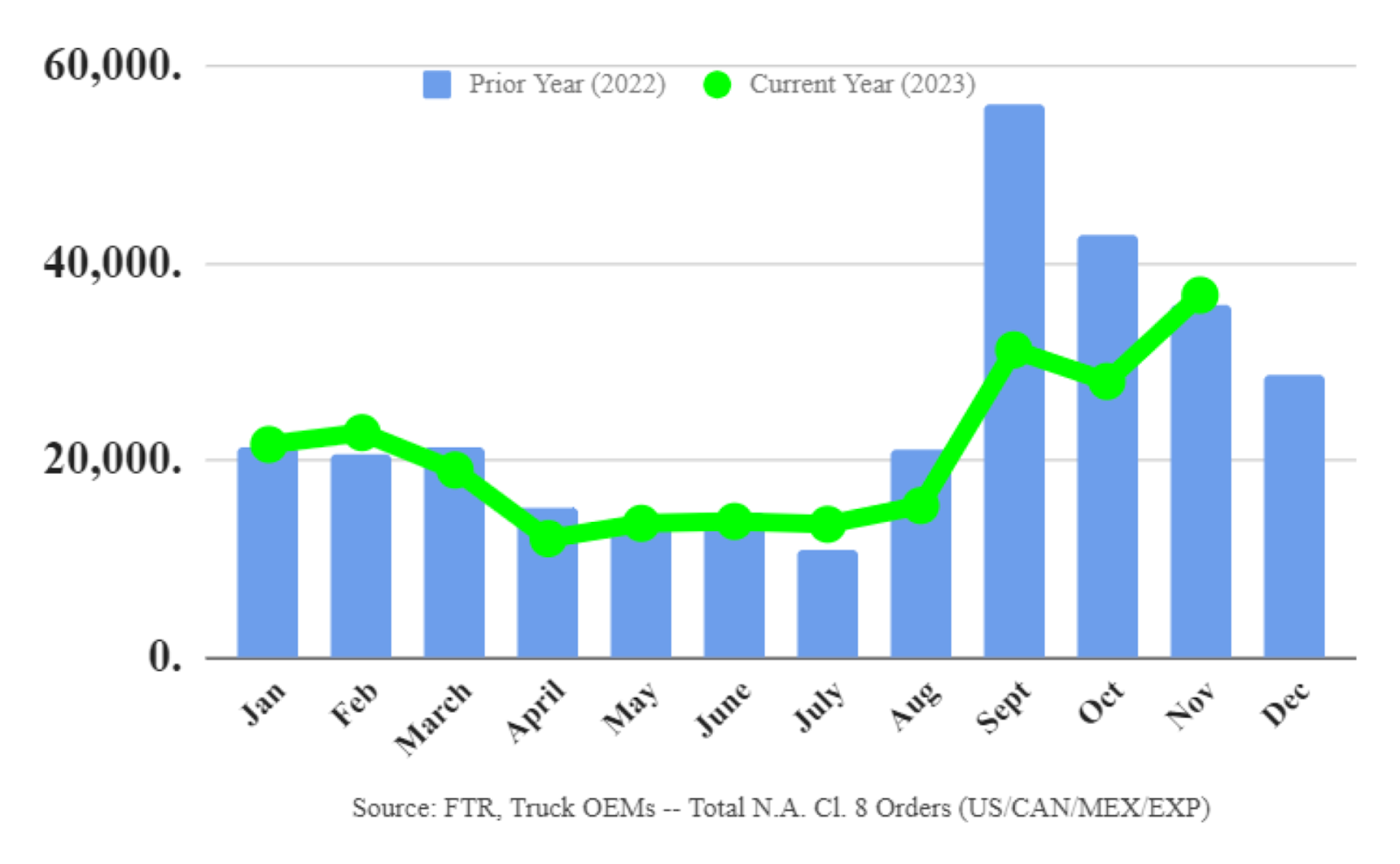
Class 8 truck orders continued to outpace the sluggish freight market with November orders surpassing 40,000. It was the best month since September 2022 on a seasonally adjusted basis.

November preliminary North American Class 8 net orders were 41,700 units, rising by 9,000 units from both October and year-ago November, ACT Research reported.

Even accounting for seasonal adjustment, orders surpassed 40,000 for the first time in more than a year.

“November [was] the best ‘real’ order month since September 2022,” Kenny Vieth, ACT president and senior analyst, said in a news release. “Since the filling of 2024’s orderboards began in earnest in September, Class 8 orders have been booked at a 413,000 seasonally adjusted annual rate.”

‘Solid rather than stellar’ 2024

Rising backlogs of trucks awaiting production suggest a “solid rather than stellar” 2024, he said.

FTR Transportation Intelligence reported lower preliminary orders of 36,750 units, up 32% from October and 2% ahead year over year. Total Class 8 orders for the previous 12 months have equaled 255,500 units.

“Despite prolonged weakness in the overall freight market, fleets continue to be willing to order new equipment,” FTR Chairman Eric Starks said. “Order levels were above the historical average but continue to follow seasonal trends, stabilizing our expectations for replacement demand in 2024.”

The slight year-over-year increase in November orders shows a market that is still performing at a high level historically, Starks said.

“We see a really strong vocational market out there. We see a strong medium-duty market. The LTL market is very strong,” Paccar Inc. CEO Preston Feight said on the company’s third-quarter call with analysts on Oct. 24. “The first quarter looks pretty good.”

Class 8 catch-up largely over as replacement iron drives orders

Class 8 truck orders hit year’s peak in September

August Class 8 truck orders reach highest level since February

Click for more FreightWaves articles by Alan Adler.

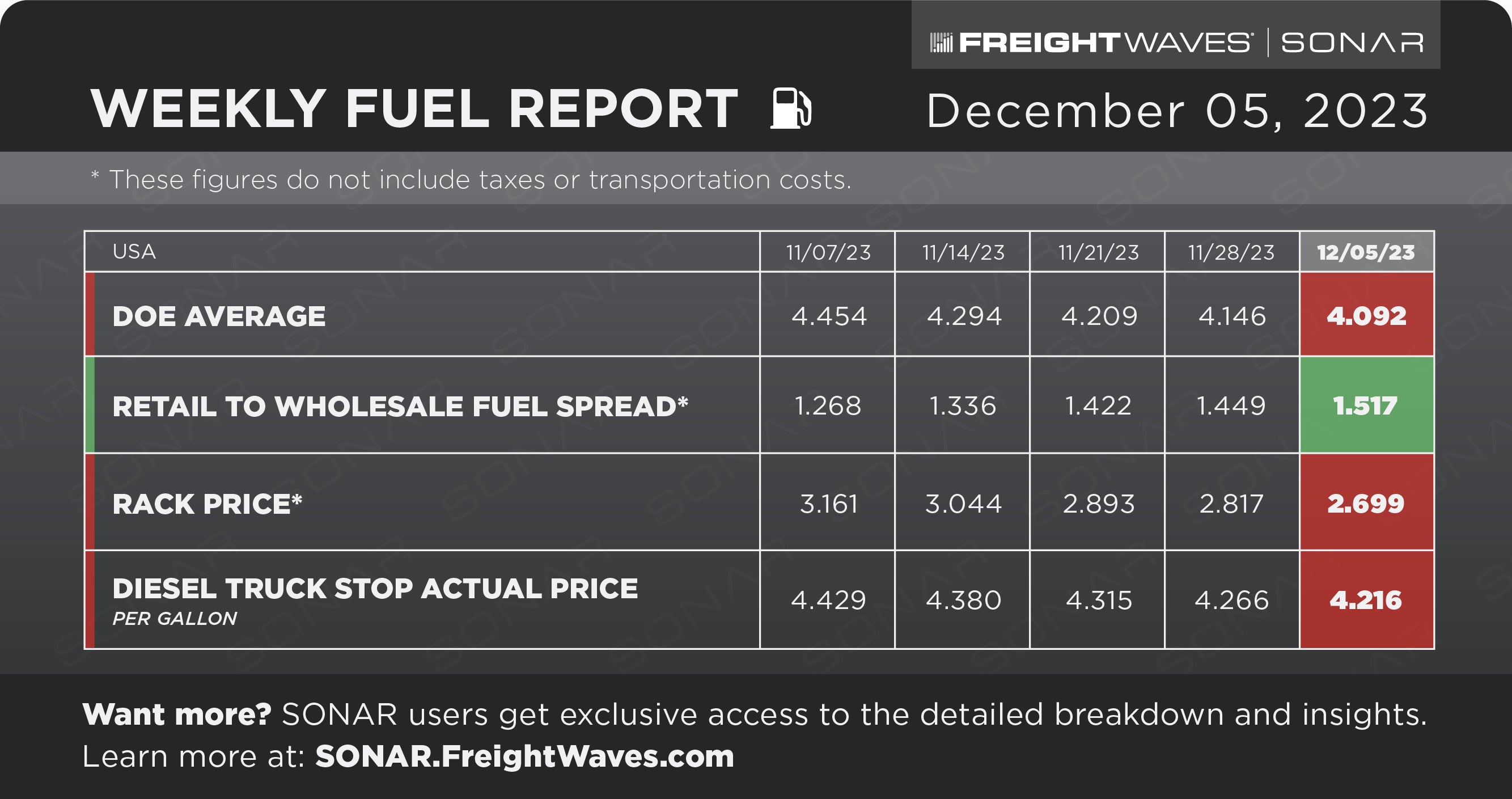
Weekly Fuel Report: December 05, 2023


Learn more at SONAR.FreightWaves.com

XPO’s November shipment increase needed to fill 28 new terminals

An XPO trailer parked at a terminal

Less-than-truckload carrier XPO reported shipments were up again in November but that lower shipment weights dragged down tonnage.

The Tuesday report showed the year-over-year (y/y) progression in metrics was more muted during November than what was previously reported for October. October shipments were up 6% y/y while November shipments increased 3.8%. A roughly 4% decline in weight per shipment in each month resulted in tons per day in the network up 2.5% in October but down slightly in November.

XPO (NYSE: XPO) does have a tougher comparison to the 2022 fourth quarter than most of its other publicly traded peers. Its shipments and tonnage were slightly positive in the year-ago quarter, when the rest of the industry was recording high-single-digit declines.

“We’re continuing to make good progress on a number of fronts in the fourth quarter despite the soft freight market,” CEO Mario Harik said.

Excluding the exit of Yellow, which resulted in a realignment of LTL market share, demand remains fairly weak.

A proxy for LTL freight demand, the Manufacturing Purchasing Managers’ Index, remained in contraction territory during November. The index was unchanged at 46.7 and below the neutral threshold of 50 for the 13th consecutive month. Softness throughout the industrial sector has resulted in lighter shipment weights across the industry.

Table: Company reports

XPO doesn’t provide any revenue-based metrics in its intraquarter updates but Harik said “yield ex-fuel growth is tracking ahead of expectations for the quarter, with continued strength heading into 2024.”

XPO previously guided to a high-single-digit y/y increase in yield during the fourth quarter, with tonnage up by a low-single-digit percentage.

“There’s a strong correlation between these operating gains and our strategy to become the industry’s best service provider,” Harik said. “By enhancing our service quality, we’re increasing our yield and can capture more profitable share when industry tonnage rebounds.”

He said the company’s damage frequency improved again to a “new company record” in the first two months of the fourth quarter.

The report came hours after XPO was announced to have a winning bid for 28 of Yellow’s terminals at a purchase price of $870 million. A Delaware bankruptcy court filing released late Monday showed the company won the largest allocation of commitments from an auction that secured new owners for 130 service centers valued at almost $1.9 billion.

The first wave of Yellow’s asset sales is expected to be finalized at a Dec. 12 hearing. The filing said Yellow’s 46 remaining owned terminals as well as some leased properties will be sold in the future.

XPO also announced Tuesday it entered into a bridge term loan financing package equal to the amount of its bid. The company plans a $585 million private offering of senior unsecured notes and is pursuing commitments for $400 million in senior secured debt. The proceeds will be used to repay the bridge loan as well as refinance other outstanding debt.

The company expects the asset acquisition to be accretive to adjusted earnings before interest, taxes, depreciation and amortization but dilutive to adjusted earnings per share next year. The deal is expected to be accretive to adjusted EPS in 2025.

More FreightWaves articles by Todd Maiden

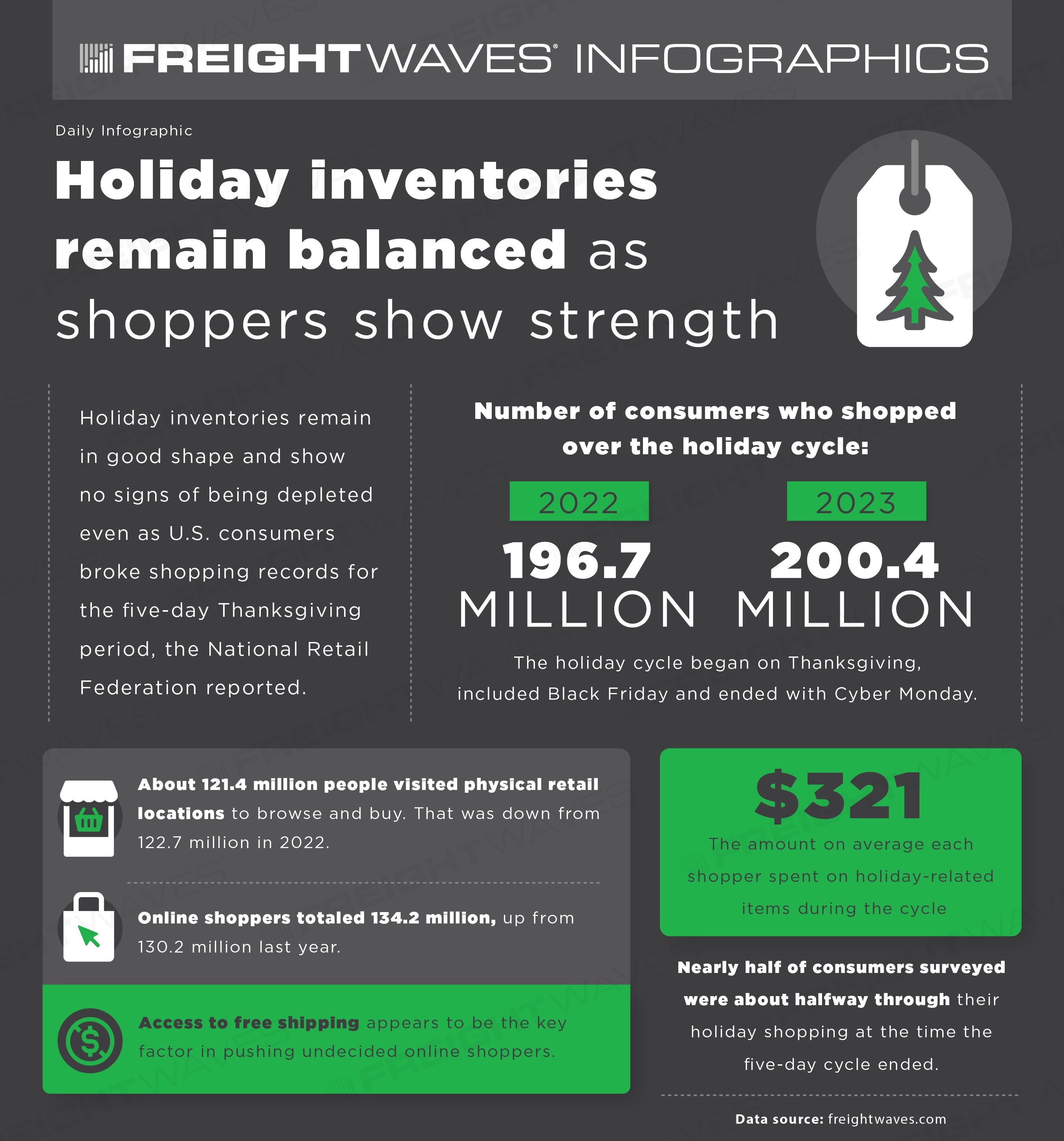
Daily Infographic: Holiday inventories remain balanced as shoppers show strength, NRF says


To view more FreightWaves infographics, click here

Uber unveils store package pickup service

Uber Technologies Inc. said Tuesday it has unveiled a store pickup service in which a buyer can arrange to have goods picked up at a store and delivered to a residence.

Under the service, following completion of a purchase, a consumer uploads the receipt in the Uber app to trigger the courier pickup. Items must be less than $200 in value and weigh less than 30 pounds, Uber (NYSE: UBER) said.

Customers can track their pickup delivery in real time in the Uber app and will be notified when the drop-off is completed, Uber said.

Starting this week, store pickup will be available in the Uber app for customers in more than 1,500 municipalities across the U.S., Uber said.