Berkshire: Haslam made secret payments for quick financial boost at Pilot

Repeatedly using words like “illicit” and “secret,” Berkshire Hathaway has fired back at Jimmy Haslam III, the former chairman of Pilot Travel Centers and son of its founder, over what began as an accounting dispute and now can only be described as a nasty battle with personal overtones.

Berkshire Hathaway’s allegations against Haslam III were in response to a suit filed in Delaware Chancery Court in late October about valuing the largest trucking and travel center in the country, 80% of which is now owned by Berkshire Hathaway (NYSE: BRK.B). It took majority control in January after taking an earlier minority position in 2017.

What’s at stake is the remaining 20%. There is a provision in the sale agreement between Berkshire Hathaway and Pilot that allows Haslam to exercise a “put option” that would require Berkshire Hathaway to purchase the remaining 20%. But the Haslam family cannot exercise that option anytime it chooses to; it must do so within 60 days at the close of the Pilot fiscal year, which is Dec. 31. If the Haslam family doesn’t exercise it in that window in one year, the option rolls over to the following year.

The heart of the Haslam complaint — filed as an action by Pilot Corp. — is that in violation of an earlier agreement, Berkshire Hathaway, upon taking control of Pilot Travel Centers (PTC), switched its accounting to a “pushdown” method. Haslam says this is reducing the value of Pilot, which would impact what Berkshire Hathaway would pay for the remaining 20%; he wants the valuation to be on the accounting in place when the sale was agreed upon.

Berkshire does not dispute the change in accounting and that it would impact earnings before interest and taxes (EBIT). But its response is that for purposes of the 20% valuation, it would abide by earlier agreements regarding the accounting to be used for setting the price in the put option if it is exercised.  

Berkshire’s response filed this week concedes that “pushdown accounting enabled PTC to avoid recognizing some expenses (increasing earnings before interest and taxes), but had other effects that reduced EBIT.” EBIT is the basis for determining the value of the put option. Berkshire said there is an Investor Rights Agreement to settle the dispute.

In the original suit by the Haslam family — which has PTC as a defendant, along with several Berkshire Hathaway executives — Berkshire Hathaway Chairman Warren Buffett was quoted as telling founder James Haslam II: “I said that Berkshire will comply with the terms of the contract. That’s exactly what will happen.” Or as Berkshire said in its filing: “Buffet wrote back the same day and set the record straight.”

But the case has taken a new turn with the filing earlier this week by Berkshire in response to the original Haslam/Pilot Corp. suit.

The gist of the counterargument is that Haslam III told his key managers at Pilot to act in such a way as to give a short-term boost to Pilot’s 2023 EBIT and persuaded them to do so by offering what Berkshire Hathaway said were “[secret] massive side payments … structured to improperly inflate PTC’s short term profits in 2023 at the expense of PTC’s long-term profitability and value.”

Those payments were to come from Haslam III directly, according to the Berkshire response. But he would cash in to a larger level than the payouts because the 2023 EBIT would presumably be inflated by these managers’ actions, and that EBIT would become the basis for valuing the put option.

“By secretly distorting the incentives of PTC’s employees for personal gain, Haslam breached the fiduciary duties he owes to PTC and NICO (a Berkshire Hathaway subsidiary) and jeopardized PTC’s long-term profitability and value,” the Berkshire lawsuit says.

The response also says Haslam III concealed those payments from Pilot management that was not chosen to receive them, mostly executives who came out of Berkshire Hathaway.

Berkshire Hathaway goes on to call Haslam III’s actions an “outrageous and illegitimate scheme.”

The response has several other nuggets that paint a picture of the relationship between Haslam III and executives at Berkshire, who now control the company founded in 1958.

  • At a dinner March 29 hosted by Haslam for a small group of Pilot executives, Haslam III said he and Berkshire “had philosophical differences in terms of the business and 2023 would likely be his last year with PTC.” As the filing notes, that suggested he would exercise the put option in 2024.
  • The bonus to be paid by Haslam III in 2023 — the one Berkshire describes as “illicit” — would be based on the formula for the Growth Partners Plan that paid out in 2023 based on the 2022 EBIT. But an aspect of GPP, the Special Distribution Growth United, ceased to exist after that payout.
  • Virtually everybody in the room at the March dinner received “a very large check” under the GPP’s Special Distribution Growth plan, “in many cases an order of magnitude greater than the executives’ annual salaries.” That fact was a direct function of the Berkshire Hathaway ramp-up to a controlling interest in PTC that took place that quarter.
  • The alleged under-the-table payments were not retention agreements. The Berkshire response said many of the executives already had those agreements in place with PTC.
  • EBIT at PTC was the highest in its history in 2022. It topped earnings projections by 50%, though no specific figures are disclosed.
  • This year, PTC CEO Adam Wright, who came into his role from the Berkshire side of the business and so did not have ties to Haslam III, “noticed an unwarranted urgency among certain employees to close deals in 2023.” The Berkshire response cites several of them but the specifics are redacted. But there were too many of them for the CEO; “Wright was not in a position to police the huge number of transactions that could have been influenced by Haslam’s improper promise of under-the-table compensation,” Berkshire Hathaway says in its response.

More articles by John Kingston

Debt ratings review: Pilot remains strong operator

1st peek at Pilot’s finances after Berkshire Hathaway ownership grows

Berkshire Hathaway will pump out more Pilot data with bigger stake

Pipes of trade tell the tale of manufacturing growth

When it comes to investing in trade’s “new tomorrow,” it’s a long game, and companies need to strategize on their return on investment in building infrastructure for that new opportunity. 

When it comes to such investment scrutiny, the returns could take years. That’s why when I see companies in the maritime sector working to build infrastructure in a country, my antennae perk up. Why? It’s quite simple. 

If a company is planning on spending millions to build a terminal or create distribution centers, it’s because it expects future growth. It is also a good forward-looking indicator of a country’s future gross domestic product because manufacturing and construction create jobs. Trade is essential to building a country’s middle class; expansion of the middle class is an energizer in global GDP.

India is the latest emerging country where you see more investment pouring in and additional companies expanding their manufacturing. Based on discussions with logistics leaders, they are happy with India Prime Minister Shri Narendra Modi’s push for infrastructure measures to both strengthen and expand India’s roads to support the flow of the transport of increased manufacturing. The changes we are seeing are a part of this long game. All countries need to start somewhere. India may be a decade behind China, but getting in on the ground floor is key to capturing market share and returns.

Growth doesn’t happen overnight, but it does need to be nurtured. The early innings of this growth story provide a unique opportunity for logistics companies — large and small.

And while there are many headlines about India, you can’t forget about Vietnam. The diversion of manufacturing and the increase in investments by ocean carriers in that country are far outpacing China. 

Containers don’t lie

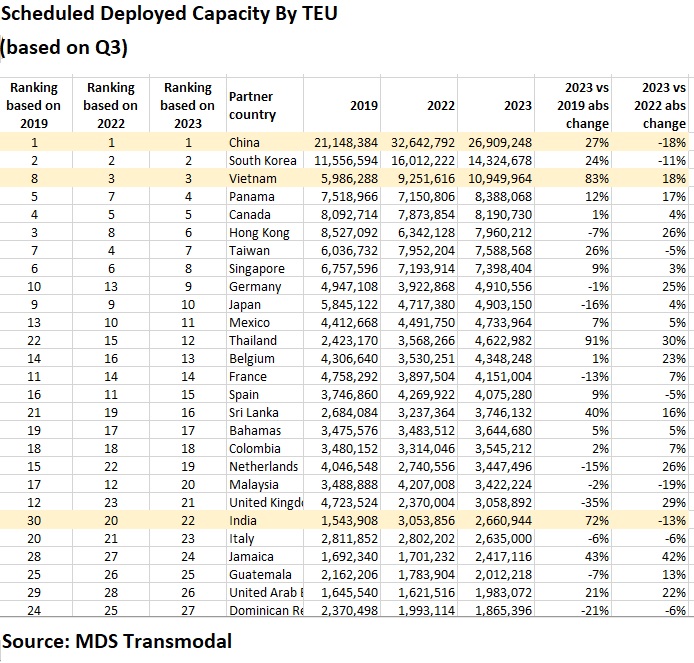
According to data compiled by maritime transport data company MDS Transmodal, Vietnam’s deployed capacity by twenty-foot equivalent units has seen an explosive 83% jump when comparing 2023 to 2019. India has experienced a whopping 72% increase. China trails Vietnam with a 27% change. In a year-over-year comparison, China’s deployed capacity was down 18% in 2023 versus 2022; Vietnam was up 18%; and India was down 13%.

Antonella Teodoro, senior consultant at MDS Transmodal, said Vietnam seems to be leading the race to become the “brightest spot” behind China. The country is strengthened by the multisource production among the Asian countries that’s been seen in the last few years.

“Analyzing the latest trends in the capacity offered between the U.S. and its trading partners, our data suggests a significant increase in the capacity as well as in the number of liner services offered on the Vietnam-U.S. trade corridor,” Teodoro said. “In terms of capacity, Vietnam is now the third most important partner country for the U.S. — it was eighth place in 2019. Looking at the number of services, the change in the ranking is even more profound: 23rd in 2019, now sixth.”

An example of this logistics long game is the world’s largest ocean carrier, MSC. In 2022, MSC-owned Terminal Investment Ltd. signed an agreement with Ho Chi Minh City to build a $6 billion port in the Can Gio district, which is just outside of the city in Vietnam. This would be a transshipment “super port” and the first phase of construction is expected to begin in 2024. The terminal venture is a partnership with Vietnam National Shipping Lines and Saigon Port. Through it, MSC is looking to capture the expansion of trade.

In India, CMA CGM is bullish on the emerging market. Ceva Logistics, a French 3PL that is a unit of the company, acquired 96% of Stellar Value Chain Solutions in Mumbai. Rodolphe Saadé, chairman and CEO of the CMA CGM Group, has visited the country and Peter Levesque, CMA CGM North American president and CEO, is scheduled for a visit.

Ceva agreed to acquire 96% of Mumbai-based Stellar Value Chain Solutions from an affiliate of private equity firm Warburg Pincus and other shareholders.

Looking at the number of ocean string services, blank sailings have hit China the hardest. India has held the same number of services, according to MDS Transmodal data. Vietnam is down just one.

While shipping lines are showing interest in India with more services and capacity allocated on this trade corridor, comparing the numbers to 2019, the changes are less significant than compared to Vietnam. Looking ahead to 2024, Peter Sand, chief analyst at Oslo, Norway-based Xeneta, an ocean freight rate benchmarking and intelligence platform, said he expects higher export growth from Vietnam than India for 2024, calling the origins change in the China+1 a steady, slower burner. Also influencing the flow of trade in these areas is geopolitics. 

“Vietnamese exports mainly to the U.S. will keep growing at a fast pace in 2024,” Sand said, “whereas India seems set to prove the point that they can turn out to become a solid go-to place if you need to de-risk your supply chains away from over-reliance on China or any other manufacturer in the Far East.”

The investments we are seeing today will only strengthen the world of trade for tomorrow.  

Trade will always flow and the players in the logistics and supply chain are opportunistic. In order for trade to be successful, it must move. It is for this reason trade is agnostic and doesn’t play favorites. 

China’s lockdowns, as well as the governmental pressures and geopolitical risks in recent years, have knocked the country off its pedestal of reliable cheap products. Other countries have jumped in and seized on this weakness. 

We are in an exciting time of trade in which diversification of product offerings is key to a company’s success. This includes investing in trade’s new tomorrow.

Essential fraud prevention strategies for freight brokers, carriers

Cargo fraud has been on a steep upward trajectory since mid-2022. Almost 700 theft incidents were reported across the U.S. during the third quarter of 2023. This number represents a 59% increase over the same quarter last year, according to CargoNet.

Types of cargo fraud

All types of cargo fraud are on the rise. Experts believe this is due, in large part, to a combination of tough economic conditions and overall supply chain vulnerabilities. Brokers, specifically, should be especially aware of two growing types of fraud: double brokering and cyberattacks.

• Double brokering

Double brokering occurs when bad actors pretend to co-broker loads from legitimate brokers or carriers. Unfortunately, these scams run through public boards and often end with the carrier that moved the load not getting paid.

This type of fraud hurts carriers and legitimate brokers by scamming them out of money, increasing the likelihood of lost loads, compromising reputations and undermining the trust that keeps the trucking industry running.

• Cyberattacks

Cyberattacks are an increasingly prevalent issue in the trucking industry. These scams are particularly attractive to bad actors, allowing them to exploit a company without ever leaving their homes. Companies across the industry are particularly vulnerable to these scams due to the rapid adoption of technology over the past few years.

Technology growth has outpaced the introduction of holistic security practices throughout the industry, leaving brokers and carriers vulnerable to fraudsters attempting to hack into their systems, redirect freight and even steal their identities. 

How to prevent fraud

There are several steps brokers can take to reduce the likelihood of falling victim to cargo fraud. 

• Verify MC/USDOT

Simple strategies like verifying MC/USDOT numbers and integrating additional layers of security into a company’s technological infrastructure can go a long way in safeguarding against threats like double brokering and cyberattacks. 

• Use a solution like Trucker Tools

Utilizing technology to vet carriers and avoiding public load boards also makes a huge difference in reducing fraud. Brokers can take advantage of digital freight matching solutions from companies like Trucker Tools to ensure they are only working with a prequalified network of carriers. Using these tools offers carriers the peace of mind that comes with knowing that a real, verified broker represents each load.

• Build stronger carrier relationships

However, one of the most impactful things brokers can do to help prevent fraud throughout the industry is to focus on building stronger relationships with their carrier partners, other supply chain companies and third-party entities like law enforcement agencies. These relationships create a more collaborative environment throughout the industry, making it easier for individual players to protect themselves — and their partners.

While building relationships is often associated with in-person meetings and frequent phone conversations, technology can also play a pivotal role in creating strong bonds between partners.

Final thoughts

“You may think that relationships with brokers only can be strengthened with in-person interactions like handshakes and conversations at trade shows, but that isn’t the case,” according to a Trucker Tools blog post. “You can use technology to build and strengthen relationships.”

For carriers seeking to strengthen relationships with brokers, that can look like booking a load with a broker via the Trucker Tools app and then continuing to book that particular broker’s loads through the Book it Now feature after having a good experience.

Likewise, for brokers, building stronger relationships with carriers via technology can look like choosing the same partners to move your loads, even when they are not doing so at the lowest possible rates.

Click here to learn more about how Trucker Tools can help secure your operations.

UPS to hike US diesel surcharges under adjusted formula

UPS Inc. has raised its fuel surcharge on its U.S. ground parcel and SurePost delivery services by 50 basis points in what is believed to be the first time in more than 18 months that UPS has changed its formula to reflect applicable surcharges on those services.

Effective Monday, UPS (NYSE: UPS) will assess a 15.25% fuel levy on all shipments moving under those domestic services. The surcharge applies to the base rates and to any add-on charges known as accessorials. 

The last time UPS changed its fuel surcharge table was in April 2022 during a cycle when weekly diesel prices set by the Department of Energy’s Energy Information Administration (EIA) frequently exceeded $5 a gallon. Fuel prices spiked along with the price of oil amid fears that Russia’s invasion of Ukraine would disrupt commodity supplies.

UPS’ most recent move, however, comes amid an ongoing downward move in diesel pump prices. The weekly on-highway diesel price set on Monday by the EIA stood at $4.14 a gallon. That is 15 cents a gallon below the price set two weeks prior and nearly $1 a gallon below the average pump price at this time a year ago. UPS and rival FedEx Corp. adjust their prices with a one-week lag from the most recent EIA price.

By contrast, surcharge levels will decline for U.S. domestic air, international import and export services. They will rise for the carrier’s international import and export ground services. Air shipment surcharges are set to the EIA’s jet fuel index.

UPS was unavailable for comment at press time.

UPS and FedEx (NYSE: FDX) index their diesel levies to a band of prices established by the EIA. UPS has in the past adjusted its ground-delivery surcharges 25 basis points for every 12 cents-a-gallon move in the EIA diesel price. FedEx Ground, FedEx’s ground delivery unit, adjusts its surcharges for every 9 cents-a-gallon move in the EIA diesel price.

For example, UPS’ upcoming 15.25% levy is based on an EIA-established price that is at least $4.10 a gallon but less than $4.22 a gallon. Currently, the levy is 14.75% for prices falling within that band.

UPS’ action will bring its levy on U.S. ground shipments in line with FedEx, which currently assesses a 15.25% surcharge within the same pricing band. Nate Skiver, founder of parcel consultancy LPF Spend Management LLC, said one of UPS’ goals is to achieve parity with FedEx’s surcharge pricing. The other is to boost revenue per package, which has taken a hit due to pricing pressure and changes in volume mix.

“It also helps to set a higher floor on the fuel table, which is now relevant with diesel prices moderating,” Skiver said in a LinkedIn message.

UPS, FedEx and other parcel delivery carriers have wide latitude as to when they adjust diesel and jet fuel surcharges. In recent years, surcharges have remained elevated despite world price fluctuations that have headed south. Analysts who follow the fuel surcharge market have said that surcharge levels stay higher long after prices have dropped, thus allowing the carriers to reap additional revenue on each transaction.

Historically, small to mid-size shipper s have found it difficult to reduce fuel surcharges through negotiations, while bigger shippers have to tender certain volume minimums for the carriers to consider reducing the levies. However, in what has turned into an all-out price war as carriers aggressively bid for business, the carriers have let it be known that fuel surcharge discounts are very much on the table.

Domestic ground parcels are UPS’ largest business. SurePost is the name for a service provided in conjunction with the U.S. Postal Service in which UPS picks up and aggregates low-value, nonurgent parcels and inducts them deep into the postal infrastructure for last-mile delivery to residences.

Shippers, haulers can work in unison to change the future of the supply chain

A blue tractor and a silver trailer on a highway

Shippers and haulers are often positioned as disparate powers being forced to work together to achieve a common goal. Players throughout the logistics industry have accepted this perceived disconnect between shippers and haulers for far too long. 

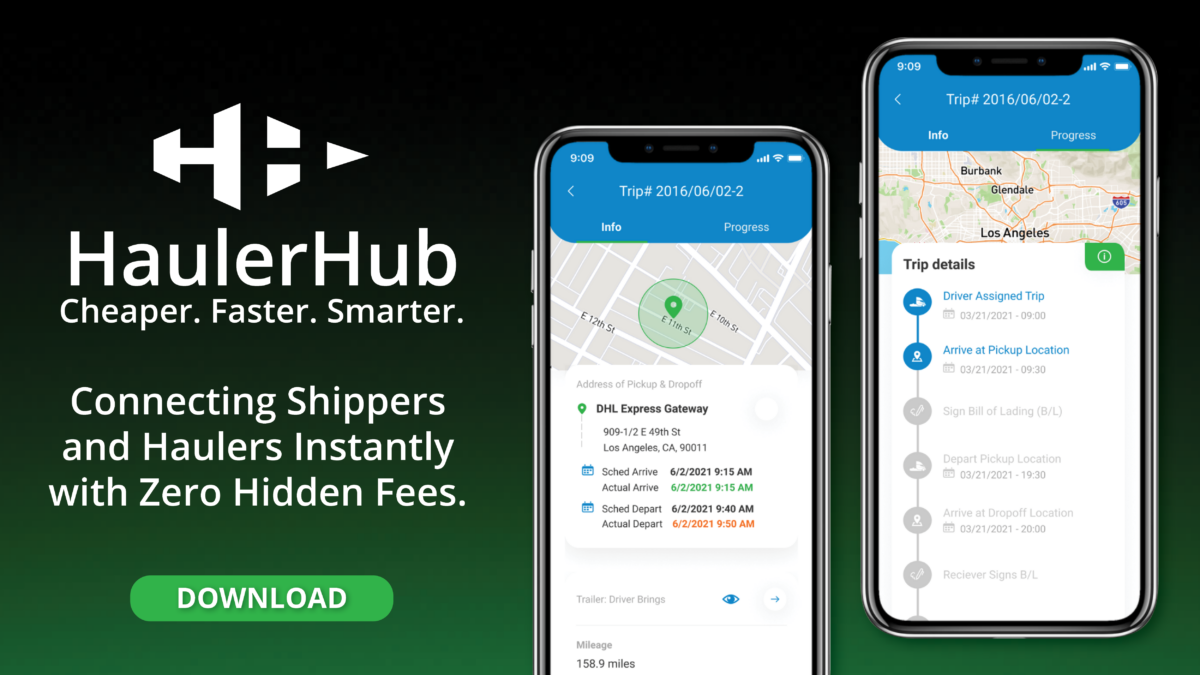
HaulerHub connects shippers and haulers directly — without including third-party logistics companies. Think food/grocery delivery apps in terms of ease of use. This company’s disruptive platform was designed to make moving freight cheaper — and make the supply chain more transparent — by cutting out the middleman and giving participants full control over cost and scheduling and to bypass the opportunity for fraud. 

Shippers can utilize HaulerHub’s tech-based solution at no cost upfront and no forced subscriptions if payment is made within seven days with no further commitments, while haulers pay a nominal fee to operate on the platform. 

The small fee haulers pay to operate on the platform pays for itself because HaulerHub imposes no intermediary fees. Additionally, connecting with shippers directly gives haulers more control over the loads they move and allows them to get on the road faster, reducing idle time.

This low barrier to entry makes it easy for both shippers and haulers to try the solution for themselves.

“HaulerHub is an innovative disruptor in the industry, recognizing the significance of avoiding complacency with the status quo,” said Sam Agyemang, VP of business development and sales for ITF Group. “The platform is crafted to fulfill the shared goal of reducing costs and maximizing bottom lines for both parties. Through direct connection, without unnecessary intermediaries disrupting what could be a seamless transaction, we can establish more efficient and cost-effective transportation solutions.”

Technology

Technology is at the heart of HaulerHub’s transformative approach, making it easy for shippers and haulers to manage the entire shipment life cycle directly from their desktops.

Shippers can use the platform to post real-time rates and instantly receive bids from a network of well-vetted haulers. This means that a load can be booked and assigned in just a few clicks, cutting out the wasted time and energy often involved in booking loads via email or traditional load boards. 

“We founded HaulerHub with the belief that technology can transform the archaic processes of yesterday with true innovation of today by simplifying paper bottlenecks and making the entire process digital by eliminating paper BOLs and POs by storing everything in one convenient platform,” Agyemang said.

Transparency

HaulerHub’s primary objective is to help shippers and haulers connect directly. By eliminating external players, the platform provides a pathway for more transparent communication — and more transparent pricing. 

This direct communication ensures shippers do not incur hidden costs. In fact, shippers will not incur any fees at all as long as they pay within seven days of each transaction. At the same time, shippers and haulers alike can expect reduced frustration and more efficient movements, enabling both parties to maximize profits.

“At HaulerHub, we believe in full transparency from the moment you post your load to its final destination,” Agyemang said. “You are literally in the driver’s seat, from evaluating rates to selecting the lanes that make sense for your desired routes.”

Real-time tracking

One of the biggest challenges in shipping is not knowing the exact location of your freight during transportation. With HaulerHub, this is no longer a concern. The company’s real-time tracking feature ensures that you can easily track your shipments and never have to wonder about their whereabouts.

Imagine the convenience of viewing your shipments in real time, just like how you keep track of your food delivery. No more blind shipments or waiting anxiously for updates. HaulerHub provides you with timely and accurate information about the location and status of your load, all in one user-friendly platform.

“You do not have to spend more time jumping between services to track your load. With HaulerHub, you have access to industry standard geolocation, all in one convenient platform,” Agyemang said.

HaulerHub was created by shippers and haulers to foster an environment of radical collaboration. By joining forces and working together, these companies hold the power to change how the supply chain functions from the inside.

Click here to learn more about HaulerHub.

Collaboration stops cargo crime in its tracks

Cyber thieves are after remote workers data

Fraud rates are on the rise, increasing significantly in 2022 and continuing to climb throughout 2023. In fact, the total annual impact of stolen freight came in at a shocking $223,096,368 last year, according to data from CargoNet.

Reports of fraud skyrocketed last year, jumping 400% between 2021 and 2022. Reports then climbed another 57% between the second quarter of 2023 and the same quarter last year. 

Chris McLoughlin, Uber Freight’s director of compliance, attributes this staggering increase in cargo fraud to a combination of tumultuous economic conditions and supply chain vulnerabilities. 

The ongoing recession has left both companies and individuals in financial turmoil, pushing existing bad actors to increase their fraudulent activities and prompting new fraudsters to enter the arena. 

“The freight recession is starting to impact everybody in the supply chain,” McLoughlin said. “We’re seeing bad actors actively targeting companies in financial distress, taking advantage of their desperation. It can range from double brokering at rates well beyond market, which the bad actor has no intention to pay, to buying up operating authorities as the owner exits the space to be used in fraudulent activity.”

These entities have been able to prey on companies that are already struggling, often by exploiting loopholes in their digital security protocols. As the industry — and the world — becomes more connected, opportunities for bad actors to exploit technology for their personal benefit grow. 

Phishing, identity cloning and payment fraud are all common examples of fraud that companies within the transportation space may experience. Companies — especially those without a holistic understanding of the digital landscape — are often ill-prepared to ward off these more modern types of fraud.

When bad actors are able to compromise a company’s onboarding protocols, digital or traditional, other types of fraud also become easier to accomplish. Fictitious pickups, shipment diversions and load pilferage are all growing threats. Companies without strong security protocols and protective partnerships in place should act now to protect their organizations and reputations from bad actors.

While the rapid adoption of technology across the industry has created new vulnerabilities, it has also given companies access to new ways to protect themselves. When utilized correctly, technology is an asset in the fight against cargo fraud.

“The digital advantage we have is allowing us to uncover the fraud that exists that most brokers may not have been aware of five to 10 years ago in a less digitized environment,” McLoughlin said. “We can take action a lot earlier than we could before.”

Becoming aware of both successful and attempted fraud is the first step to creating a more secure supply chain, but efforts cannot stop there. Companies should incorporate security processes into every aspect of their operations, keeping in mind that a single layer of security is not enough to keep determined fraudsters out of their systems.

“You have to understand that there is not one single silver bullet that is going to protect you,” McLoughlin said. “It takes multiple processes and multiple layers of control to be able to insulate your supply chain.”

Uber Freight, for example, has more than 20 distinct, independent security processes related to carrier vetting, management and monitoring running in the background at all times. This is because not every process is going to work all the time. 

Working with third-party partners in the logistics space is often a crucial part of creating these layered security processes. Companies should not be afraid to collaborate with other industry players and outsource tasks outside their field of expertise.

“Understand what your business is good at and be willing to leverage other entities to give you additional layers of security,” McLoughlin said.

The importance of working with entities outside of the industry, however, should not be overlooked. Outside players, including law enforcement agencies, play a significant role in mitigating the impact of fraud on the supply chain. 

“You should be working with law enforcement locally, regionally and federally,” McLoughlin said. “You should be having conversations and supporting those agencies before you have problems. You want to have those relationships early on.”

Uber Freight has in-house specialists devoted to preventing fraud, as well as recovering stolen cargo and solving digital fraud cases when they do occur. For smaller companies that cannot afford to take this approach, however, layers of protection can be found in strategic partnerships. The key is understanding that everyone is in this together.  

“Fraud is ever present in the supply chain right now because of the era we are in,” McLoughlin said. “Everybody is exposed to this. No single mode of the supply chain is being attacked, it’s everybody.” 

Click here to watch our recent webinar on fraud in the supply chain industry.

Renewable diesel creates pathway to cleaner transportation industry

Legislators, consumers and corporations across the globe have increased their attention to climate change and sustainability in recent years. As a result, the transportation sector is actively looking for ways to reduce greenhouse gas emissions. This has created increased demand for cleaner, more innovative fuel sources, like renewable diesel. 

The U.S. produces more carbon emissions than almost any other country in the world, coming second only to China. The movement of vehicles – both passenger and commercial – is the single largest source of those emissions. Freight trucks, specifically, are responsible for almost 25% of overall transportation emissions, according to the U.S. Environmental Protection Agency.

Reducing dependence on fossil fuels is the only way to cut that number. While companies are experimenting with a variety of alternatives, switching to renewable diesel is one of the simplest and quickest paths to cleaner transportation.

Renewable diesel 

Neste MY Renewable Diesel (™) is one of the flagship products of Neste, the world’s leading producer of renewable fuels.  Because of its similarities to fossil diesel, Neste MY Renewable Diesel is compatible with all diesel engines. The fuel can be used pure or blended with petroleum diesel at any ratios, making it easy to integrate into any fleet’s fueling strategy.

Renewable diesel offers serious sustainability benefits, as well as potential operational perks for carriers hoping to keep their trucks on the road longer. 

“We’re going to lower a customer fleet’s GHG emissions by up to 75% because we’re not using crude oil and petroleum,” Matt Leuck, the North America Technical Manager of Renewable Road Transportation at Neste, said. “When you start putting it into a truck, you’re going to see some tangible physical benefits as well.”

Leuck noted that Neste MY Renewable Diesel is so clean that it looks and smells like water. Naturally, this level of purity leads to much less soot and particulate matter being produced, which increases the lifespan of truck engines and may help reduce truck maintenance costs.

West Coast 

The West Coast has led the country in ramping up environmental protection laws and promoting lower- and no-carbon transportation options. It makes sense, then, that the bulk of the renewable diesel market in the U.S. is concentrated in this region.

California’s Low Carbon Fuel Standard (LCFS) was created to reduce the carbon load associated with transportation in the state by easing the financial burden of renewable fuel producers.

The program, which was implemented in 2011, has grown leaps and bounds over the past several years. Now, it is possible for renewable diesel companies like Neste to sell into the California market at near parity with petroleum diesel, according to Leuck

While California has always stood out for its eco-conscious efforts, nearby states Oregon and Washington have also created programs aimed at cleaning up their fuel supplies. This has created a pathway for Neste to offer up its clean diesel in those markets as well.

East Coast 

Outside of the West Coast corridor, most U.S. states have not rolled out substantial renewable diesel incentives. Even though most of the renewable diesel consumption is on the West Coast thanks to the regulatory support, Neste is seeing increasing voluntary demand from other parts of the country too, driven by businesses’ ambitious sustainability commitment. Also, the success of California’s LCFS program is encouraging other states to adopt similar programs including New York, New Jersey and Massachusetts. Forward-thinking companies across the Northeastern region have already expressed interest in Neste MY Renewable Diesel, according to Leuck

These states – like those on the West Coast – have announced more ambitious environmental protection goals than many states in other regions of the country. As such, a significant number of companies headquartered in the Northeast have pledged to rescue their carbon footprints in the near future, pure renewable diesel offers an intuitive pathway to cleaner transportation.

“Fleet operators across all industries are switching to Neste MY Renewable Diesel because it’s easy, cost effective and delivers immediate reductions in GHG and particulate matter emissions,” Neste notes on its website.

Click here to learn more about Neste MY Renewable Diesel.

The first aircraft mechanic

By Richard Scarbrough

This story originally appeared on flyingmag.com.

The Wright brothers flew into history on Dec. 17, 1903, achieving the once-unheard-of feat of powered flight. Although debated, the accomplishment is globally accepted as the first flight of its kind. While the Wrights earned a place in the spotlight as daring aviators, one key figure is often overlooked: mechanician Charles Taylor.

An introduction

There is a fantastic book, “Charles E. Taylor: 1868-1956 The Wright Brothers Mechanician,” by H. R. DuFour with Peter J. Unitt, currently out of print. The text has a foot in two worlds, part biography and part technical manual. DuFour led a colorful life, working on the Manhattan Project in Chicago during World War II helping to develop the atomic bomb.

As with many of us, the aeronautical spark ignited early for DuFour. According to “A Dream Fulfilled: The Replica of the 1903 Wright Flyer at Wright State University” by Unitt, DuFour noticed a photograph of the Wright Flyer on the wall of Detroit Technical High School, beginning a lifelong interest in the Wright brothers and Taylor. DuFour continued to educate people about Taylor until his death in 2009.

Quick show of hands, how many of you already knew the term “mechanician”? The Oxford English Dictionary defines mechanician as “a person skilled in the design or construction of machinery.” This term is commonly shortened to “mechanic.” Another quick show of hands: Who votes we go back to the term “mechanician”? It has a certain ring to it.

His early life

Charles Edward “Charlie” Taylor was born in a log cabin in rural Illinois on May 24, 1868. His family moved to Lincoln, Nebraska, after a hog cholera epidemic ended their primary income source. Leaving school in the seventh grade, Charlie worked odd jobs before returning to complete his education.

Eventually, he owned and operated a machine shop in Omaha, Nebraska, but he had to shutter it because of a lack of work. When he was 24, Charlie met the love of his life, Henrietta Webbert, in Kearney, Nebraska, and they married in 1894. Coincidently, the Wright brothers’ father, Bishop Milton Wright, a family friend of the Webberts, counseled the couple and convinced them to move to Ohio.

In Dayton, Charlie found work as a machinist for the Stoddard Manufacturing Co., building engines, farm equipment and bicycles.

He eventually opened his own bicycle shop and did subcontract work for two brothers who would plot the trajectory of his life.

Enter the Wright brothers

The significance of June 15, 1901, is largely unknown. On this day, Taylor began working for the Wright brothers as a bicycle technician. For me, this ranks higher than John Lennon meeting Paul McCartney on July 6, 1957, in Liverpool, England. Taylor would be the Wright brothers’ sole employee for eight years.

In 1901, Taylor built a wind tunnel so the brothers could test their wing and control surface theories. This task was his first aircraft-related assignment.

As the brothers worked to perfect their airframe, their dreams of building more than just a glider hinged on the ability to produce a reliable power plant. The Wrights approached ten potential engine manufacturers; none was interested in building just one engine. We see this today with modern OEMs with little financial interest in investing production resources in legacy fleets. There is a profit margin in volume, not one-off pieces.

Rubin Battino, professor emeritus at Wright State University, is co-author of “An Oral History of Charles E. Taylor: The Wright Brothers’ Mechanician.” He is a frequent presenter on Taylor and owns the diaries of Bishop Wright.

We had a spirited discussion, and his exuberance for the mechanician and his work shone through. He spent several years touring the country, interviewing relatives of Taylor and helping to spread the word of the first mechanic’s achievements. He is one of the world’s leading scholars of Charles Taylor, and speaking to him was an honor.

When I mentioned the Wright brothers’ search for an engine builder, Battino relayed the story of the brothers approaching Taylor. After carefully listening to the specifications, Taylor removed the cigar from his mouth and simply said, “Sure.” He started by tacking scratch paper drawings onto his workbench, assembling his tools and gathering materials.

Once Taylor completed his four-cylinder engine, it produced 12 horsepower at 1,025 rpm and weighed around 180 pounds. He accomplished this incredible feat in six weeks. Try getting anyone to complete a new project in six weeks these days — much less design, source and manufacture the world’s first aircraft engine. Imagine the Six Sigma-led exploratory committees you would need today.

1903 Wright engine parts. (Photo: Library of Congress)
1903 Wright Brothers engine on a stand. (Photo: Library of Congress)

Working together, the three set out to solve the engineering challenges of powered flight. As the first aerospace engineers, there was plenty of trial and error. The team tested over 200 airfoils, using a jig with a bicycle spoke constructed by Taylor to check the torque on the wings. Working shoulder to shoulder, the three continued to make slow progress. Once they had a working model, it was time to test it in the field.

The aircraft could be disassembled into three parts, placed on a train to North Carolina, then put on a boat to Kitty Hawk. On Dec. 14, 1903, Wilbur Wright said, “The machinery worked in an entirely satisfactory manner and seemed reliable. The power is ample. There is no question of final success.” To an aircraft mechanic, that signals mission accomplished. This test was the most significant ops check ever. Three days later, the trio made history.

True to his supporting role, Taylor remained in Ohio, tending the shop while the brothers flew into the history books in North Carolina.

Staying behind was not an act of humility but of necessity. The brothers relied on the shop for income and needed the spare parts Taylor produced and sent to Kitty Hawk.

In 1908 at Fort Myer, Virginia, for a military demonstration, Orville Wright offered to take Taylor on his first airplane ride. Army observer Lt. Thomas E. Selfridge took Taylor’s place, and the aircraft crashed shortly after takeoff — badly injuring Orville and killing Selfridge, who became the first military air casualty. Taylor finally secured his first airplane ride when Orville — whom Taylor referred to as his friend — took him up in 1910.

Orville Wright (left), Charlie Furnas (middle), and Charlie Taylor (right) at Fort Myer in 1908. (Photo: Library of Congress)
Wilbur Wright and Charlie Taylor inspect the Flyer – with attached canoe – during the the Hudson-Fulton Celebration in 1909. (Photo: Library of Congress)

Beyond the brothers

When Calbraith Perry “Cal” Rodgers made the first transcontinental airplane flight across America in 1911, he purchased one complete aircraft dubbed the Vin Fiz from the Wrights and enough parts to fabricate two additional ones. Publisher William Randolph Hearst had recently announced he would award $50,000 to someone who could accomplish this feat in 30 days or less.

Knowing what lay before him, Rodgers hired Taylor, paying him $70 weekly to travel behind him in a train containing a makeshift machine shop and parts. They both enjoyed cigars and hit it off, even joking that Rodgers knew how to take off but not land. Rodgers eventually logged 4,321 miles in 82 hours and 4 minutes; however, he did so in 49 days.

During this time, Taylor moved his family to California. He hoped the climate would help improve his wife’s waning health. It did not; he eventually had no choice but to place her in an institution. Staying only a while, Taylor returned to Ohio and worked for the Wright brothers until leaving for California in 1928. A failed real estate venture set him back financially and he never recovered. He occasionally found work as a machinist, but the search was difficult because of his age.

There is a parable in here somewhere.

Cal Rodgers and Charlie Taylor. (Photo: Library of Congress)

Charlie’s legacy

In 1937, Taylor left California and his job at North American Aviation to join Henry Ford’s Edison Institute and assist in restoring the Wright brothers’ bicycle shop, which Ford relocated to Greenfield Village in Dearborn, Michigan. This venture would become one of the highlights of the great mechanician’s life.

Orville Wright died on Jan. 30, 1948, leaving Taylor the last remaining survivor of the three people who built the first airplane. Taylor served as a pallbearer. For years Orville provided Taylor with a small pension of $800 per year, but the Great Depression took its toll, and he struggled to make ends meet.

On Christmas Day in 1948, Collier’s published an interview with Taylor, living in retirement in California. The article was reprinted in Air Line Pilot in December 1978. This text is a fascinating firsthand account of the Wright brothers and their historic flight told by the man with the front row seat.

One quote, in particular, struck a chord with me and summed up Taylor’s life and legacy. He said, “I always wanted to learn to fly, but I never did. The Wrights refused to teach me and tried to discourage the idea. They said they needed me in the shop and to service their machines, and if I learned to fly, I’d be gadding about the country and maybe become an exhibition pilot, and they’d never see me again.” It is a shame Taylor never had a chance to take to the skies. I know quite a few mechanics who cross over to the cockpit, but almost none go back to make a living with a wrench fulltime.

Taylor died on Jan. 30, 1956, at age 88, from complications with asthma — eight years to the day after his friend and former employer, Orville Wright. Taylor rests at the Portal of Folded Wings Shrine to Aviation in Burbank, California.

I intend to travel to Kitty Hawk and the Folded Wings Shrine with a few new bucket list items on the radar. I will head to California and stand before the man who made it happen.

Godspeed to you, Charles Taylor, master mechanician; we who carry on your legacy do so with honor.

Charlie Taylor (Public Domain
A drawing of the 1903 Wright Brothers engine. (Image: Library of Congress)

Charlie’s awards

Here are a few awards Taylor received posthumously:

  • In 1965 the National Aviation Hall of Fame enshrined him, reuniting him with the Wright brothers, who entered in 1962.
  • Aviation Maintenance Technician Day is observed on May 24, Taylor’s birthday, to honor the Wright brothers’ mechanician.
  • On Dec. 3, 2021, the FAA issued FAA/FS-I-8700-3(Rev.7) the Charles Taylor Master Mechanic Award Information Guide to help recognize individuals with 50 or more years of safe maintenance operations experience.
  • Taylor is on the Smithsonian National Air and Space Museum Wall of Honor at foil: 46 panel: 1 column: 1 line: 10.
  • In 2020 FLYING named Taylor one of its 51 Heroes and Heroines of Aviation.

Lessons from across the pond — Taking the Hire Road

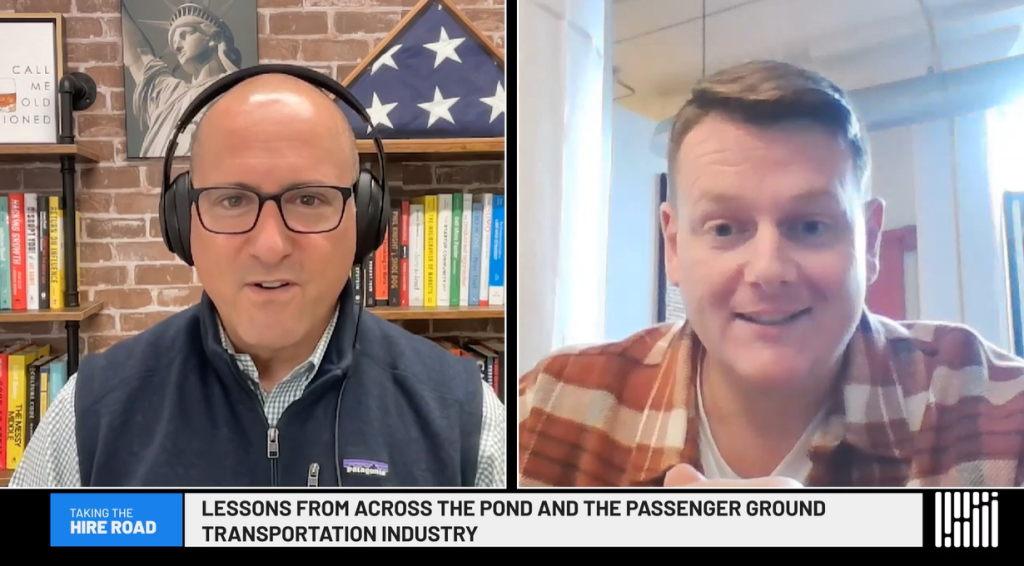
On this week’s episode of Taking the Hire Road, Jeremy Reymer, founder of DriverReach, is joined by Simon Curtis, CEO of Career Driver as well as founder and director of Curtis Gabriel, a leading digital marketing agency based in the U.K.

Curtis took a circuitous path toward his present affiliation with the transportation industry, starting with sports marketing in university. But he quickly realized that the fundamentals of marketing in sports were equally applicable to all verticals.

Fundamental as they might be, however, these principles of marketing are not taken for granted by all.

One of Curtis’ early successes in the transportation industry came from a realization that hyperlocal marketing provided both better quality and cost-effectiveness than global ad campaigns, which tended to be generic by design.

Another assumption that Curtis challenges is the necessity of deception in marketing: “I will always try to educate customers to help them make decisions.” 

As it turns out, honesty breeds trust, and trust leads to success.

“I have had clients for over a decade,” he related, “which is virtually unheard of. Part of it comes down to our open-book policy, where people understand what they’re spending their money on.”

When it comes to recruitment, knowing exactly what you are spending your money on is all-important.

“The way to get the most bang for your buck,” Curtis stated, “is to split your efforts into each campaign — pay-per-click, job boards, etc. — and then look at the sources of your engagement.” 

Once you have a complete picture of your marketing spend and its efficacy, creative A/B testing comes into play. One job listing might invite more clicks, while another listing might see a higher conversion rate.

Different tactics work for different audiences, and so it is vital for recruitment efforts to be aligned with the right industry.

Curtis likens marketers to chefs with a full pantry of ingredients — that is, with the basic tools of advertising. Yet what makes a quality chef is not quality ingredients, but rather understanding individual recipes and making adjustments as needed.

Even so, having the right ingredients is still mandatory.

Before trying to increase hiring efforts, Curtis advises, make sure your house is in order. For instance, social media profiles should not be used solely to attract customers but also to interest would-be applicants.

These two efforts frequently go hand in hand. “Your employer brand will resonate with both customers and potential, as well as existing, employees,” Curtis notes.

Most of all, it is essential to embrace change in marketing efforts when change is needed. Technology is rapidly evolving while its adoption is increasing, so traditional campaigns often fall short of their goals.

“You don’t need it for the sake of it, but technology — when it pulls all of your efforts together and serves as a conduit — is paramount.”

Click here to learn more about Career Driver.

More from Taking The Hire Road:

Show up for yourself to show up for others

Leveraging associations and networking in tough economy

DriverReach rolls out driver qualification checklist

Loaded and Rolling: ATRI predatory towing data

ATRI predatory towing data

(Source: ATRI)

On Wednesday the American Transportation Research Institute (ATRI) released a report that examined causes and impacts of predatory heavy-duty towing. The report defined predatory towing in which “a T&R [towing and recovery] company egregiously overcharges, illegally seizes assets, damages assets by use of improper equipment, or illegitimately withholds release of a truck, trailer, and/or cargo.” When a trucking company is overcharged, it can happen in two ways, through either excessive costs or unnecessary additional equipment.

One of the impacts the report notes is these costs are passed on to insurance companies, which then pass on the charges as higher premiums. If the invoice exceeds the limits of an insurance policy, those extra costs are then absorbed by the motor carrier or driver, who must pay the difference out of pocket. Adding to the complexity, a patchwork of local and state towing regulations hampers efforts for carriers evaluating an invoice. Even after service is invoiced, there are inconsistent and nonstandardized invoice practices to cause further headaches for carrier accounting teams.

The report notes that the most common form of predatory towing is in the form of excess rates, according to 82.7% of the motor carriers surveyed. Unwarranted extra charges were a close second at 81.8% of those surveyed. An example of extra charges can be the hourly rate charged by a heavy-duty rotator versus a heavy-duty wrecker. The report adds, “Due to asset availability, rotators are sometimes used as wreckers, without the use of their rotating arm, and are thus billed at a wrecker rate.”

Price declines for used Class 8 trucks stabilizing?

(Source: FreightWaves SONAR)

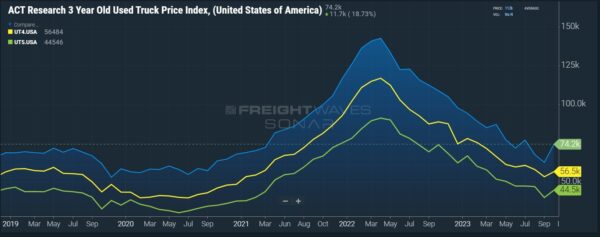
Prices for used Class 8 trucks are beginning to see signs of stabilization but are still in flux, according to October data released recently by ACT Research. ACT reports that the used Class 8 average retail sale price came in at $62,900 in October, a decline of 1% month over month and down 25% year over year. A big question the report examines is whether pricing declines will continue or improve. The report predicts continued lower prices through the end of 2023 but expects m/m growth toward the end of 2024.

Steve Tam, vice president at ACT Research, said: “The answer to that question seems to be in flux. There are still too many trucks chasing too little freight. Until the economy can strike a balance between those two factors, downward pressure on pricing will continue to exist. Once the excess capacity is absorbed, the freight rate environment and trucker profits will correct, restarting the cycle that is the commercial vehicle industry.”


FreightWaves’ Alan Adler wrote that according to J.D. Power, “In October, the average sleeper tractor sold at retail was 71 months old, had 437,227 miles and sold for $67,441. A month earlier, the average sleeper was four months older, had 20,547, or 4.9%, more miles and sold for $4,240, or 5.9%, less.” Power notes that depreciation for 2023 is averaging 4.4% m/m with new model years showing values below the strong pre-pandemic period of 2018 and 20% lower when adjusted for inflation.

Market update: Trucking conditions improve in September

(Source: FTR Transportation Intelligence)

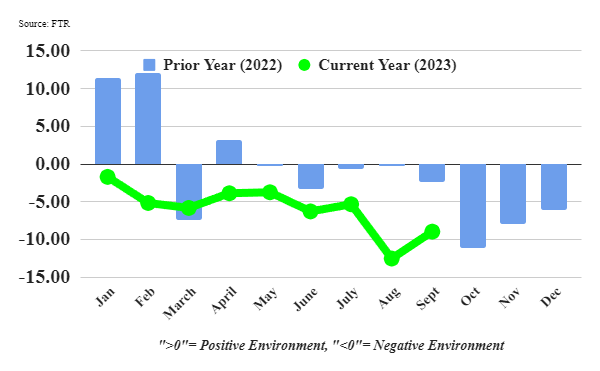
FTR Transportation Intelligence’s recently released Trucking Conditions Index (TCI) for September saw some improvement but tough market conditions remain. The TCI improved from minus 12.54 in August to minus 8.97 in September due to improving fuel prices and slightly higher freight demand. The index covers five major conditions in the U.S. full-truckload market, including freight volumes, rates, fleet capacity, fuel pricing and financing. A TCI reading above zero shows an adequate environment with a reading of 10 or above showing volumes, prices and margins are in a good range for carriers.

Avery Vice, vice president of trucking, noted in the report: “The TCI was less negative in September principally because fuel costs did not rise as much as they did in August, but trucking companies saw no real improvement in freight market conditions. Although carriers today are seeing some temporary relief due to the recent drop in diesel prices, freight rates look to improve only gradually over the next year. The trucking industry continues to struggle with more capacity than is ideal given sluggish freight volume. Many operations apparently are hanging on or maintaining driver levels in hopes of a near-term rebound, but that approach amounts to an increasingly high stakes game of chicken.”

FreightWaves SONAR spotlight: Spot market rates reheat post-Thanksgiving

(Source: FreightWaves SONAR)

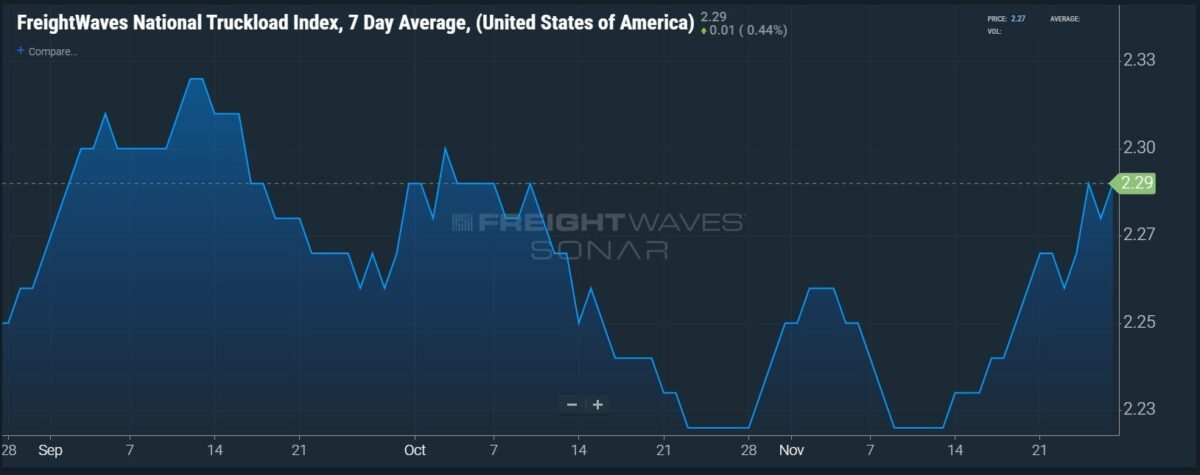
Summary: All-in spot rates rose sharply in the past week and are at levels not seen since Oct. 10, according to the FreightWaves National Truckload Index 7-Day Average (NTI). NTI spot rates rose 3 cents per mile week over week from $2.26 on Nov. 20 to $2.29 per mile. Over the past month, spot rates rose 7 cents per mile from $2.22 all-in on Oct. 28 to $2.29 per mile. Truckload capacity leaving the market for the Thanksgiving holiday contributed to the rise, as fewer drivers competing on the spot market will cause a jump in rates.

Spot market linehaul rates with a projected fuel surcharge saw a similar jump from $1.60 per mile on Nov. 20 to $1.63 per mile, according to the FreightWaves National Truckload Index (Linehaul Only) or NTIL. Looking ahead, the NTI Forecast 28-Day outlook (NTIF28) projects all-in spot rates to rise 23 cents per mile from $2.29 to $2.52 by Dec. 26.

Spot market rate increases follow a seasonal pattern in which rates climb leading up to Thanksgiving, peak past Christmas and then begin a decline in the new year. This primarily is driven by truckload capacity changes in which drivers from fleets of all sizes take additional time off to spend with family just as truckload volumes climb for holiday replenishment orders. For truckload carriers, projecting and adjusting to changing working tractor percentages will remain a challenge, as customers expect higher service and tender compliance levels right as fewer assets are available to dispatch.

Michigan trucking fraudster sentenced to 17 years for $40M Ponzi scheme (FreightWaves)

How to not just survive, but thrive, through the bottom of the freight markets (Overdrive)

Renewed migrant surge forces closure of Texas border bridge (FreightWaves)

‘An absolute privilege’: Werner drivers recount driving Capitol Christmas Tree (The Trucker)

Biden administration announces massive logistics plan (FreightWaves)


FMCSA administrator: Compensation, lack of parking among root causes of truck crashes (Land Line)

Like the content? Subscribe to the newsletter here.